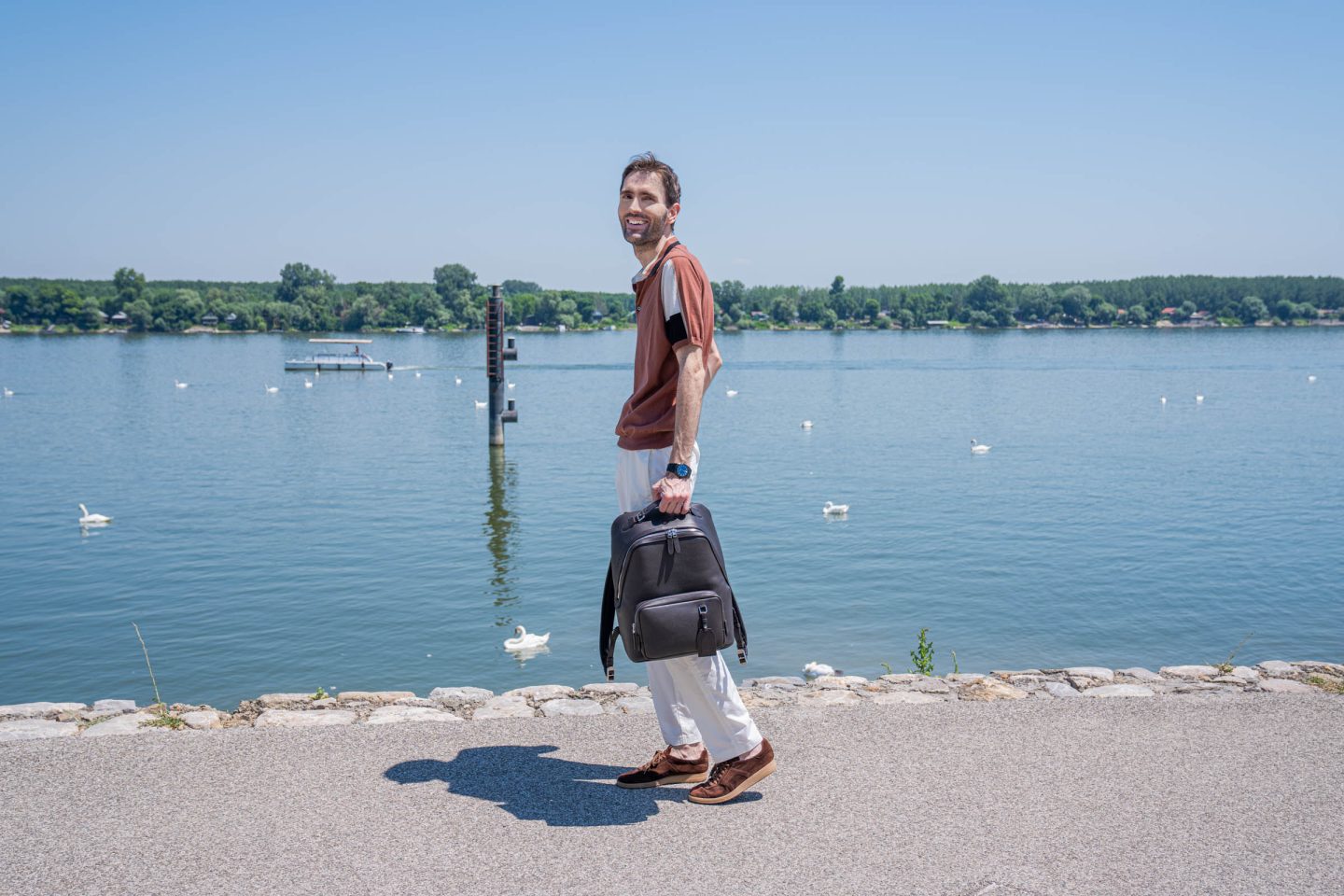
My dear fashionistas, welcome to a new fashion story on the Mr.M blog. All of us who are big fans of fashion have some fashion accessories in our wardrobe that we buy, wear for a few weeks and simply forget about them. On the other hand, there are those that slowly become a part of our everyday life, so after a month we no longer perceive them as a thing, but as a habit. My 1900 Tempo Grande Backpack belongs to the latter group. I’ve been wearing it for some time on meetings, filming and traveling, and for this story I took it to the quay by the Danube, where we were accompanied by swans and a few boats in the distance.
Along with the backpack, which is the undisputed star of this post, I wore a Kiton tricolor silk thread knit polo shirt, white Kiton cotton pants, and on my feet I put on Santoni Oly flip-up leather sneakers. On my wrist was the Slovakian Biatec Fusion 03, a watch that I haven’t taken off for a long time. It sounds like a simple summer combination, and it is. It is precisely in this simplicity that what I value most in men’s clothing today is hidden: calm colors, high-quality materials and objects that have a story.
And the story of the 1900 brand really deserves to be told from the beginning. So let’s start with new fashion adventure on Mr.M blog!

Who Is Behind the 1900 Brand? The Story of Luxury Leather Craftsmanship
When I first picked up this backpack, I thought it was a big, famous fashion house. I was wrong, and I’m glad about it. Behind the 1900 brand stands Manifattura Ceraolo Moroni, a family company with more than forty years of experience in the world of luxury.
It is interesting what this house was doing all those decades. She didn’t make handbags for shop windows, but luxury packaging and leather goods for some of the world’s most prestigious watch and jewelry houses. In other words, when you buy an expensive watch or jewelry from the great masters, there’s a good chance that the box it arrived in came right out of their workshops.
Decades of work for the most demanding clients in the world have taught them one important thing, which they emphasize: true luxury is not exaggeration, but balance, precision and attention to every detail. The headquarters of the company is located in Kriens, Switzerland, and their motto is that everything is designed in Italy and developed in Switzerland. Italian sense of beauty and Swiss precision in the same product sounds like a winning combination, right?
After all those years of working in the shadow of big names, they wanted to make something of their own. That’s how the brand was born in 1900.

Why Is the Brand Called 1900? The Meaning Behind the Name and Its Symbolism
I admit that the name confused me at first. I was expecting a founding year or some historical date, but the truth is much more humorous. The abbreviation of Manifattura Ceraolo Moroni‘s mother house is MCM. If you read those three Latin digits as Roman numerals, you get exactly 1900.
This little game with numbers perfectly describes the whole brand: the connection between heritage and the contemporary moment, between the artisan workshop and the digital age. I like that kind of ingenuity, because it shows that the people behind the brand have thought about identity, not just sales.
The values that the brand stands for also speak volumes. There is no mass production, only controlled quantities. Each piece is produced in-house, so that the quality remains uniform. There is also one detail that particularly surprised me: their products also carry the fragrance note of Tonatto Profumi. When you open the backpack, you feel not only the leather, but also a discreet, carefully selected scent. Such little things separate a good product from an unforgettable one.
Together, the brand calls it a new language of luxury: masculine elegance through subtlety, quality and discretion. No big logos, no shouting. Just the touch, the proportion and the time the object spends with you.

1900 Tempo Grande Backpack Up Close: Design, Materials and Craftsmanship
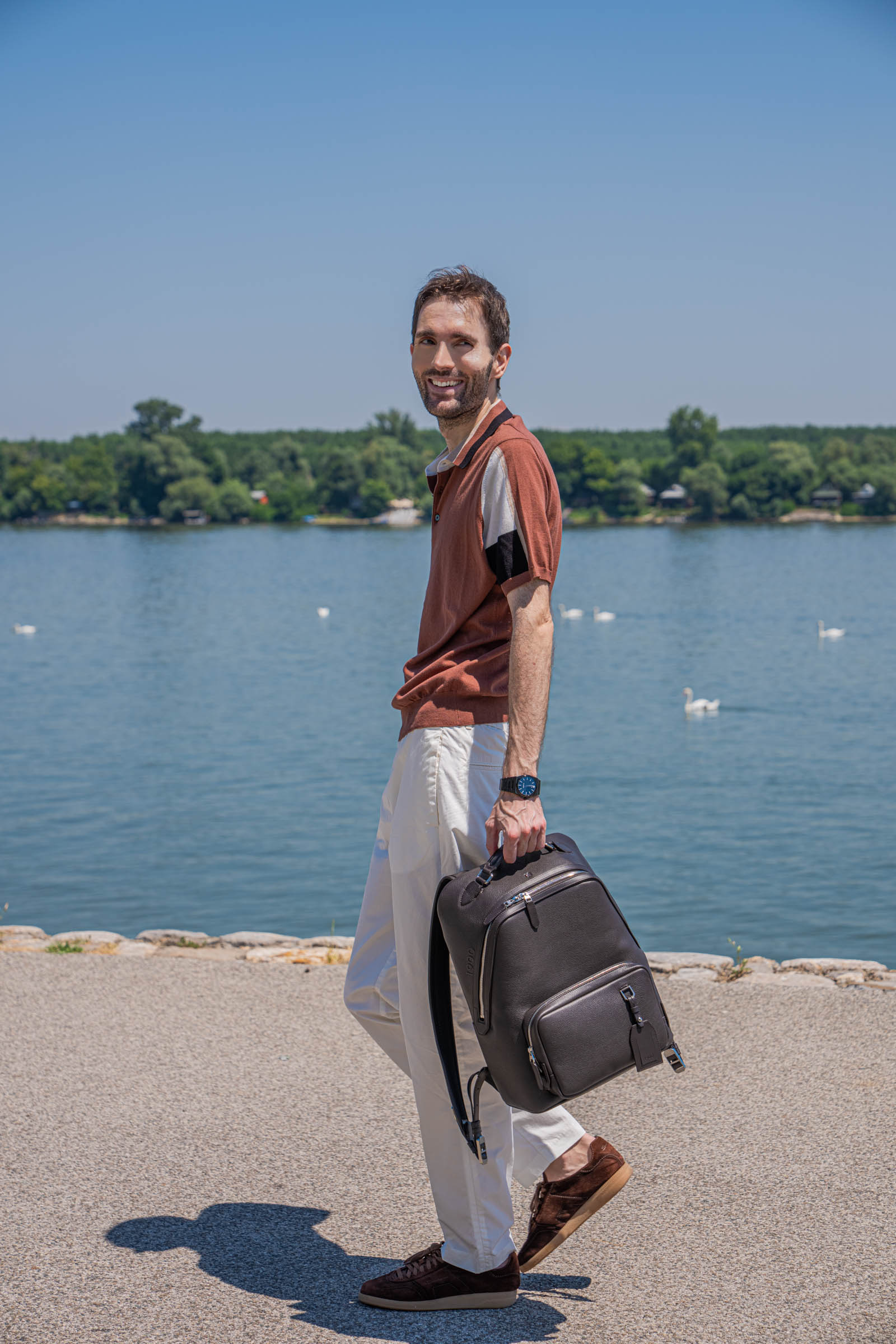
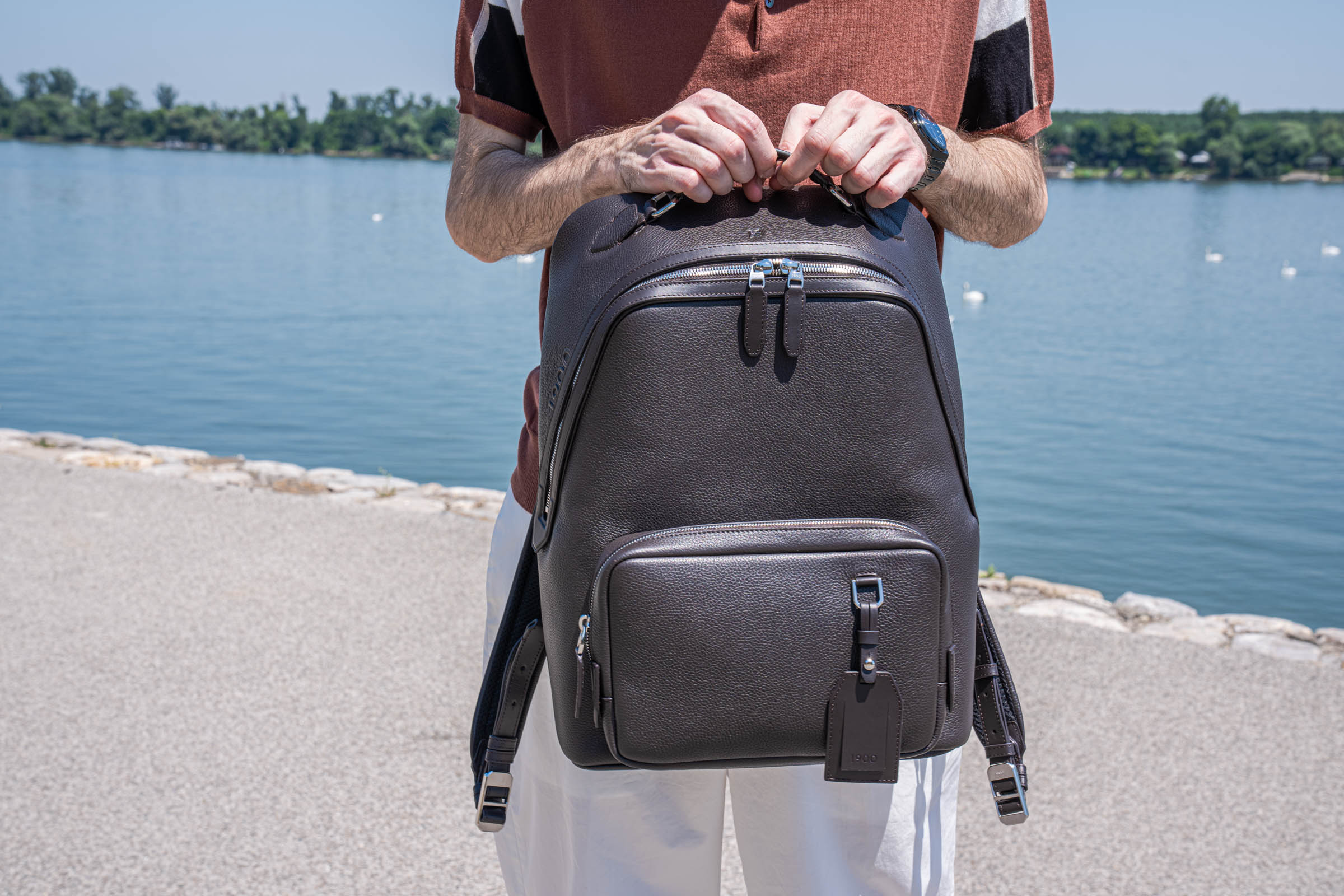
Now let’s move on to the protagonist of today’s fashion story. The 1900 Tempo Grande backpack arrived in dark brown, although there is also a black version. It’s made of luxurious grained leather with brushed leather details, and it’s clear from the first touch that the material comes from the highest grade.
The dimensions are 34 by 20 by 42 centimeters, which makes it roomy enough for a full working day, yet neat enough that it doesn’t look like hiking gear. The interior is thought out to the last stitch. There is a laptop compartment, a phone pocket, a card holder, a key hook, a place for two pens and an inner zipped pocket.
On the outside there are two zipped pockets, ideal for small items you want to keep close at hand. For passengers, there’s also a pass-through for the suitcase handle, so the backpack can easily be attached to a travel bag as you rush through the airport. Until now, I have seen a similar detail mostly on business bags, rarely on backpacks of this type.
I especially like the little leather travel tag that hangs from the front pocket and can be personalized. The leather straps are adjustable and distribute the weight nicely, and the top handle allows you to carry the backpack as a purse, which is what I do most of the time. The price is 920 euros, with free shipping worldwide and the possibility of returns within fourteen days.

1900 Tempo Grande Backpack: Slanted Zipper and Watch-Inspired Metal Hardware
Every good design has a signature, a detail by which you recognize it from a distance. With this backpack, it’s a slanted zipper that cuts diagonally across the front. The brand calls it an architectural detail, and it really does: a bold line on an otherwise calm facade. In addition to looking impressive, it makes access to the main compartment easy, so you don’t have to take your backpack off your shoulder to retrieve a document.
The second detail is even more interesting for watch lovers, including myself. The metal fittings, designed exclusively for the 1900 brand, are inspired by the cases of Gerald Genta’s famous watches. If that name doesn’t mean much to you, here’s a quick reminder: Zhenta is a designer who, in the 1970s, created the most famous sporty elegant watches with an integrated bracelet in the history of watchmaking. His ideas about balance and functional beauty continue to shape the industry today.
When you consider that the mother house has been making packaging specifically for the big watch houses for decades, this inspiration makes complete sense. Buckles on the straps really resemble precisely machined watch parts: polished surfaces, polished edges, solid and reliable mechanism. The sound they make when they close is closer to an hourglass than a regular bag clasp.
Such details are not noticeable at first glance. Yet they are the reason the item has been loved for years.

1900 Tempo Grande Collection: A Family of Luxury Travel Companions
The 1900 Grande Tempo backpack I am writing about is not the only piece in the exceptional Grande Tempo collection, but part of a larger whole. The Tempo Grande collection also includes a business bag, a small cross body bag, a spacious weekend bag and a travel case for watches and cufflinks. All the pieces share the same language: grained leather, brushed details, a distinctive oblique zipper and hardware inspired by the world of watches.
I like this consistency for practical reasons. When one day you want to add a weekend bag to your backpack for shorter trips, you’ll have a matching pair, not two items that happened to be in the same hallway. A little thing, but little things make style.
I would especially like the travel case for the watch and the cufflinks. Few young brands even think of such a product, and here it makes complete sense. The house that has been making boxes for the most prestigious watchmaking workshops for decades knows exactly how a watch should travel: protected, wrapped in soft leather and separated from anything that could scratch it.
The same thought runs through the entire collection. Items are not designed to scream off the shelf, but to follow you through airports, offices and city streets for years. This is exactly how modern men’s haberdashery should look.
How Does the 1900 Tempo Grande Backpack Perform in Everyday Use?
Theory is one thing, life is another. That’s why I put the 1900 Tempo Grande backpack to the test the way fashion accessories are only fairly tested: by wearing them. I took photography equipment, a bottle of water and a thin jacket for evening hours in it for the photoshoot for this fashion story because I didn’t plan on returning home. Everything fits without creasing and without struggling with zippers.
I was most surprised by the comfort. The leather straps are wide enough not to cut into the shoulders, and the back fits nicely. When I get tired of carrying it on my back, I simply grab it by the top handle and carry it like a business bag. It looks perhaps the best in that version, especially with bright summer pants.
Grained leather has another practical advantage that is rarely talked about. Its texture perfectly tolerates everyday touches and small scratches, which are immediately visible on smooth skin. This backpack looked like the first day after several weeks of wear, and the dark brown color is extra forgiving.
On the quay next to the Danube, while the swans were gliding by the shore, I realized something else. Dark brown skin takes on a warm, almost bronze glow in the strong summer sun. The photos prove it better than any of my sentences. That’s why I always advise you to choose the leather in live or at least look at it in the daylight, because only then does it show its true character.
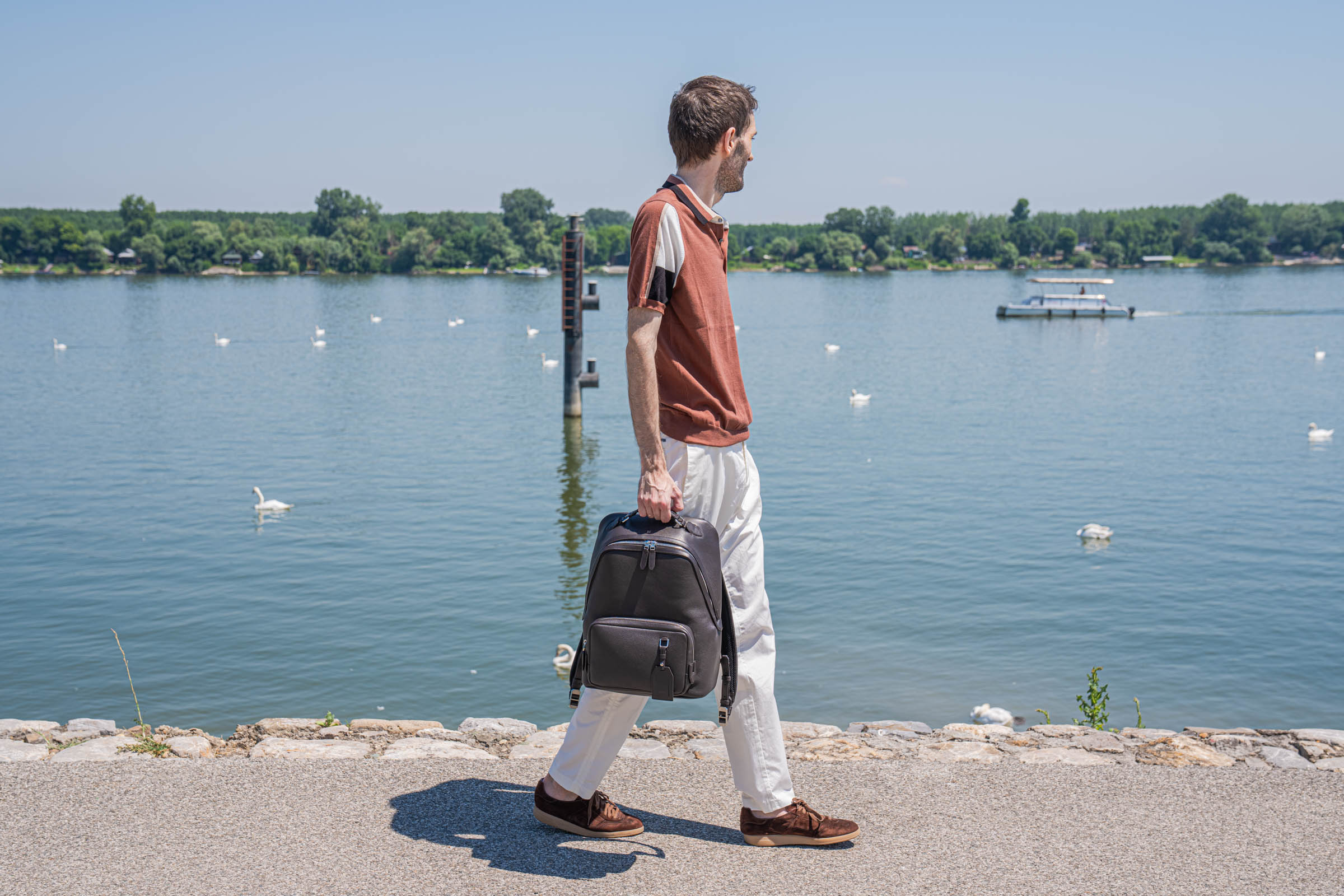
OUTFIT
Polo T-Shirt: Kiton
Watch: Biatec
Backpack: 1900
Trousers: Kiton
Sneakers: Santoni

Kiton Silk Polo Shirt: A Hallmark of Italian Luxury and Craftsmanship
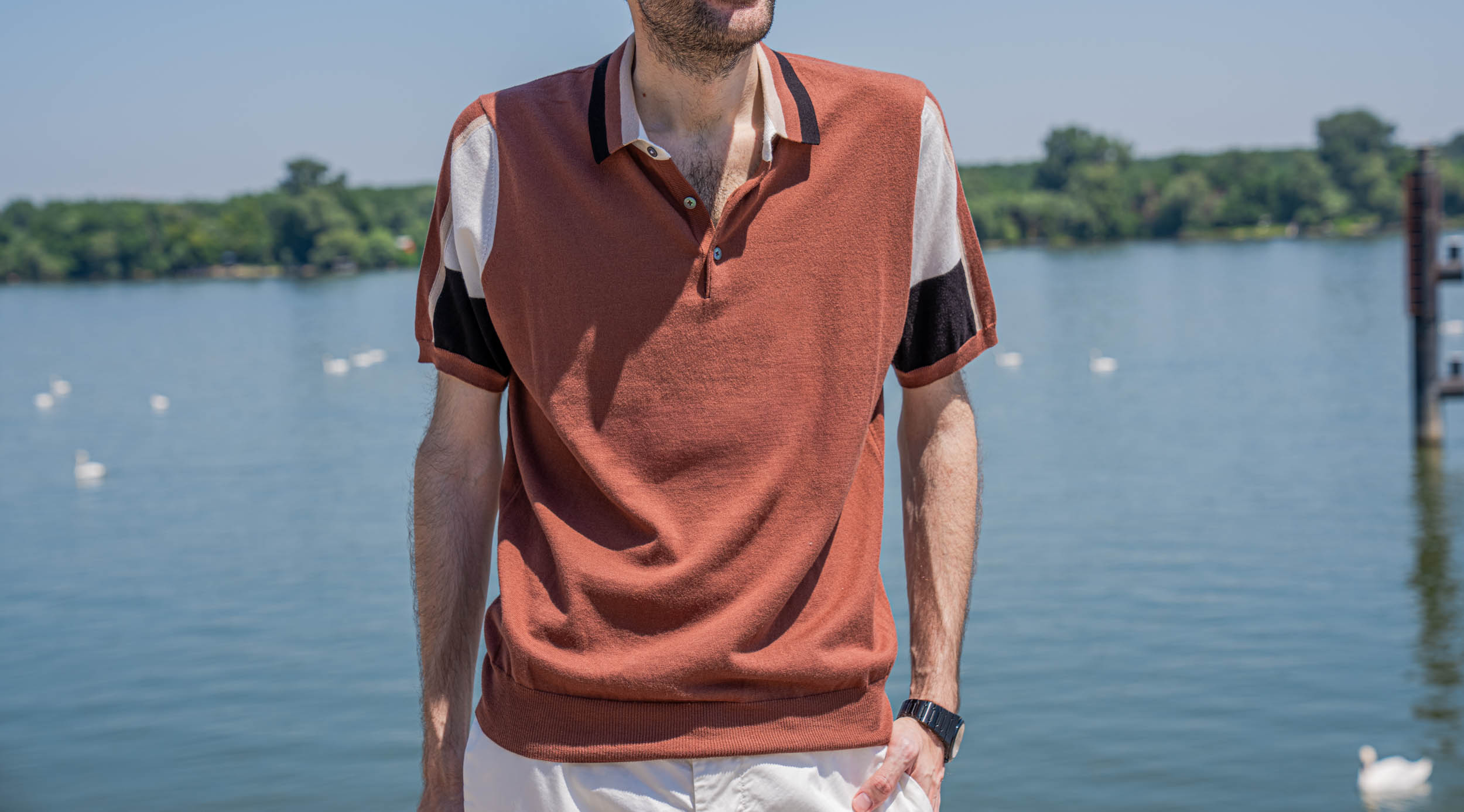
Let’s move on to the wardrobe of today’s outfit. For the upper part of the outfit, I chose a knitted polo shirt from the house of Kiton, made of silk thread in three colors. The base is a warm shade of brick brown, while the shoulders and sleeves feature bold blocks of white and black. The collar with a dark border gives it a slight 60s spirit, so the shirt seems both classic and a bit naughty.
Kiton is a story unto himself and deserves a few lines. The house was founded in 1968 in Arcano near Naples by Ciro Paone, a descendant of a family that had been involved in the fabric trade for generations. His parents ran a fabric stall in the Neapolitan market, so Paone learned the quality of materials literally from an early age.
The brand name comes from the Greek word chiton, a ceremonial tunic worn by the ancient Greeks in temples. The choice of the name is not accidental, because Naples has combined Italian and Greek heritage for centuries. Paone’s motto was: the best of the best, plus one. Even today, that sentence best describes the approach of the house, where about twenty-five hours of manual labor are spent to make one jacket.
Ciro Paone died in 2021 at the age of eighty-eight, but the company remained in the hands of the family. It is run by his cousin Antonio De Mateis, along with Paone’s daughter Maria Giovanna. Knitwear, like my shirt, is created in their facility in Fidenza, one of five production sites across Italy. In 2001, the house opened its own high tailoring school, in order to pass on the mastery to new generations.

White Kiton Trousers: The Foundation of Timeless Summer Elegance
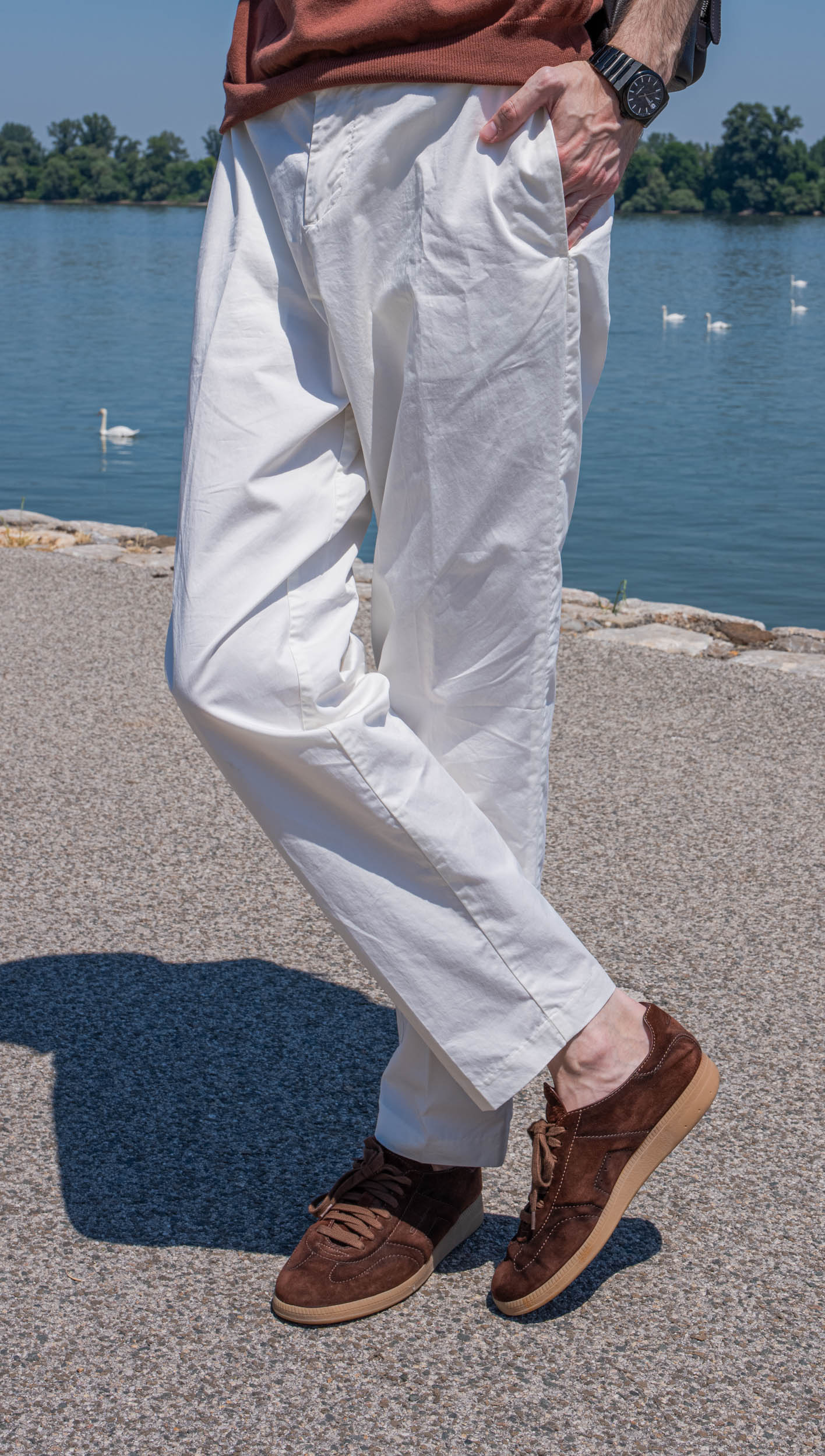
The lower part of the combination consists of white cotton pants, also from Kiton. The cut is relaxed, with a slightly wider leg that falls nicely and ends just above the ankle. This length works best with low sneakers, because it leaves the ankle free and visually lengthens the leg.
White trousers are, in my experience, the most underrated piece of a man’s summer wardrobe. Many avoid them for fear of blemishes or because they perceive them as too conspicuous. The truth is completely the opposite. White is a neutral color that accepts everything: earth tones, blue, green, pastel shades. With brown, it looks warm and Mediterranean, with navy, maritime, with gray, urban.
Cotton of this quality has another feature that you only notice when you wear it. It breathes in the heat, keeps its shape and does not stick to the leg even after a whole day of walking. It was over thirty degrees on the quay that morning, and my pants held up better than I did.
My advice for maintenance is simple: wash them at a lower temperature, dry them in the shade and iron them while they are still slightly damp. Properly cared for white pants last for years and only get softer with time.
Biatec Fusion 03: A Celtic Coin on the Wrist Where History Meets Modern Design
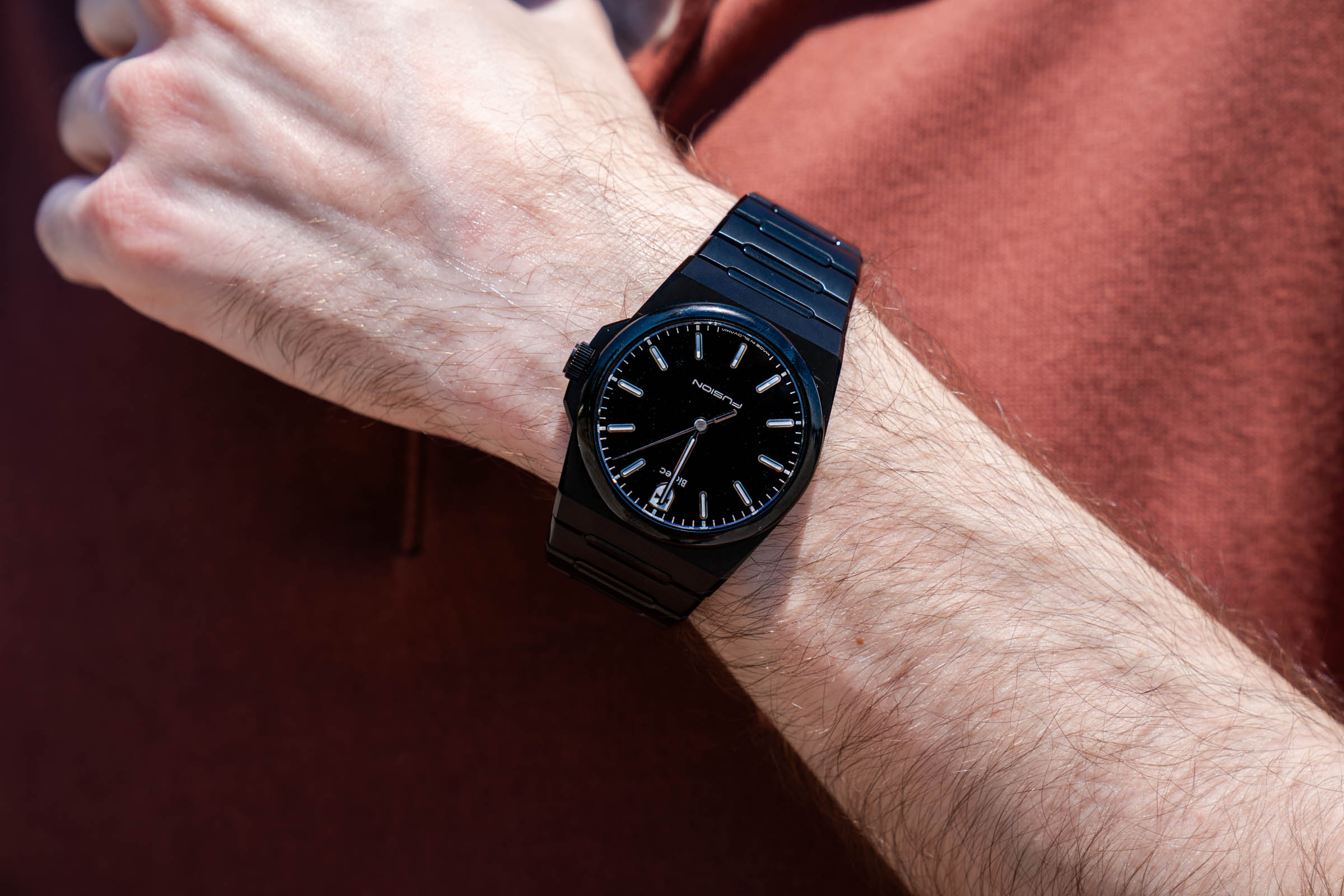
I was wearing the watch that has received the most questions in social media and email in recent days: Biatec Fusion 03. It is a Slovak brand based in Zvolen, and its story begins long before watchmaking, in the first century BC.
Biatec is the name of the Celtic coins minted by the Boii tribe in the area of today’s Bratislava. On those silver and gold coins, the inscription BIATEC appeared most often, probably the name of the then ruler depicted on a horse. Every child in Slovakia learns about these coins at school, so the founder of the brand, who registered the trademark in 2016, found in them the perfect symbol of national heritage. The connection is also artisanally logical: coinage and watch case making share the same language of metal, engraving and precision.
I particularly like the philosophy of the brand. Instead of expensive ambassadors and big advertisements, Biatec sells directly to customers and tries to keep prices fair. They give a five-year warranty on each watch, completely free of charge, which is still rare in the industry today. In some models, under the glass on the back, there is also a genuine mint coin from the Kremnica mint, which has been operating for almost seven centuries and is among the oldest in Europe.
The Fusion collection, to which my watch belongs, was created as a tribute to large watches with an integrated bracelet. And that’s where the circle of this announcement closes nicely: the same design school of Gerald Genta that inspired the straps of my backpack, also inspired the watch on my wrist. Coincidence? Maybe, but dear to me.


What Is Biatec Fusion 03 Hiding Beneath the Dial? The Movement and the Art of Watchmaking
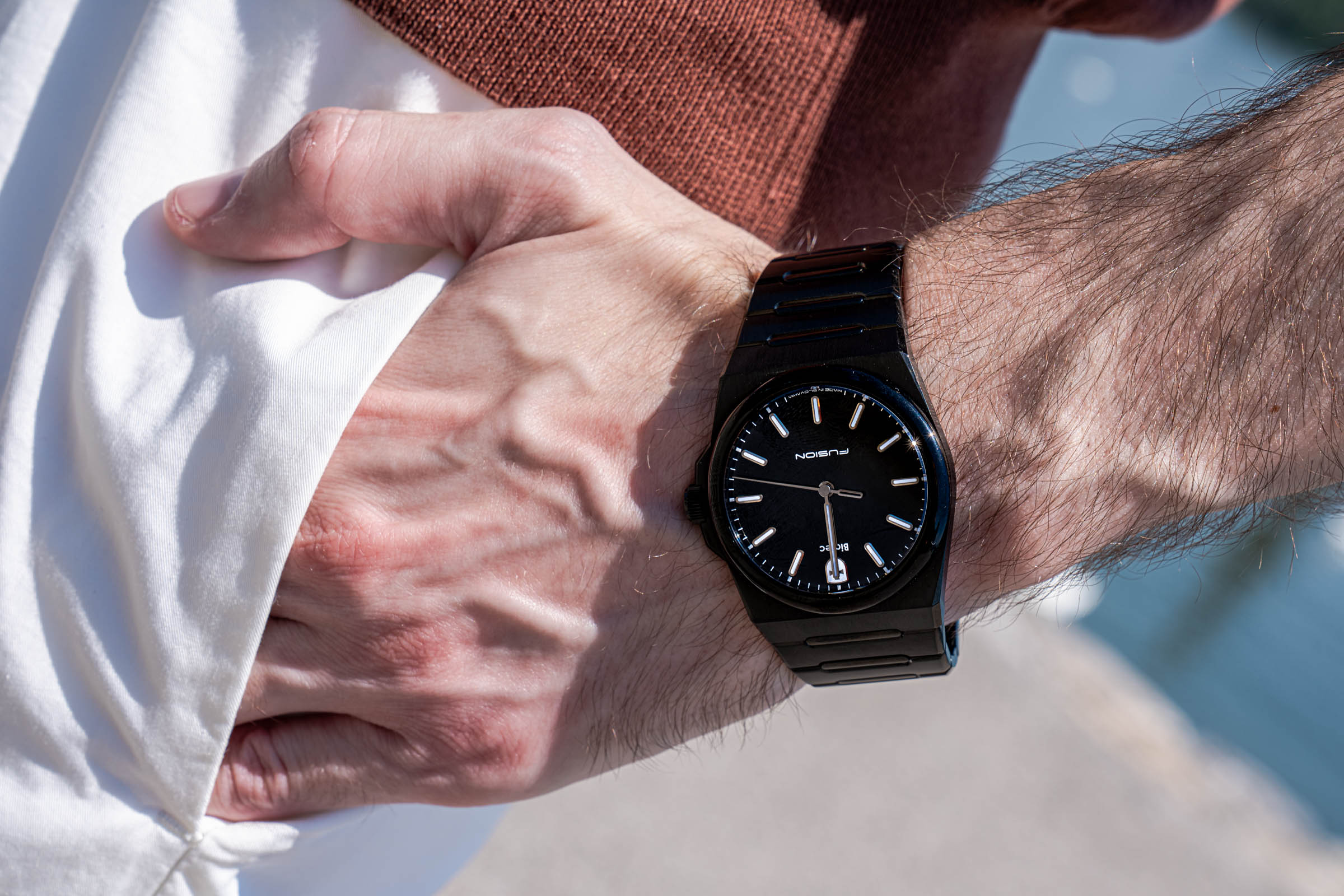
For readers interested in numbers, here’s what this watch has to offer. The 316L stainless steel case wears a black DLC coating, an extremely hard carbon layer that protects against scratches. The width is 39 millimeters without the crown protector, and the thickness is only 9 millimeters. Thanks to this, the watch slides under each cuff and is not felt on the hand.
Sapphire glass protects the dial on both sides: at the front with a double anti-reflective layer, and at the back as a window through which the mechanism can be seen. And there is something to see. Inside it beats the Swiss automatic movement Selita SW300 in the highest TOP range, with twenty-five bearings, decorative perlage, blue screws and a gold-plated rotor. The power reserve is about fifty-six hours, and the water resistance reaches one hundred meters.
The black lacquered dial features brushed indices with faceted edges and a coating of luminescent material that glows blue at night. The bracelet with a butterfly clasp has a total of 4.4 millimeters of micro-adjustment, so the length adjusts to the hand even on hot days when the wrist swells. The price is 1,890 euros.
It all sounds serious on paper, but it feels incredibly easy in the hand. A black watch with a brown and white combination provides a point of support, like punctuation at the end of a good sentence.
Santoni Oly Sneakers: Born in a Garage, Crafted with Italian Excellence
For shoes, I chose Santoni Oly trainers in dark brown flip-up leather, with a light caramel colored rubber sole. Their silhouette follows the spirit of classic court shoes from the last century: low profile, soft seam lines and no superfluous details except for a discreet signature on the side.
The story of the Santoni house is one of the most beautiful in Italian footwear. In 1975, Andrea Santoni, together with his wife Rosa, started a workshop in the garage of the family house in Coridonia, in the Marche region, with only five employees. For centuries, brands have been the shoemaking heart of Italy, so the competition was merciless. Santoni distinguished himself with quality and a technique that became his trademark.
It is about manual dyeing of the leather in layers, a process that the house calls velatura. The masters apply the color layer by layer, similar to Renaissance painters, until the leather acquires a depth and patina that the machine cannot reproduce. That’s why each couple comes out of the workshop with their own character.
Today, the company is run by Andrea’s son Giuseppe, and the brand is still fully owned by the family. Last year they celebrated their fiftieth birthday, with a lavish monograph from the Asulin publishing house and a new store on Madison Avenue in New York. Despite its worldwide success, production remained in Coridonia, in a solar-powered headquarters. From the garage to Madison Avenue, without ever compromising on quality. That is rarely seen.


Why Brown and White Always Work: The Secret of Timeless Elegance
Let me go back to the combination itself for a moment, because I believe that behind every good outfit there is a simple logic. Brown and white are a couple that never fails, and here’s why.
White color brings light and freshness, while brown brings warmth and weight. One without the other easily slips into extremes: an all-white combination can seem sterile, and an all-brown combination too heavy. Together they balance perfectly, like sand and shade on the same beach.
In this ensemble, brown appears in as many as four different textures, and that’s exactly what makes the combination interesting. The silk thread of the T-shirt has a discreet sheen. The grained leather of the backpack bears a tangible relief. The flip-up leather of the sneakers is soft and matte. The black steel of the watch adds a cool, technical contrast. The observer’s eye registers these differences even before consciousness names them, so the whole seems rich even though the palette remains calm.
If you take away just one piece of advice from this post, let it be this: when the colors are subdued, the textures should do the talking. Two to three related shades in different materials will always look more expensive and thoughtful than five strong colors that get used.
Can a Backpack Work with an Elegant Outfit? Combining Luxury and Practicality
I know some of the readers here will raise an eyebrow and think twice. A backpack with a knitted silk shirt and white pants? Isn’t that equipment for students and hikers? I understand the doubt, because I have shared it myself for years. Then the leather backpacks convinced me.
The key difference is in material and form. A nylon backpack with ten external pockets really does not belong in an elegant ensemble. However, a backpack made of grained leather, with clean geometry and clockwork fittings, is a completely different category. It does not detract from the combination, but adds a relaxed urban tone to it.
The practical side is undeniable. The hands remain free, the weight is distributed on both shoulders, and the spine is less tired than with a bag that has been dragging one side of the body for years. For travel, the advantage is even greater: the pass-through for the suitcase handle turns the backpack into the perfect companion, and the built-in compartment stores the computer during the flight.
My rule goes like this. A backpack still doesn’t go well with a suit and tie, that’s where the purse remains irreplaceable. With everything else, from a knit polo shirt to a jacket without a tie, a quality leather backpack not only fits, but often looks better. Elegance has long since moved from rigid rules to a good selection of materials.


Three Ways to Style the 1900 Tempo Grande Backpack with Elegant Outfits
Not to dwell on theory alone, here are three units in which this backpack regularly works for me.
The first is business. Then I carry the backpack exclusively for the upper handle, like a purse, with an unstructured jacket, a light shirt and darker pants. In that role, it seems serious, yet more contemporary than the classic briefcase. The slanted zipper allows me to pull out the notebook even before I sit down at the desk.
The second unit is travel. There, the backpack goes on both shoulders, over a lighter jacket or sweater, while the passage on the back slides over the handle of the suitcase. A padded compartment holds a computer, exterior pockets hold a passport and headphones, and a leather tag with my info hangs from the front pocket. Everything important at your fingertips, without rummaging around.
The third is the weekend version, exactly the one from the photos. Knitted polo shirt, bright pants, flip-up leather sneakers and backpack in hand. Casual, but never messy.
One last tip: dark brown leather works best with earth tones, white, cream and olive. If your wardrobe relies on gray, navy and black, consider a black version of the same model.
Who Is the 1900 Tempo Grande Backpack For? The Perfect Choice for Modern Men Who Value Style and Functionality
After everything written, it’s time to answer the most important question: to whom would I recommend this backpack? The answer is clear. This is the backpack for the man who has left the flashy logo phase behind and is now looking for items that quietly speak for him.
The price of 920 euros is not small, but it should be viewed through what I call the mathematics of investment dressing. Quality grain leather, with basic care, lasts a decade or more, and looks better over time. Divide the price by ten years of daily wear, and you get less than one coffee a week. A cheap backpack that you replace every two years ends up being more expensive and never feels the same.
There is also the issue of rarity. Since the 1900 brand consciously produces in controlled quantities, there is little chance that you will meet the same backpack on every corner. At a time when the same models of famous houses are seen on every other shoulder, such a discreet uniqueness becomes a real luxury.
If you’re looking for your first serious leather backpack, or trading in a business bag for something more contemporary, the Tempo Grande is a choice you’ll be hard pressed to outgrow. It works equally well in the boardroom, at the airport and on the riverside promenade, as I hope this text and photos make clear enough.
How to Care for Leather to Last for Decades: A Guide to Preserving Luxury Leather Goods
Since I mentioned a decade of wear, I also owe you a few care tips, because even the best skin needs a little attention. The good news is that grainy leather is among the most rewarding to maintain.
My routine is simple. Once a week I wipe the backpack with a soft, dry cloth to remove dust from the recesses of the grainy surface. Every few months I apply a thin layer of neutral skin balm, which nourishes the material and keeps it from drying out. I always try on a hidden place first, on the underside, and only then move on to the visible surfaces.
This backpack withstands the rain better than I expected, but after getting wet, I never dry it next to the radiator. Heat is the worst enemy of the skin, because it makes it brittle. Drying at room temperature, away from a direct heat source, is the only correct way to go.
When I don’t use the backpack for a long time, I lightly fill it with paper to keep its shape and store it in a canvas bag. I also avoid stuffing while wearing, because it permanently stretches the seams and spoils the silhouette. That much is enough. With these few habits, the skin does not age, but matures, and this is the difference you will see with the naked eye.
Does the 1900 Tempo Grande Backpack Live Up to Expectations? Final Thoughts on Luxury, Functionality and Design
When we finished the photo shoot, I sat down on the stone railing of the quay, put my backpack down next to me and watched the swans fight over a piece of bread. It occurred to me how good things in fashion and life coincide: the most beautiful are the ones that don’t ask for attention, but still get it.
This combination doesn’t have any attacking pieces that stand out. It has silk thread from Naples, white cotton fabric, leather from a workshop that has served the greatest for decades, a watch with the name of a Celtic coin and sneakers born in a garage in Marche. Each of these items carries a story longer than any trend.
So in the end I ask you what I always ask myself in front of the mirror: does your wardrobe tell stories or just fill up closet space? Tell me in the comments how you like this combination and whether the leather backpack has found a place in your style.
How did you like my outfit today? I really tried to prepare this post with lots of love and I hope you like it! If you have any questions, comments, suggestions or messages for me, you can write me below in the comments. Of course, as always, you can contact me via e-mail or social networks, which you can find on the CONTACT page. See you soon in new fashion adventures on the Mr.M blog!
With Love,
Mr.M
This post is sponsored by Biatec, 1900 (Manifattura Ceraolo Moroni), Kiton and Santoni brands. This post is my personal and honest product review.
Marko, the first thing that caught my attention was actually the shape of the bag rather than the branding. The diagonal opening gives it a slightly different character from the usual rectangular crossbody designs I see everywhere. I can imagine that being useful when you are walking and want to reach inside without taking the bag completely off. The brown leather also seems like the right choice for this particular design because it softens what could otherwise look quite technical. I noticed how naturally it sits with the olive Loro Piana pieces in the photographs. The old stone pavement in… Read more »
Hallo Marko, bei diesem Beitrag bin ich bei der Geschichte hinter dem Hersteller hängen geblieben. Ich finde es immer interessanter, wenn eine Marke nicht erst seit gestern existiert, sondern auf Erfahrungen zurückgreifen kann, die ursprünglich für andere Luxusunternehmen gesammelt wurden. Gerade bei Lederwaren merkt man meiner Meinung nach den Unterschied zwischen einem schönen Entwurf und einem Produkt, das wirklich durchdacht ist. Die Verbindung zur Uhrenbranche erklärt auch, warum du so ausführlich auf die Metallteile eingehst. Das ist normalerweise ein Detail, über das man bei einer Tasche kaum nachdenkt. In deinem Styling gefällt mir außerdem, dass die Tasche nicht versucht, mit… Read more »
Ce qui m’a vraiment intéressé dans ton article, c’est la transition entre le travail en coulisses et la création d’une identité propre. Une entreprise qui a longtemps travaillé pour d’autres maisons de luxe possède forcément une expérience différente d’une jeune marque qui commence directement avec son propre logo. Cela donne au projet 1900 une certaine profondeur. J’aime aussi que tu ne présentes pas le cuir uniquement comme un matériau luxueux, mais comme quelque chose qui doit être utilisé et entretenu. Le marron foncé me semble justement adapté à cette philosophie, car les petites marques du temps devraient moins se voir… Read more »
Hay algo en las fotografías que me parece muy acertado: la bolsa no parece estar posando, parece estar siendo utilizada. El paseo junto al Danubio y el suelo antiguo de Zemun crean un contexto mucho más cotidiano que una habitación de hotel de lujo. Eso me ayuda a imaginar el tamaño y la forma con mayor facilidad. También me gusta que el bolso no tenga que depender de un logotipo grande para llamar la atención. La textura de la piel ya aporta suficiente interés cuando se ve de cerca. En mi opinión, ese tipo de discreción funciona especialmente bien en… Read more »
La cosa che mi ha fatto rileggere il passaggio sulla manifattura è il rapporto tra orologeria e pelletteria. Sono due mondi diversi, ma condividono una cosa importante: i dettagli piccoli devono essere precisi perché fanno parte dell’esperienza complessiva. La presenza di Gérald Genta in questa storia mi sembra quindi tutt’altro che casuale. Mi piace soprattutto il fatto che questa influenza non trasformi la borsa in un oggetto troppo tecnico. Il risultato rimane morbido e molto italiano grazie alla pelle e alla palette marrone e verde. Anche il Biatec Fusion 03 crea un bel punto di contrasto al polso. Mi chiedo… Read more »
Jag fastnade för färgerna här eftersom de känns väldigt lätta att bära tillsammans utan att vara tråkiga. Det mörkbruna lädret, olivtonerna och de ljusare naturfärgerna ligger nära varandra men har ändå olika djup. Jag tycker särskilt att mockaskorna hjälper till att göra väskan mindre formell. Hade samma väska burits med svarta läderskor hade intrycket blivit betydligt striktare. Zemun-miljön förstärker dessutom den jordnära känslan på ett fint sätt. Det gamla underlaget mot det välgjorda lädret skapar en kontrast som jag gillar. Vilken färg skulle du själv välja om du skulle köpa väskan en andra gång?
Ik moest glimlachen om de uitleg van 1900, omdat ik zelf eerst ook aan een jaartal dacht. Juist zo’n klein stukje achtergrond maakt een merknaam interessanter. Wat ik daarnaast sterk vind, is dat het verhaal niet alleen over het eindproduct gaat, maar ook over de ervaring die erachter zit. Een bedrijf dat jarenlang voor horloge- en juwelenmerken heeft gewerkt, kijkt waarschijnlijk anders naar details zoals sluitingen en metalen onderdelen. Dat zie je volgens mij terug in de tas. De combinatie met de Giannetto Portofino en de Santoni-schoenen maakt het geheel bovendien verzorgd zonder overdreven te worden. Ik ben benieuwd welk… Read more »
I am usually sceptical about the phrase “quiet luxury” because it gets attached to almost anything made in brown leather. In this case, however, I think the description actually makes sense. The bag has several recognisable design elements, but none of them are shouting for attention. I particularly like the small 1900 detail because you have to look twice before you really notice it. That makes the object feel more rewarding to someone who pays attention to construction. The photographs also show why texture matters so much with a restrained colour palette. Would you personally consider this more of a… Read more »
Pidin siitä, että tässä laukussa käytännöllisyys ei ole kokonaan piilotettu muotoilun taakse. Puhelintasku, korttipaikka ja avainlenkki ovat juuri sellaisia yksityiskohtia, joita arvostan vasta silloin, kun käytän tuotetta oikeasti. Kaunis laukku voi nopeasti muuttua ärsyttäväksi, jos kaikki tavarat päätyvät samaan suureen lokeroon. Tässä järjestys vaikuttaa harkitulta. Myös säädettävä hihna on tärkeä, koska laukun asentoa voi muuttaa päivän aikana. Zemunissa otetuissa kuvissa näkee hyvin, ettei kyseessä ole pelkkä koriste. Käyttäisitkö itse tätä enemmän päivittäisenä kaupunkilaukkuna vai matkalla mukana kulkevana pienenä järjestäjänä?
Jeg likte faktisk fotografiene mer etter at jeg hadde lest hele teksten. Først ser man bare en velkledd mann med en brun veske, men detaljene i artikkelen gjør at man begynner å se på materialene på en annen måte. Lin og silke i Loro Piana-plaggene gir et lett uttrykk, mens skinnvesken tilfører mer tyngde. Det fungerer godt sammen med de brune semskede Santoni-skoene. Jeg synes også den svarte Biatec-klokken er viktig fordi alt ellers ligger i varme fargetoner. Bildene ved Donau blir derfor nesten en forlengelse av fargepaletten. Hadde du valgt samme kombinasjon hvis bildene skulle vært tatt midt i… Read more »
Uma das coisas que mais gostei foi a explicação sobre a dimensão da mala. Em fotografias de moda é muito fácil perder a noção do tamanho real de um acessório. As medidas ajudam a perceber que esta não é uma mala enorme, mas também não é apenas uma pequena bolsa para o telemóvel. Parece-me um tamanho interessante para quem quer levar o essencial sem encher os bolsos das calças. A organização interior torna essa ideia ainda mais prática. O formato crossbody também combina muito bem com a roupa descontraída das fotografias. Usarias a mesma mala para um dia inteiro de… Read more »
Najbardziej zaciekawiło mnie to, jak wiele uwagi poświęcono metalowym elementom torby. W przypadku większości skórzanych akcesoriów mówi się głównie o skórze, kolorze i logo. Tutaj pojawia się natomiast historia związana z zegarkami i Géraldem Gentą. Dzięki temu zamek czy klamra przestają być dla mnie zwykłymi elementami technicznymi. Zaczynam patrzeć na nie jak na część całego projektu. Podoba mi się też, że nie próbujesz dopasować zegarka do torby w banalny sposób, używając identycznego koloru. Czerń Biateca przy brązowej skórze daje znacznie ciekawszy efekt.
The part about the two different leather finishes caught my eye. Smooth leather next to a more textured grain creates a subtle change that becomes visible only when you look closely. That is exactly the kind of detail I tend to appreciate more than a prominent logo. It also makes sense with the watchmaking background you describe, because small variations in surface and finishing can completely change how an object feels. I think the dark brown colour was a smart choice for showing those differences in the photographs. The Zemun setting helps too because the natural light reveals the texture… Read more »
Ich finde die Größe der Tasche ziemlich interessant, weil sie genau zwischen einer klassischen Herrentasche und einer sehr kleinen Crossbody liegt. Für mich wäre entscheidend, ob sie auch dann bequem bleibt, wenn man sie mehrere Stunden trägt. Auf den Bildern sieht der Gurt angenehm proportioniert aus und nicht wie ein zusätzliches Band, das den Look dominiert. Besonders gut gefällt mir, dass man die Tasche offenbar unterschiedlich tragen kann. Das macht sie vielseitiger als viele ähnliche Modelle. Ich würde sie wahrscheinlich eher über einer leichten Jacke tragen als direkt unter einem Mantel. Hast du sie auch einmal über längere Zeit getragen,… Read more »
Le détail qui m’a retenu est le contraste entre le cuir grainé et les parties en cuir plus lisses. C’est discret, mais cela donne beaucoup plus de profondeur à la silhouette du sac. J’aime également le fait que la fermeture diagonale ne soit pas simplement décorative. Elle semble vraiment participer à l’utilisation quotidienne du modèle. La relation avec l’univers de l’horlogerie est probablement ce qui rend 1900 différent de nombreuses jeunes marques d’accessoires. Ton choix de le porter avec une tenue aux tons olive fonctionne très bien. Les photos au bord du Danube donnent presque l’impression que le sac appartient… Read more »
I enjoyed this one, Marko. You can tell when a brand has thought about the small things, and the Tempo Grande seems full of them. The card holder, key hook and pen holders are almost old-fashioned in the best possible way. At the same time, the laptop compartment and luggage sleeve make it completely modern. I also like that the straps are designed around balance and comfort rather than simply looking good. Have you found them comfortable after wearing the backpack for several hours?
Marko, me gusta mucho que aquí el lujo no dependa de un logotipo. Se reconoce por la calidad de los materiales y por la manera en que están combinados. La piel granulada tiene una presencia muy bonita y las partes de piel cepillada le dan profundidad. También me llamó la atención la inspiración de Gérald Genta. Es un detalle que probablemente solo aprecias cuando conoces un poco el mundo de la relojería. ¿Crees que la versión negra mostraría igual de bien estos detalles?
Ciao Marko, trovo molto riuscito il modo in cui hai fotografato questo zaino. Il Danubio sullo sfondo lo rende immediatamente parte di una giornata reale, non di una semplice presentazione di prodotto. Mi piace molto anche l’abbinamento con il maglione Kiton. È elegante, ma non troppo costruito. La pelle marrone scuro completa perfettamente il tutto. Pensi che lo vedremo presto anche abbinato a un cappotto più invernale?
Hallo Marko, bei deinen Artikeln über Lederaccessoires achte ich inzwischen automatisch auf die Materialkombinationen. Hier gefällt mir besonders der Unterschied zwischen dem genarbten und dem gebürsteten Leder. Dadurch wirkt der Rucksack nicht langweilig, obwohl die Farbpalette sehr zurückhaltend ist. Auch die Metallteile passen erstaunlich gut dazu. Ich könnte mir vorstellen, dass gerade das braune Modell mit der Zeit immer individueller wird. Würdest du ihn deshalb eher nicht zu vorsichtig behandeln?
Hi Marko, this is one of those pieces where I understand the “quiet luxury” idea immediately. Nothing is trying too hard. I particularly like the way the 1900 details are embossed rather than displayed as a large logo. The bag also seems genuinely designed for travel, not simply styled to look like it belongs in an airport. The luggage pass-through is a great example. Would you personally take this instead of a traditional briefcase for a short business trip?
Cześć Marko, bardzo podoba mi się ten plecak właśnie dlatego, że nie wygląda jak typowy plecak biznesowy. Ma funkcjonalne wnętrze, ale wizualnie jest znacznie bardziej elegancki. Skośny zamek jest świetnym detalem, który przełamuje klasyczną formę. Zwróciłem też uwagę na połączenie różnych rodzajów skóry. Na zdjęciach nad Dunajem wygląda to naprawdę bardzo naturalnie. Czy sam częściej używałbyś go do pracy, czy raczej podczas podróży?
Marko, I think you have found a really interesting balance here. The backpack is clearly luxurious, but it still looks like something you could throw over your shoulders and walk around a city with. That is not always the case with expensive leather bags. The brown colour also makes it feel less corporate. I especially liked the photographs because the Danube setting gives it some movement and atmosphere. Do you think this colour would work equally well with navy tailoring?
Marko, jag tycker faktiskt att det här är en av de mer intressanta läderryggsäckarna du har visat. Den känns vuxen utan att bli konservativ. Den diagonala dragkedjan gör mycket för formen. Jag gillar också att metallen inte är blank på ett överdrivet sätt. Det finns en fin balans mellan det matta och det polerade. Skulle du vilja se 1900 göra samma modell i en något ljusare cognacfärg?
Bonjour Marko, j’ai beaucoup aimé la partie consacrée à l’histoire de 1900, parce qu’elle donne au sac une profondeur que l’on ne perçoit pas forcément au premier regard. Le fait que MCM puisse être lu comme 1900 en chiffres romains est une idée assez élégante, surtout pour une marque qui possède justement des liens avec l’univers de l’horlogerie et de la joaillerie. J’ai également trouvé intéressant que les éléments métalliques aient été conçus spécialement pour 1900, avec cette inspiration de Gérald Genta, car cela explique pourquoi ils semblent presque avoir une présence de boîtier de montre. Ce sont finalement de… Read more »
Marko, I really like this one because the backpack feels like something that could actually become more beautiful through use. I have always preferred leather goods that develop character rather than pieces that are expected to remain perfectly untouched forever. The description of the natural grain and the way the leather can develop a patina made me particularly curious about the dark brown version. I can already imagine it becoming slightly deeper and richer after a few years of travelling. The brushed leather sections are another detail I would probably appreciate more in person than in photographs. Your pictures beside… Read more »
Olá Marko, gostei muito deste artigo porque a mochila parece realmente integrada no teu estilo e não apenas colocada numa fotografia para ser apresentada. A combinação com a malha da Kiton ficou muito natural, e as sapatilhas da Santoni ajudam a manter o conjunto elegante sem o tornar excessivamente formal. Também gostei bastante do facto de explicares a organização interior, porque um acessório destes precisa de funcionar tão bem quanto parece. O compartimento acolchoado para o computador, os bolsos exteriores e o sistema para prender a mochila à mala são detalhes que fazem sentido para quem viaja frequentemente. O fecho… Read more »
Hi Marko, I think the watchmaking influence is what makes this backpack particularly interesting. When you mentioned Gérald Genta, I went back to look at the metal details again and suddenly understood what you meant. There is something very precise about the shapes and the combination of brushed surfaces with polished edges. It gives the hardware a presence without turning it into decoration. I also appreciate that the leather remains the dominant material rather than being overwhelmed by the metal. The whole thing feels considered in the same way a good watch feels considered. Would you say that this is… Read more »
Marko, ich finde die Kombination auf den Fotos wirklich hervorragend, gerade weil sie nicht nach einer klassischen Werbekampagne aussieht. Der Rucksack wirkt zusammen mit dem Kiton-Strick und den Santoni-Sneakern wie ein Teil eines tatsächlich getragenen Outfits. Genau das gefällt mir bei deinen Beiträgen immer besonders: Man sieht nicht nur ein Produkt, sondern bekommt eine Vorstellung davon, wie es sich in eine Garderobe einfügt. Der dunkelbraune Farbton ist für mich dabei entscheidend, weil er viel wärmer wirkt als Schwarz und die Struktur des Leders stärker zur Geltung bringt. Auch die verschiedenen Lederoberflächen finde ich sehr gelungen. Ich frage mich allerdings, wie… Read more »
Ciao Marko, questo è proprio il tipo di accessorio che mi fa pensare a quanto sia difficile progettare uno zaino elegante. Non basta utilizzare della bella pelle, perché il risultato può comunque sembrare troppo sportivo oppure troppo simile a una normale borsa da lavoro. Il Tempo Grande invece mantiene una certa leggerezza visiva, nonostante le dimensioni siano abbastanza generose. La pelle martellata, le parti lisce e la zip diagonale lavorano molto bene insieme. Mi piace anche il fatto che l’interno sia organizzato senza trasformarsi in una successione infinita di tasche e scomparti. Il passaggio per il manico della valigia è… Read more »
There is something about the proportions of this backpack, Marko, that I find particularly appealing. It looks substantial enough to be genuinely useful, but it does not appear oversized when you wear it. The 34 x 20 x 42 cm dimensions probably explain some of that balance. I also like that the external pockets are integrated without making the front look busy. The laptop compartment and luggage pass-through make it much more convincing as a travel piece than many luxury backpacks I have seen. I could imagine taking it through an airport in the morning and then wearing it to… Read more »
Hoi Marko, ik vind vooral de rustige uitstraling van deze rugzak erg geslaagd. Wat mij aanspreekt, is dat het leer duidelijk de hoofdrol speelt en dat er geen groot logo nodig is om de tas herkenbaar te maken. De diagonale rits geeft hem net genoeg karakter om niet klassiek of voorspelbaar te worden. Ook de combinatie met de Kiton-trui vind ik sterk, omdat de rugzak daardoor onderdeel van de outfit wordt in plaats van alleen een praktisch object op de rug. De foto’s langs de Donau vind ik trouwens misschien wel de mooiste van het artikel, juist omdat de omgeving… Read more »
Hei Marko, tässä repussa kiinnostaa erityisesti se, että käytännöllisyys ei näy ensimmäisenä. Kun katsoo tarkemmin, huomaa kuitenkin kuinka paljon arjen käyttöä on mietitty. Tietokonelokero, puhelintasku, korttitila, avainlenkki ja kynäpaikat ovat kaikki sellaisia yksityiskohtia, joita oikeasti voi käyttää joka päivä. Matkalaukun kahvan läpivienti on minusta vielä parempi esimerkki siitä, että kyseessä ei ole vain kaunis nahkareppu. Myös tummanruskea väri näyttää kuvissa erittäin hyvältä, varsinkin kun sitä verrataan vihreisiin ja maanläheisiin sävyihin. Pidän siitä, että nahkan luonnollinen pinta saa näkyä eikä sitä yritetä tehdä liian täydelliseksi. Näyttäisitkö joskus myös mustan version samalla tavalla stailattuna? Olisi kiinnostavaa nähdä, muuttaako väri koko repun luonnetta… Read more »
Marko, lo que más me gusta de tus artículos sobre accesorios es que normalmente consigues explicar por qué una pieza merece la pena y no solamente decir que es bonita. Aquí sucede exactamente eso. Al principio ves una mochila de piel muy elegante, pero después empiezas a descubrir la historia de 1900, la interpretación de MCM en números romanos y la relación de la empresa con el mundo de la relojería y la joyería. Entonces los detalles metálicos adquieren mucho más sentido. También me parece muy acertado que las piezas metálicas hayan sido diseñadas específicamente para la marca, porque eso… Read more »
Hi Marko, this feels very close to the idea of modern menswear that I have come to associate with your blog. The outfit is relaxed, but nothing looks casual in the careless sense of the word. The Kiton knitwear gives the look softness, the Santoni sneakers keep it contemporary, and the 1900 backpack brings everything together. I particularly like that you photographed it by the Danube instead of putting it against an obviously luxurious background. It makes the backpack feel much more wearable. I have always thought that the best luxury accessories should work with real life rather than only… Read more »
Marko, ce que j’aime ici, c’est que le sac n’a absolument pas besoin d’être spectaculaire pour être mémorable. La fermeture diagonale lui donne une identité immédiate, tandis que le cuir marron foncé apporte quelque chose de beaucoup plus chaleureux que le noir. J’ai aussi aimé la manière dont tu expliques les différentes textures, parce qu’on comprend que le contraste entre le cuir grainé et le cuir brossé n’est pas simplement décoratif. Il y a une vraie réflexion derrière les matériaux. La référence à Gérald Genta m’a également intrigué, surtout parce que l’inspiration reste très discrète au lieu d’être transformée en… Read more »
Marko, I honestly think the dark brown version suits your style better than black. It feels warmer, and you can actually see the texture of the leather in the photographs. I also noticed the polished edges on the metal components after reading your explanation, which is exactly the kind of small detail I would probably have missed otherwise. The reference to watch design makes more sense once you look at the hardware closely. I like that the connection is subtle rather than literal. The whole backpack feels precise without becoming technical. Have you had any reaction from readers who normally… Read more »
Hei Marko, jeg liker virkelig kombinasjonen av tradisjonelt lærarbeid og moderne funksjon her. Det er lett å lage en vakker lærsekk som fungerer dårlig i praksis, men denne virker som om den er utviklet med begge deler i tankene. Den diagonale glidelåsen gir designet litt mer karakter enn en vanlig, klassisk ryggsekk. Jeg synes også metallbeslagene er spesielt fine fordi de ikke blir for blanke eller dekorative. Den mørkebrune fargen passer dessuten veldig godt til de naturlige fargene i antrekket på bildene. Jeg kunne absolutt sett for meg denne sammen med en ullfrakk om høsten eller vinteren. Hvordan synes du… Read more »
Ciao Marko, mi è piaciuto molto il modo in cui hai costruito queste fotografie perché il Danubio sullo sfondo cambia completamente la percezione dello zaino. Non sembra più un semplice accessorio da ufficio, ma qualcosa pensato per accompagnare una giornata di spostamenti. La maglieria Kiton e le sneakers Santoni rendono il tutto molto naturale. Mi piace soprattutto il contrasto tra la pelle marrone scuro e i colori più morbidi dell’abbigliamento. Anche la zip diagonale è un dettaglio riuscito, perché dà movimento alla parte frontale senza rendere il design aggressivo. La storia di 1900 e il collegamento con l’universo dell’orologeria sono… Read more »
Marko, ich musste bei diesem Rucksack sofort an einige deiner früheren Artikel über hochwertige Herrenaccessoires denken. Du hast oft dieses Talent, gerade die Dinge hervorzuheben, die man auf den ersten Blick übersieht, und hier sind es für mich eindeutig die Lederkombination und die Metallverarbeitung. Besonders interessant finde ich die Verbindung zur Uhrenwelt, weil sie erklärt, warum die Hardware so präzise wirkt. Gleichzeitig bleibt der Rucksack sehr ruhig und wird nicht durch ein großes Logo dominiert. Genau diese Zurückhaltung gefällt mir. Die braune Farbe finde ich persönlich wesentlich charaktervoller als Schwarz, gerade weil man dadurch die Struktur des Leders besser wahrnimmt.… Read more »
Hi Marko, I really enjoyed the backstory of the brand because it made the product feel much more substantial to me. Knowing that the company behind 1900 has decades of experience with luxury leather accessories for the watch and jewellery world gives the backpack a different kind of credibility. It also explains why the metal hardware seems to have received so much attention. I particularly like the brushed stainless steel because it keeps the finish sophisticated without making it look flashy. The leather is probably what makes the biggest impression visually, though. I like materials that are expected to change… Read more »
Marko, bardzo spodobało mi się to, że pokazałeś ten plecak w normalnej stylizacji, a nie wyłącznie jako produkt. Dzięki temu można zobaczyć, jak naprawdę wpływa na cały wygląd. Zestawienie z dzianiną Kiton jest moim zdaniem świetne, bo plecak pozostaje elegancki, ale całość nie wygląda przesadnie formalnie. Zwróciłem też uwagę na Santoni, ponieważ sneakersy sprawiają, że zestaw jest bardziej współczesny. Sam plecak ma natomiast wystarczająco dużo klasy, żeby można go było wyobrazić sobie również z płaszczem albo marynarką. Bardzo ciekawa jest też organizacja wnętrza, szczególnie miejsce na komputer, kieszeń na telefon i zewnętrzne kieszenie. Czy testowałeś go podczas całego dnia podróży,… Read more »
Marko, jag gillar verkligen den här typen av accessoar som inte behöver förklara sig själv. Man ser kvaliteten i materialet och detaljerna utan att få ett stort varumärke framför sig. Den mörkbruna färgen känns dessutom väldigt lätt att kombinera med neutrala kläder. Jag tycker att bilderna vid Donau visar det bättre än en traditionell studiobild skulle ha gjort. Väskan ser ut som något man faktiskt använder, inte bara något man äger. Jag blev också nyfiken på de andra modellerna i kollektionen efter att ha läst artikeln. Har du någon personlig favorit bland dem, bortsett från Tempo Grande? Jag kan tänka… Read more »
Marko, I have to say this is one of the few luxury backpacks I could immediately imagine wearing with a proper wool coat. The shape is clean enough for tailoring, while the leather keeps it from looking like technical outdoor equipment. That distinction matters to me because I have never really enjoyed the sporty look of most backpacks. The Tempo Grande seems to occupy a much more interesting middle ground. I also appreciate the practical details because I would actually use most of them, especially the laptop compartment, external pockets and luggage sleeve. The two pen holders are almost old-fashioned,… Read more »
Olá Marko, gostei muito deste artigo porque a mochila tem aquela qualidade que normalmente procuro nas peças que mostras: não parece depender de tendências. A forma é contemporânea, mas o couro e os acabamentos fazem com que continue a ter uma aparência clássica. A história ligada à relojoaria também explica muito bem a importância dos elementos metálicos, e gostei particularmente dessa parte do artigo. Há uma precisão nos detalhes que provavelmente se percebe ainda melhor quando se tem a mochila nas mãos. As fotografias junto ao Danúbio ficaram excelentes, sobretudo porque o cenário e os tons da roupa deixam o… Read more »
Bonjour Marko, j’aime beaucoup le fait que tu montres ici un sac luxueux dans une situation assez quotidienne. Cela permet de comprendre immédiatement son potentiel, surtout avec une tenue aussi décontractée que celle des photos. Le marron fonctionne très bien avec les tons olive et naturels, et je trouve que cela met davantage en valeur la texture du cuir que ne le ferait probablement le noir. J’ai aussi apprécié la façon dont tu expliques les différents compartiments, parce qu’on comprend que le Tempo Grande n’est pas simplement conçu autour de son apparence. La poche pour ordinateur, les deux poches extérieures,… Read more »
Marko, the first photograph immediately made me think that this is more than just a travel accessory. It has enough character to become part of someone’s personal style. I also like that the hardware has been kept relatively restrained rather than made excessively shiny. The combination of brushed surfaces and polished edges sounds like a small distinction, but those are exactly the details I tend to notice in quality leather goods. The interior organisation is another big advantage because the backpack looks elegant without sacrificing the things you actually need. I can imagine carrying a laptop, notebook, phone and travel… Read more »
Hola Marko, me encanta cuando presentas una pieza y después explicas los pequeños detalles que hacen que cambie nuestra percepción de ella. Eso ocurre claramente aquí con el metal y la referencia a Gérald Genta. De repente la mochila deja de parecer simplemente una mochila de piel y adquiere una identidad mucho más concreta. También me gusta mucho la combinación de diferentes acabados de cuero, porque aporta profundidad sin necesidad de añadir elementos innecesarios. El marrón oscuro me parece precioso y creo que las fotografías junto al Danubio lo favorecen muchísimo. Además, el conjunto con la ropa de punto y… Read more »
Marko, ich finde den Tempo Grande besonders deshalb interessant, weil er nicht nach einem typischen „Luxury Backpack“ aussieht. Und das meine ich ausdrücklich positiv. Viele hochwertige Lederrucksäcke wirken entweder sehr konservativ oder versuchen zu stark, modern und sportlich zu sein. Dieser hier scheint genau dazwischen zu liegen. Die Form bleibt klar, während der diagonale Reißverschluss und die unterschiedlichen Lederoberflächen für genügend Spannung sorgen. Auch die Metallteile geben ihm Charakter, ohne dass man das Gefühl bekommt, der Rucksack müsse seine Herkunft ständig zeigen. Die praktische Ausstattung gefällt mir ebenfalls, vor allem der Laptopbereich und die Möglichkeit, ihn am Koffer zu befestigen.… Read more »
Marko, questo articolo mi è piaciuto molto perché racconta bene il rapporto tra estetica e funzionalità. Lo zaino è elegante, ma non sembra fragile o troppo prezioso per essere utilizzato davvero. La pelle con la sua texture naturale è probabilmente il dettaglio che preferisco, soprattutto perché non ha quell’aspetto eccessivamente perfetto che a volte rende una borsa poco personale. Mi piace anche il fatto che il materiale sia pensato per sviluppare una patina nel tempo. Il sistema per agganciarlo alla valigia è poi molto intelligente e rende il modello più interessante per chi viaggia spesso. La combinazione con la maglieria… Read more »
Hi Marko, I think this is exactly the sort of product where your photography makes a difference. Seeing the backpack beside the Danube, with the knitwear and sneakers, gives it a completely different feeling from a catalogue shot. It looks lived-in and sophisticated at the same time. I also liked learning that 1900 comes from MCM interpreted as Roman numerals, because it is the sort of brand story that feels connected to the object rather than invented around it. The watchmaking influence makes the hardware more interesting once you know where to look. I have to admit that before reading… Read more »