
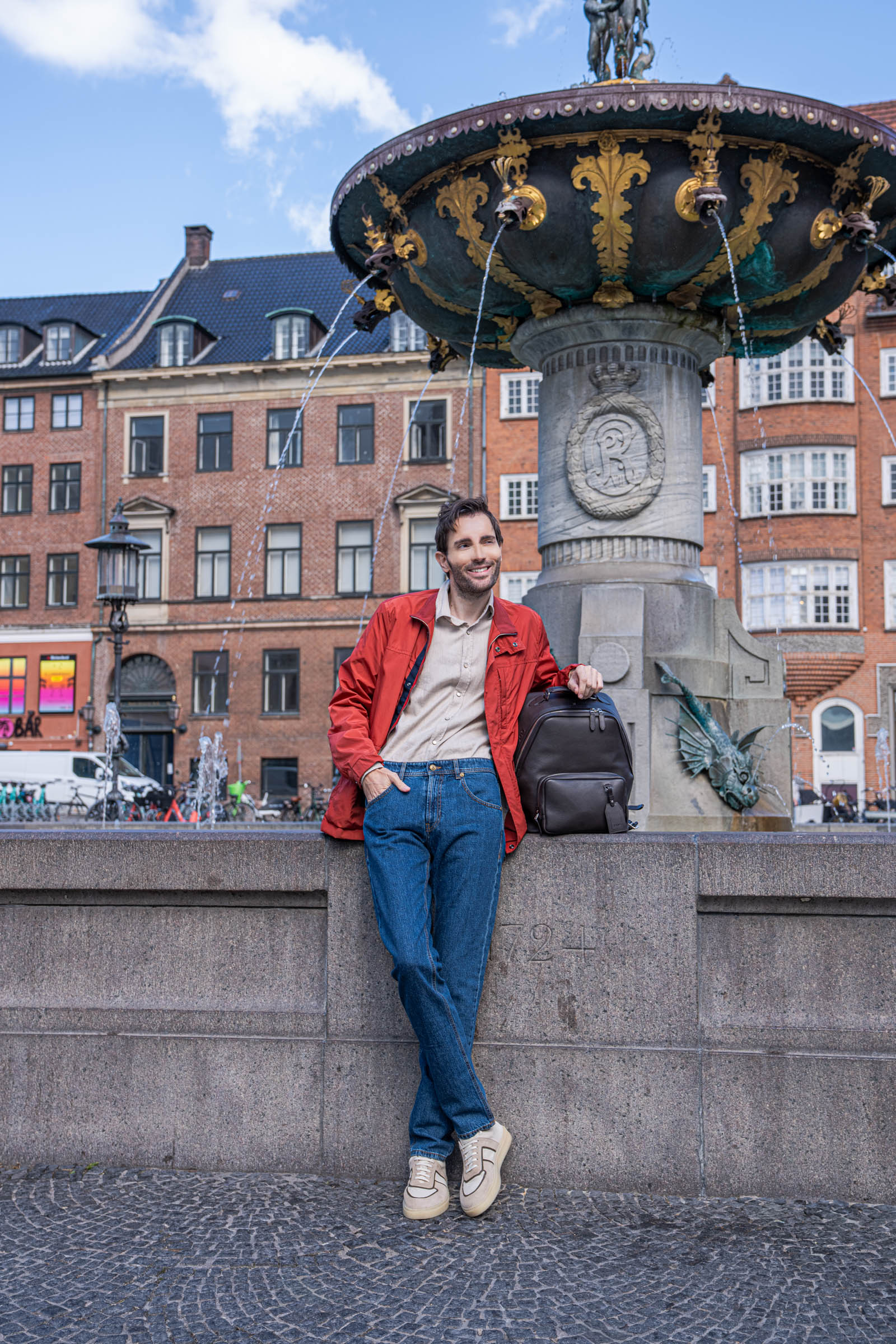
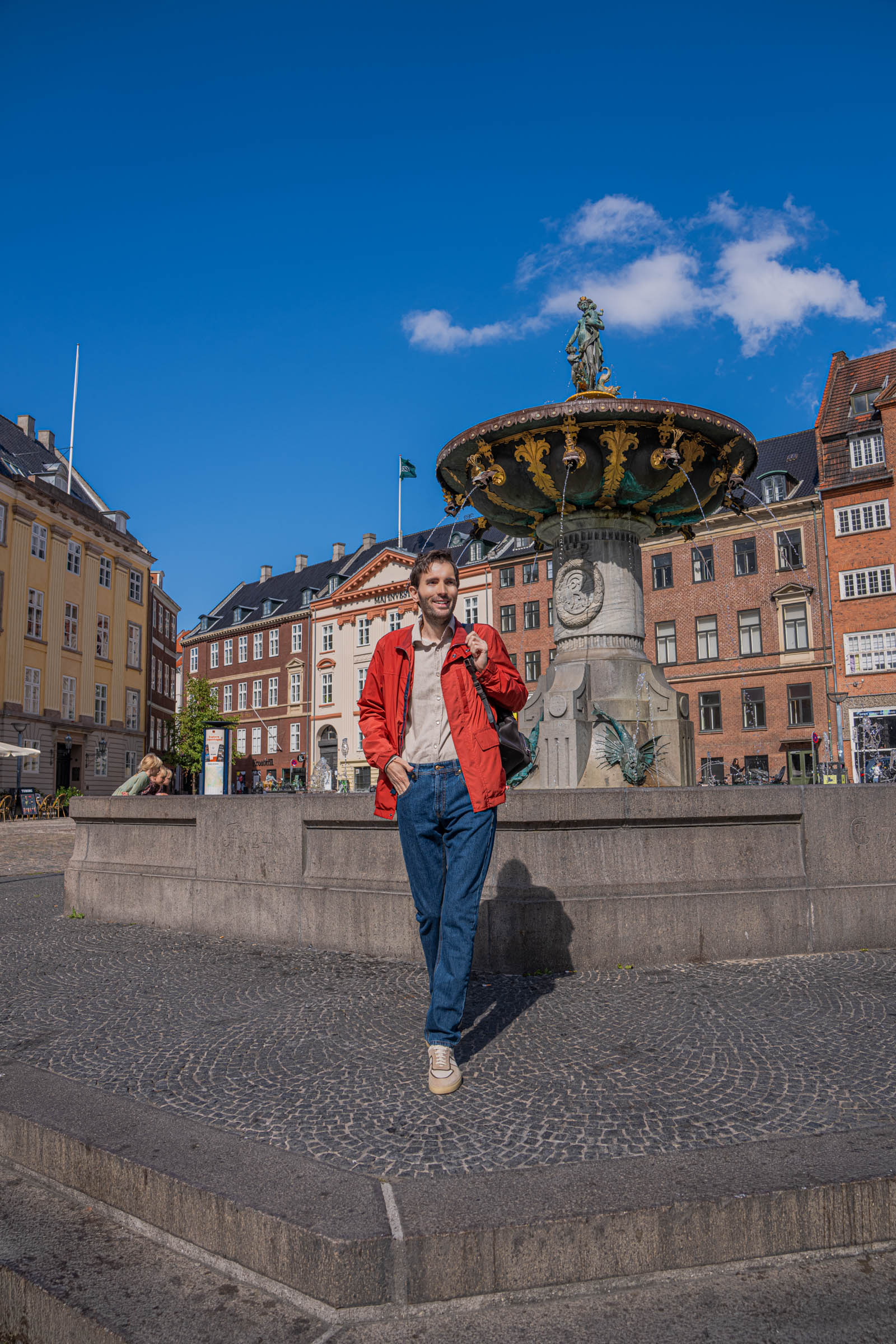
My dear fashionistas, welcome to a new fashion story on the Mr.M blog. Some outfits begin with a defined plan. My fashion story this time began with a color. I packed the Canali field jacket for Copenhagen without overthinking it. Red is not a neutral choice and Copenhagen is not a loud city. That contrast is exactly why it worked. The Danish capital is built from brick, granite, and gray water. Drop a warm red into that palette and the whole frame wakes up.
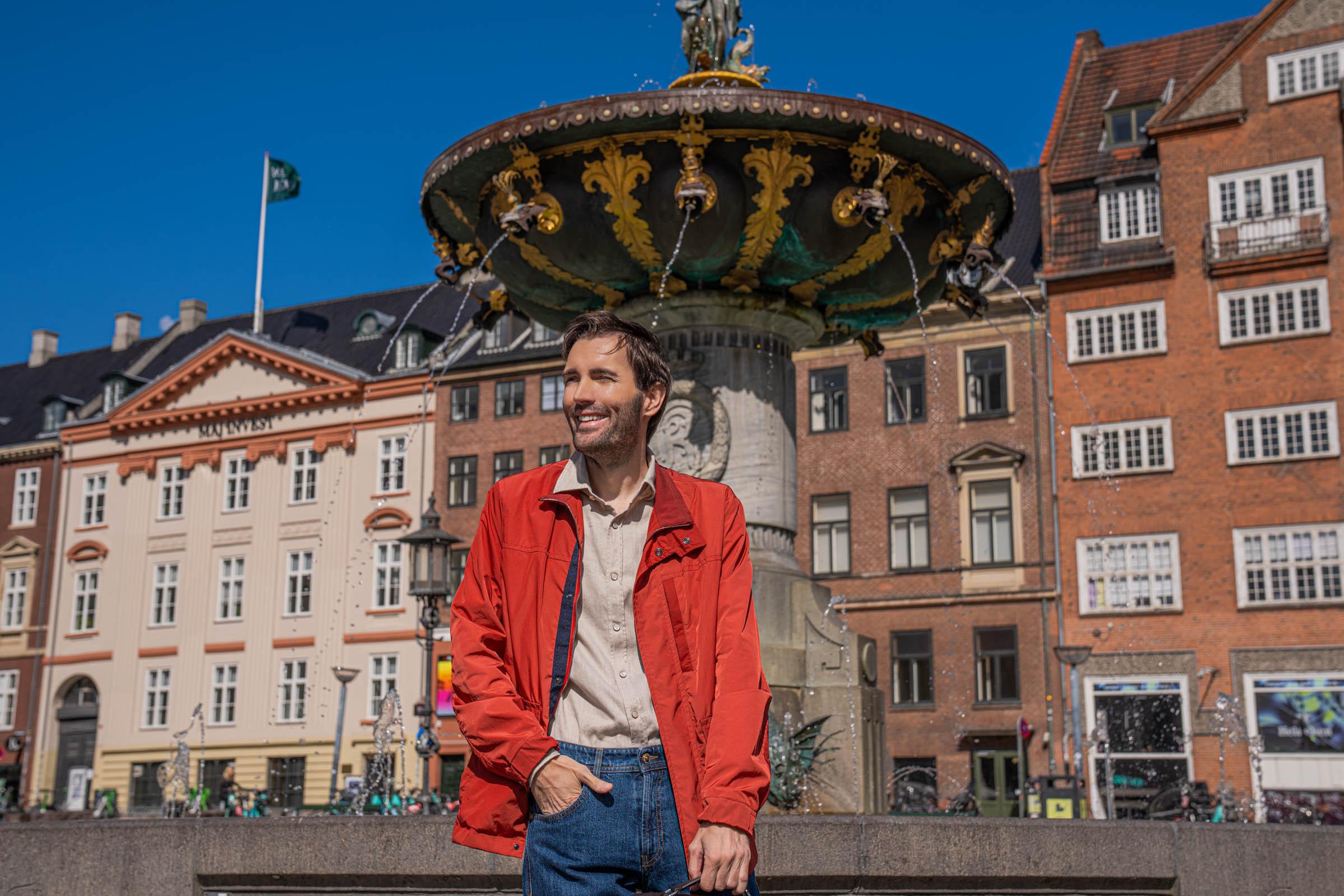
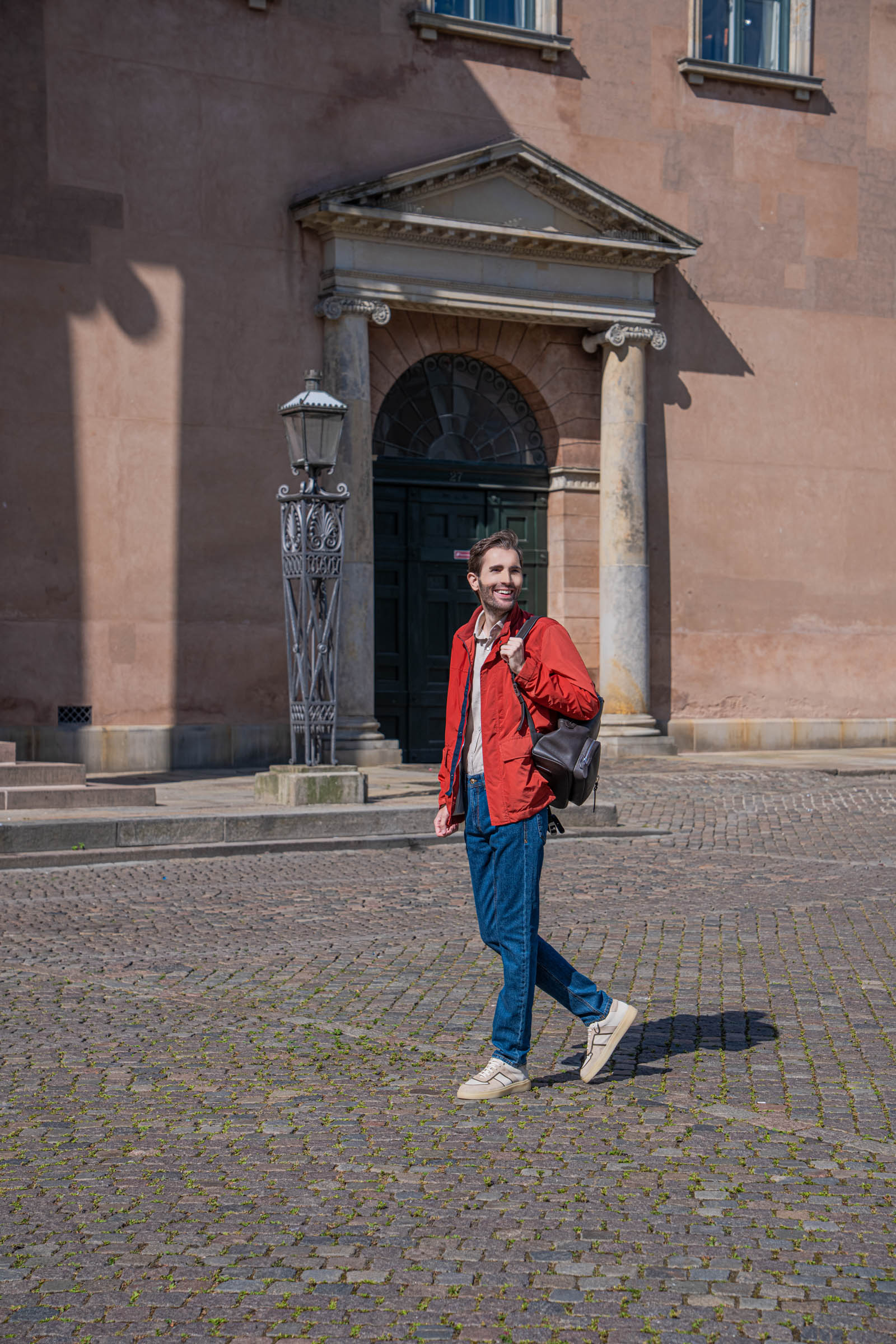
We shot this story across two squares that sit side by side in the oldest part of the city. First came Gammeltorv, where Copenhagen’s oldest fountain has been running since 1608. Then we crossed to Nytorv and stood under the columns of the old courthouse. Both squares are pure stone. Both made the jacket look like the only living thing in the photo.
What follows is not a product list. It is a walk through five pieces I actually wore for a full day, plus the stories behind the houses that made them. You will read about a Brianza tailor’s shop that survived a war, a southern Italian family that has been cutting shirts since 1979, a boy from Reggio Calabria who grew up in his mother’s dressmaking workshop, a Portuguese town that lives on shoes, a Swiss-Italian workshop that spent forty years building boxes for watchmakers, and a fountain whose water once came through hollowed tree trunks.
If you dress with intention rather than impulse, I think you will enjoy this fashion story today.
WHY COPENHAGEN SUITS A MODERN MAN’S WARDROBE
Copenhagen rewards restraint. People here dress well without announcing it. You see excellent coats, honest denim, and shoes that have clearly been resoled at least once. That mood suits how I dress now. I am past the stage of buying something because it photographs well for a week. I want pieces that still make sense in three years.
The city also has weather with opinions. Morning sun can turn into wind in twenty minutes. A light jacket that blocks air but does not cook you is not a style choice here. It is survival gear with good manners. Cobblestones matter too. Gammeltorv and Nytorv are paved in old granite setts, and they are unforgiving on thin soles. Your shoes will tell you the truth by the third hour. During this trip I stayed at Manon Les Suites Guldsmeden, a fifteen-minute walk from these two squares, which is exactly the kind of distance this city rewards.
So the brief for this outfit wrote itself. One layer that handles wind. One shirt soft enough to wear all day. Trousers that do not fight the walking. A bag that carries a laptop without looking like office equipment. Shoes with real cushioning under a clean upper.
Simple on paper. Harder in practice, because every piece has to earn its place. I walked this city properly in Letters from Denmark: Copenhagen, From Nyhavn to the Little Mermaid, if you want the full route.
CANALI FIELD JACKET: THE STORY THAT BEGAN IN A SMALL TAILOR’S SHOP
The house behind this jacket did not begin with a logo or a runway. It began with one man and a workroom. In 1908, Giacomo Canali opened a tailor’s shop in Triuggio, a small town in the Brianza region north of Milan. Brianza was a textile heartland at the time, close enough to Milan to matter and traditional enough to still teach the craft properly.
The Canali company as we know it dates from 1934. That year Giacomo’s brother Giovanni joined him, bringing experience from Galeazzo Viganò, an important textile firm of the period. Together they grew the workshop to roughly one hundred employees, which was a serious operation for the era.
Then the war stopped everything, as it stopped most Italian manufacturers. The restart came from the second generation. Giovanni’s sons Giuseppe, Genesio, and Eugenio divided the work between them: commerce, creative production, and administration. They also made a decision that shaped the next fifty years. They went into raincoats.
CANALI: FROM RAINWEAR TO A GLOBAL MENSWEAR NAME
The family launched Fratelli Canali S.p.A. and a brand called Cafra, focused on raincoats in cotton, wool, silk, and newer experimental materials. Raincoats were one of the best-selling categories of the postwar years, so the timing was smart. That period taught the house something it never lost: how to build outerwear that performs.
By the 1970s, the company had moved into men’s suits and helped drive Italy’s menswear renaissance. Headquarters later shifted from Triuggio to Sovico. During the 1980s, the brand took on the United States seriously, and in the 1990s it added casual wear and began its global retail expansion, including a Milan flagship on Via Verri. The house also developed its own icons along the way, most famously the Kei jacket.
In 2024 the company marked ninety years since 1934. Stefano Canali, CEO and grandson of founder Giovanni, has described the best advice his father gave him as never feeling like you have “made it.” That mindset shows in the product. There is always another detail to refine.
Knowing that history changes how you look at a red nylon jacket. This is not a fashion experiment. It is a rainwear company that never forgot what it learned.
CANALI FIELD JACKET: WHAT IT ACTUALLY DOES FOR THE SILHOUETTE
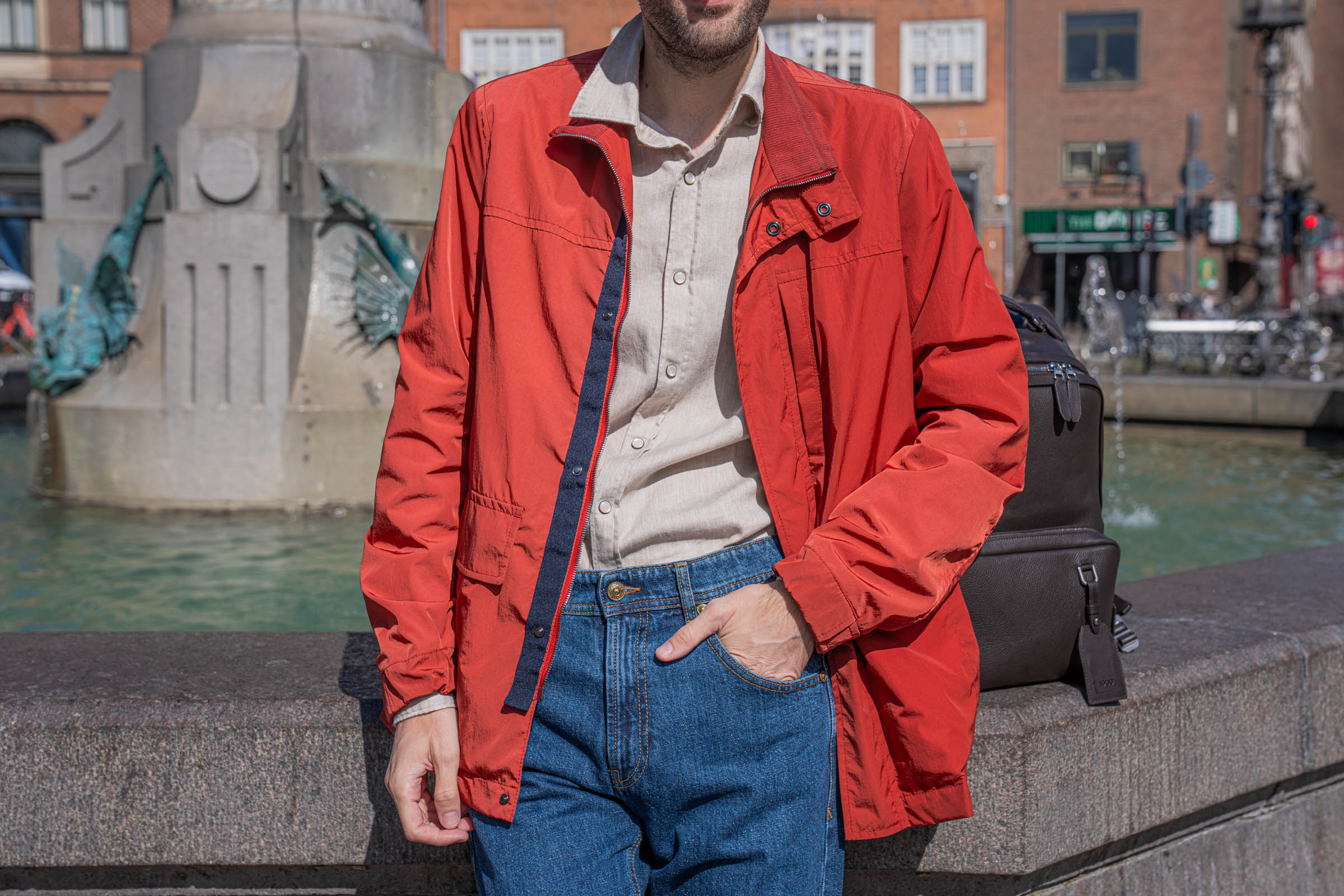
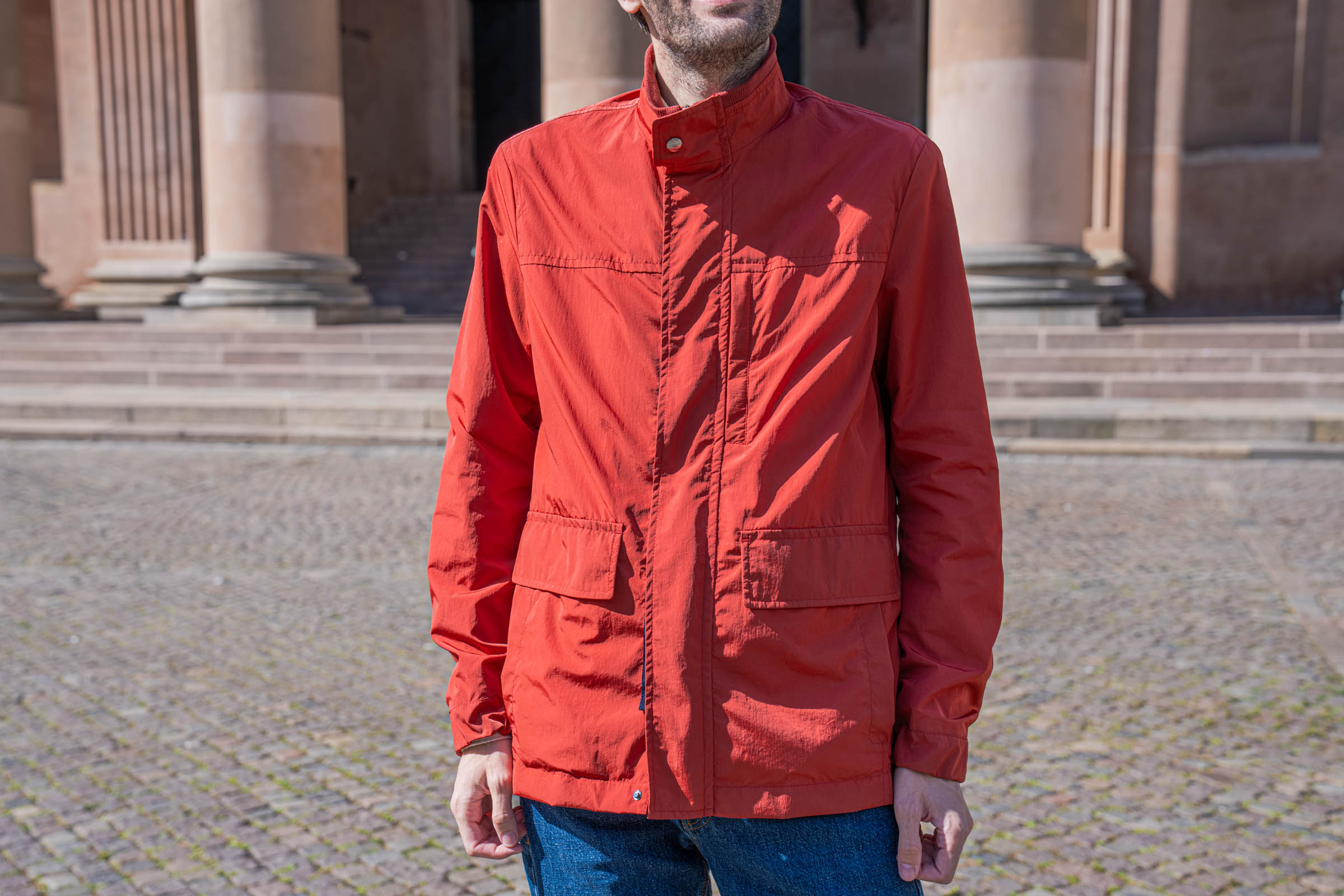
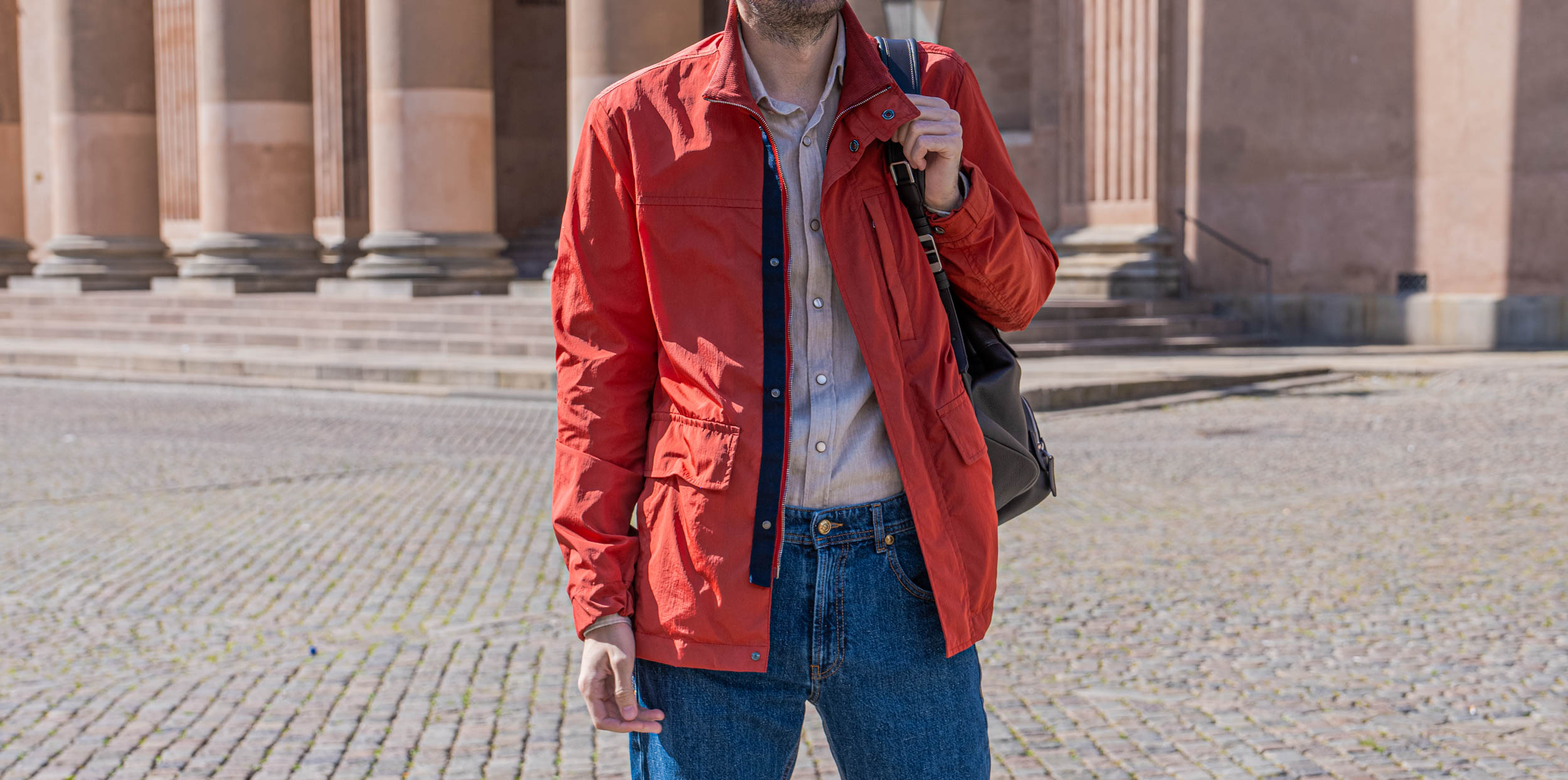
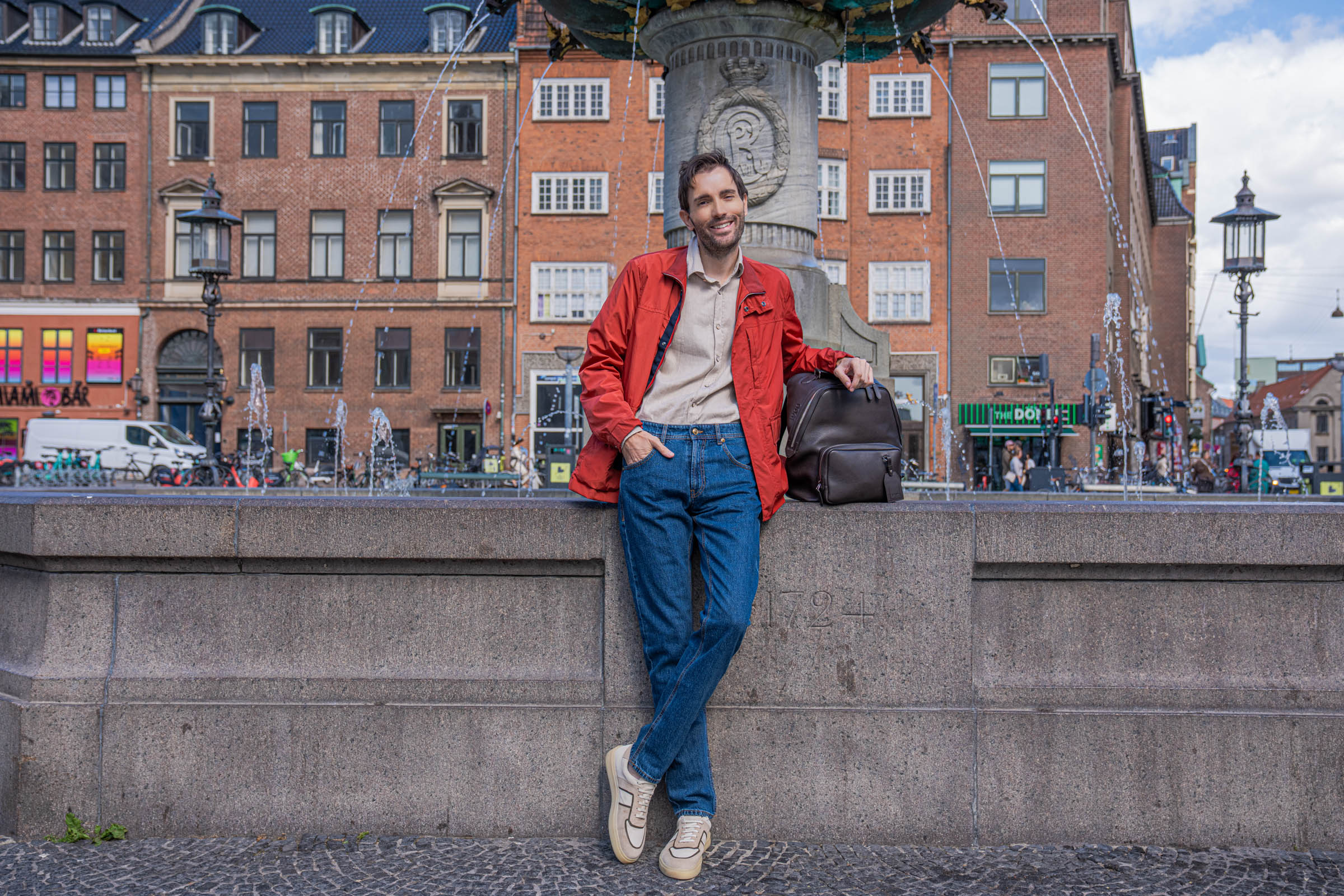
Now the garment itself. The Canali field jacket is cut from a light, crisp technical fabric with a subtle sheen. It has a genuine field-jacket structure: four pockets, a yoke seam across the chest and back, and a slightly longer body that covers the hip.
The details are where the money went. A two-way zip runs up the front, backed by a navy tape that reads as a thin dark line against the red. A storm placket with snaps covers it. The stand collar is lined in fine corduroy, which is the detail I like most. Nylon against the neck feels cheap. Corduroy feels considered.
There is a welt chest pocket with a snap tab, two flap pockets at the hip, and side-entry hand pockets tucked underneath. Cuffs close with snaps. The hem snaps too, so you can nip the waist in when the wind picks up.
Fit-wise, it sits away from the body without swallowing it. I could wear a flannel shirt under it comfortably, and a light knit would also fit. Above all, it packs down to nothing. It rolled into my backpack twice during the day and came out without a single crease that mattered.
CANALI: WHY RED WORKS BETTER THAN MOST MEN EXPECT
Men of my age often avoid red. We associate it with sports gear or with trying too hard. That is a misunderstanding of the color rather than a problem with it.
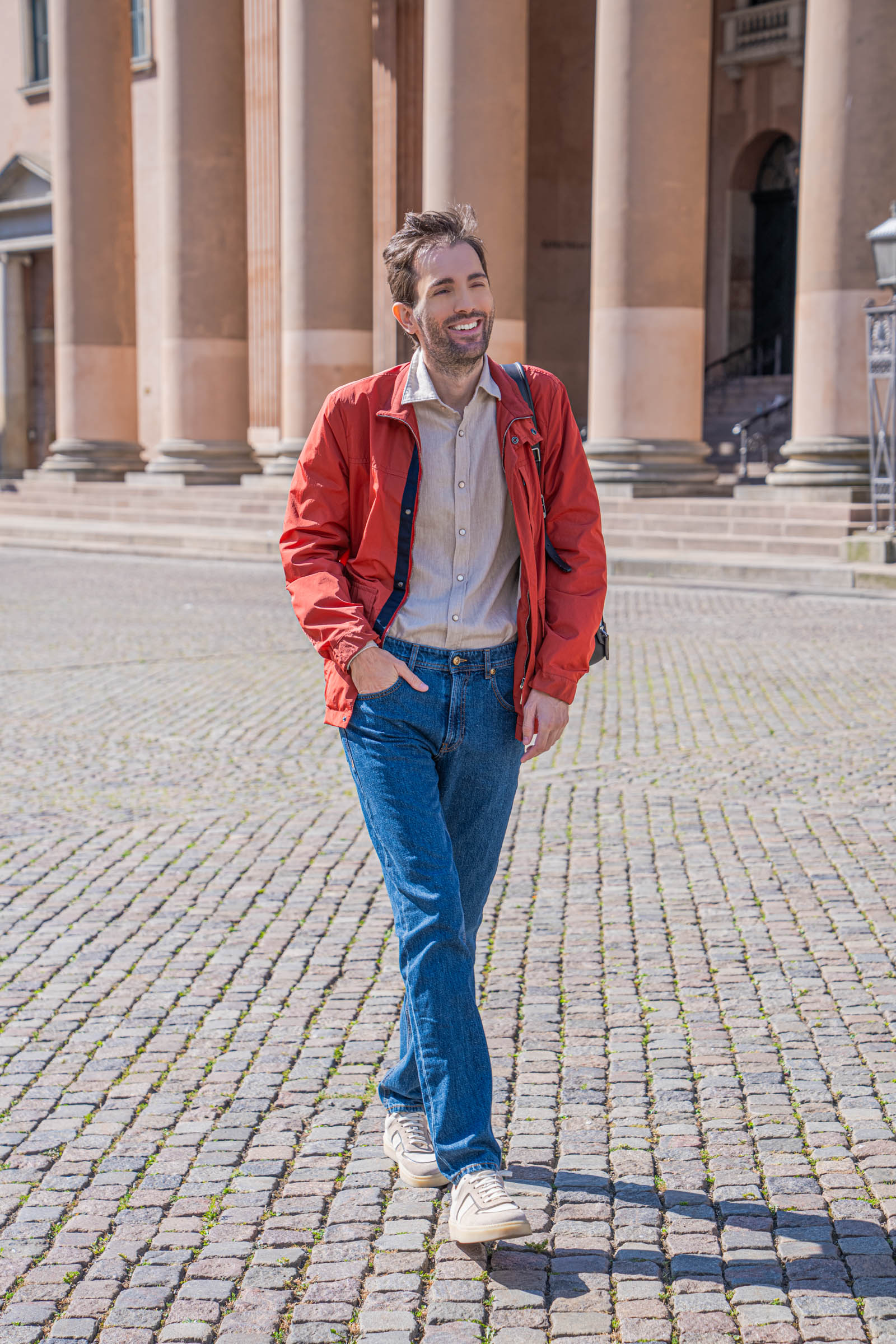
The red here is not a pure primary. It leans slightly toward brick and rust, which makes it warm instead of aggressive. Warm reds sit beautifully next to beige, cream, and mid-blue denim. Cool reds do not.
The second trick is coverage. Red works when it is the only bright thing you wear. Everything else in this outfit is quiet: sand, indigo, dark brown, cream. The jacket carries the whole color story alone, so nothing competes.
The third trick is texture. Matte red looks like workwear. Slightly lustrous red looks intentional. This fabric has just enough sheen to read as designed rather than borrowed.
Finally, think about the background. In a green landscape, red can look cartoonish. Against brick, granite, and Nordic sky, it looks like a deliberate accent in a painting. So if red has always felt out of reach, start with the temperature of the shade, not the volume.
THE CARITAS FOUNTAIN: COPENHAGEN’S OLDEST WORKING FOUNTAIN
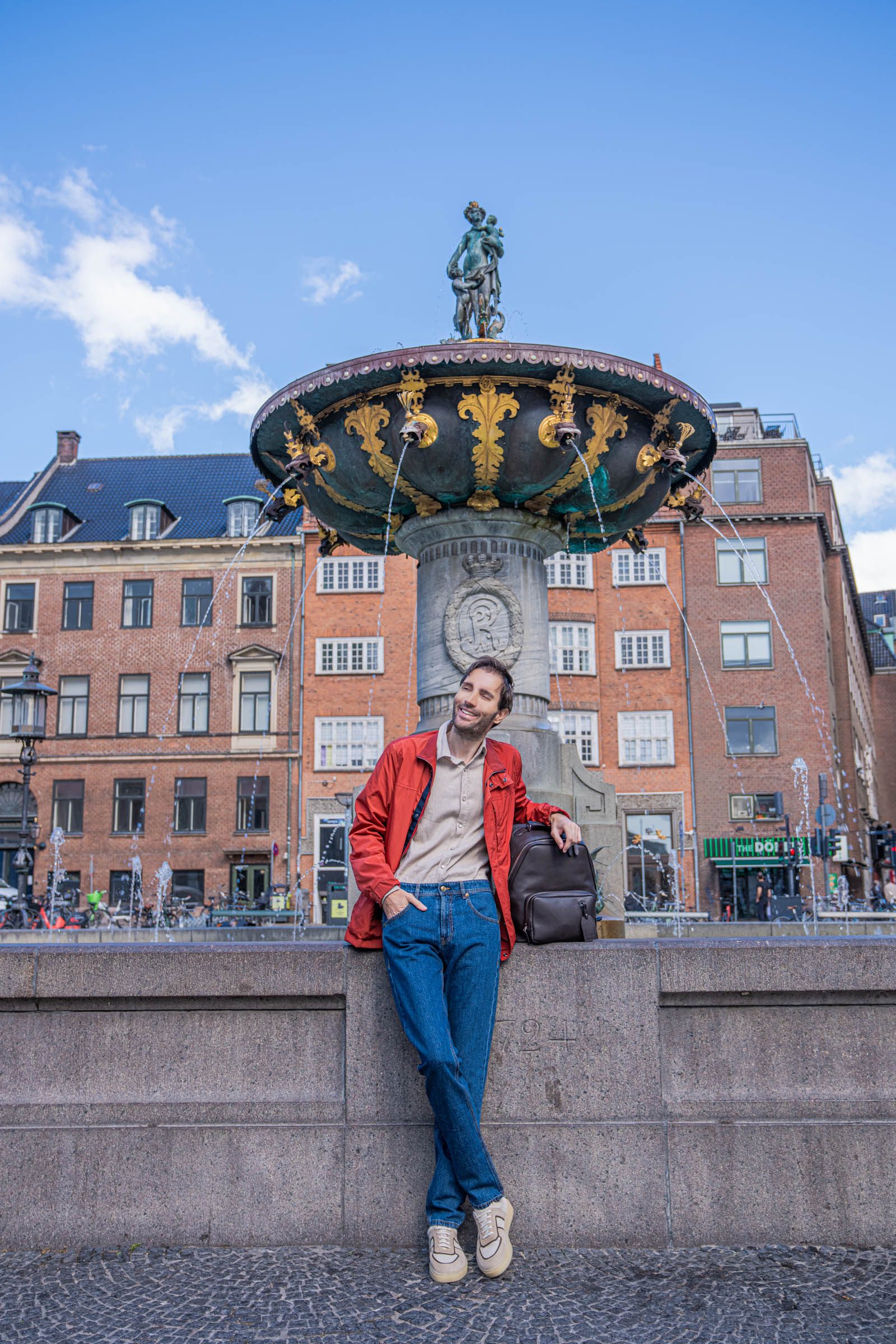
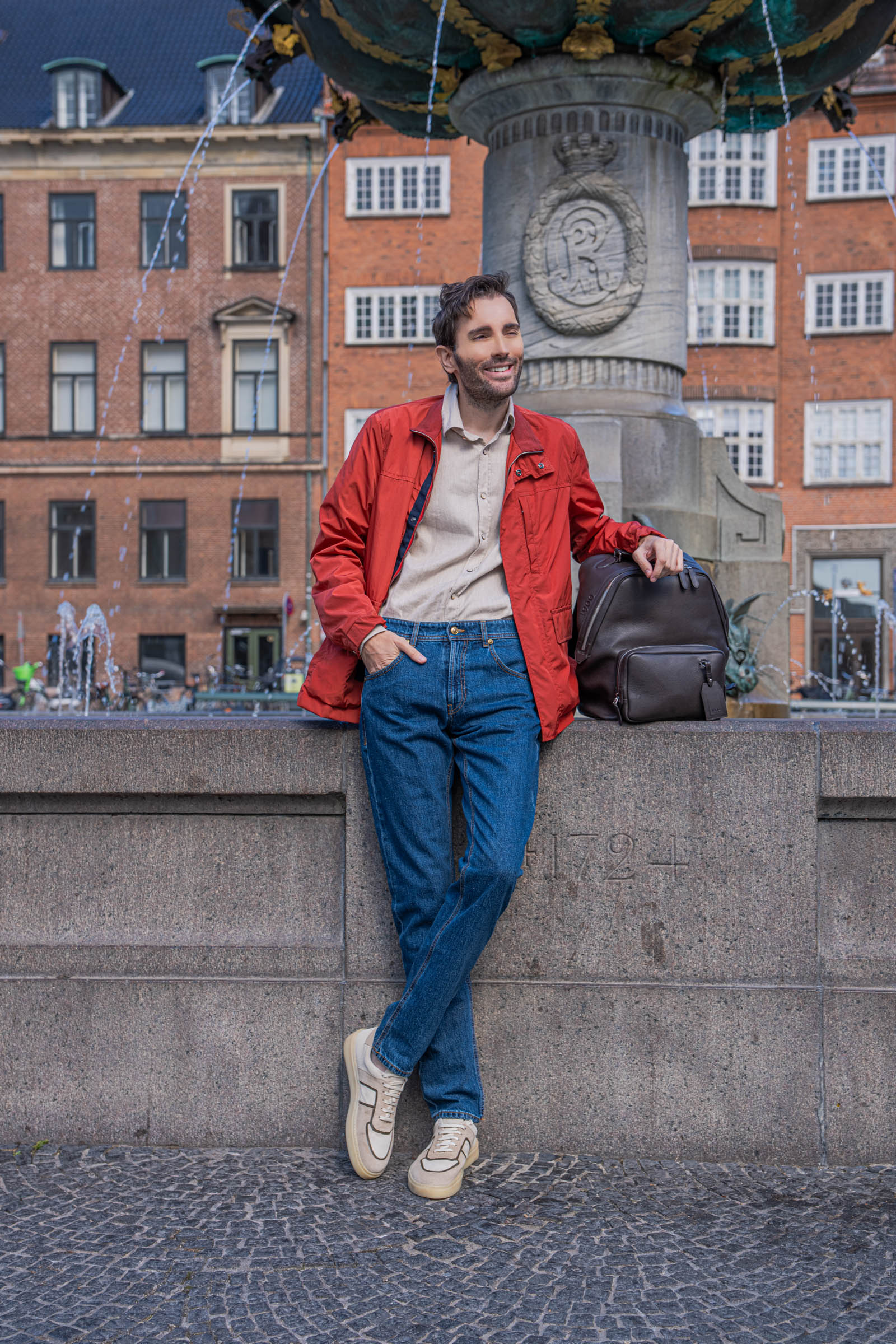
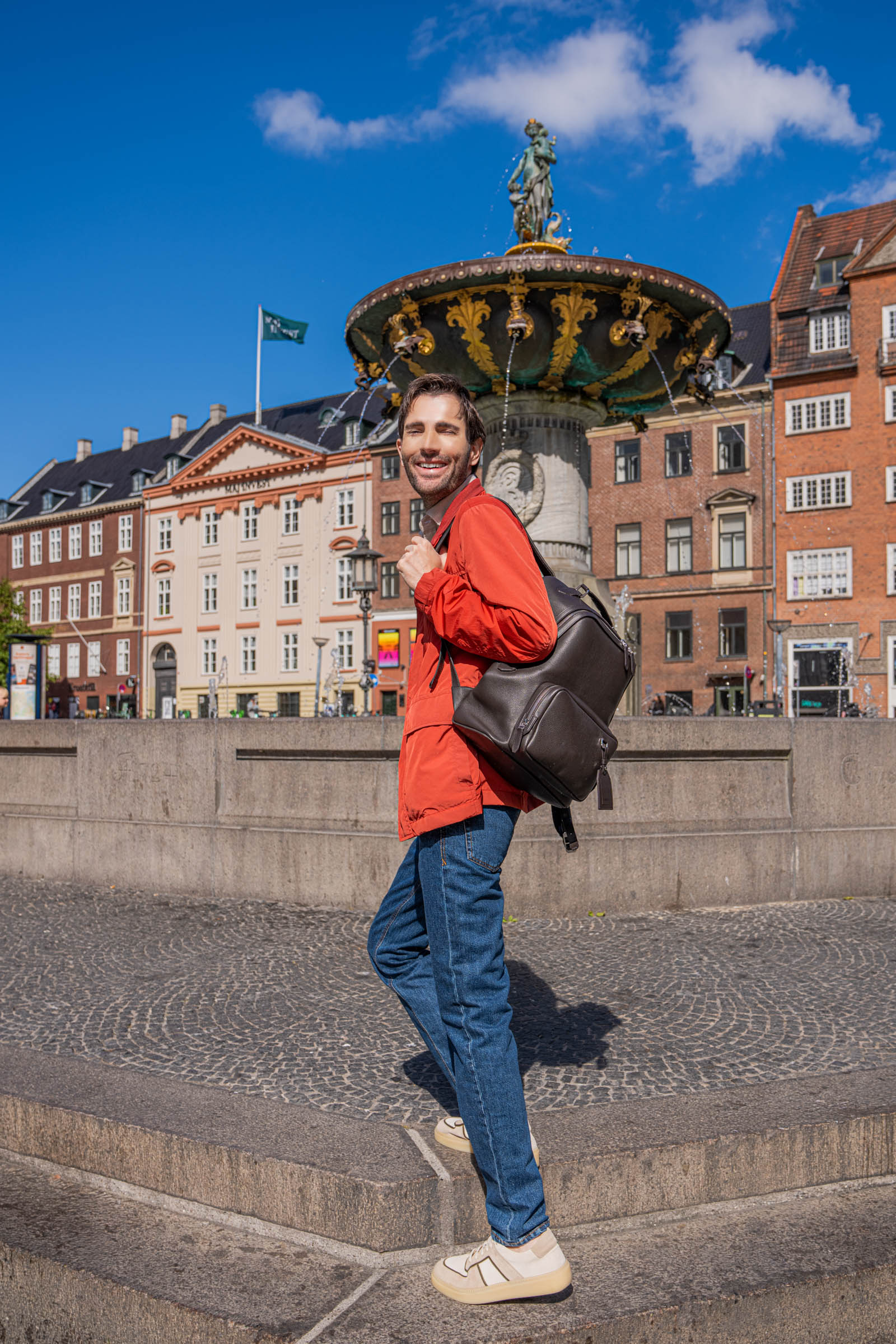
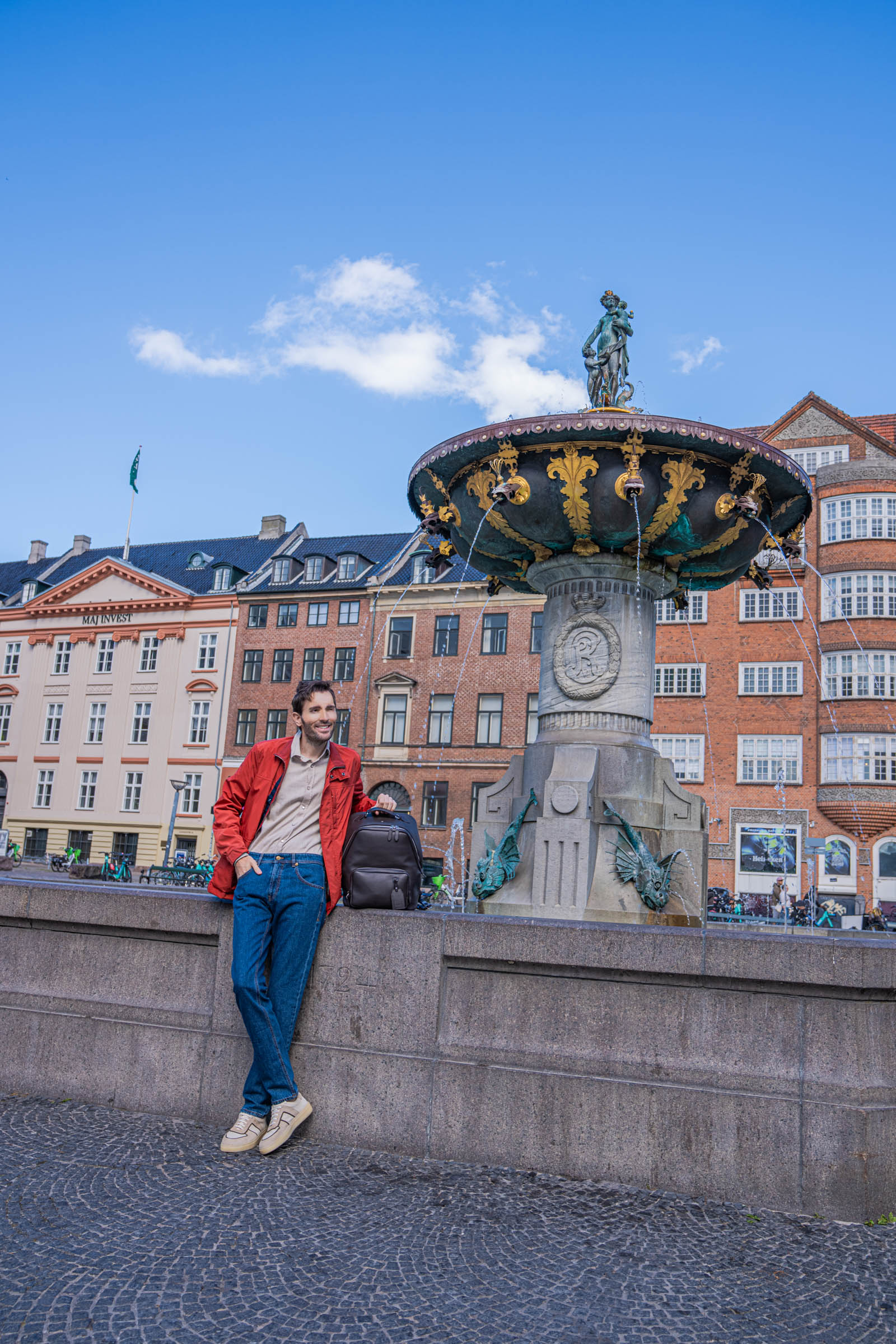
The first half of these photos was shot at the Caritas Well on Gammeltorv, the oldest square in the city.
The fountain dates from 1608, when Christian IV built it over one of Copenhagen’s wells so citizens could draw fresh water. It replaced and modernized an older fountain from the time of Frederik II, who had laid a six-kilometer wooden water pipe from Emdrup Lake into town. The nine-meter drop in elevation gave enough pressure for a working fountain.
The sculpture group was carved in wood by the German carver Statius Otto and then cast in bronze by Peter Hoffmann. The bronze itself has a remarkable origin: it came from Danish church bells that Christian IV had seized in 1601 and 1602 to cast cannons.
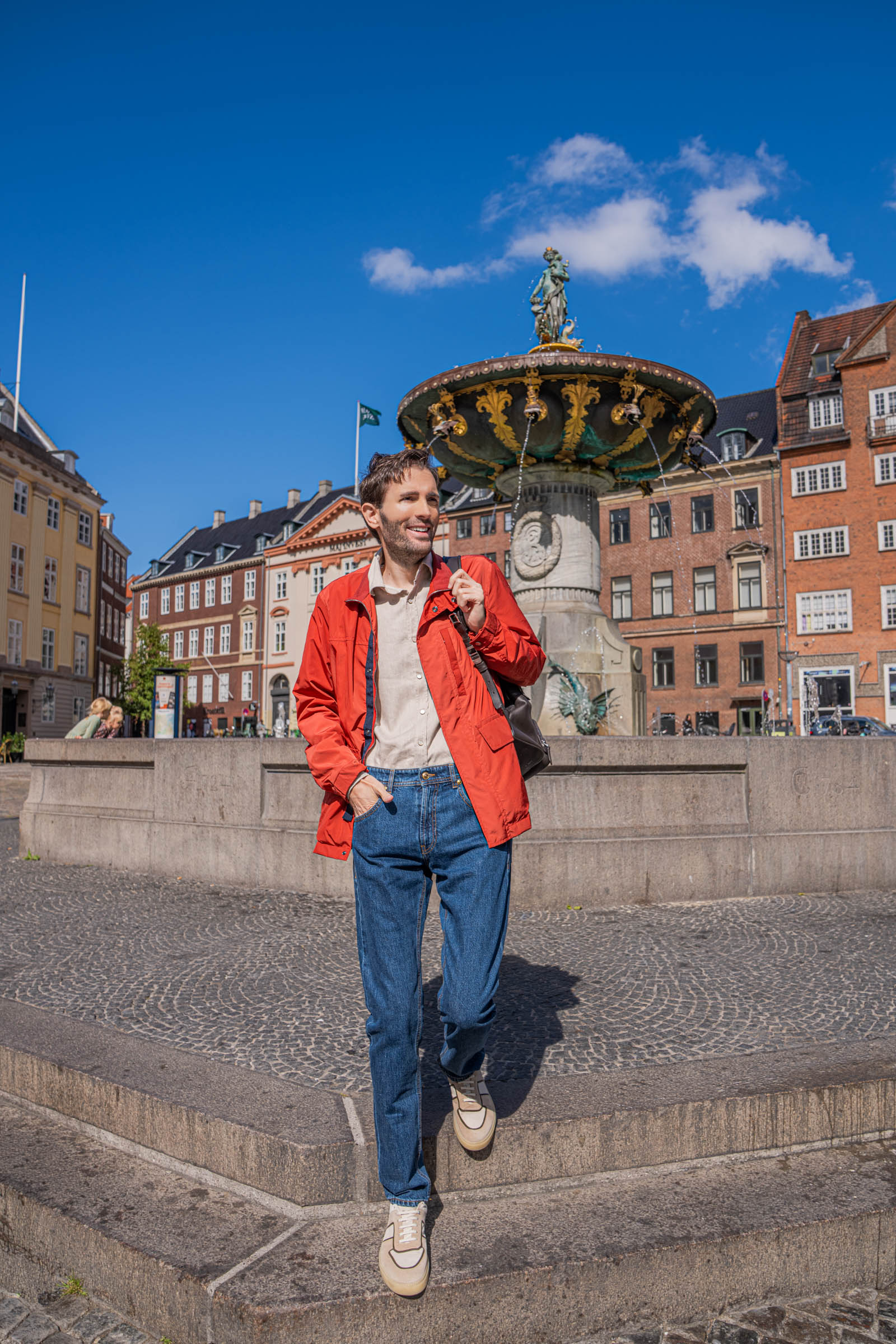
Caritas means charity in Latin, and the figure shows a pregnant mother with her children. The walled well, roughly six meters deep, still exists beneath the fountain. It is the only preserved Renaissance fountain in Denmark.
In 1781 the plinth was rebuilt in marble, carved with Christian VII’s monogram and the city arms. The granite basin around it carries monograms and dates from several Danish monarchs, which is why you can see old numerals cut into the stone right beside me in the photos.
On royal birthdays, gilded copper balls are set dancing on the water jets. Locals call them the golden apples. That tradition goes back to the eighteenth century.
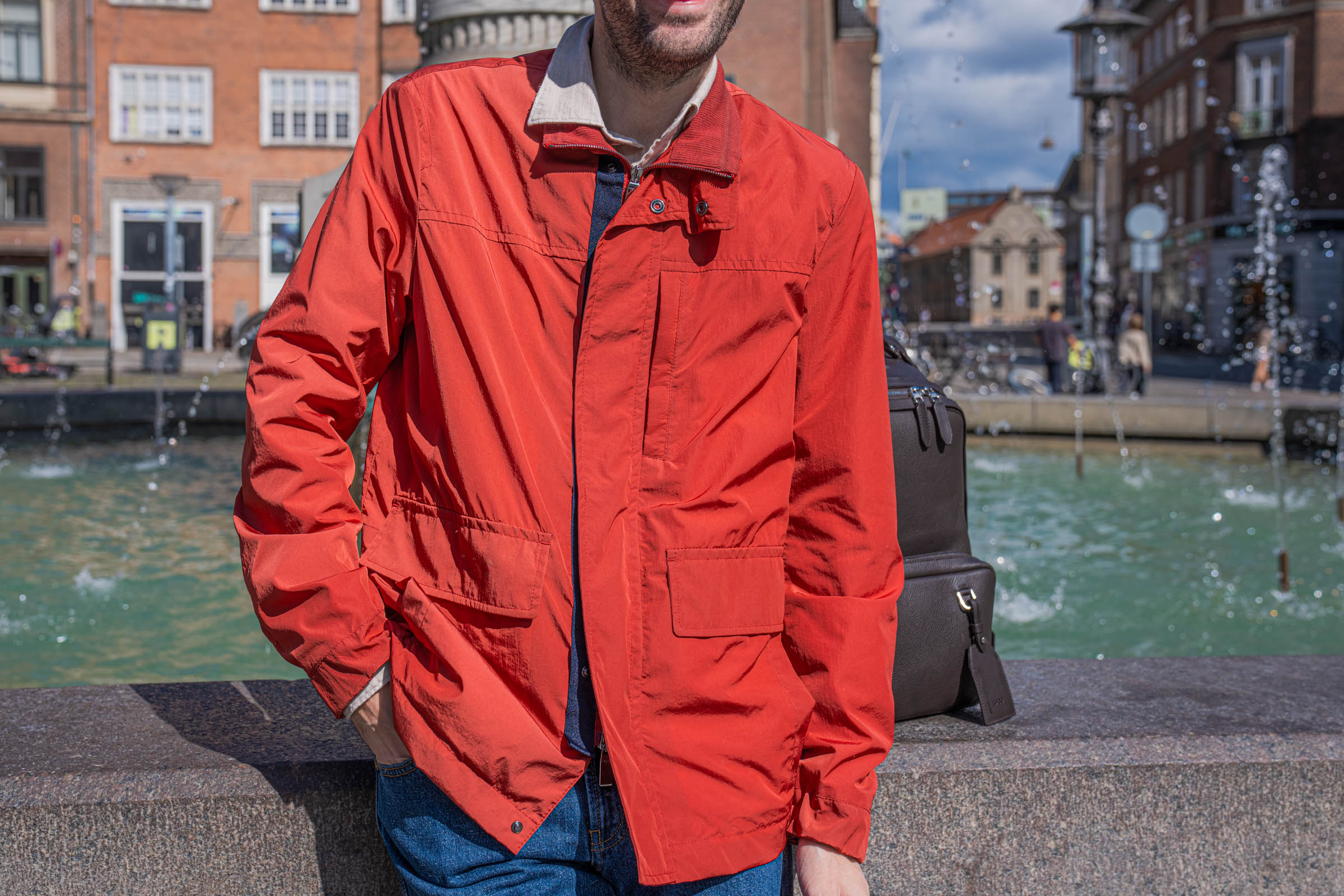
OUTFIT
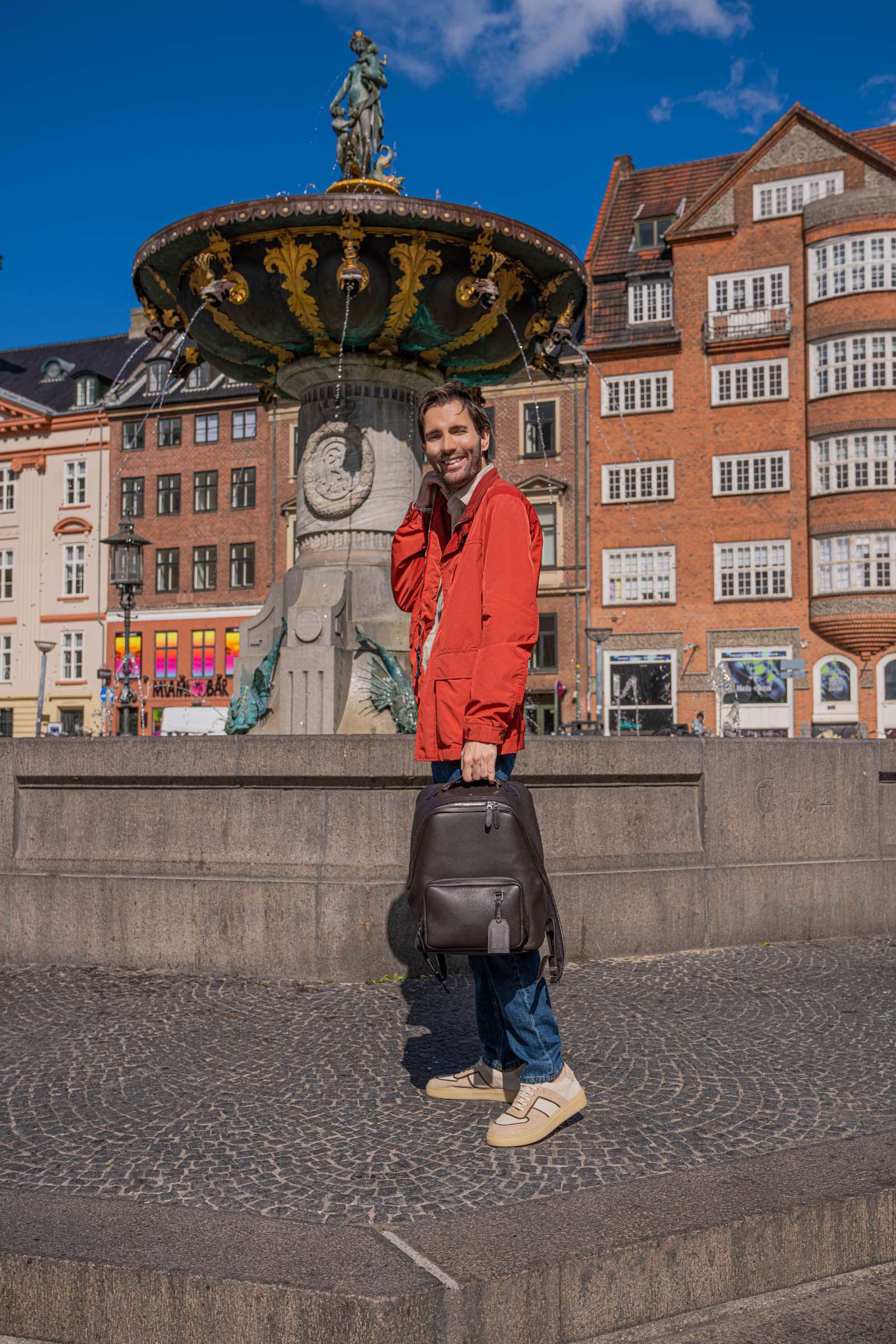
Field Jacket: Canali
Shirt: Giannetto Portofino
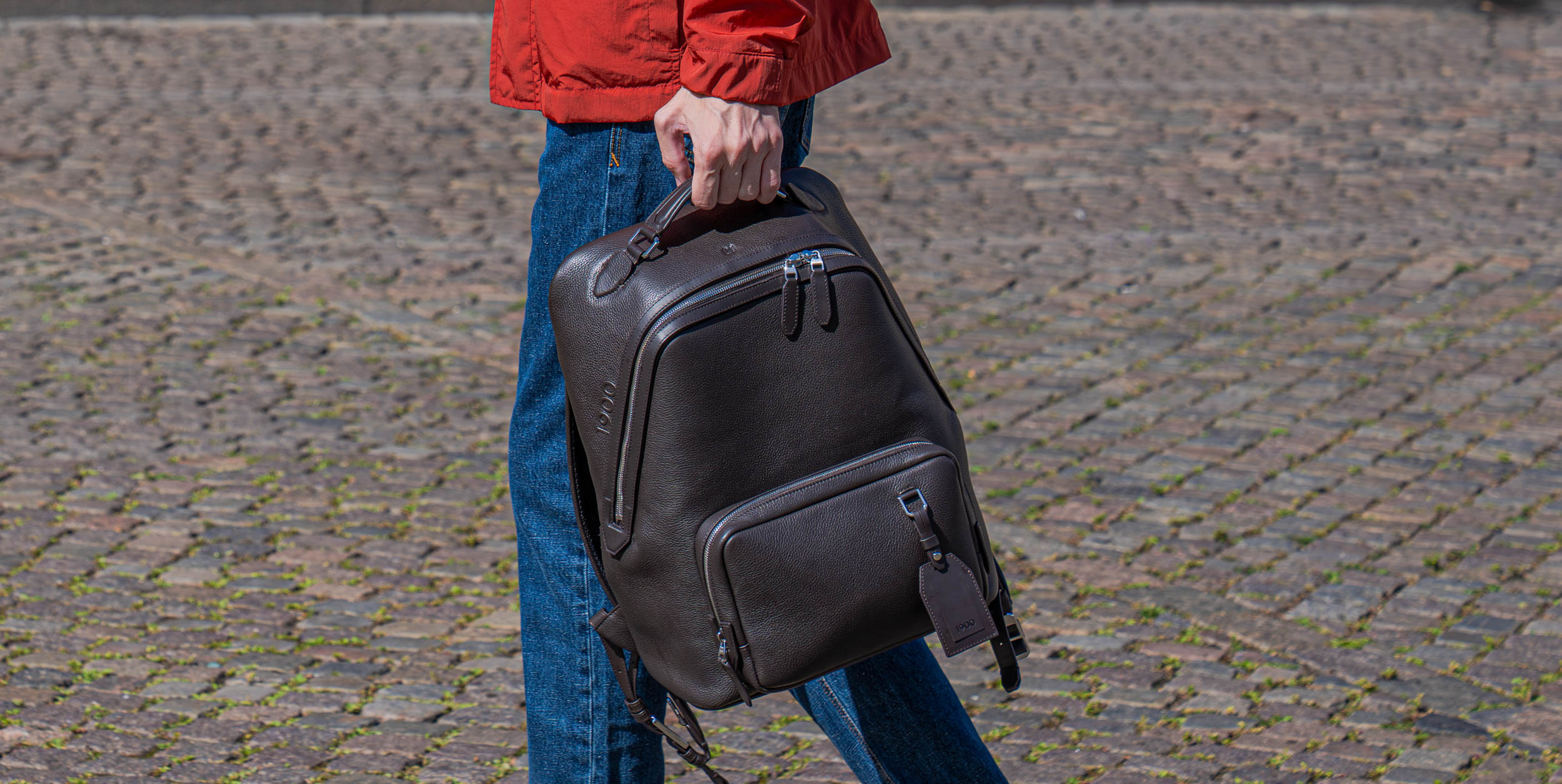
Backpack: 1900
Denim (Jeans): Versace
Sneakers: Carlos Santos
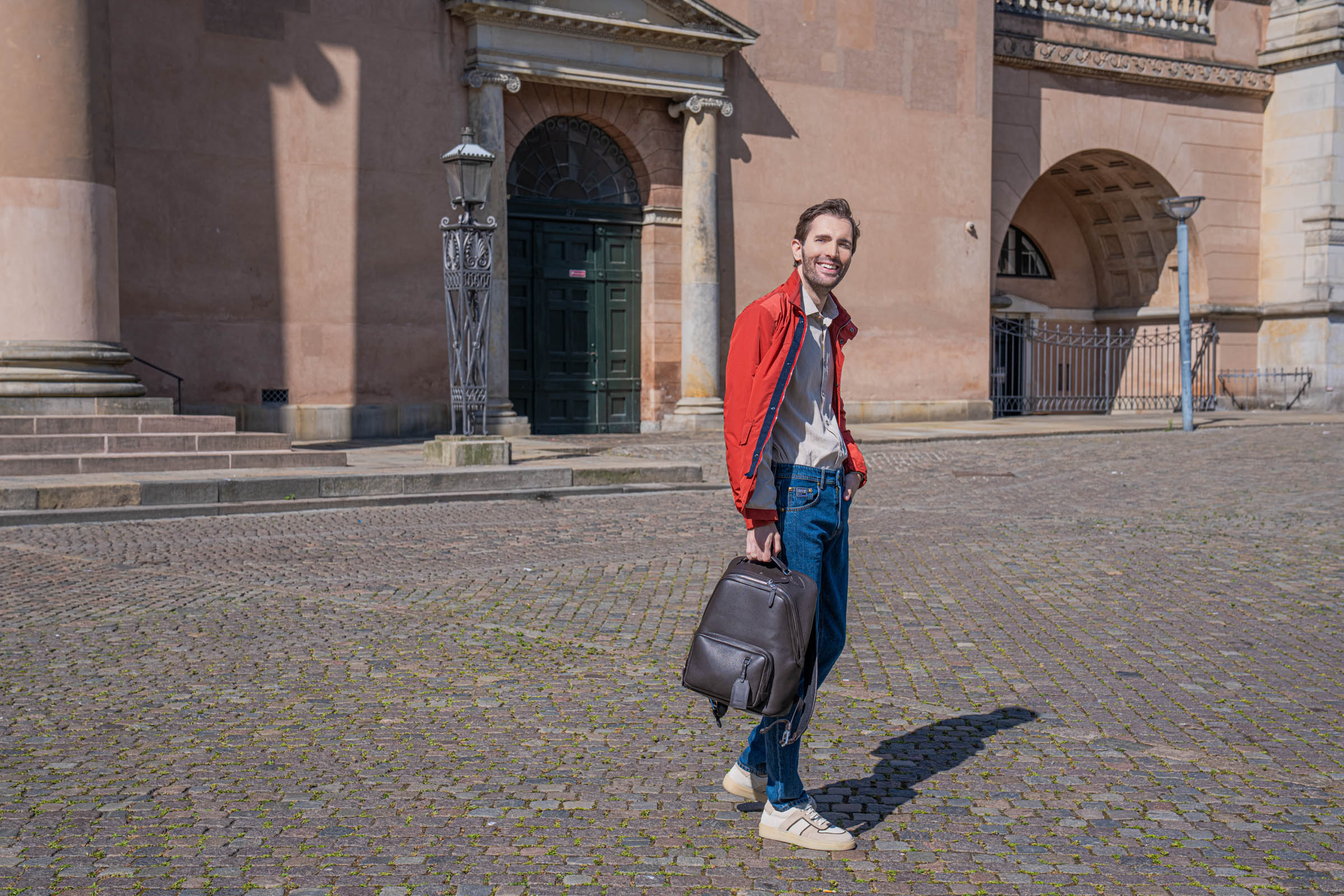
GIANNETTO PORTOFINO WASHED FLANNEL: THE SHIRT THAT DISAPPEARS
Under the jacket I wore a Giannetto Portofino washed cotton flannel shirt in warm sand beige.
I have written about this Italian family house before, so I will keep the history short. It started in 1979 in southern Italy as a shirtmaking business, and the next generation, Vincenzo and Stefania, joined in 2000 and gave the brand its current name. Today the collections travel well beyond Italy, with strong followings in Japan, South Korea, and the United States. What interests me here is the fabric decision.
The shirt is 100% cotton flannel, cut slim, and then put through a gentle wash. That wash is the whole point. It softens the hand before you ever wear it, and it gives the color a lived-in depth instead of a flat, showroom finish.
Flannel in early autumn is underrated. It has more body than poplin, so it holds its shape under a jacket. It also breathes better than most people assume, because it is still just cotton. The color does quiet work too. Sand beige sits between the red above it and the indigo below, softening the jump between them. Wear a white shirt here and the contrast turns harsh.
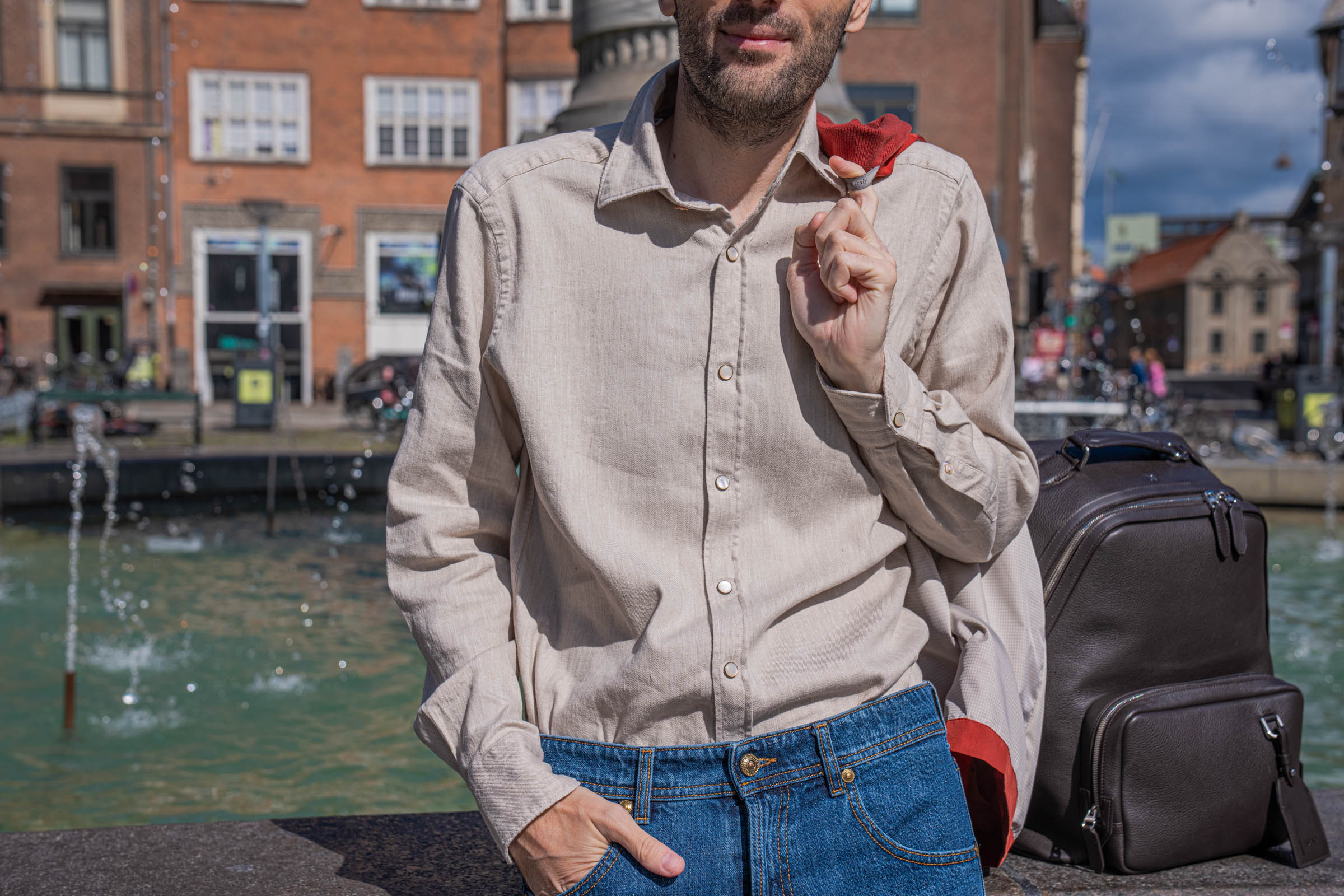
GIANNETTO PORTOFINO: SMALL DETAILS WORTH NOTICING
Look closely at the close-up images and you will find the character. The buttons are pale and domed, closer to mother-of-pearl than to plastic. They catch light differently from the fabric, which adds depth without adding pattern.
Then there is the tiny yellow sun embroidered just beside the placket. It is maybe eight millimeters across. You would never see it in a wide shot. You absolutely see it when someone is standing close enough to shake your hand.
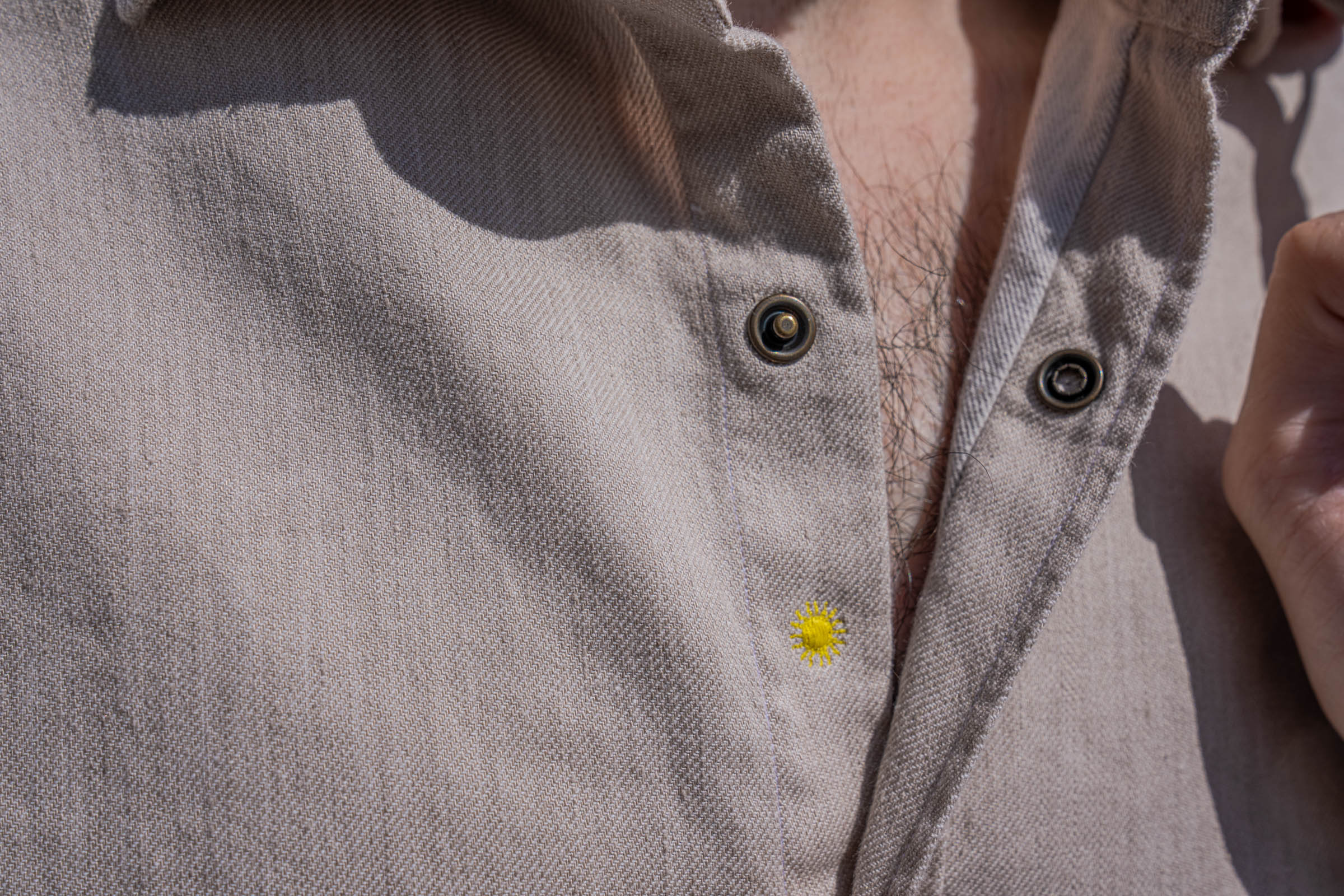
I have come to believe that these hidden details are what separate good clothes from expensive clothes. Nobody buys a shirt for a sun the size of a lentil. You just enjoy it every single morning.
The collar is soft and unfused, so it rolls naturally rather than standing at attention. That matters when you wear a shirt open, which I did all day.
Cuffs rolled once sit clean because the flannel has enough weight to stay put. Thin cotton slides down within an hour. Small things. They add up!
VERSACE DENIM: STRAIGHT, HONEST & MID-BLUE
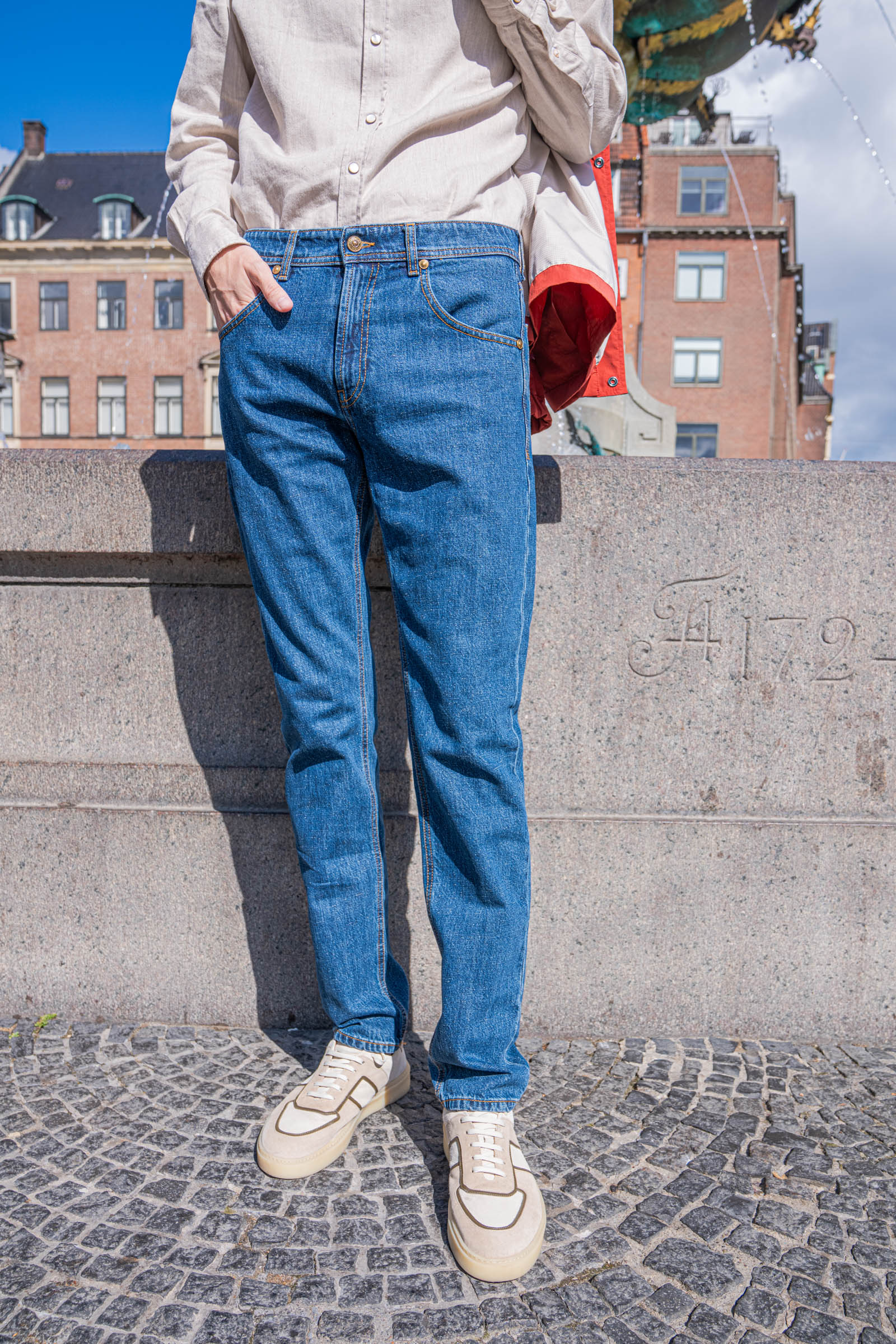
The jeans are Versace, and they are deliberately unremarkable in cut. Straight leg, mid-rise, classic five-pocket, clean mid-blue wash with warm orange topstitching. That restraint is the interesting part.
Gianni Versace founded the house in Milan in 1978, with his brother Santo handling the business and his sister Donatella soon joining. He opened his first store on Via della Spiga and showed a women’s collection early that year, followed by menswear in September.
He grew up around the craft. Born in Reggio Calabria in 1946, he spent his childhood in his mother’s dressmaking workshop, which employed dozens of seamstresses. He moved to Milan in 1972 and never looked back.
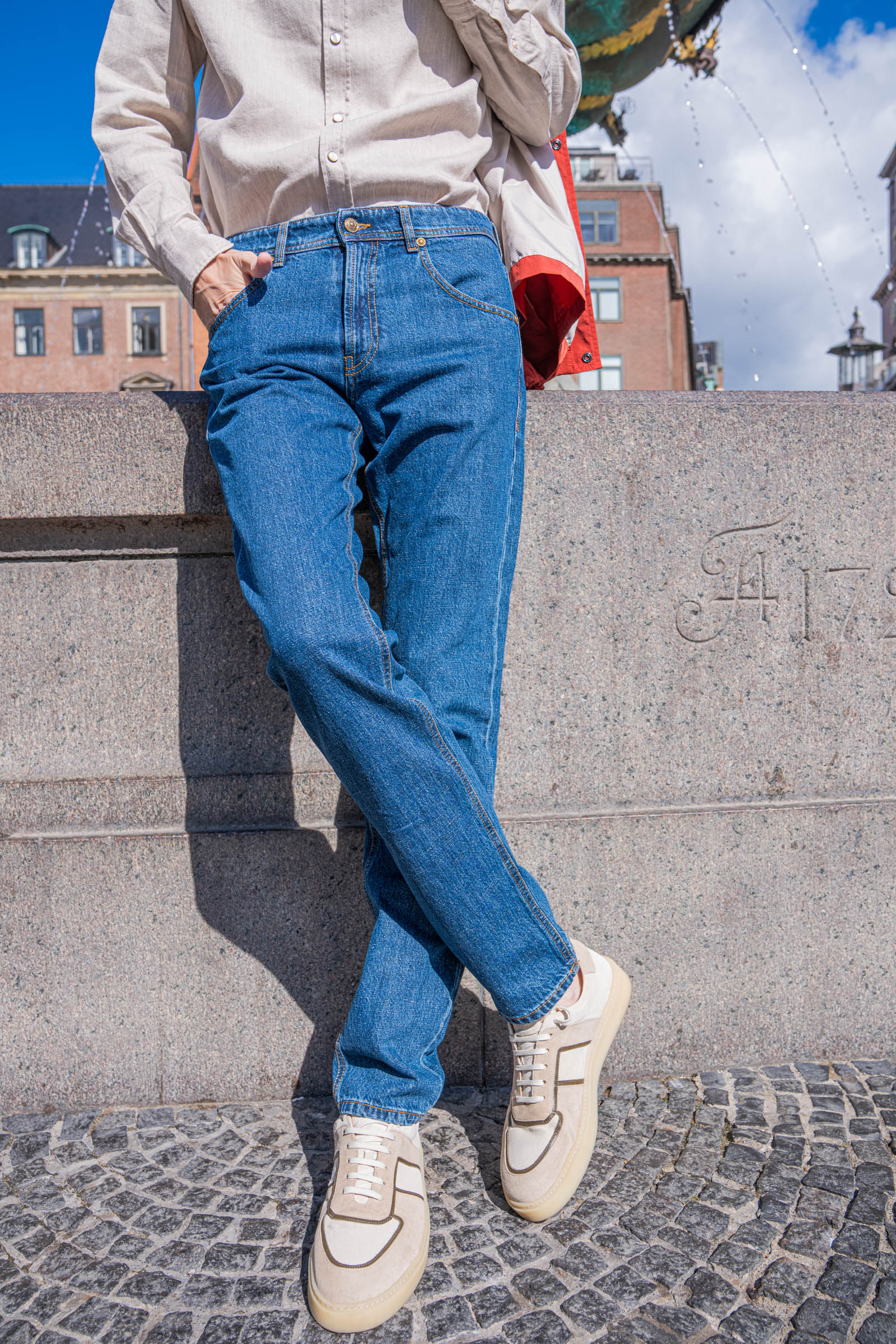
The Medusa head became the house symbol, drawn from the Greek mythology of his southern Italian upbringing. He wanted a mark that held your attention rather than one you politely ignored. Here that heritage appears in whispers: a gold-toned shank button at the waist, a small tab at the back. Nothing else.
The fit is what sells it to me. A straight leg with a slight break over the shoe flatters most men past forty far better than anything slim. It also lets the sneaker show its full shape, which matters when the sneaker is good.
1900 TEMPO GRANDE BACKPACK: LEATHER WITH A SWISS ACCENT
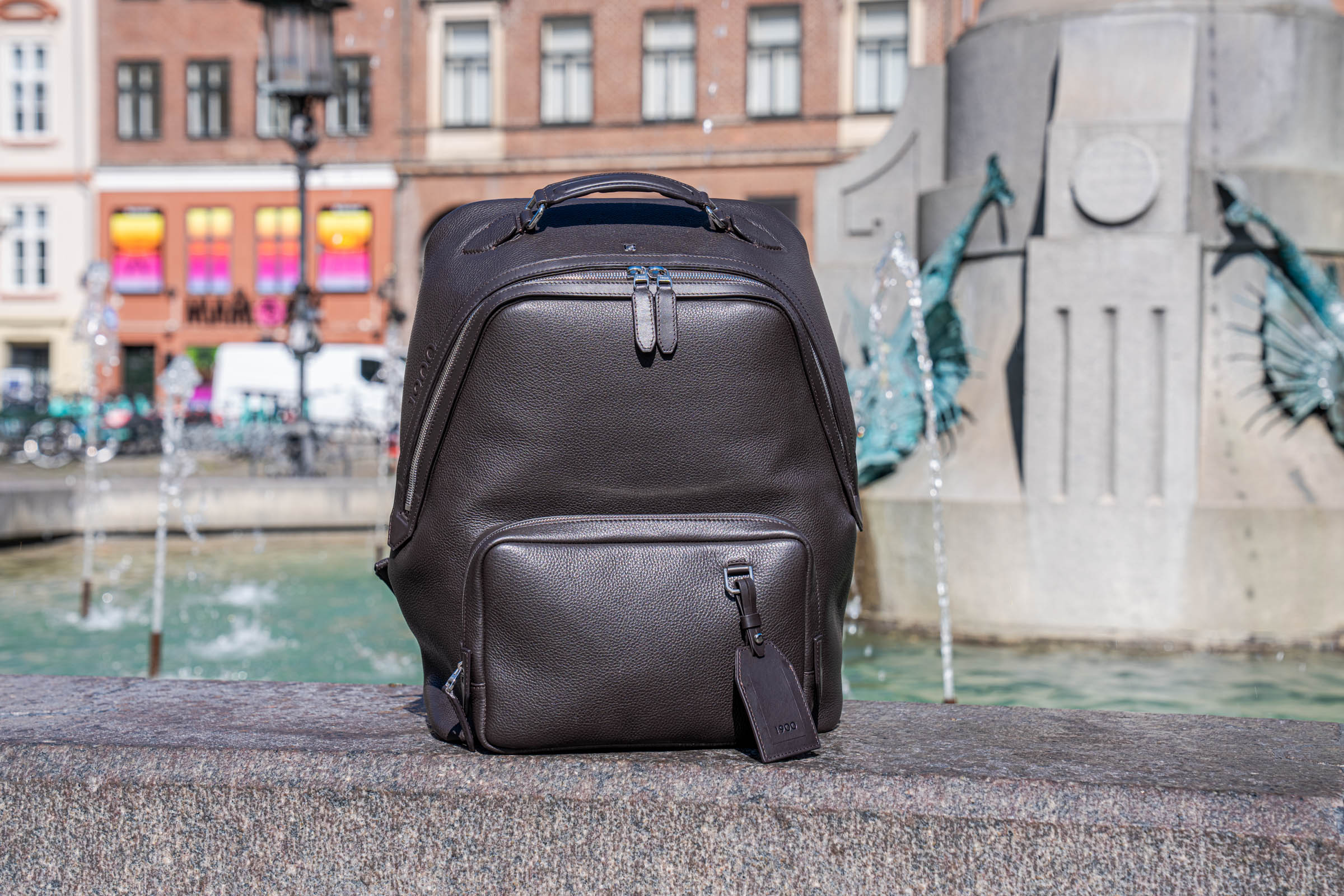
The dark brown backpack is the Tempo Grande from 1900, and its backstory is one of my favorites in this whole story.
1900 was born from Manifattura Ceraolo Moroni, a company with more than forty years of experience in luxury packaging. For decades, they designed and produced for some of the world’s best-known watch and jewelry maisons. If you have ever opened a beautifully engineered watch box, you have handled that kind of work.
Over time, the workshop also developed real expertise in leather goods, building fully custom accessories for clients. Eventually the obvious question arrived: why not make something under our own name?
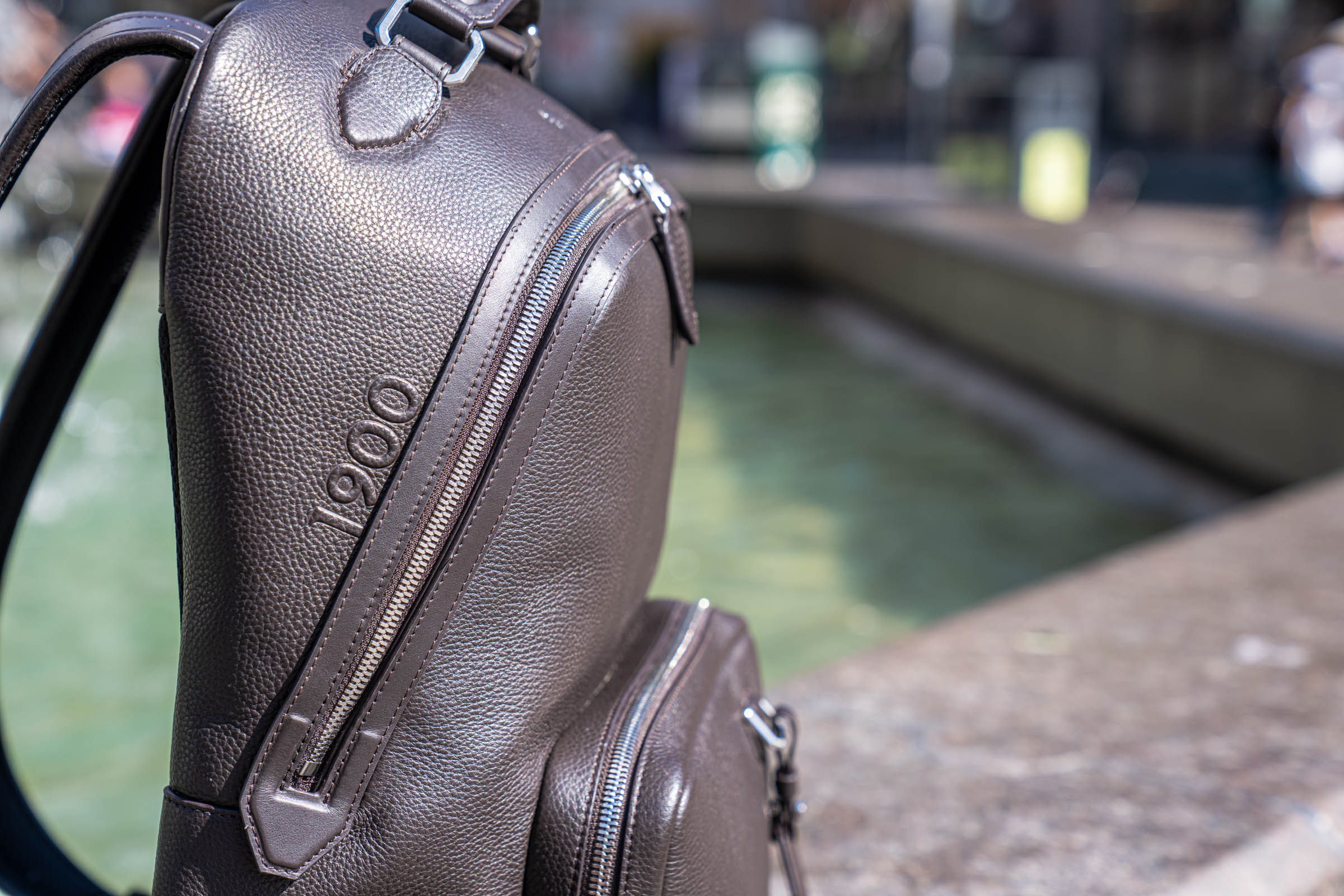
The name itself is a small puzzle. Take MCM, the initials of Manifattura Ceraolo Moroni, and read them as Roman numerals. You get 1900.
The brand describes itself as designed in Italy and engineered in Switzerland, and the company is registered in Kriens, near Lucerne. That combination shows in the product. The proportions are Italian. The tolerances feel Swiss.
They also keep production volumes controlled rather than mass market, which is increasingly rare at this price level.
1900 TEMPO GRANDE: DETAILS BORROWED FROM WATCHMAKING
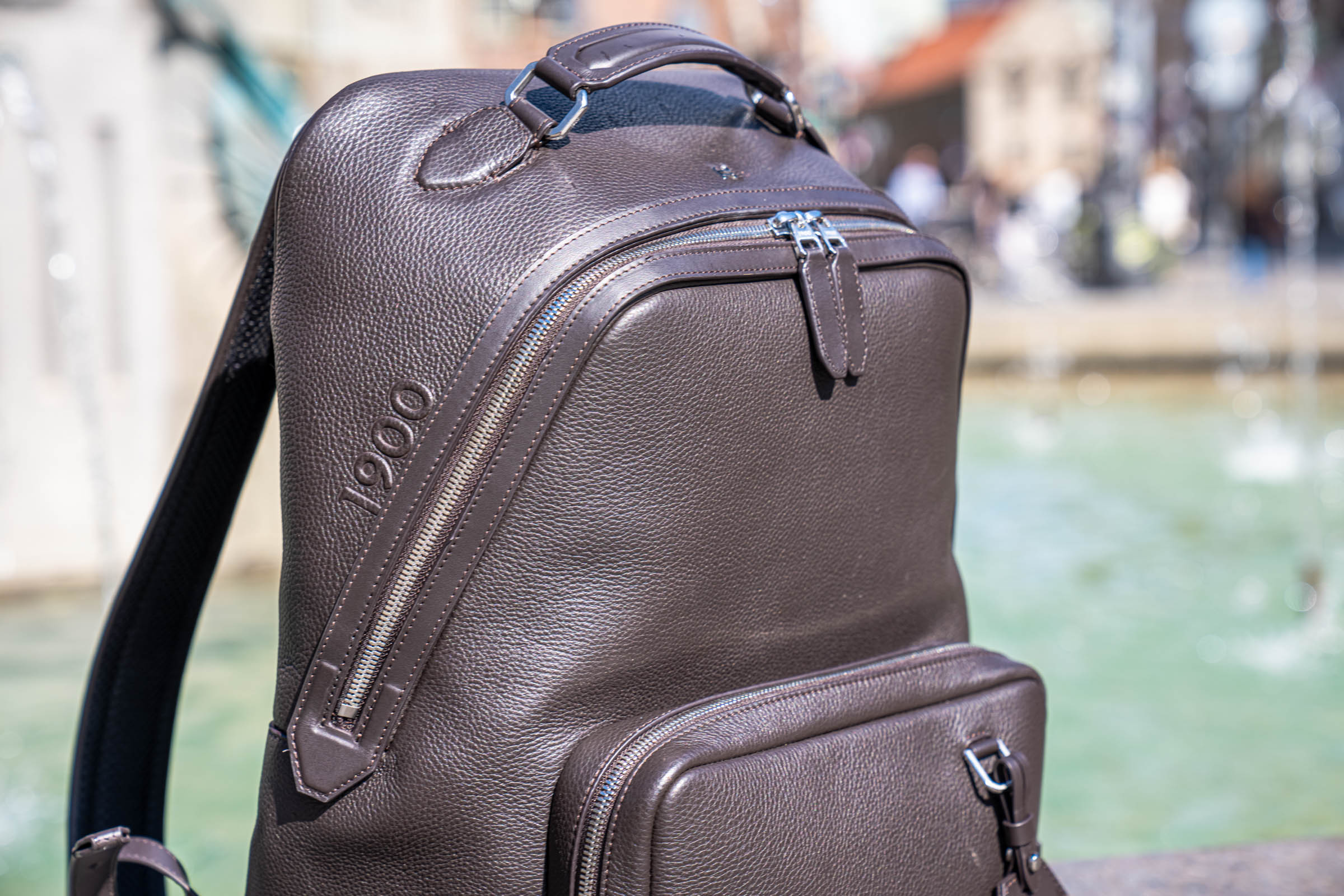
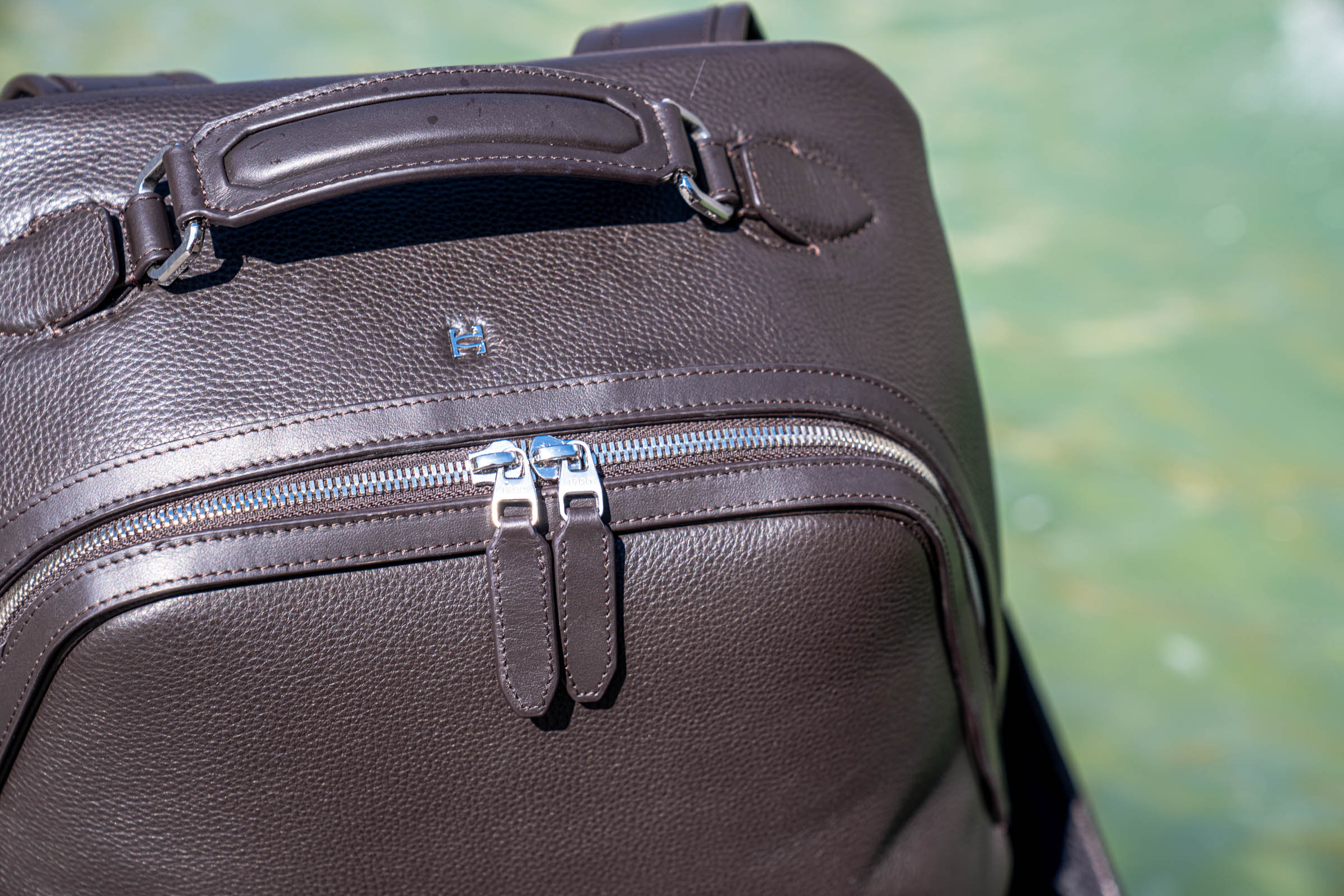
Here is the detail that made me smile when I first read it. The metal components are designed exclusively for 1900, and the brand draws inspiration from Gérald Genta’s iconic watch cases. Genta is the man behind some of the most recognizable sports watch designs of the twentieth century. His signature was balance: shapes that look simple and are extremely hard to execute.
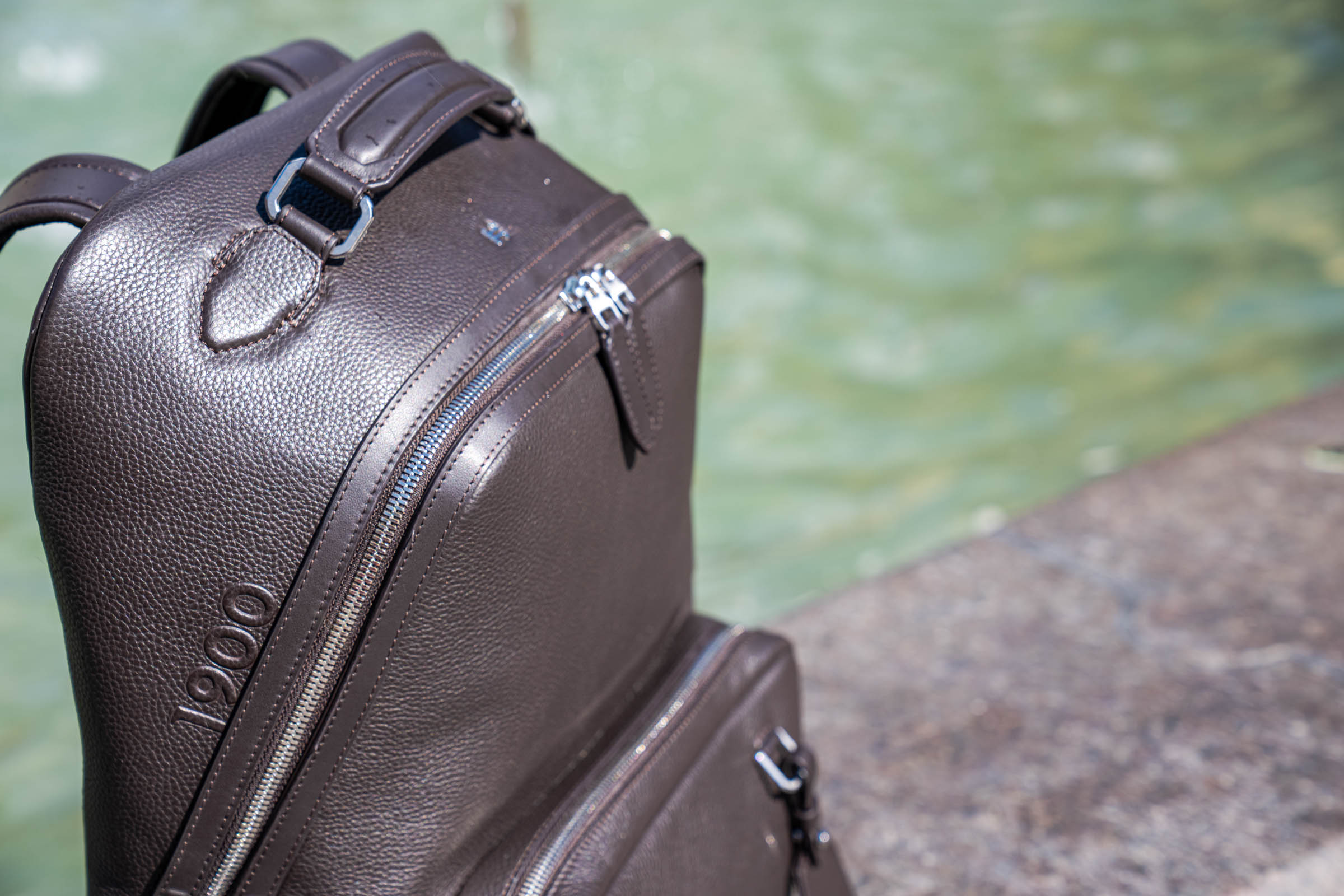
You can feel that logic on the bag. The zipper pulls are flat leather tabs with clean stitched edges. The hardware has soft-cornered geometry rather than generic hooks. The strap anchors are shaped, not bolted on.
Most of all, look at the angled top zip. It sweeps diagonally across the upper panel instead of running straight. That single line gives the whole bag its identity, and it opens wider than a straight zip would.
The embossed 1900 logo sits discreetly on the side panel, pressed into the grained leather rather than printed on it. From two meters away, you see a well-made brown backpack. From half a meter, you see who made it.
1900 TEMPO GRANDE: WHAT IT’S LIKE TO CARRY EVERY DAY
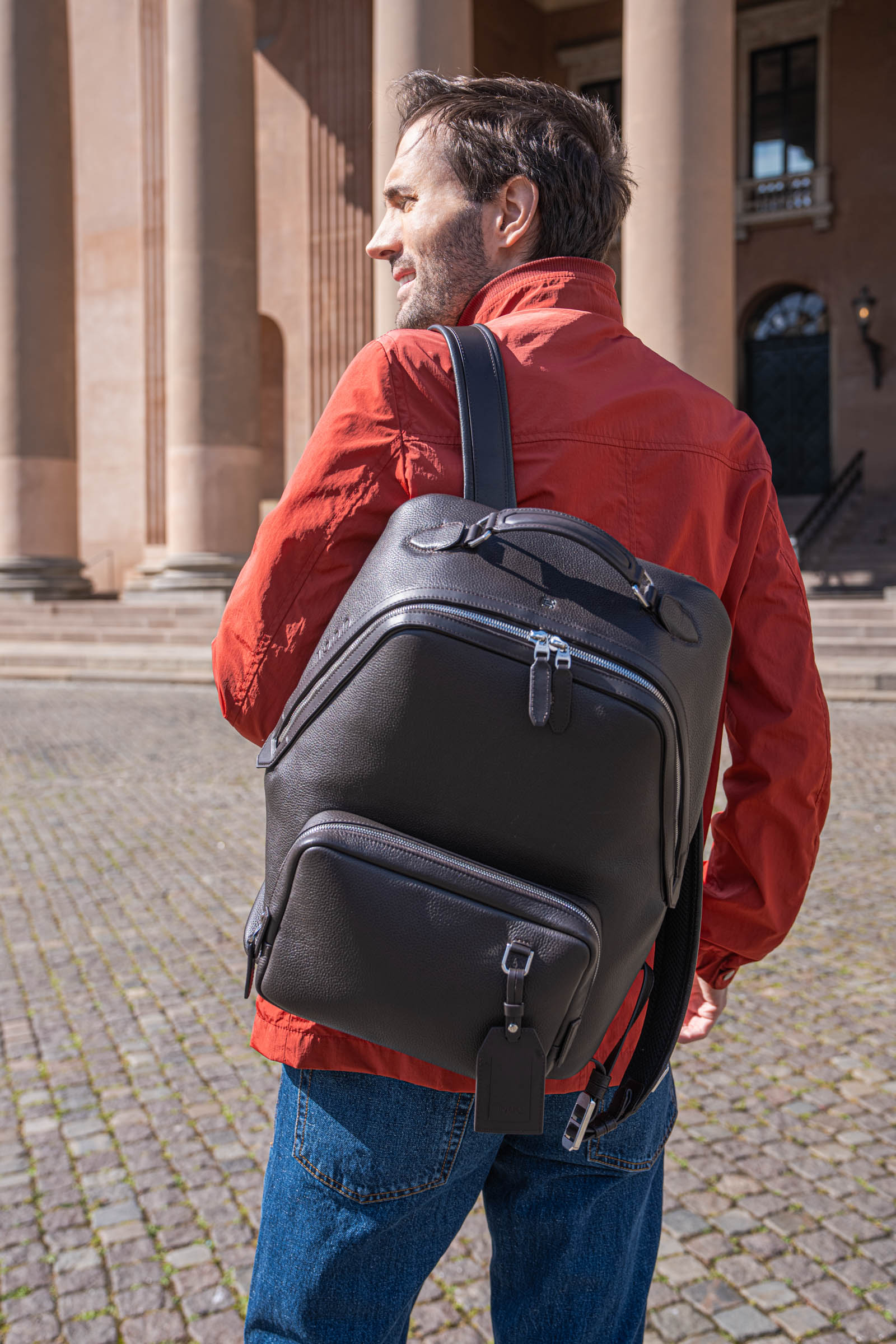
Specs matter, so here they are. The bag measures 34 by 20 by 42 centimeters. It is built from grained leather with brushed leather accents, and my version is the dark brown. Black is the other option.
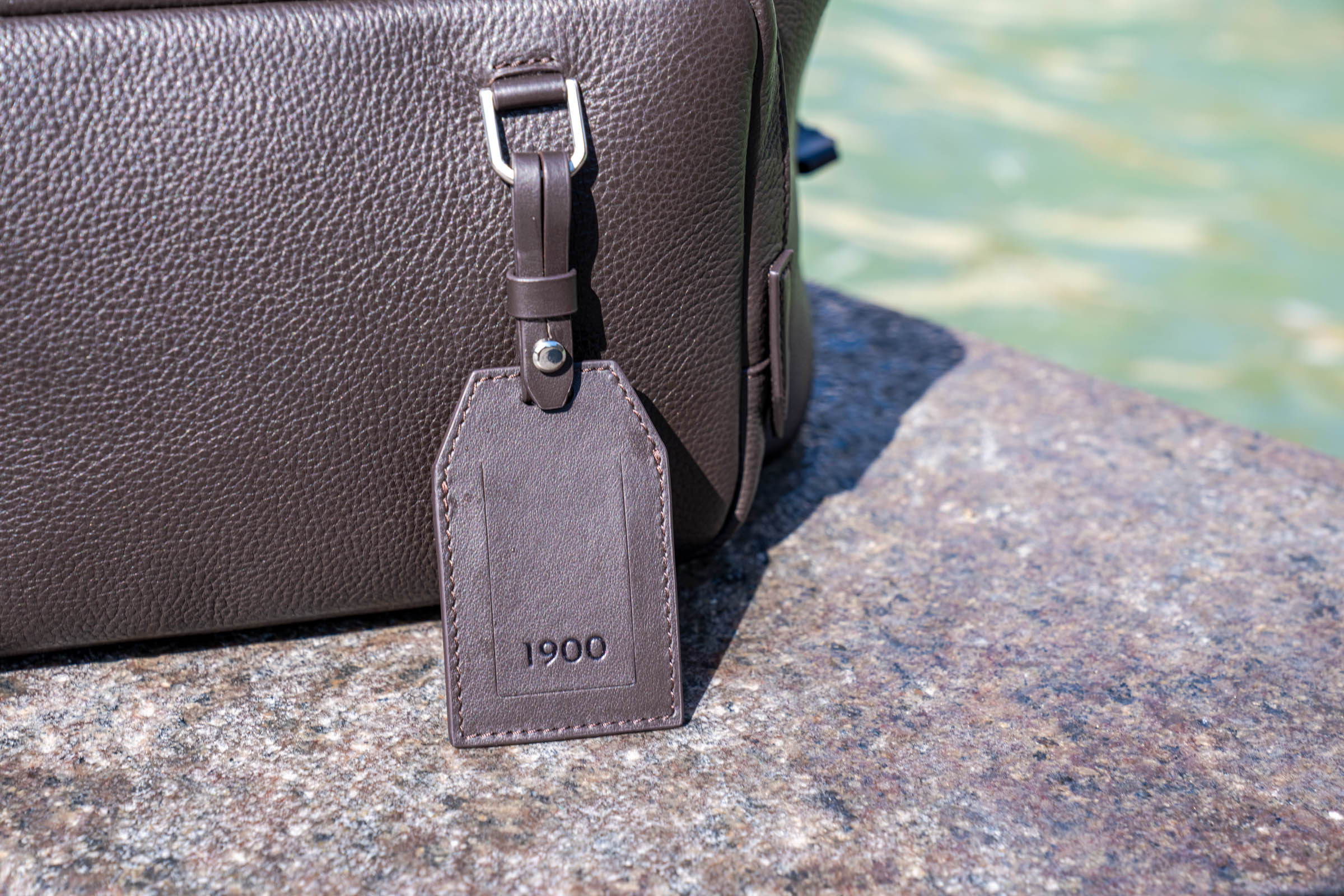
Inside there is a padded laptop compartment, a smartphone pocket, a credit card holder, a key hook, two pen holders, and one zip pocket. Outside there are two more zip pockets. A luggage pass-through lets it sit on a rolling case, and a removable leather travel tag hangs from the front.
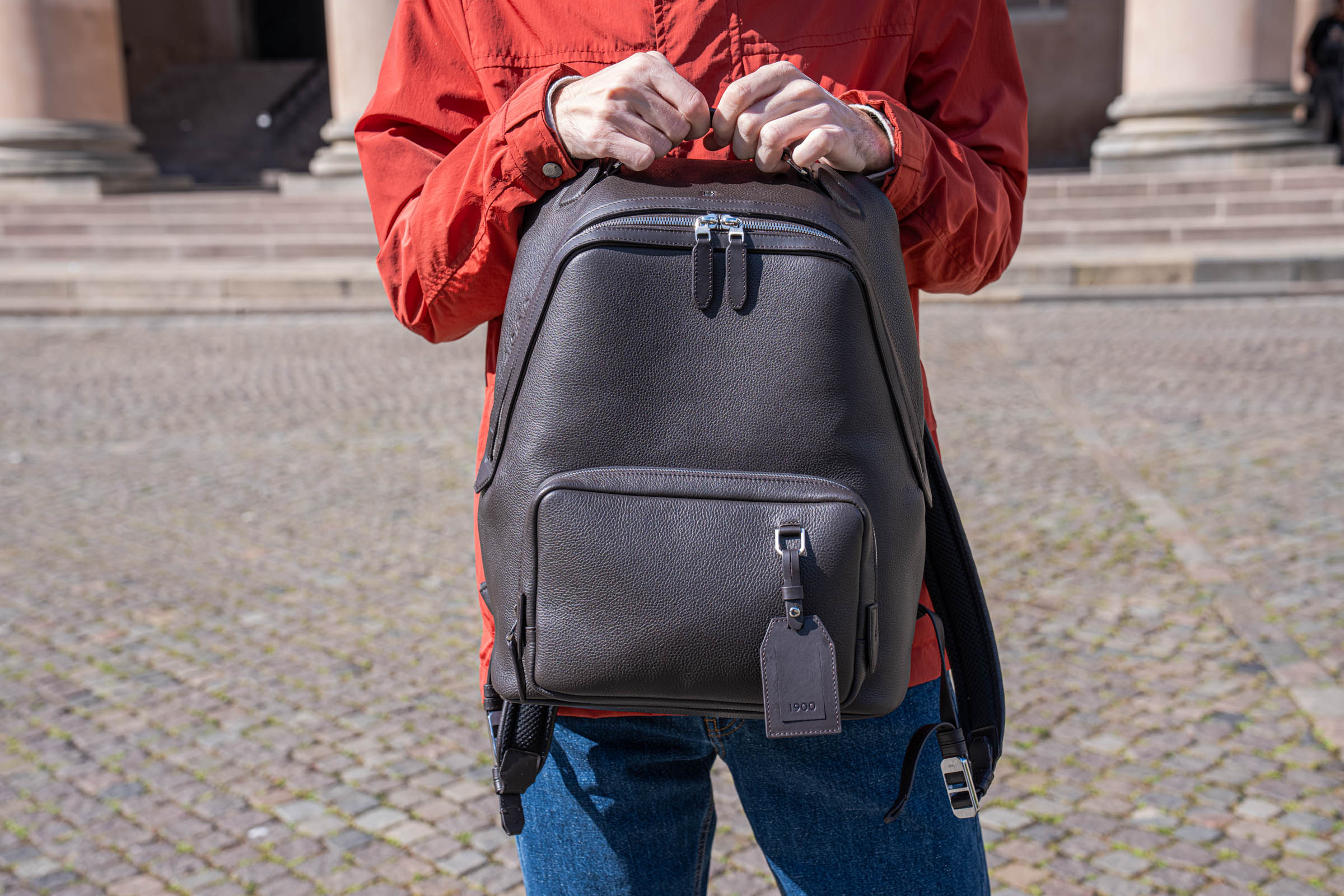
The shoulder straps are adjustable leather over a ventilated back panel. In practice, I carried a laptop, a charger, a water bottle, and the jacket itself for several hours. The weight sat high and centered rather than dragging at the base.
One honest note: a full-grain leather backpack of this size is not light when empty. That is the trade you accept for leather that will look better in five years than it does today.
The retail price is 920 euros, which places it against the entry range of the big luxury houses. Considering who actually builds it, I find that reasonable.
CARLOS SANTOS LONNIE 1987 STB: WHERE PORTUGUESE CRAFT MEETS MODERN STYLE
Footwear is where most smart outfits quietly fail. Mine did not, because I wore the Lonnie 1987 STB from Carlos Santos.
The brand comes from São João da Madeira in northern Portugal, and the factory history goes back to 1942. That town is to Portuguese shoemaking what Northampton is to England or Marche is to Italy. Shoes are not an industry there. They are the local identity.
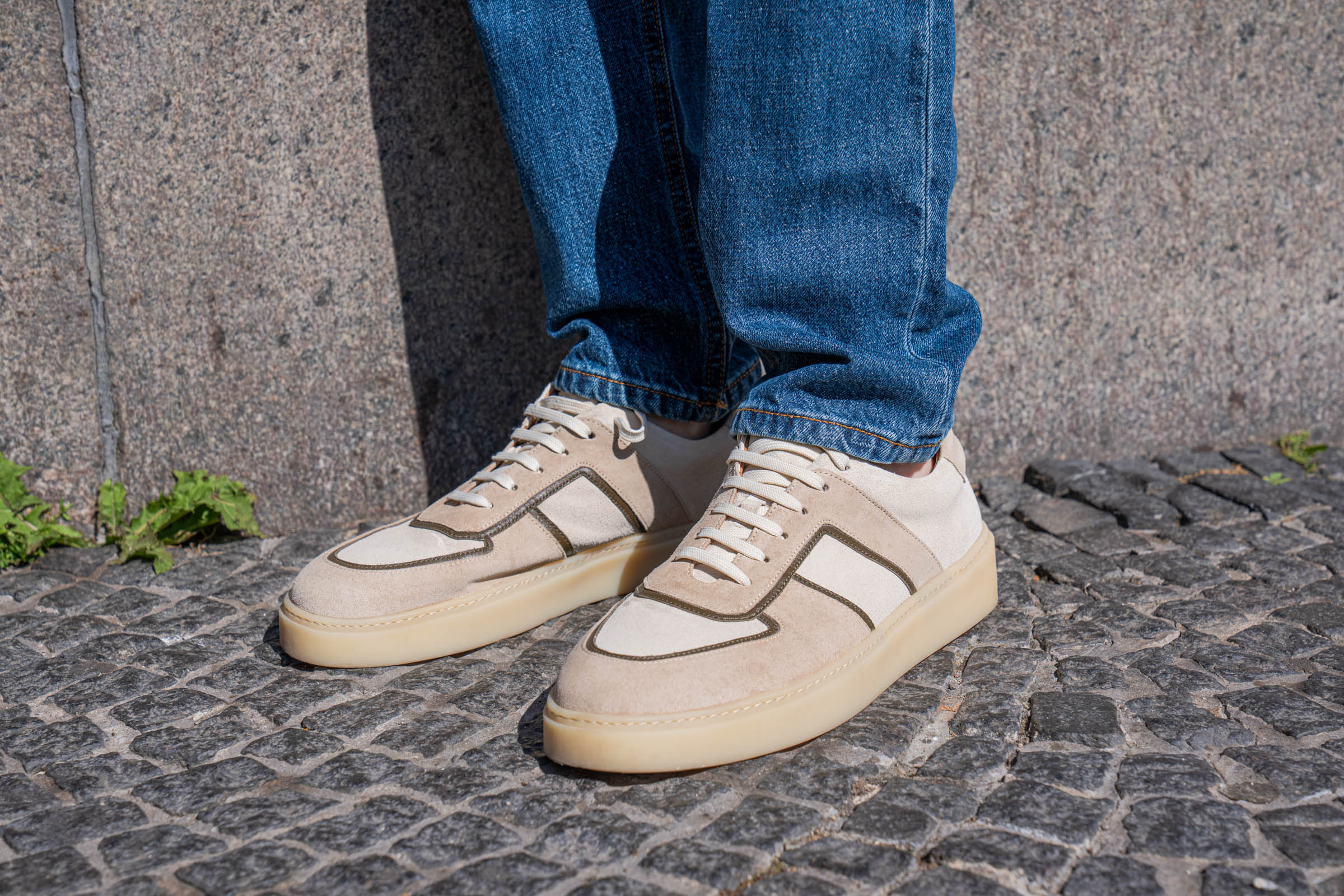
Carlos Santos himself began his career inside that factory, moved from the office to the production floor to sales to management, and eventually gave the company his own name. The brand now exports to dozens of countries and is known for leather quality, fit, and a large amount of handwork.
The Lonnie is their sport line rather than their welted dress line. It uses Strobel construction, which is what gives a sneaker genuine flexibility and cushioning underfoot.
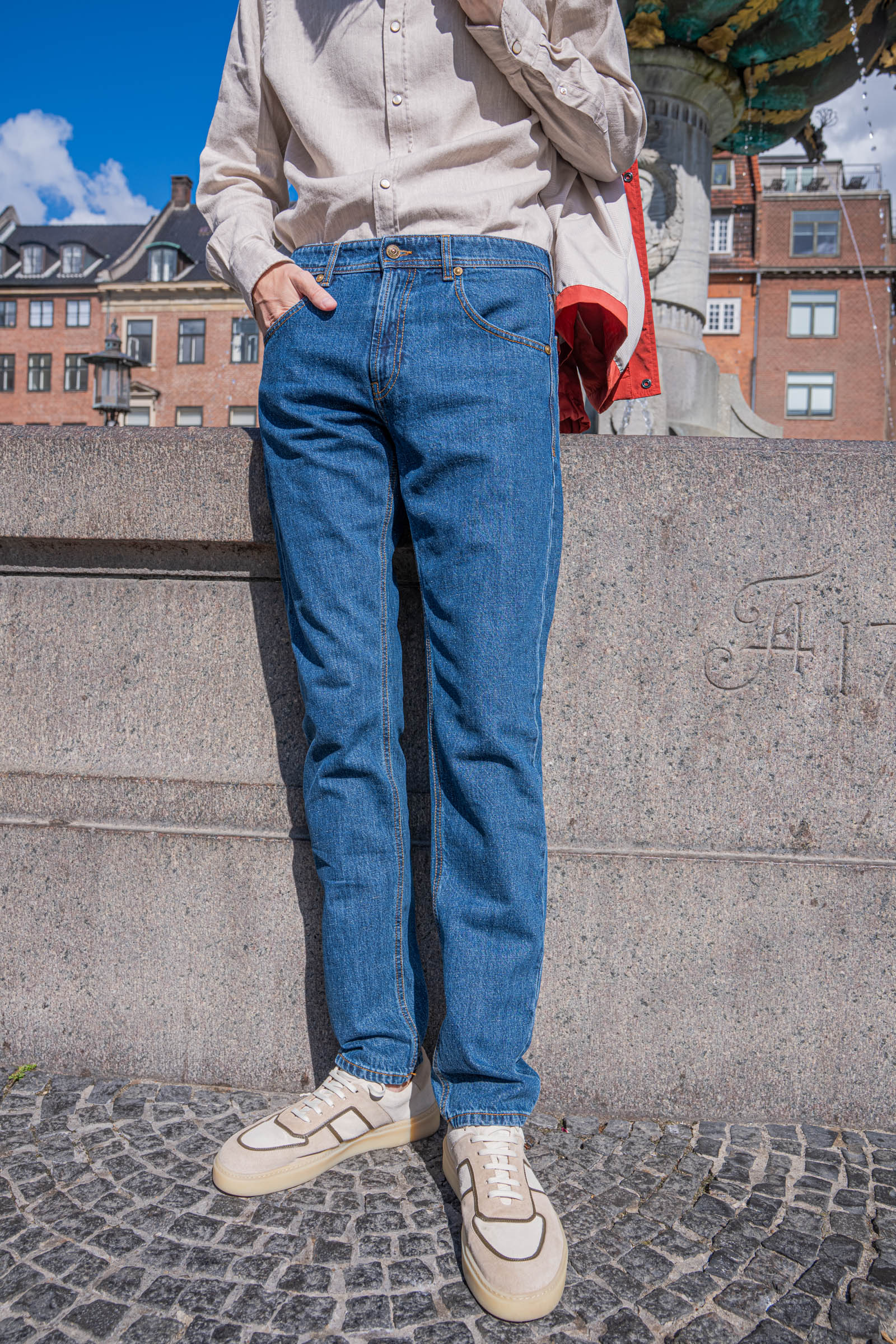
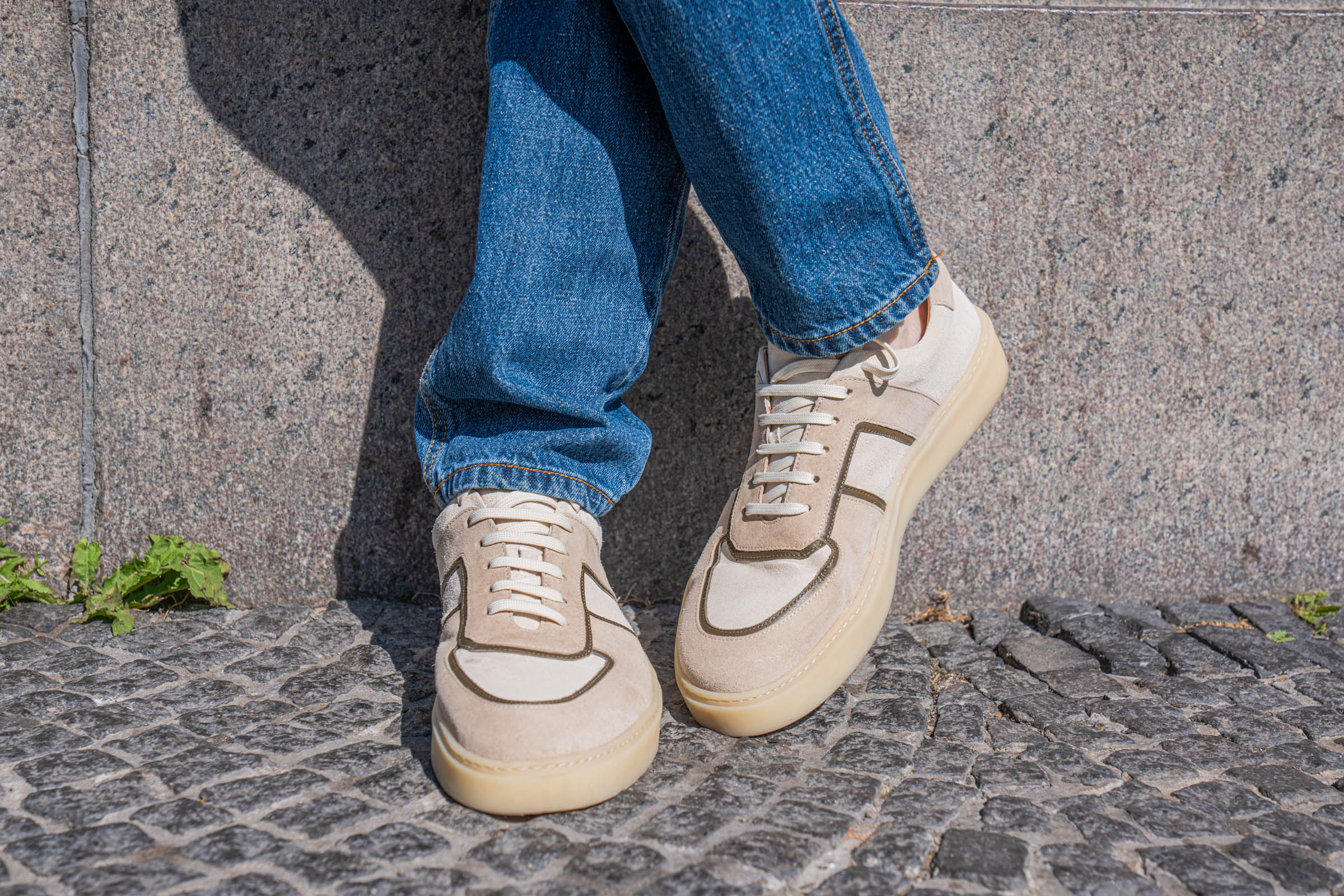
My pair combines two tones of suede with smooth nappa panels and olive outlines, sitting on a thick gum-colored sole. Retail is 260 euros. On granite cobblestones, they were excellent. No hot spots, no sliding, no fatigue at hour six.
WHY SUEDE SNEAKERS BEAT WHITE LEATHER FOR THE MODERN MAN
I own white leather sneakers. I rarely reach for them anymore. Suede in cream and sand has three advantages. It reads softer, so it does not shout against tailored or semi-tailored clothing. It ages with character instead of cracking. And it hides city dust far better than polished white.
The gum sole helps as well. Bright white soles look sporty. Warm gum soles look like something a shoemaker chose.
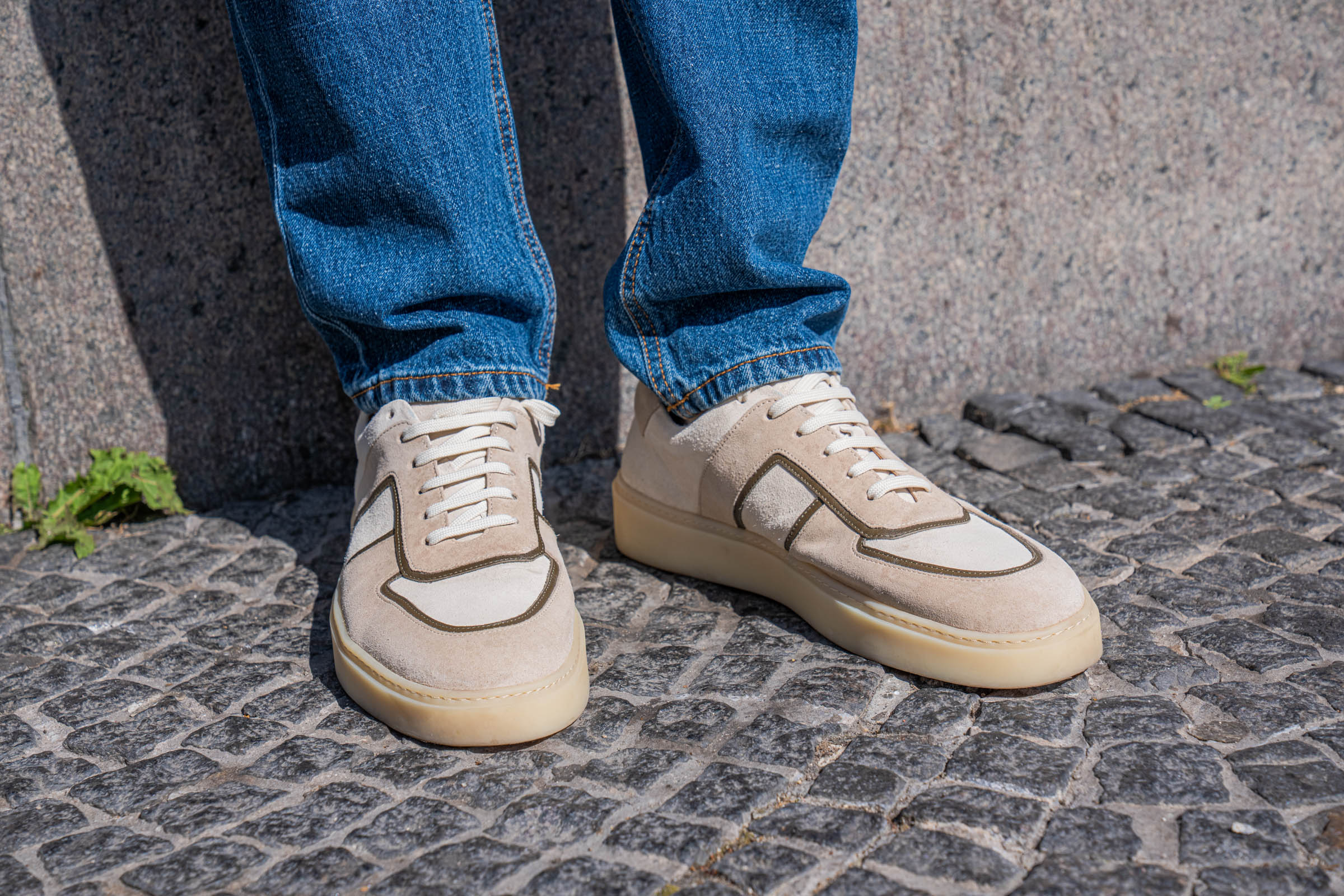
Care is straightforward. Use a suede brush regularly, brushing gently in one direction to lift dust and raise the nap. Carlos Santos sells a care kit with the right brush for exactly this. Keep them away from heavy rain, and use cedar trees when you store them. That is genuinely the whole routine.
The olive trim is the styling bonus. It quietly picks up the earth tones in the shirt and the brown of the backpack, tying the lower half of the outfit to the upper half.
NYTORV & THE COURTHOUSE: THE STORY BEHIND “MED LOV SKAL MAN LAND BYGGE”
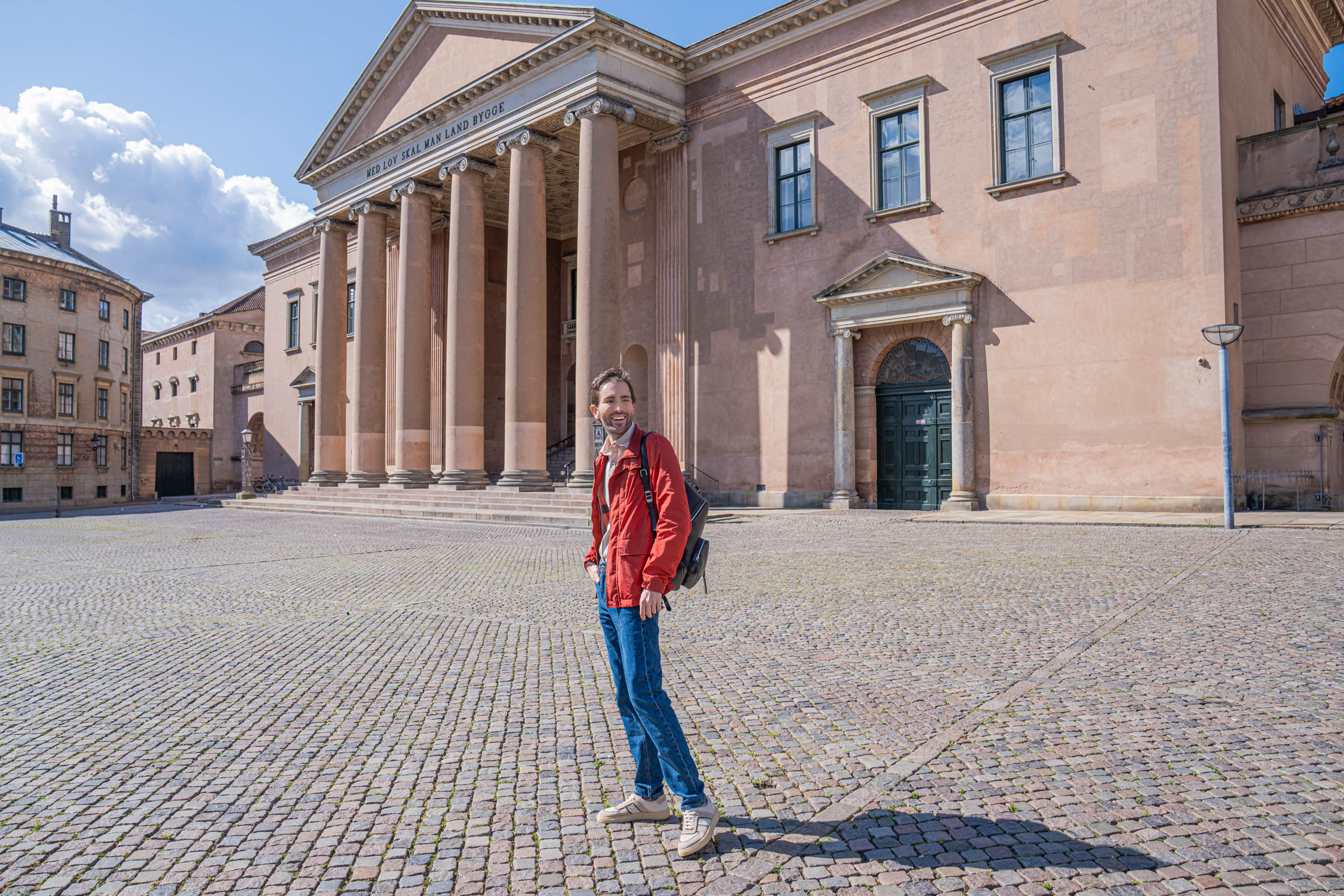
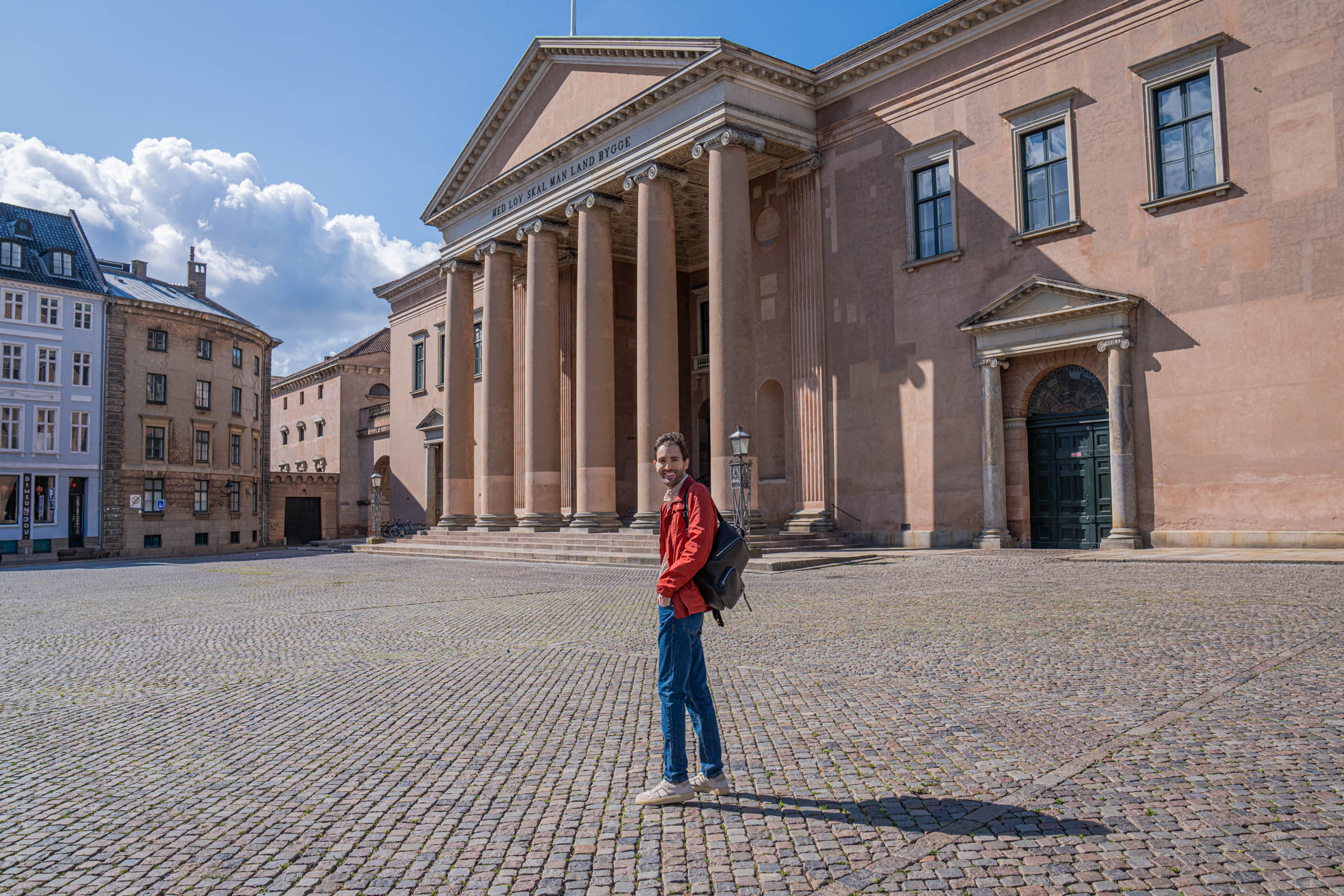
The second half of these photos was shot on Nytorv, in front of the Copenhagen Court House.
After the great fire of 1795 destroyed the old city hall, the city needed a new seat of authority. The commission went to Christian Frederik Hansen, the leading Danish architect of the period, who also designed the Church of Our Lady. Construction began in the first years of the 1800s and finished in 1815, delayed by material shortages and by the British bombardment of 1807.
Across the pediment above the Ionic columns runs the inscription you can read in my photos: MED LOV SKAL MAN LAND BYGGE. With law shall the land be built.
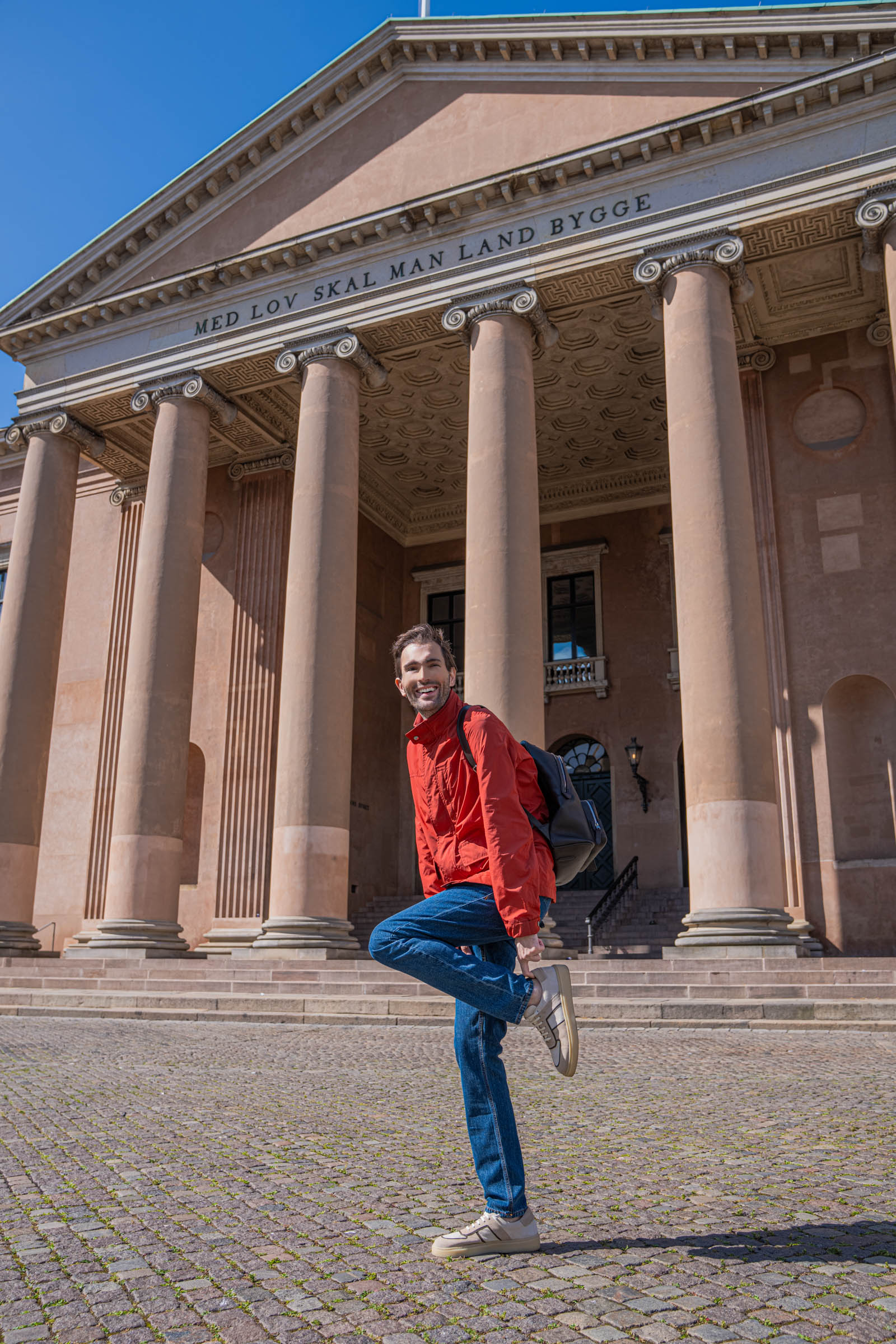
The line comes from the preamble to the Jutlandic Law of 1241, issued under Valdemar the Victorious. A thirteenth-century sentence carved onto a nineteenth-century building, still doing its job today.
The complex included a jailhouse across the street, linked to the courthouse by an arched passageway that locals nicknamed the bridge of sighs.
The building served as city hall until 1905, when the council moved to Martin Nyrop’s new Rådhus. Since then it has belonged entirely to the courts. Standing there in a red jacket felt slightly irreverent. I enjoyed that. Nyhavn sits a ten-minute walk from here, and it became the setting for another fashion story from this trip.
HOW TO RECREATE THIS LOOK YOURSELF
Let me translate all of this into something you can actually use.
Start with the color formula. One warm bright piece, everything else in earth tones and indigo. The bright piece should be the outer layer, because the outer layer is what people see from a distance.
Keep textures varied. Crisp technical nylon, brushed flannel, raw-feeling denim, grained leather, soft suede. Five different surfaces in one outfit, all in a narrow color range. That is what makes a simple outfit look considered rather than plain.
Respect proportion. The jacket ends at the hip. The jeans are straight and break once over the shoe. The sneaker has visible volume. If you slim the trouser too much, the whole silhouette tips forward and the shoe looks oversized.
Let the bag do the aging. Leather is the only element here that will visibly improve with time. Buy the best one you can, then use it hard.
Skip the extras. No scarf, no visible jewelry, no logo cap. When one piece carries the color, everything else should carry nothing.
That is the entire system. It transfers to navy, to olive, to camel, and to any city with gray stone.
CARE NOTES FOR PIECES YOU’LL WANT TO KEEP
Since I write for men who buy fewer things and keep them longer, here is the maintenance side.
The Canali field jacket is a technical fabric, so avoid fabric softener entirely. Softener coats fibers and kills water repellency. Cool wash, gentle cycle, air dry away from radiators.
The flannel shirt washes cold and should never see bleach. Pull it out of the machine slightly damp and hang it on a wooden hanger. It will need almost no ironing, which is one more reason washed flannel travels well.
Denim needs less washing than people think. Air it out between wears, spot-clean small marks, and wash inside out in cold water only when it genuinely needs it. Frequent hot washes are what flatten a good indigo.
Grained leather wants a soft dry cloth after dusty days and a light conditioner once or twice a year. Never dry it near heat. Stuff it when you store it so the shape holds. Suede needs its brush and nothing else most of the time.
None of this takes more than a few minutes a week. It is the difference between clothes that last two seasons and clothes that last a decade.
WHAT THIS DAY IN COPENHAGEN TAUGHT ME
I walked from a 1608 fountain to an 1815 courthouse in about ninety seconds. Both were built to last. Both are still doing exactly what they were designed to do.
That is not a bad standard for a wardrobe. The pieces in this story come from houses that share something specific. A Brianza family that survived a war and rebuilt through raincoats. A southern Italian shirtmaking family now in its second generation. A Portuguese factory in a town that has made shoes for over eighty years. A Swiss-Italian workshop that spent four decades perfecting objects for watchmakers before putting its own name on anything.
None of those stories are about speed. I have reached the point where that matters to me more than novelty. I would rather own one jacket that a company spent ninety years learning how to build than five that were designed last season.
Copenhagen was the right place to feel that. The city does not reward noise. It rewards things that are made properly and then simply used. So if you take one idea from this story, take that one. Buy fewer things. Buy better ones. Then wear them somewhere worth walking.
NOW I’D LOVE TO HEAR FROM YOU
How did you like my outfit today? I really tried to prepare this post with lots of love, and I hope you like it.
If you have any questions, comments, suggestions or messages for me, you can write me below in the comments. Of course, as always, you can contact me via e-mail or social networks, which you can find on the CONTACT page.
See you soon in new fashion adventures on the Mr.M blog!
With Love from Copenhagen,
Mr.M

This post is sponsored by Canali, Versace, 1900 (Manifattura Ceraolo Moroni), Giannetto Portofino and Carlos Santos brands. This post is my personal and honest product review.
Hi Marko, this is such a good example of how one strong colour can completely change an otherwise quiet outfit. The red Canali field jacket immediately catches the eye, but I like that everything underneath stays in sand, indigo and brown. The brick-leaning red is much easier to wear than a bright primary red. I also really noticed the corduroy lining inside the collar. That is exactly the kind of detail you only appreciate once you actually wear a jacket. The Copenhagen setting makes the whole combination even better because the grey stone gives the red somewhere to speak. Would… Read more »
Marko, j’ai vraiment aimé cette histoire parce qu’elle montre qu’une couleur forte peut rester élégante lorsqu’elle est bien entourée. Le rouge de la veste Canali est beaucoup plus subtil qu’un rouge vif classique. Il tire légèrement vers la brique, ce qui fonctionne parfaitement avec le beige, le denim et le brun. J’ai aussi beaucoup aimé ton observation sur le col doublé de velours côtelé. C’est un petit détail, mais il change complètement le confort autour du cou. Et les photos devant le vieux palais de justice sont magnifiques. Le contraste entre la pierre grise et la veste rouge est particulièrement… Read more »
Marko, diese Kombination gefällt mir sehr, gerade weil sie nicht versucht, zu modisch auszusehen. Die rote Canali Field Jacket ist natürlich das auffälligste Stück, aber durch die sandfarbene Flanellbluse und die mittelblaue Jeans bleibt alles ausgewogen. Besonders interessant fand ich die Erklärung zur Farbe Rot. Ein warmer, leicht rostiger Rotton ist tatsächlich viel einfacher zu tragen als ein kühles Signalrot. Auch die Cordauskleidung am Kragen ist ein schönes Detail. Ich glaube, genau solche kleinen Entscheidungen machen eine hochwertige Jacke langfristig interessant. Copenhagen passt natürlich perfekt zu dieser reduzierten Ästhetik.
Ciao Marko, questo è uno di quei look che sembrano semplici, ma diventano molto più interessanti quando si osservano i dettagli. La giacca Canali rossa è sicuramente il punto focale, però mi piace tantissimo il modo in cui hai mantenuto tutto il resto molto tranquillo. La camicia Giannetto Portofino color sabbia è perfetta sotto il rosso. Anche i jeans Versace, volutamente semplici, funzionano molto bene. Le sneakers Carlos Santos aggiungono poi una bella combinazione di suede e tonalità calde. E Copenhagen è uno sfondo straordinario per tutto questo.
Marko, me ha gustado mucho la explicación sobre por qué elegiste este tono concreto de rojo. Siempre he pensado que las chaquetas rojas eran demasiado deportivas, pero ese tono entre ladrillo y óxido cambia completamente la impresión. También me parece muy acertado que sea la única pieza realmente llamativa. El resto de la ropa mantiene una paleta muy tranquila. Los vaqueros rectos me parecen especialmente elegantes y creo que favorecen mucho más de lo que algunos hombres creen. ¿Probarías esta misma chaqueta con unos pantalones de lana gris medio?
The Canali history was fascinating, particularly the fact that the company learned so much about outerwear through raincoats after the war. It makes the technical field jacket feel much less like a seasonal fashion experiment. There is a logic behind the garment. I also loved the point about the jacket packing down into a backpack without developing meaningful creases. That is exactly what I want from travel clothing. The two-way zip, storm placket and snap-adjustable hem make it sound genuinely useful too. Luxury becomes much more convincing when it performs like this.
Marko, bardzo podoba mi się ten zestaw, szczególnie dlatego, że czerwony kolor nie wygląda tutaj agresywnie. Ciepły odcień przypominający cegłę świetnie pasuje do kopenhaskiej architektury. Zwróciłem też uwagę na beżową koszulę Giannetto Portofino. Bardzo dobrze łączy czerwień kurtki z granatem jeansów. Proste jeansy Versace są kolejnym dobrym wyborem, bo nie próbują konkurować z kurtką. A sneakersy Carlos Santos wyglądają bardzo wygodnie na kopenhaskim bruku. Świetny przykład nowoczesnego miejskiego stylu.
I really like how practical this outfit is without looking like technical travel clothing. The Canali jacket gives you protection from the wind, while the flannel shirt adds warmth without becoming too heavy. The straight-leg Versace denim is also a refreshing choice after years of extremely slim jeans. I completely agree that a little break over the shoe makes the silhouette much more natural for men over forty. The cream and brown Carlos Santos sneakers are excellent with the mid-blue denim. I would probably wear the same outfit for a full day of walking in Amsterdam.
The detail that stayed with me was the tiny yellow sun on the Giannetto Portofino shirt. Eight millimetres and almost invisible from a distance, yet somehow that is exactly what makes it special. I think those details are far more interesting than visible branding. The washed flannel itself also looks fantastic under the Canali jacket. It creates just enough softness against the technical nylon. I particularly like the sand colour because it prevents the red from becoming too dominant. This is probably the most wearable red jacket combination I have seen in a while.
Ce que j’ai particulièrement apprécié ici, c’est la façon dont tu expliques la couleur au lieu de simplement dire que la veste est rouge. Le choix d’un rouge chaud, proche de la brique, change tout. Il fonctionne très bien avec le beige et le bleu moyen du jean. J’aime aussi le fait que tu n’aies pas ajouté de foulard ou de bijoux visibles. Avec une veste aussi forte, cela aurait facilement créé trop d’informations. Les sneakers crème et brunes apportent juste la bonne quantité de douceur. Très belle silhouette pour une journée entière à Copenhague.
Die vier Taschen, der Sturmverschluss und der verstellbare Saum machen die Canali-Jacke für mich besonders interessant. Viele Field Jackets sehen zwar gut aus, sind aber im Alltag nicht wirklich praktisch. Hier scheint das anders zu sein. Auch die Tatsache, dass du sie mehrmals in den Rucksack gerollt hast und sie trotzdem fast knitterfrei herauskam, ist für Reisen ein großer Vorteil. Die rote Farbe hätte ich persönlich wahrscheinlich nie gewählt. Nach diesem Beitrag bin ich mir da aber nicht mehr so sicher. Vielleicht muss ich einfach den richtigen Rotton finden.
There is something very Copenhagen about this outfit even though most of the brands are Italian or Portuguese. That is what I enjoyed most. The clothes are warm and refined, but the styling is restrained enough to fit the city. The red jacket becomes almost architectural against the grey granite. I also like the fact that you stayed with a straight jean rather than a narrow silhouette. It gives the Carlos Santos sneaker enough room to show its shape. The whole outfit feels made for walking rather than posing.
Mi ha colpito molto la storia della Canali. Non sapevo che la famiglia fosse entrata così profondamente nel settore dei soprabiti e degli impermeabili dopo la guerra. Ora capisco meglio perché una field jacket tecnica possa avere una costruzione così raffinata. Anche il colletto con interno in velluto a coste mi sembra un dettaglio molto intelligente. Il rosso caldo è sicuramente la scelta più audace, ma il resto della palette lo rende molto facile da portare. Personalmente la proverei con pantaloni color crema in autunno.
I have always been suspicious of red jackets because they can easily look like outdoor sportswear. Your explanation of the temperature of the colour changed my mind. This slightly rusty red feels much more sophisticated. The fact that you kept the shirt sand beige and the jeans mid-blue makes a huge difference. I also noticed the navy tape underneath the zipper, which is such a subtle Canali touch. It gives the front of the jacket a little visual structure. Would you ever wear the jacket fully zipped with the collar up, or do you prefer it open for the softer… Read more »
La parte sobre el clima de Copenhague me ha parecido especialmente realista. No basta con llevar una chaqueta bonita cuando el sol puede convertirse en viento en veinte minutos. La Canali parece precisamente ese tipo de prenda que resuelve el problema sin parecer demasiado técnica. También me gusta mucho el largo ligeramente más bajo de la cadera. Con los vaqueros rectos crea una proporción muy equilibrada. Y las zapatillas con suela color goma son perfectas para las calles de piedra. Es un conjunto que realmente parece pensado para caminar.
Marko, ich finde besonders schön, dass du die Stadt nicht einfach als Hintergrund benutzt. Gammeltorv und Nytorv sind wirklich Teil der Geschichte des Outfits. Die rote Jacke vor dem grauen Stein funktioniert dadurch fast wie ein Farbfleck in einem Gemälde. Auch die Geschichte des Caritas-Brunnens war für mich neu. Dass das Bronze ursprünglich aus beschlagnahmten Kirchenglocken stammt, ist ein erstaunliches Detail. Solche Informationen machen deine Fashion Stories immer interessanter. Man bekommt gleichzeitig Mode und Stadtgeschichte.
The Caritas Fountain section was one of my favourite parts of the article. I had no idea that Copenhagen’s oldest preserved Renaissance fountain was connected to a six-kilometre wooden water pipe. The golden apples tradition is also wonderful. It makes the location feel much more alive than simply calling it an old square. And then there is the red Canali jacket standing beside all that history. I like the slight irreverence of it. A formal Renaissance setting does not necessarily require a formal outfit.
Marko, gostei muito da maneira como explicaste a lógica por trás de cada peça. A jaqueta vermelha é obviamente a protagonista, mas a camisa Giannetto Portofino em bege é o que torna tudo mais equilibrado. Também gostei bastante dos jeans Versace, porque são simples e não têm aquele excesso de detalhes que vemos muitas vezes. As sapatilhas Carlos Santos parecem muito confortáveis para andar durante horas. A combinação de camurça, pele lisa e sola cor de borracha é muito elegante. É um excelente look de viagem.
The phrase “survival gear with good manners” made me laugh because it describes Copenhagen weather perfectly. I also think it describes the Canali jacket very well. It is technical, but there is nothing aggressively technical about the appearance. The corduroy collar is probably my favourite detail because it changes how the fabric feels against the neck. The four-pocket structure gives it enough character without turning it into military styling. I could see this becoming one of those jackets you reach for constantly between September and November.
Marko, j’ai beaucoup aimé la partie consacrée au jean Versace. C’est presque amusant de voir qu’un pantalon aussi simple peut avoir une histoire aussi importante. La coupe droite et le milieu de taille sont effectivement beaucoup plus flatteurs pour beaucoup d’hommes que les jeans très ajustés. Avec les sneakers Carlos Santos, la silhouette devient immédiatement plus moderne. J’aime aussi le petit bouton doré à la taille, qui rappelle discrètement l’identité Versace sans imposer le logo Medusa. C’est exactement le genre de détail que j’aime dans le luxe.
Ciao Marko, la cosa che preferisco di questo look è il rapporto tra texture diverse. Nylon tecnico, flanella lavata, denim, pelle martellata e suede: cinque superfici diverse, ma una palette molto controllata. È proprio questo che evita che un outfit semplice sembri piatto. La giacca rossa aggiunge poi l’unico vero elemento luminoso. Mi piace moltissimo anche lo zaino 1900 Tempo Grande. Quel dettaglio della zip diagonale ispirata al mondo dell’orologeria è davvero particolare. Sembra molto più interessante di un normale zaino di lusso.
I think the 1900 Tempo Grande deserves more attention than it might initially receive. The angled top zipper is a genuinely clever design decision. It gives the backpack a recognisable line without needing a giant logo. I also liked the explanation of the connection between Manifattura Ceraolo Moroni and watchmaking. You can almost see that precision translated into the hardware. The dark brown leather also works beautifully with the olive details on the sneakers. This is exactly the sort of bag I would want for business travel without carrying something that looks like office equipment.
De 1900 Tempo Grande vond ik misschien wel het interessantste onderdeel van deze outfit. Het idee dat het merk voortkomt uit een bedrijf dat jarenlang luxe horlogedozen maakte, verklaart waarschijnlijk waarom de hardware zo verfijnd is. Vooral de diagonale rits vind ik sterk. Dat is een klein ontwerpdetail, maar het geeft de rugzak onmiddellijk karakter. De combinatie van donkerbruin leer met de rode Canali-jas werkt ook verrassend goed. Ik zou hem persoonlijk zelfs bij een camel jas dragen.
The history of 1900 was completely new to me. I have seen plenty of luxury backpacks, but very few that can trace their expertise back to forty years of making watch and jewellery packaging. The “designed in Italy and engineered in Switzerland” idea makes sense once you look at the construction. The bag seems visually Italian but mechanically precise. I also appreciate your honesty about the weight. A full-grain leather backpack is never going to be featherlight. That is a much more useful review than simply calling it luxurious.
Najbardziej podoba mi się tutaj zestawienie czerwonej kurtki z ciemnym brązem plecaka. Zwykle przy tak mocnym kolorze wybrałbym czarny, ale ten brąz wygląda znacznie cieplej. W połączeniu z piaskową koszulą i kremowymi sneakersami tworzy bardzo spójną całość. Zwróciłem też uwagę na oliwkowe wykończenia butów, które łączą je z resztą kolorów. To pokazuje, że dodatki nie muszą być identyczne kolorystycznie, żeby wyglądać razem. Bardzo dobra lekcja stylizacji.
Me ha gustado mucho la elección de unas zapatillas de ante en lugar de las típicas blancas de piel. La explicación tiene mucho sentido: el ante crema se integra mejor con una ropa más elegante y además disimula mucho mejor el polvo de la ciudad. La suela color goma también me parece fundamental. Una suela blanca habría hecho que todo pareciera más deportivo. Estas Carlos Santos tienen una presencia mucho más refinada. Y después de seis horas caminando por adoquines, si realmente no hubo puntos de presión, eso dice bastante.
Die Carlos Santos Lonnie gefallen mir ausgesprochen gut. Besonders die Kombination aus zwei verschiedenen Wildledertönen, Nappaleder und olivfarbenen Details macht sie interessant. Ich finde auch die Idee mit der Gummisohle sehr überzeugend. Auf altem Granit möchte ich nicht sechs Stunden mit einer dünnen Ledersohle unterwegs sein. Der praktische Teil über die Wildlederpflege ist ebenfalls hilfreich. Eine Bürste, wenig Wasser und vernünftige Lagerung – eigentlich braucht man gar nicht mehr. Solche Details machen einen Modeartikel für mich wertvoller.
Je suis complètement d’accord avec ton idée selon laquelle les sneakers en cuir blanc deviennent parfois trop sportives avec un pantalon habillé. Le daim crème est beaucoup plus doux visuellement. Avec le jean bleu moyen, il crée une transition très naturelle. J’aime aussi énormément les touches olive sur les Carlos Santos. Elles reprennent subtilement les tons de terre présents dans la chemise et le sac. Rien n’est assorti de façon évidente, et pourtant tout communique. C’est une très bonne leçon de coordination des couleurs.
The straight Versace jeans are such a good decision here. They almost disappear into the outfit, which is exactly what you want when the jacket is carrying the colour. I have noticed that a lot of men still think straight-leg denim looks old-fashioned. Your silhouette proves the opposite. The slight break over the sneaker looks relaxed but intentional. It also gives the shoe enough room to breathe. I would love to see these jeans styled with the same Carlos Santos sneakers and a navy field jacket for comparison.
Mi piace moltissimo la filosofia “one bright piece, everything else quiet”. È una regola molto semplice, ma funziona davvero. La giacca Canali porta tutto il colore, mentre camicia, jeans, zaino e sneakers rimangono in una gamma molto naturale. Anche la scelta di non aggiungere gioielli o cappelli mi sembra perfetta. In un outfit così, ogni elemento extra avrebbe solo disturbato l’equilibrio. Trovo particolarmente elegante il modo in cui il rosso caldo dialoga con il grigio della pietra di Copenhagen.
There is a real difference between wearing red and understanding how to wear red, and I think you explain that difference very well. The temperature of the colour is important, but so is the amount of it. Making the jacket the only bright element gives it purpose. I also liked the point about texture. A slightly lustrous technical fabric makes red feel more intentional than a matte cotton work jacket. It is a small distinction, but visually it matters. I may finally be ready to buy a red outer layer.