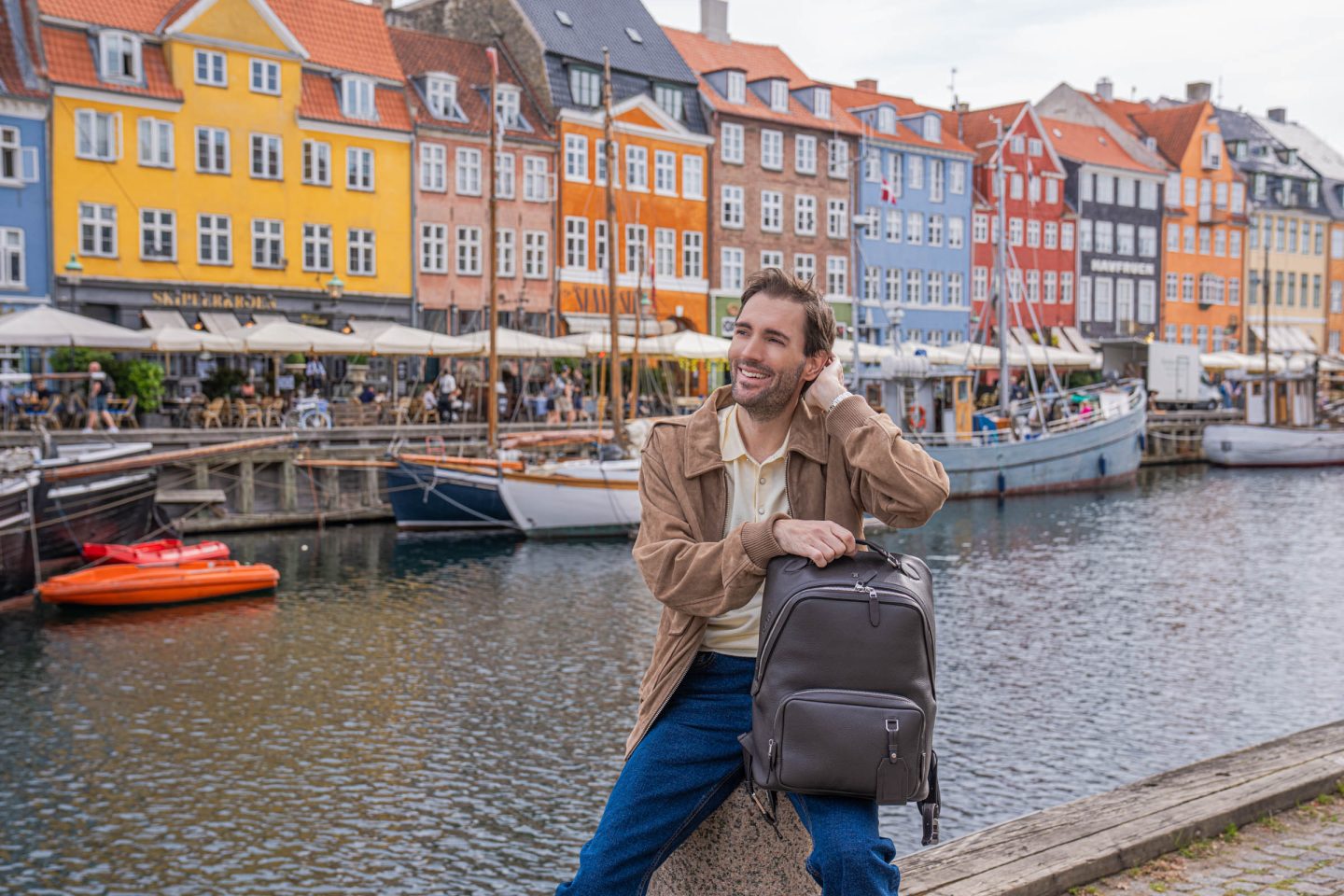
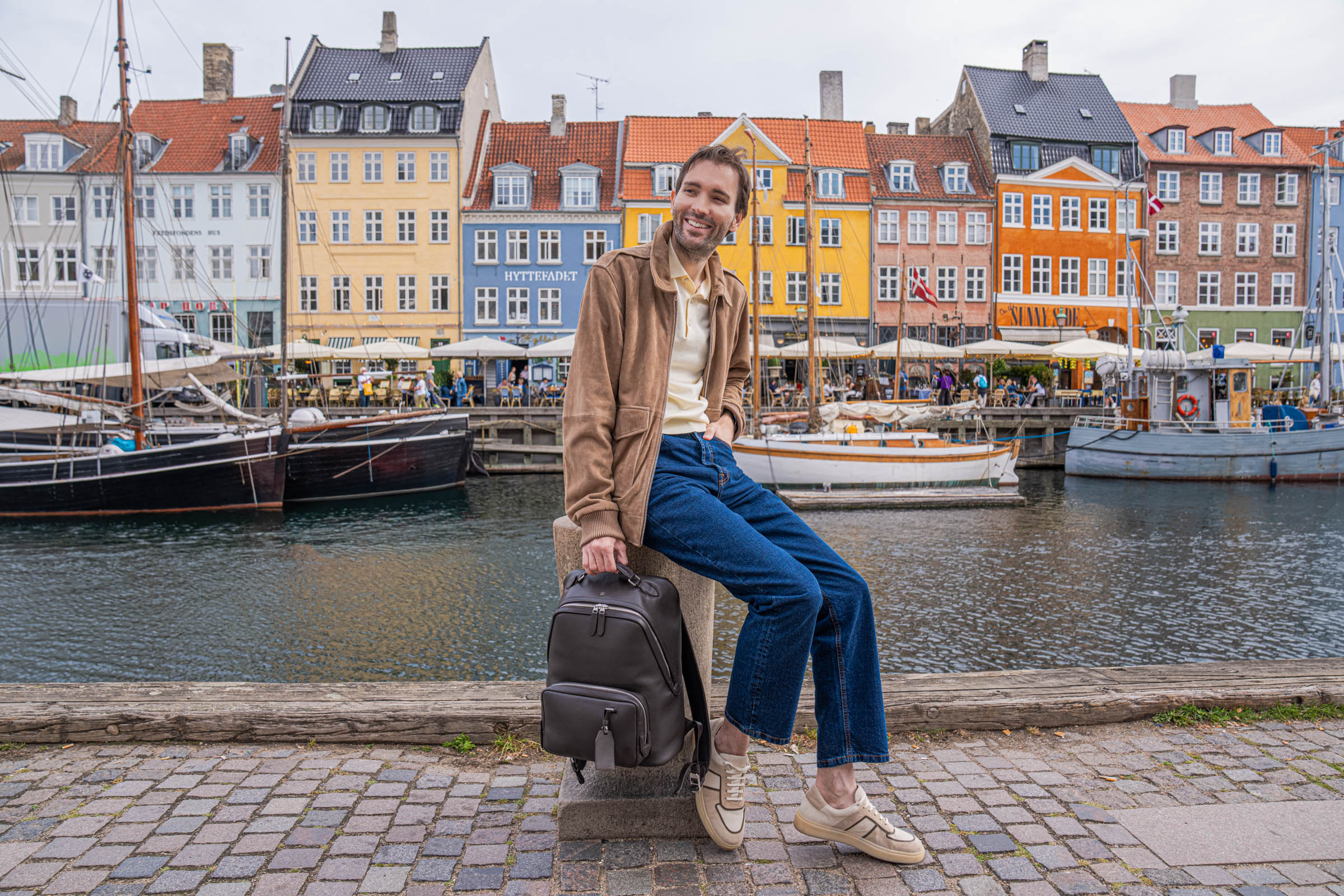
My dear fashionistas, welcome to a new fashion story on the Mr.M blog. Copenhagen dresses with more courage than most European capitals. On the street you see strong color, bold pattern and cuts that ask to be noticed. Danish design, however, follows a much quieter rule: fewer parts, better materials, longer life. The Tod’s suede jacket I wore on the Nyhavn quay follows exactly that rule. It never raises its voice, and it still holds the whole outfit together.
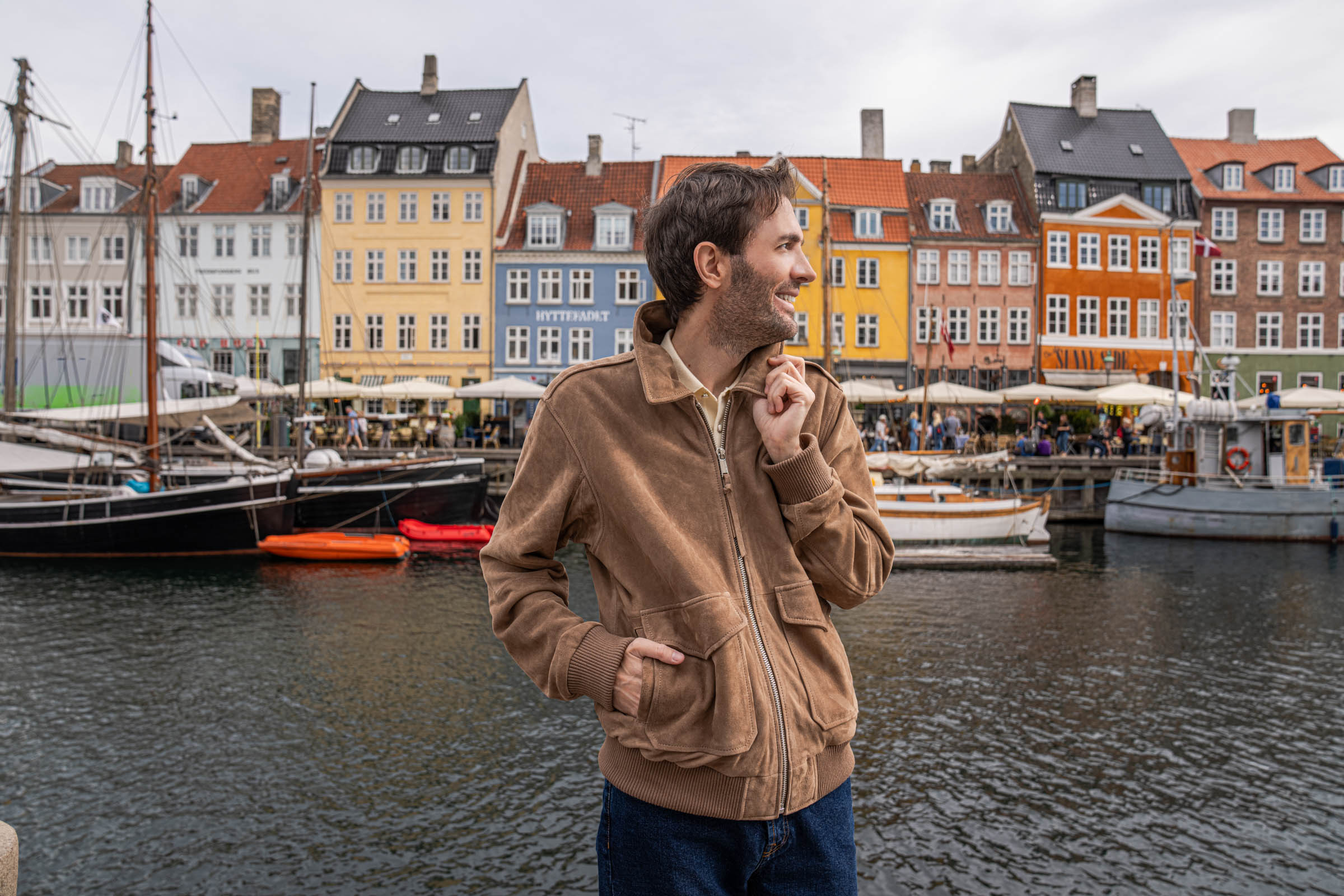
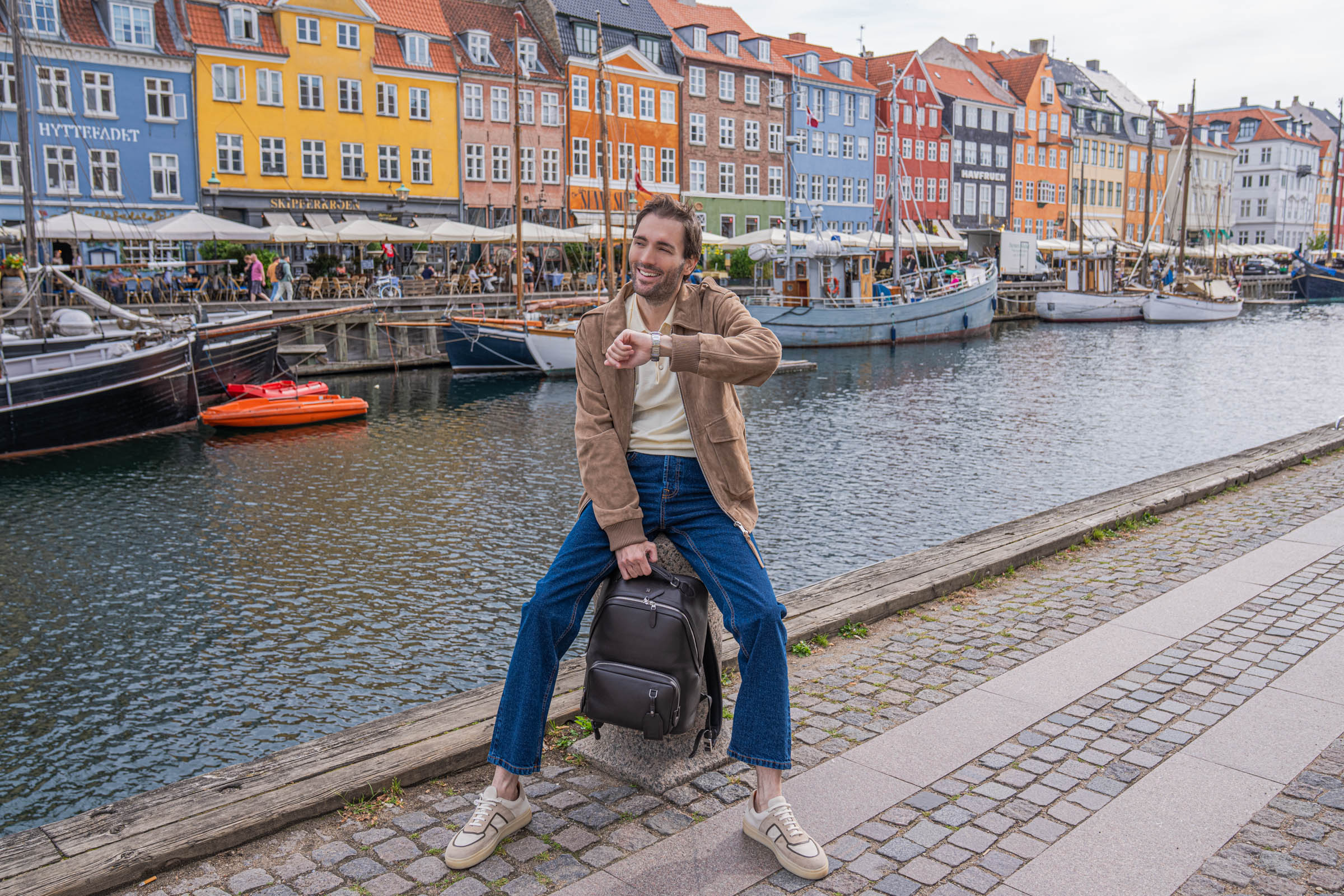
This fashion story was born on the Nyhavn quay, in the heart of the Danish capital. Around me stood wooden sailboats, and behind them a row of brightly colored houses. In front of such a backdrop painted in brown and beige tones, my outfit seems even calmer. The contrast was not overly emphasized, but it was completely coordinated.
WHY THE TOD’S SUEDE JACKET STEALS THE SPOTLIGHT IN THIS LOOK
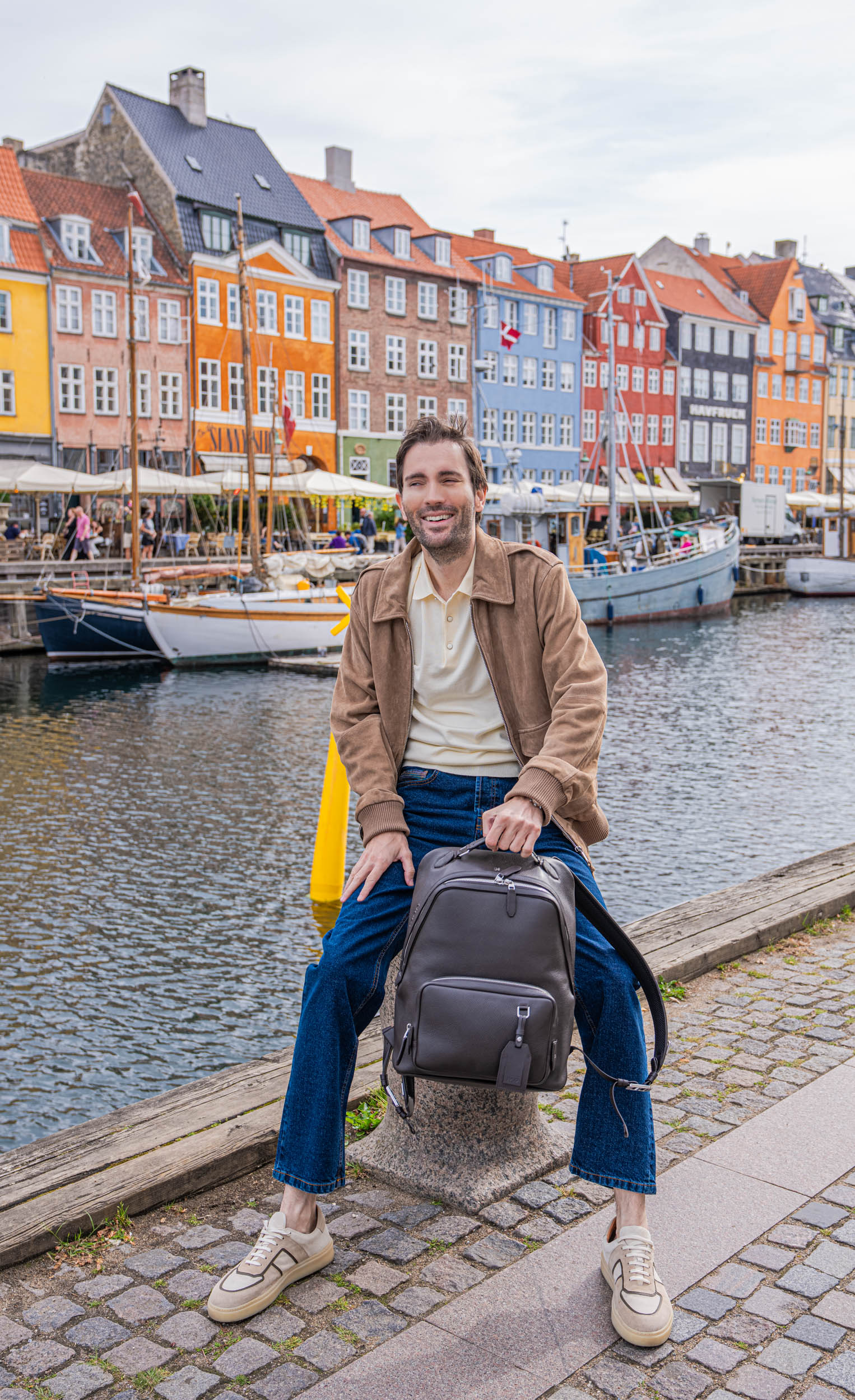
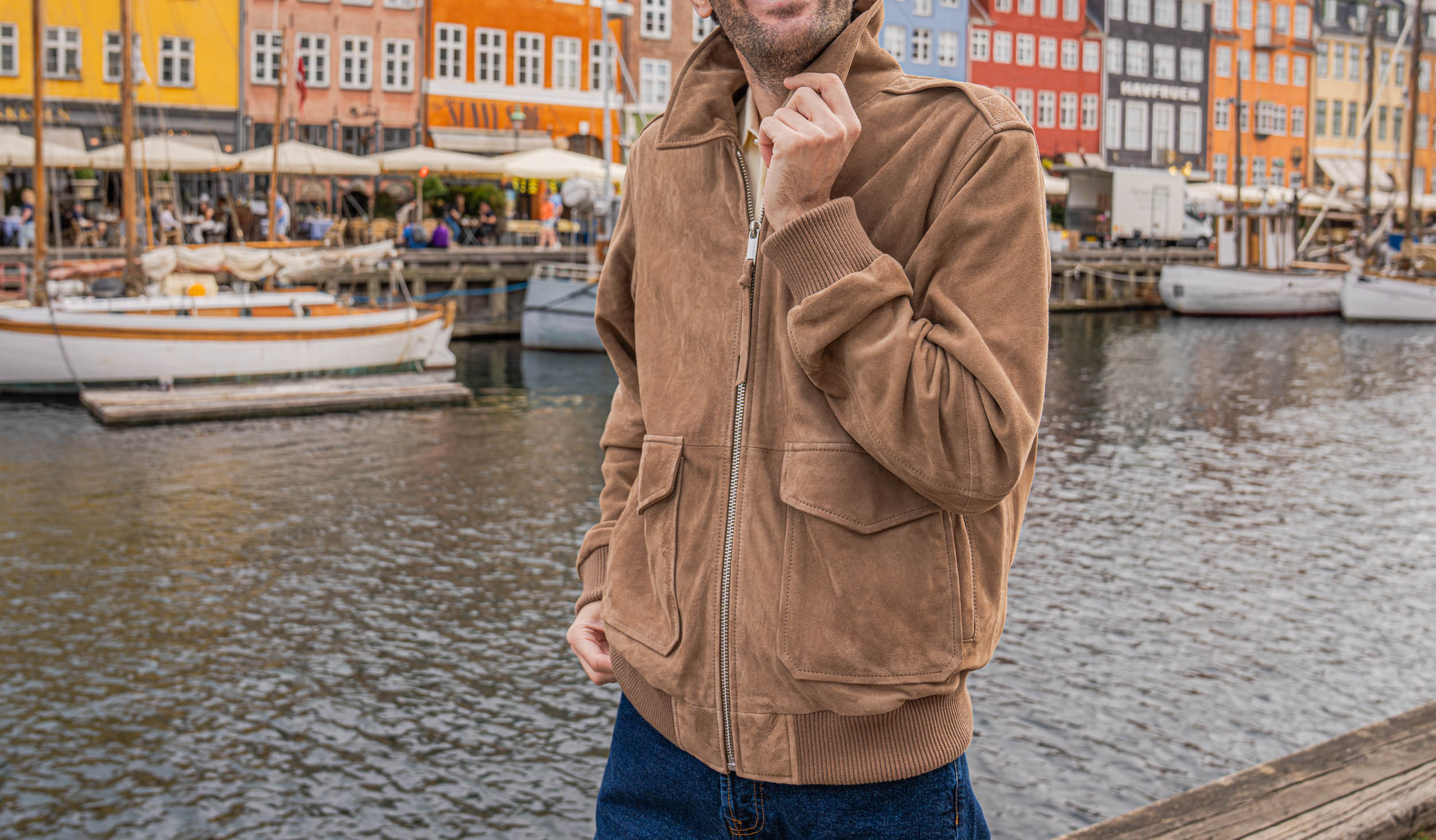
I made the decision about the main piece of today’s fashion story quickly. Tod’s suede jacket has the cut we have known for decades: dropped shoulders, a straight front, a ribbed collar, hem and cuffs. This cut originates from aviation clothing, and today it belongs to the classic men’s wardrobe.
Color is crucial here. The warm beige shade is right between sand and tobacco. Therefore, it goes well with blue, white, cream and gray tones without any problems or efforts. None of those combinations seem like stepping out of the comfort zone.
Suede leather as a material, in itself, requires some courage. The surface absorbs light instead of reflecting it, so the jacket looks softer and warmer than smooth leather. Likewise, every crease remains visible. The material records movement, sitting and leaning on the fence.
That’s why Tod’s suede jacket feels like a living piece. After a few seasons, it takes the shape of the wearer’s shoulder. Smooth leather ages differently, often more evenly, but also more impersonally. For me, that’s the key difference. I like clothes that become personal over time. A jacket that looks exactly the same after five years usually means I haven’t worn it enough.
THE ORIGINS OF TOD’S: FROM A SMALL WORKSHOP TO A LUXURY ICON
The story of Tod’s begins in the Italian region of Marche, in Casette d’Ete. There, in the late 1920s, Filippo della Valle started a small shoemaking workshop in the family home. Even before that, the region had a centuries-old tradition of shoe making.
The turning point came with the grandson of the founder. Diego della Valle, born in 1953, grew up among molds and leather. In the mid-seventies, he traveled to New York with suitcases full of samples of his father’s production. There, he convinced the big fashion houses to entrust him with the production of shoes.
In 1978, he took over the family business and gave it a new name: J.P. Tod’s. The prefix disappeared in the late nineties, leaving only Tod’s. There are two versions about the origin of the name. According to an oft-quoted story, he found it in the Boston phone book. Della Valle himself claimed something else for years: he was looking for a short name that was easy to pronounce in all languages.
Over time, the house grew into a group. Fay, Hogan and the French house Roger Vivier now sit under the same roof. The shares have been on the Milan Stock Exchange since 2000, and the family withdrew the company from the stock exchange in 2024. What appeals to me most about this story is the consistency. The house grew out of craftsmanship, not marketing.
WHAT DOES THE GOMMINO REVEAL ABOUT TOD’S CRAFTSMANSHIP?
No piece explains Tod’s better than their Gommino loafers. Diego della Valle designed it at the end of the seventies, after a trip to the United States. There he noticed the shoes of racing car drivers, with soles that do not slide on the pedals.
The result arrived in 1979. The Gommino has 133 small rubber studs on the sole and a completely soft upper. Gommino means little rubber in Italian. The creator himself described them as gloves for the feet.
The detail I like to recount concerns the first commercials. Della Valle used old photos of Cary Grant and Audrey Hepburn to give the young brand a patina of decades. The move was bold, and the audience believed the story.
Why is this important to the jacket in this story? Because the same logic is behind the entire clothing collection. The house starts from materials and comfort, and only then adds form. This jacket has no decoration that does not serve a purpose.
The collar lies flat over the shoulders. Flap pockets sit right where the arm falls. The zipper slides without snagging, even when the jacket is half unzipped. You don’t notice any of it at first glance, but you feel it all throughout the day.
TOD’S TODAY: WHERE HERITAGE MEETS SOCIAL RESPONSIBILITY
There is one episode that tells me a lot about the character of this house. In 2011, Diego della Valle offered 25 million euros for the renovation of the Roman Colosseum. The Italian state did not have enough funds for that work at the time.
The first phase of the works started in September 2013. Experts removed soot and deposits from the exterior facade by hand, using brushes and water mist. Work on the exterior was completed in 2016, and the monument remained open to visitors throughout the renovation.
Della Valle repeated the same explanation several times. He claimed that the project has no commercial goal and that he sees it as an obligation to his own country. The group later supported other ventures, among them the restoration of the hill that inspired Giacomo Leopardi’s famous poem.
I admit that news like this affects my attitude towards the brand. Buying an expensive piece of clothing always involves the question of value. I like it when there is more than just a logo behind the price.
Of course, no great house has a perfect history. Over the years, Tod’s has gone through trademark disputes and tensions within the group. However, the connection with Italian craftsmanship and Italian heritage remained unchanged.
TOD’S: THE DETAILS THAT DEFINE A GREAT SUEDE JACKET
This is the question that readers ask me most often. The answer starts with the hand, not the eyes. Quality suede has a short, dense and uniform fiber. When you run your palm over it, the surface changes tone, then immediately returns to its original state.
The next sign is weight. A good suede jacket feels lighter than it looks. The leather is thinned to the point where it falls down the body but still holds the shape of the shoulders. A hard and heavy jacket usually means poor processing.
Then I look at the seams and the interior. The ribbed collar must be sewn straight, without curling. The lining should slide over the polo knit, otherwise the sleeves will rise with every movement.
Maintenance is simpler than people think. I use a soft brush and always go in the same direction, once a week. Water stains disappear on their own as soon as the material dries at room temperature. Heaters and direct sun are never an option.
I emphasize one thing in particular. Suede does not like rain, but it does not have to avoid it at all costs. A short shower will not cause damage, while an hour under strong wind and water will leave a mark. In Copenhagen, I therefore followed the forecast more seriously than usual.

HOW I WORE THE TOD’S SUEDE JACKET IN MY EVERYDAY STYLE
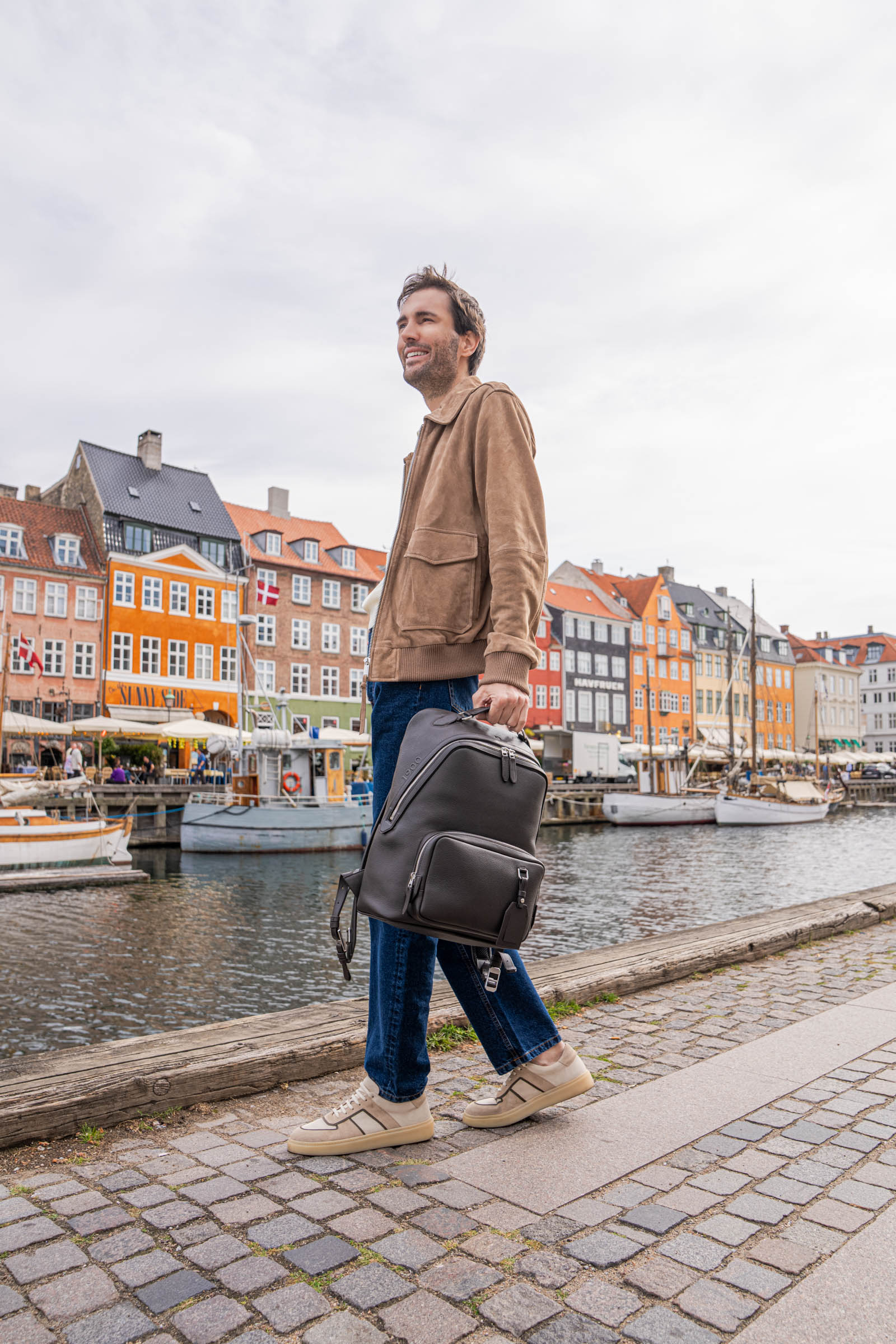
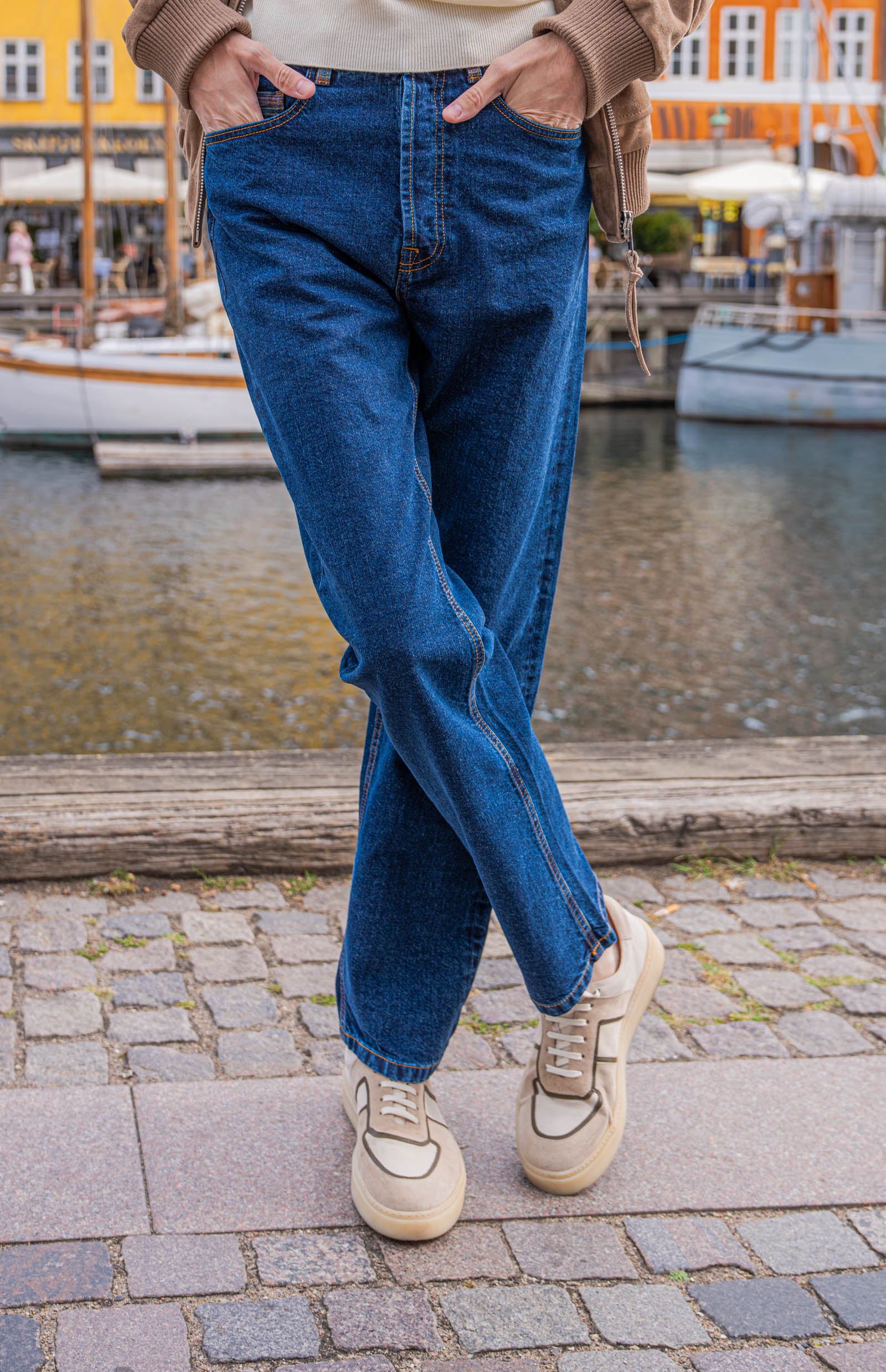
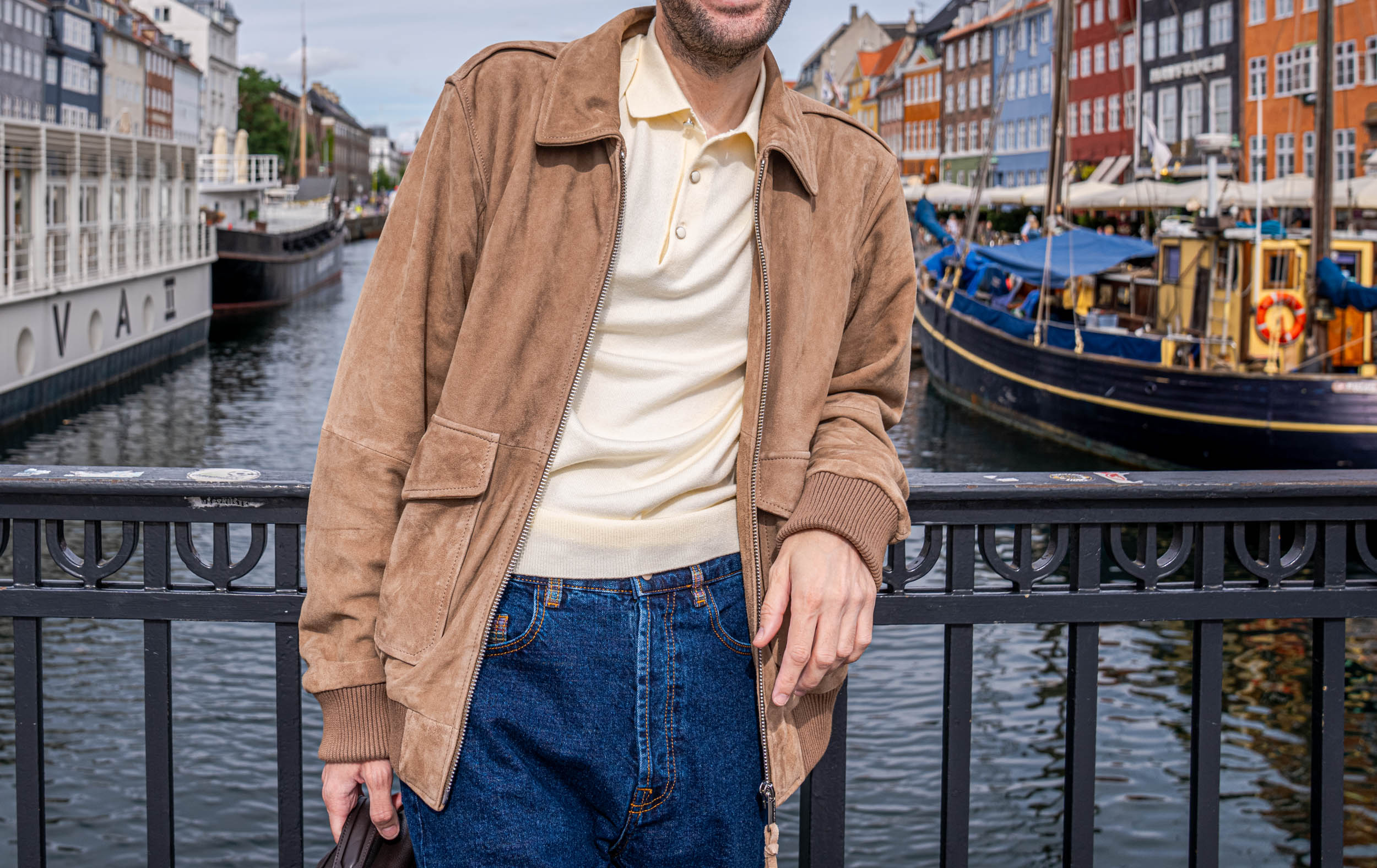
The rule I apply is as follows: the main piece of clothing, in this case the jacket, stands out, while the rest of the outfit complements the whole story. That’s why I brought a butter coloured polo underneath, without a single visible logo. The jeans remained classic and dark blue, with a relaxed leg.
Tod’s suede jacket looks best unbuttoned. Two vertical zip lines are then visible, elongating the silhouette. When I zip it up only a third of the way, I get a slightly tighter look, suitable for colder mornings.
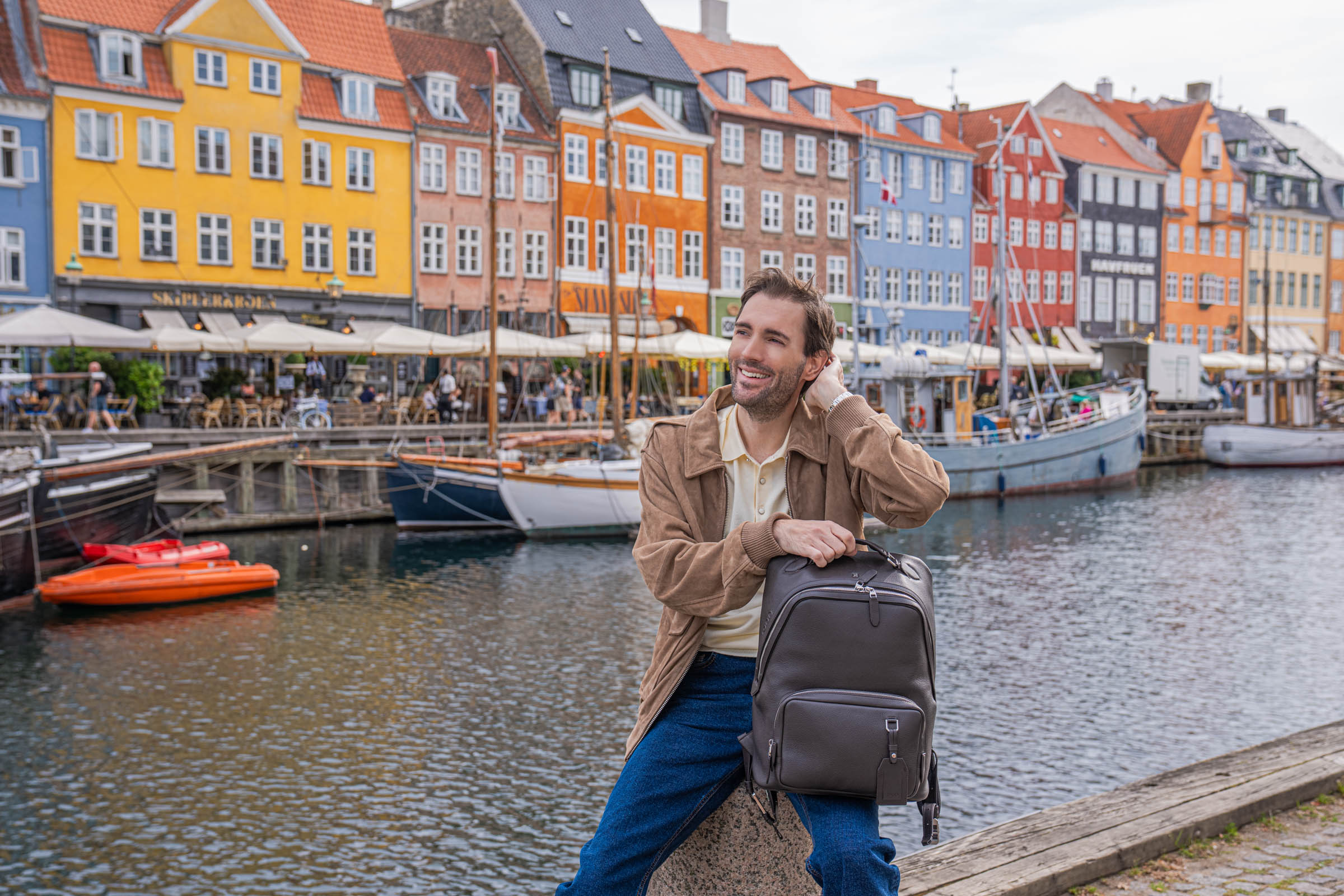
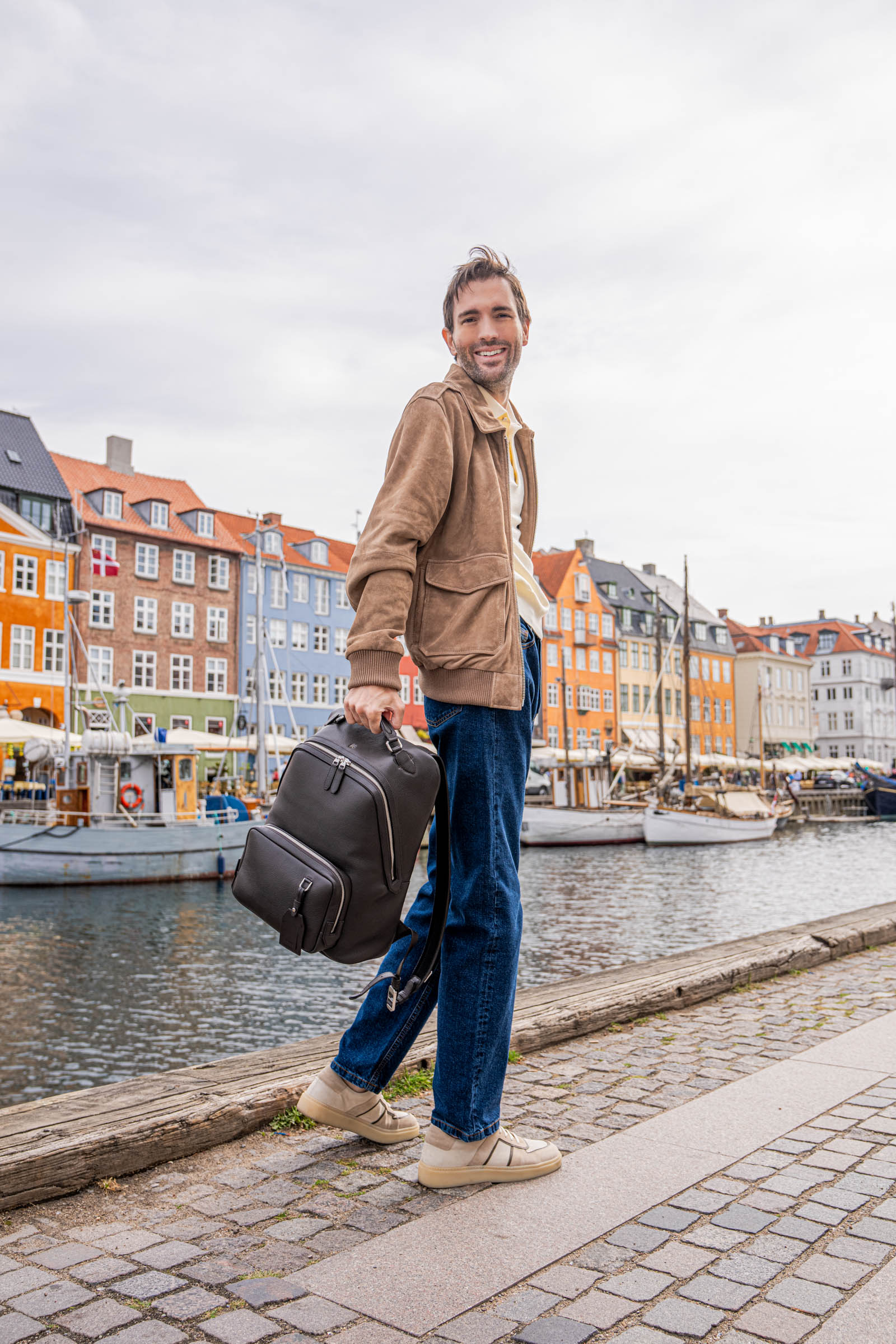
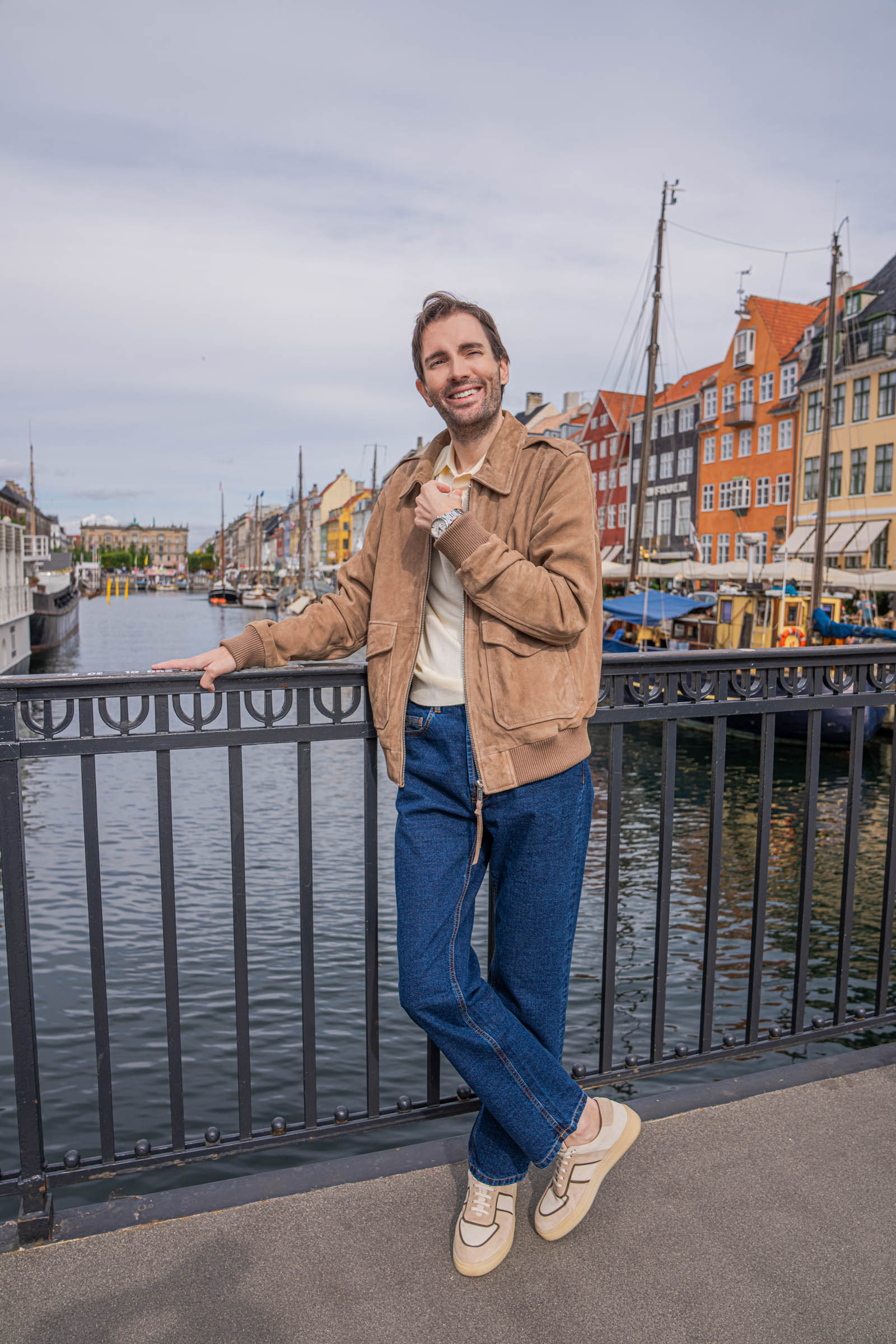
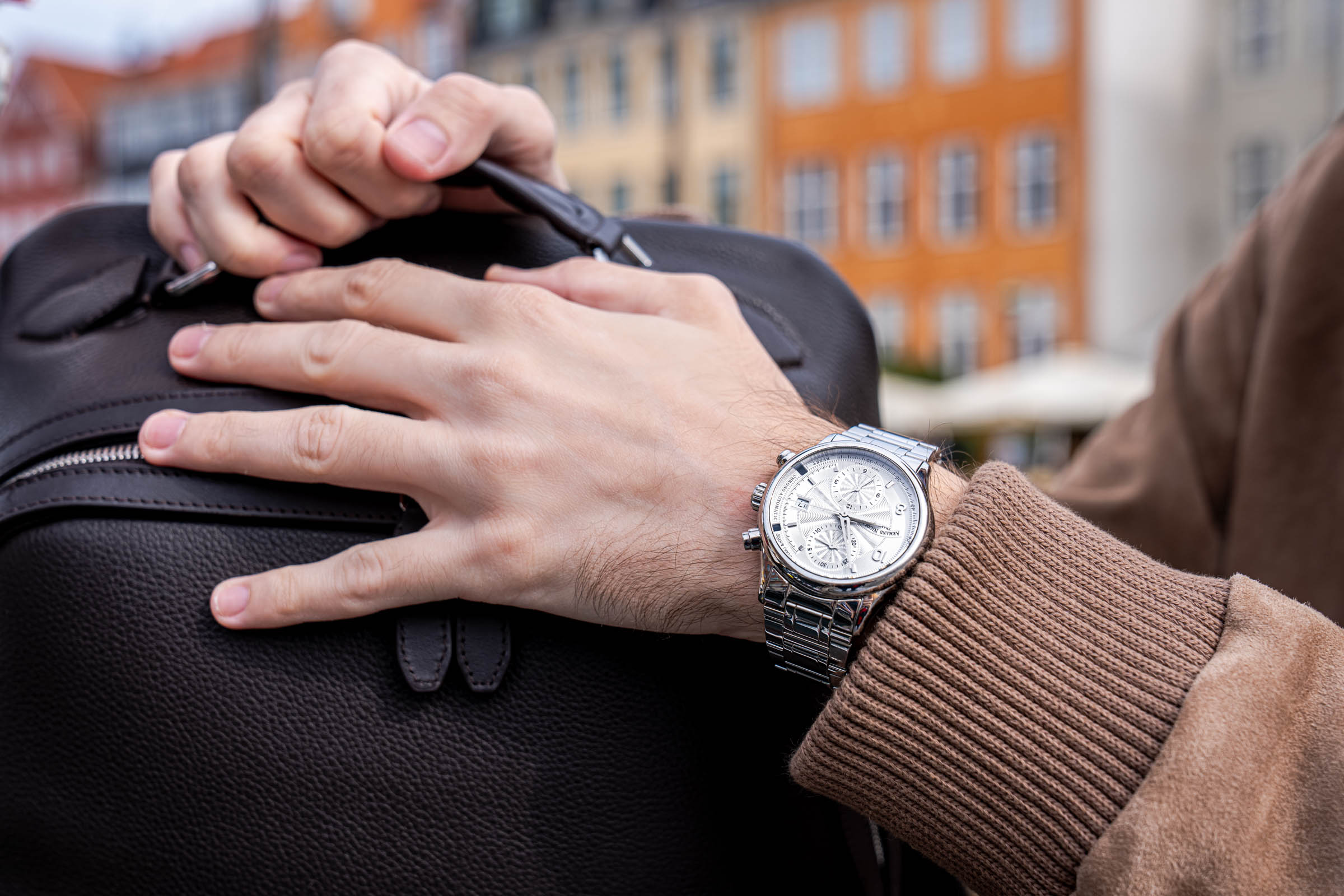
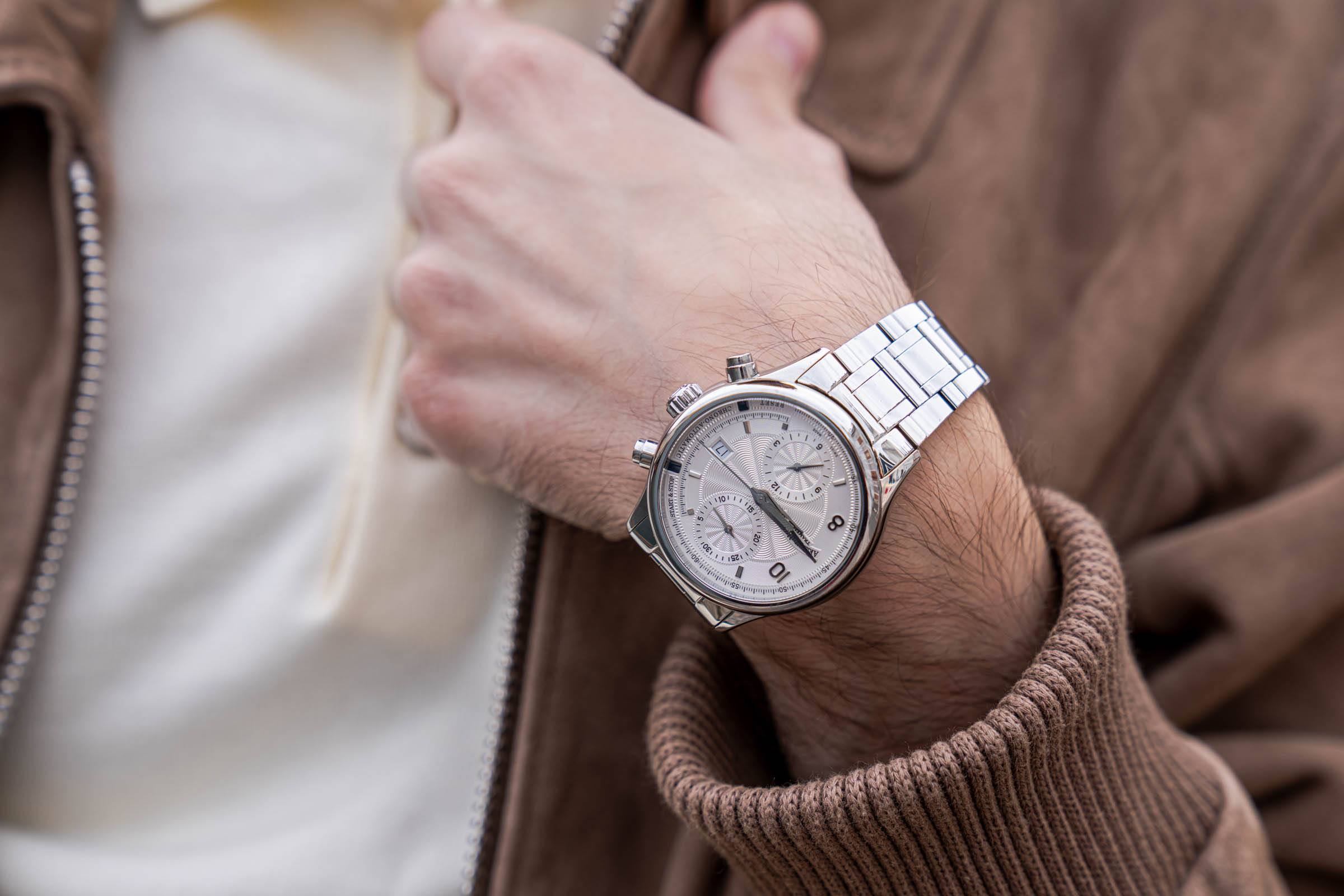
The length of the sleeves deserves attention. The ribbed cuff should sit exactly at the wrist, so it reveals the watch when the hand moves. The photos from the quay show exactly that relationship between the jacket and the watch. The color of the shoes holds the whole outfit together. Sand sneakers repeat the tone of the jacket, only a few shades lighter. Because of this, the eye travels from top to bottom without interruption, so the figure appears taller.
I would change only two things for the evening. Instead of sneakers, I would wear dark brown moccasins, and instead of jeans, I would bring classic cut pants. The jacket would remain the same, but the impression would change completely. This is precisely where I see its greatest value.


OUTFIT
Suede Jacket: Tod’s
Silk Knit Polo: Tod’s
Watch: Armand Nicolet
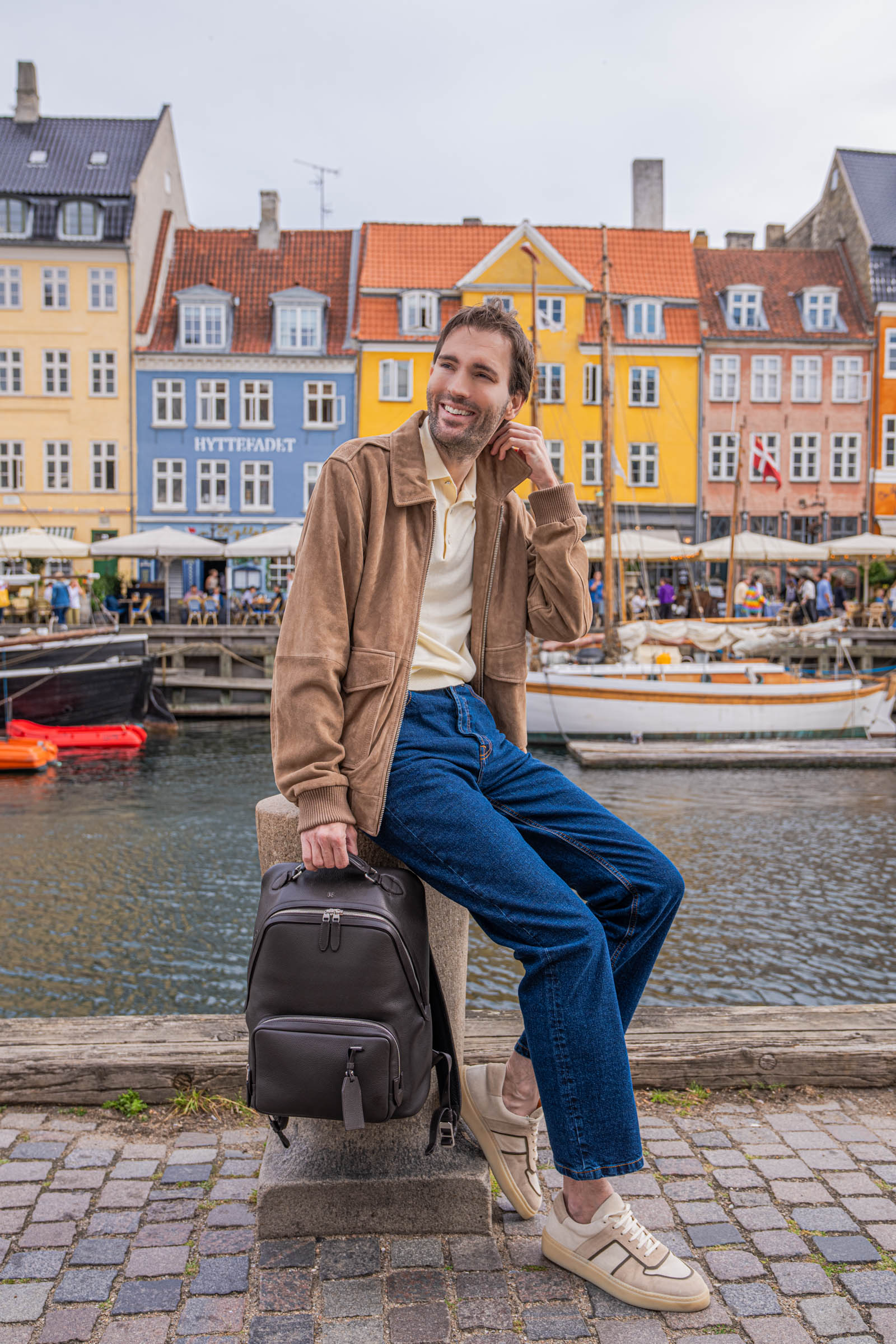
Backpack: 1900
Denim (Jeans): Missoni
Sneakers: Carlos Santos
WHY I CHOSE NYHAVN FOR THIS FASHION STORY
Nyhavn means New Harbor in Danish. The canal was dug between 1670 and 1673, by order of King Christian the Fifth. The plan was drawn up by the Dutch fortification engineer Henrik Ruse. The work was carried out by Danish soldiers and Swedish prisoners of war from the war that was fought from 1658 to 1660.
The purpose was completely practical. The canal connected the sea with the old city center near Kongens Nytorv. Ships unloaded cargo and fish there, so the area had a bad reputation for a long time. Beer, sailors and fights were part of everyday life.
You don’t suspect any of that today. The north side of the canal has a row of houses made of wood, brick and plaster, painted in yellow, blue, red and ochre. The oldest among them is number 9 and dates from 1681.
When you look more closely at the photos, you will recognize the inscriptions on the facades. Hyttefadet, Skipperkroen and Havfruen have stood in the same places for years. The latter name means mermaid, a sweet connection to Denmark’s most famous statue.
The south side looks completely different. Luxurious palaces are lined up there, including Charlottenborg. Since 1977, that part of the canal belongs to the museum port, so berths are reserved for old ships. Nyhavn is only the beginning of what this city does with water and colour. The full walk is in Letters from Denmark: Copenhagen, From Nyhavn to the Little Mermaid.
WHAT TRACES DID HANS CHRISTIAN ANDERSEN LEAVE IN NYHAVN?
Hans Christian Andersen spent about eighteen years of his life along this canal. He changed addresses but never left Nyhavn. When you walk along the quay, you pass three houses that were his home.
The first bears the number 20. He lived there at the time he published his first fairy tales. The building was built at the end of the seventies of the eighteenth century, and today there is a commemorative plaque on the facade.
The second address bears the number 67. The house was built in the eighteenth century, and Andersen spent the longest period in it. And there a plaque with his name welcomes visitors.
The last address is number 18. The writer moved there in 1871 and lived there until the final months of his life. Today, the building hosts visiting artists and scientists.
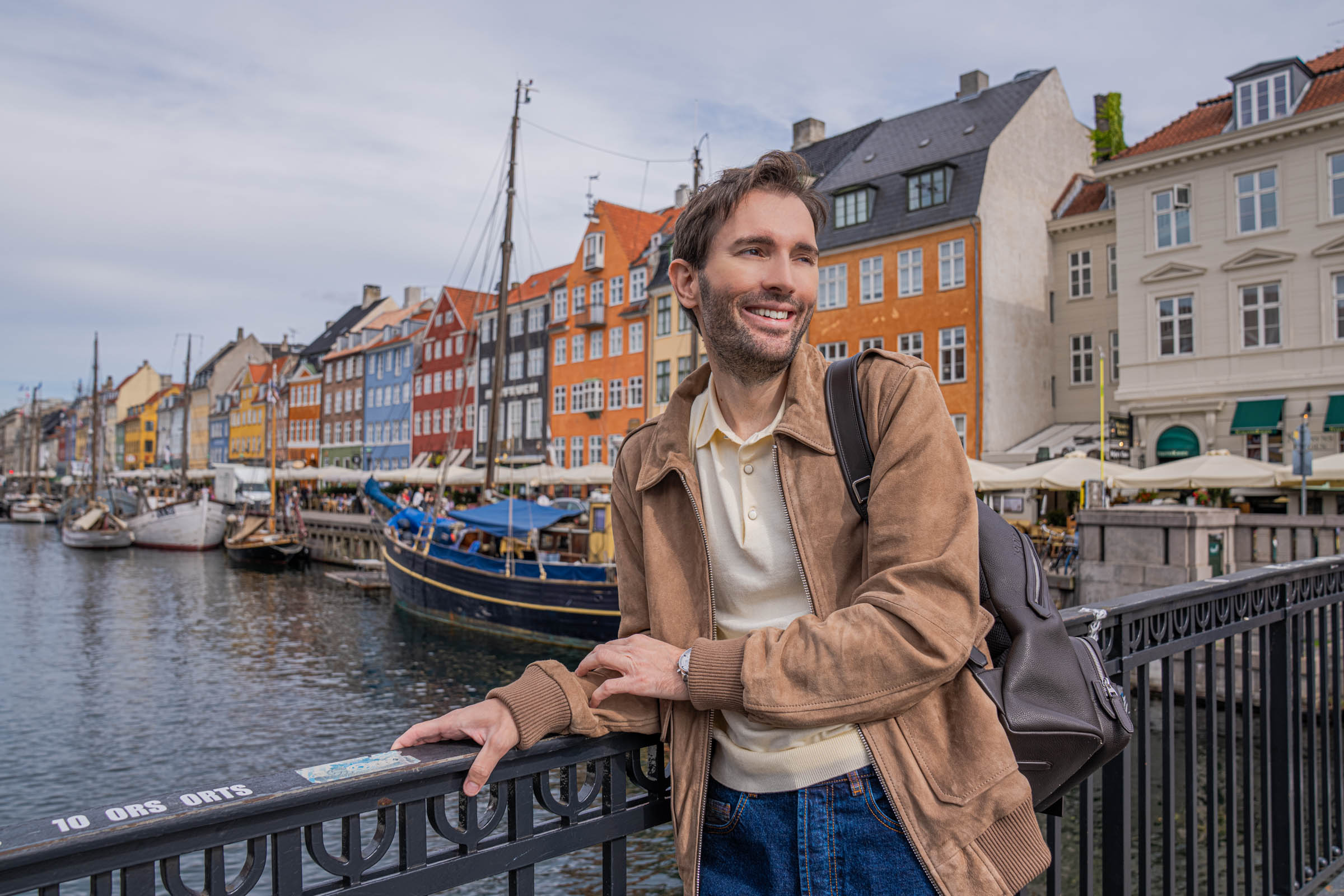
The bridge over the canal also has its own story. The first crossing was temporary, wooden, and was opened in 1874. The current bridge has been standing in that place since 1912. In several photos, I’m leaning on its railing, next to a lamppost covered in stickers.
I love that the mix still works. One bridge connects fairy tales, sailboats and tourists with cameras.

HOW DOES MISSONI DENIM ELEVATE THIS LOOK?
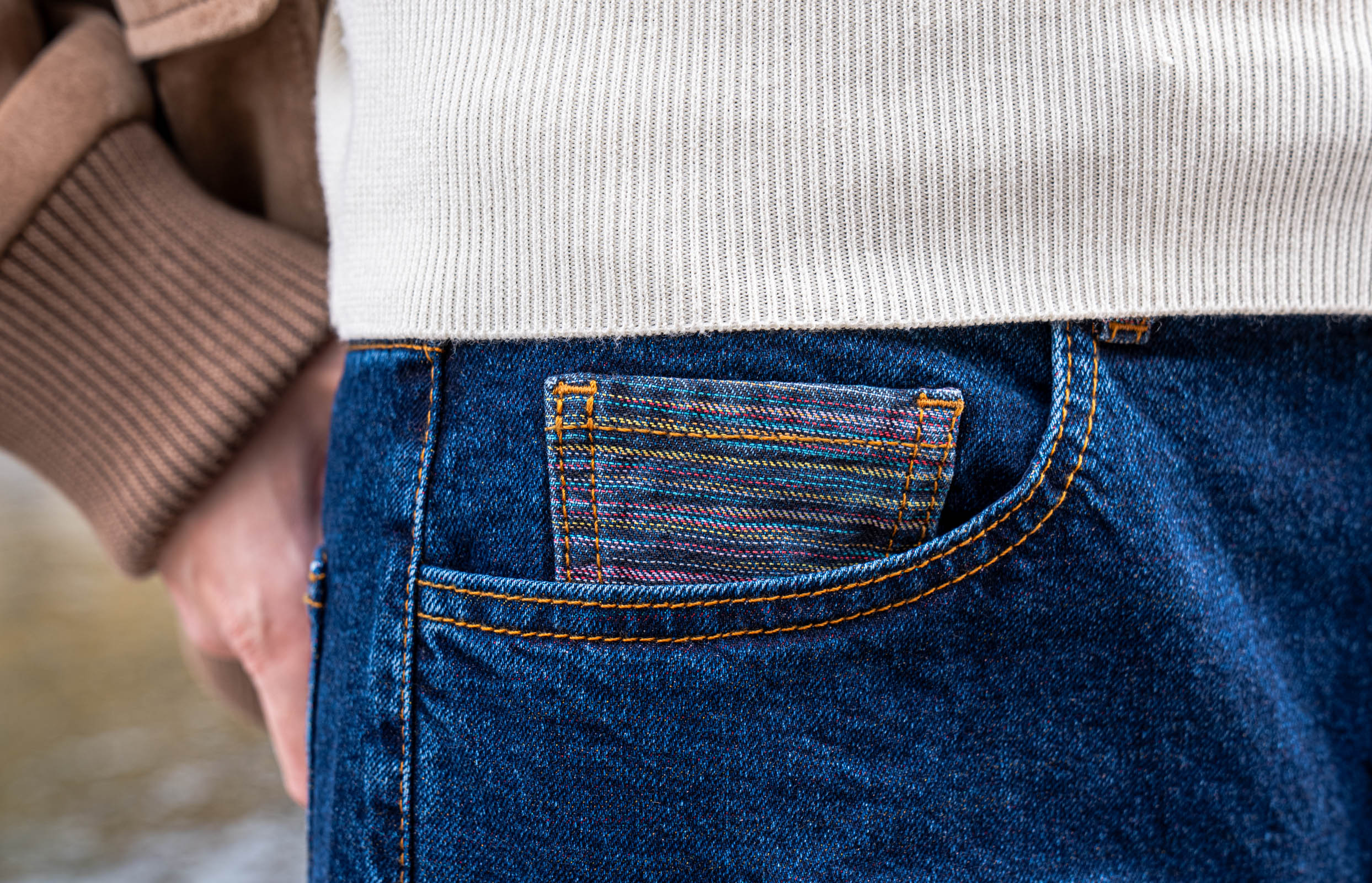
The jeans I wear are signed by the Italian company Missoni. The cut is intentionally unobtrusive: high waist, straight leg and classic five pockets. The indigo is darker than most models today, so it goes well with the caramel color of the jacket.
A small coin pocket hides the surprise. Its interior is lined with fabric with colorful stripes, in turquoise, yellow, red and gray. That detail bears the signature of the house without any logo. The photo from the second part of this story shows it up close.
The story of the Missoni house begins in 1953 in Gallarate. Ottavio, whom everyone called Tai, and Rosita Missoni opened a small knitting workshop. They met five years earlier, in London. He then ran the final of the four hundred meter hurdles race at the Olympic Games.
Everything changed when they discovered the Raschel knitting machine. That machine made it possible to knit multiple colors in the form of a zigzag line. This is how the sign that the whole world recognizes, known as fiammato, was born.
The first big job came in 1958. The Rinascente department store ordered five hundred dresses with vertical stripes. They were the first dresses with the Missoni label.
HOW DID THE MISSONI FAMILY CHANGE ITALIAN FASHION?
The house moved to Sumirago near Varese, where the family built both a factory and a home. The windows looked out on the Monte Rosa mountain, which Rosita was particularly fond of. Colors from those slopes often ended up on knitted pieces.
They staged their first Missoni fashion show in Milan in 1966. The very next year, an incident took place that went down in fashion history. At a fashion show in Florence’s Pitti Palace, Rosita noticed that the models’ bras were showing under the thin material.
She asked the girls to take them off. Under the strong spotlights, the dresses became transparent, and the news went around the world. The house received huge attention overnight and Milan began its rise as a fashion capital.
The founders handed over the business to their children in 1997. Ottavio died in May 2013, at the age of ninety-two. Rosita left us on January 1, 2025, at the age of ninety-three.
When I put on their jeans today, I think about that tenacity. Seven decades of work in the same place, with the same signature. That’s why I don’t see the hidden colorful pocket as an ornament. I experience it as a signature of a family.
TOD’S: WHY DOES A SILK POLO KNIT CHANGE THE WHOLE LOOK?
Underneath the jacket I wear a Tod’s polo knit, in the color of butter. It is knitted from silk thread, with short sleeves and two buttons. The edges of the sleeves and the bottom have a ribbed finish, so the polo knit falls nicely over the waist.
Silk here does three things at once. First, it gives a quiet sheen that smooth cotton never achieves. Second, it cools the body during the day, because the fiber allows air to pass through. Third, it holds the shape of the collar without any stiffening tape.
The collar deserves special praise. It sits softly, but does not fall over the collar of the jacket. Therefore, the appearance remains neat even when I unbutton the top button.
The color is carefully chosen. Butter is warmer than white and much milder than yellow. With caramel suede it creates a gentle transition, instead of a sharp border. A white t-shirt would look rough in this place.
This knit polo solves a common problem. Men in their fifties often choose between overly sporty and overly formal outerwear. A knit polo falls right in between. It looks smart under a blazer, and completely relaxed with the suede jacket and jeans.

ARMAND NICOLET: WHO IS BEHIND THE WATCH BRAND?
I wear a Swiss watch by Armand Nicolet. The story of this house begins in 1875 in Tramelan, a mountain village in the Bernese Jura. Armand Nicolet, the son of a watchmaker, then opened his own workshop.
Already by 1902, the workshop was making pocket watches with great complications. One example had a rose gold case, an enamel dial, a single-button chronograph, a full calendar, and a mechanism that strikes the hours and minutes. Several such pieces are still standing today in the house museum in Tramelan.
The founder died in 1939, so his son Willy took over the business. Under his management, the workshop grew into a large manufacturer of mechanisms for other brands.
The seventies and eighties brought the most severe crisis. Quartz movements flooded the market, and many old Swiss houses closed their doors. Armand Nicolet survived thanks to reputation and cooperation with big names.
A new era began in 1987. Willy Nicolet then met Rolando Braga, an Italian lover of watches. That acquaintance gave the house a direction that it still follows today.

ARMAND NICOLET A844AAA-AG-M9742: WHAT’S BEHIND THE REFERENCE?
The Armand Nicolet model I’m wearing belongs to the M02-4 line. The stainless steel case has a diameter of 42 millimeters. It comes with a steel bracelet with a folding clasp.
The dial is the most beautiful part of this watch. The silvery surface is decorated with the guilloche technique, so the light travels through tiny concentric lines. This is why the tone changes with each hand movement. In the photos taken along the canal itself, it is clearly visible.
It is a self-winding chronograph. Inside is the Sellita SW500 movement. Two small dials keep track of the elapsed time, while a date window sits at three o’clock.
The case is protected by scratch-resistant sapphire crystal. The back is transparent, so the mechanism can be seen without any tools. Water resistance of one hundred meters covers all everyday situations.
What makes this watch special is the price-performance ratio. A Swiss chronograph with a guilloché dial and transparent back usually costs much more. A house with a history of more than a hundred years offers here a serious piece, without loud marketing.
With caramel suede, steel looks clean and calm. The silver dial echoes the tone of the zipper, rounding off the whole look.
1900 & THE TEMPO GRANDE BACKPACK: THE STORY BEHIND THEIR CREATION
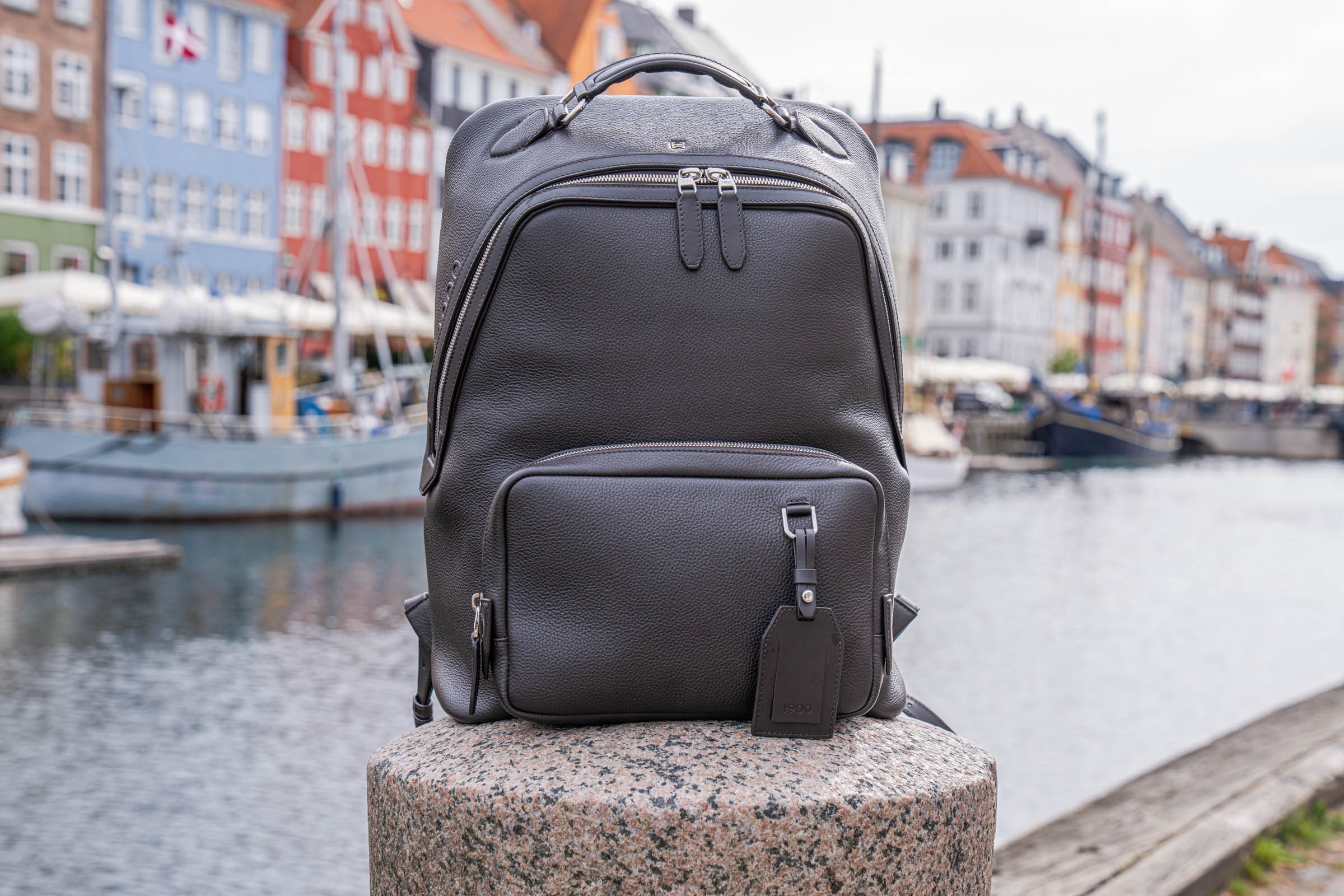
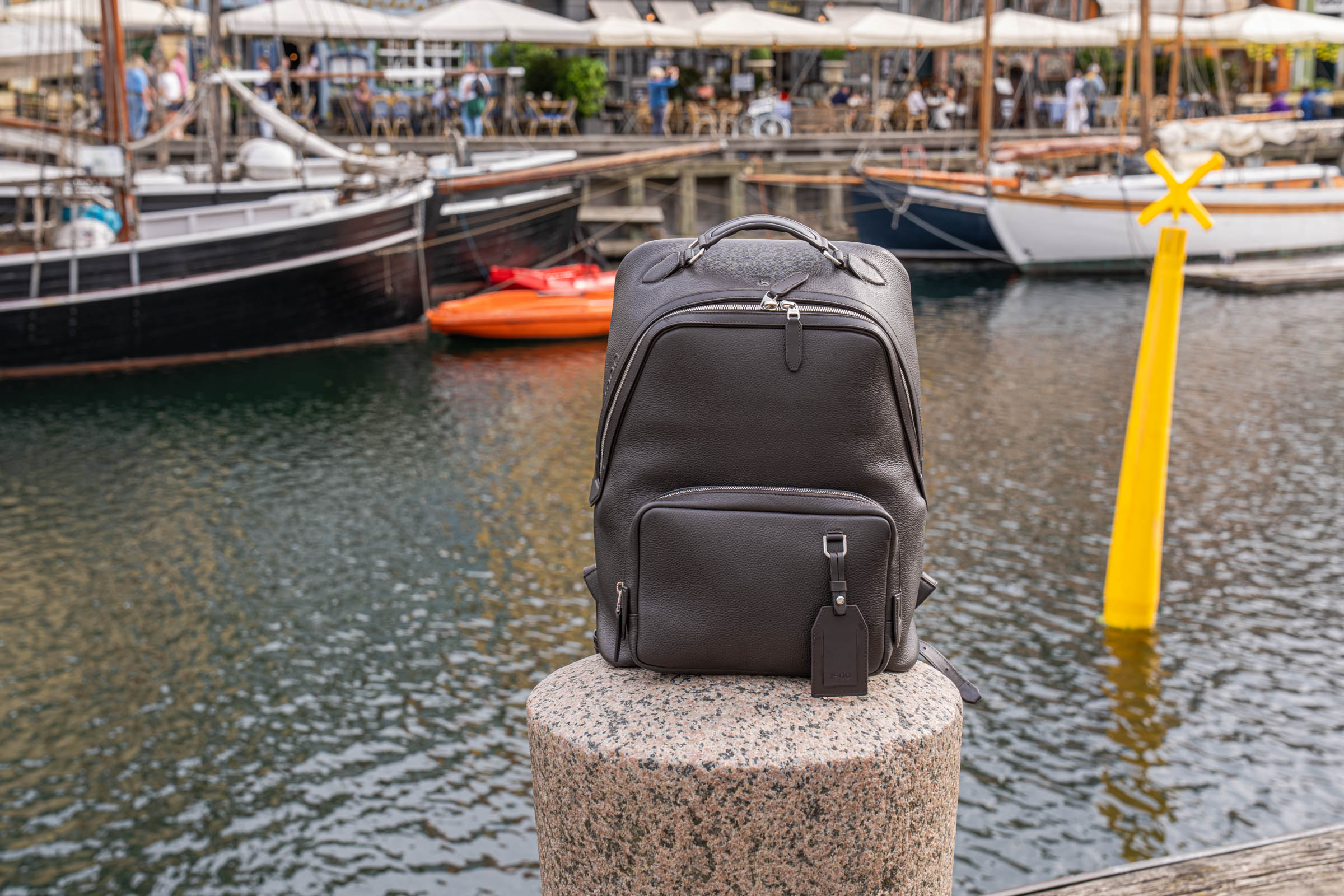
The Tempo Grande backpack I’m wearing is signed by the brand 1900. Behind it stands the family company Manifattura Ceraolo Moroni, with more than forty years of experience. For decades, they have been making luxury packaging and leather accessories for major watch and jewelry houses.
The brand name hides an interesting game. The abbreviation MCM, written in Roman numerals, gives the number 1900. The heritage is thus written into the name itself.
The philosophy boils down to one sentence from their story. True luxury is not exaggeration, but balance, precision and attention to detail. Production is designed in Italy, and engineering is done in Switzerland.
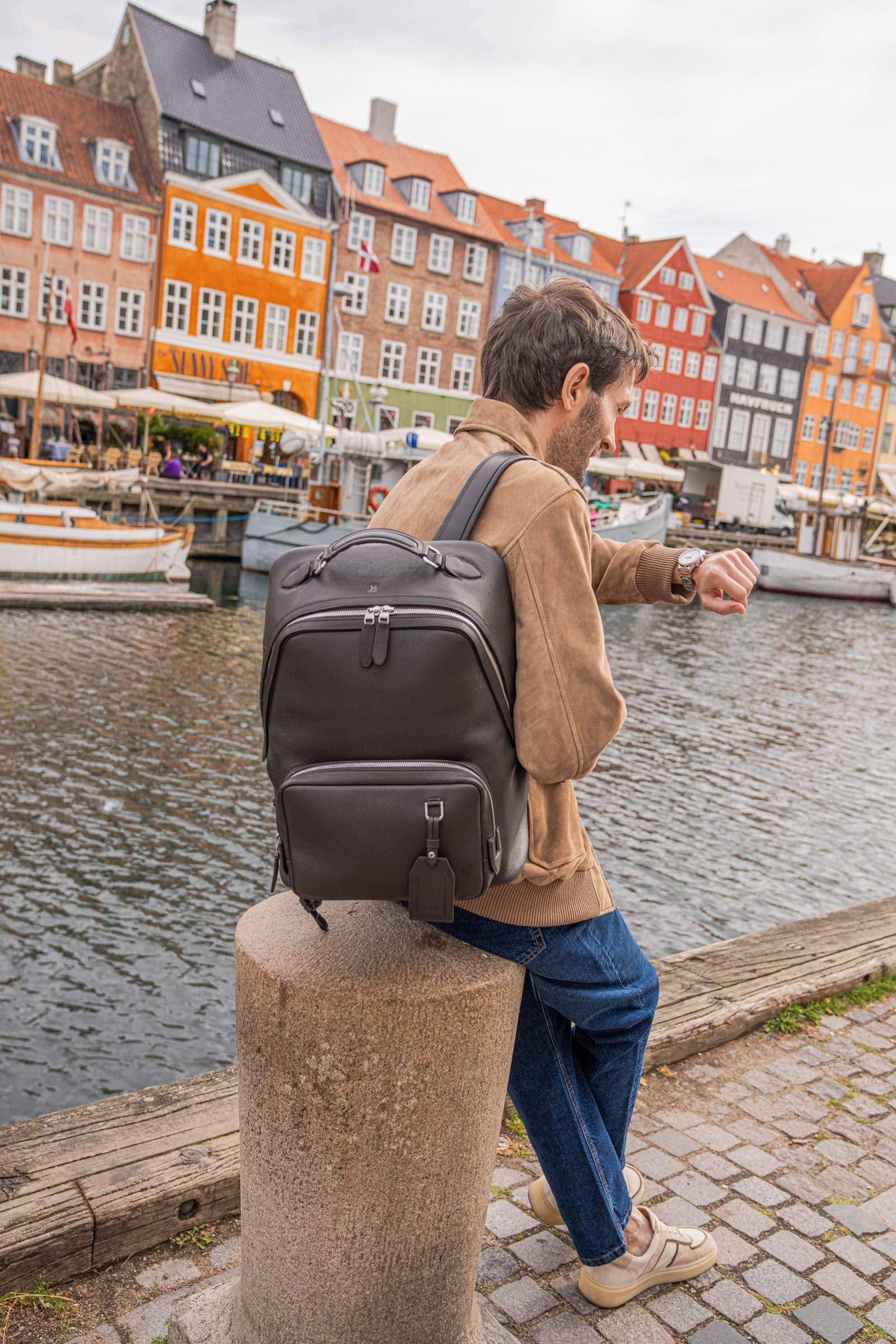
I particularly like one detail. The metal parts were made exclusively for this brand, and they looked for inspiration in the watch cases of Gérald Genta. When you hold the buckle in your hand, that connection becomes completely clear.
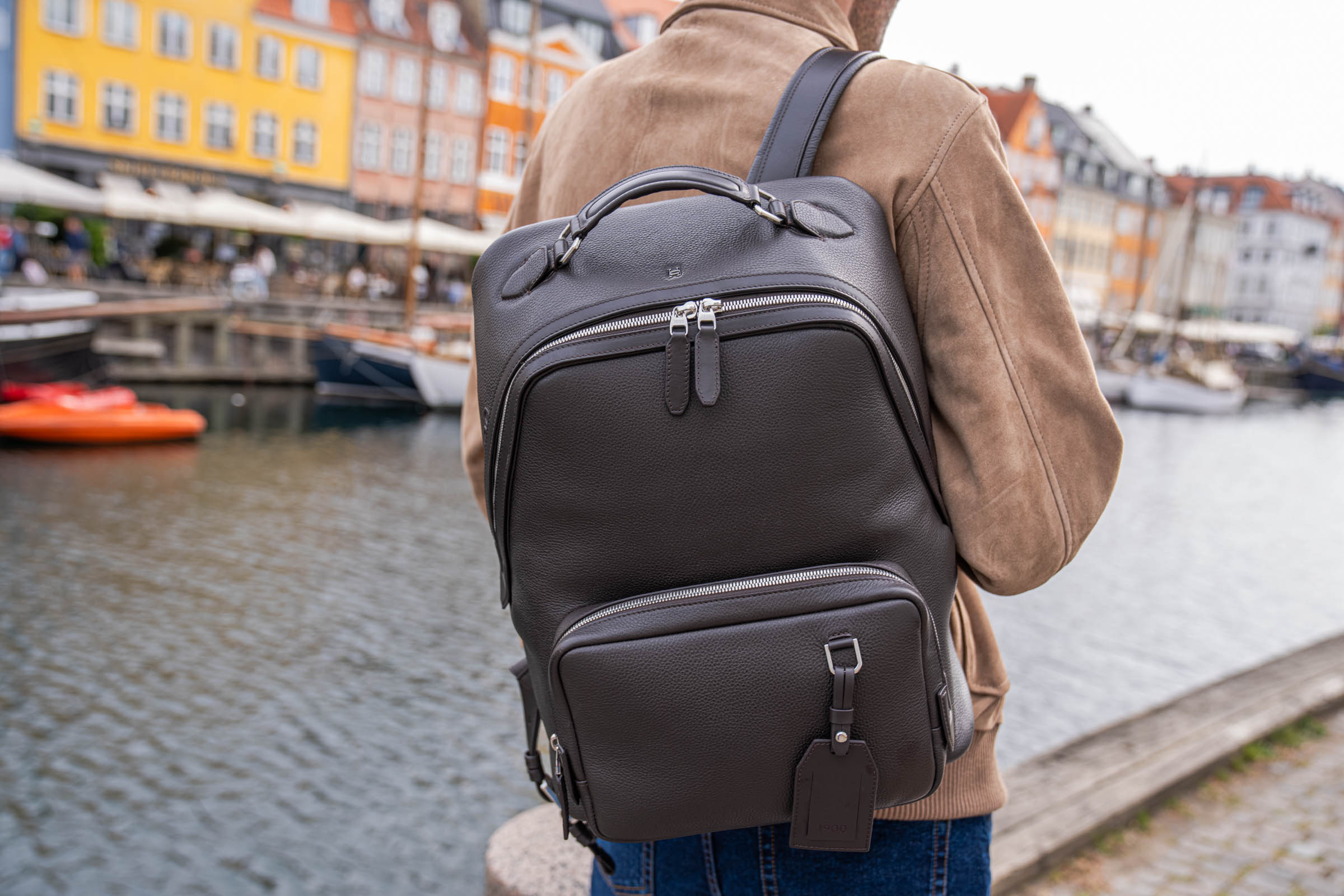
The backpack model I’m wearing is called the Tempo Grande. It is made of grained leather, with brushed leather inserts. A distinctive detail is the angled zipper, which goes over the upper part of the backpack.
The interior is well thought out. There’s a padded laptop compartment, phone pocket, card holder, key hook and two pen holders. There are two pockets on the outside with a zipper.


WHY DO CARLOS SANTOS SNEAKERS DESERVE YOUR ATTENTION?
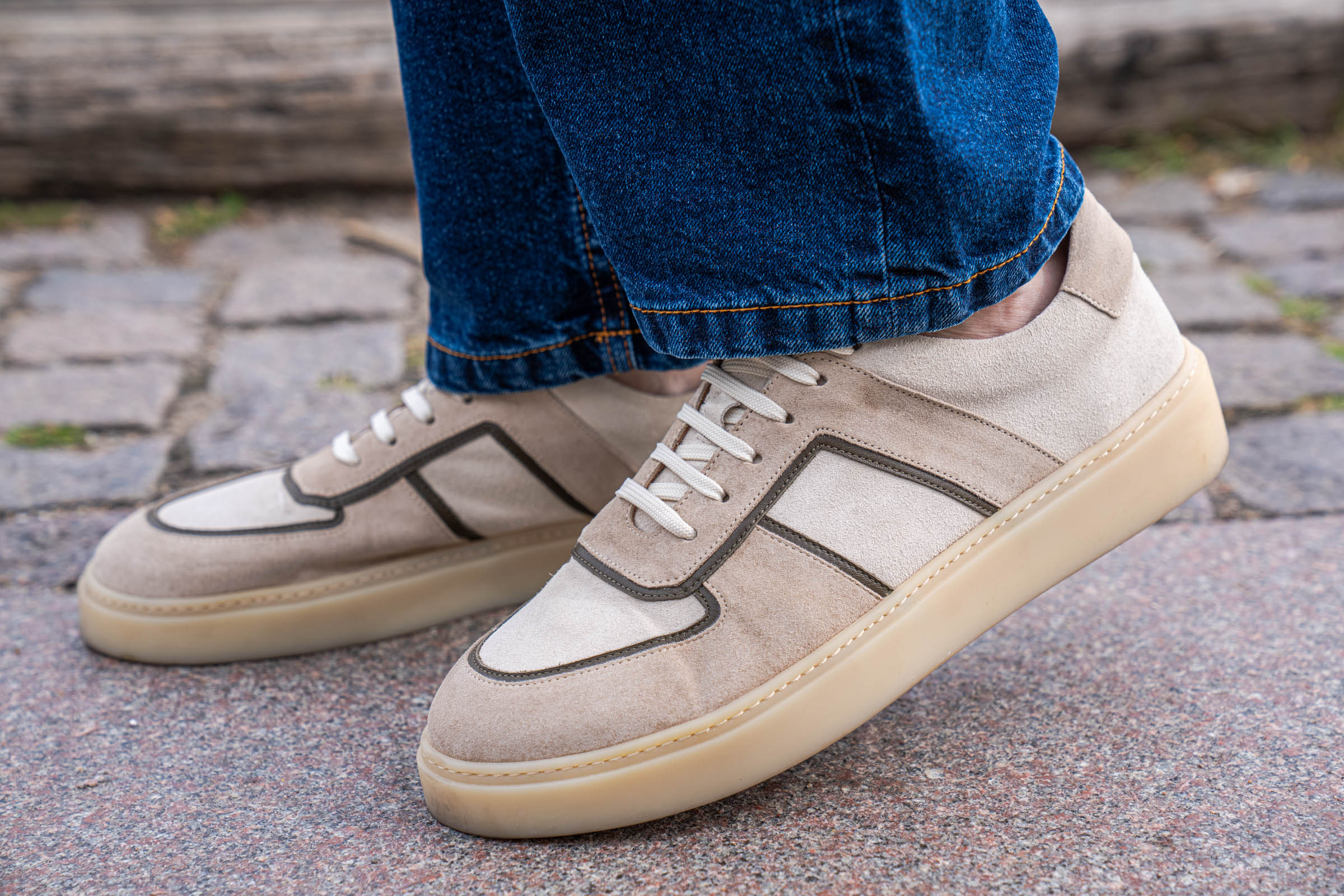
On my feet I am wearing the Lonnie model from the Portuguese house Carlos Santos. The upper combines suede in two shades of sand, with thin dark lines following the cut. The beige sole provides warmth that white rubber would never provide.
The founder’s story begins very early. Carlos Santos started working in the shoe industry at the age of fourteen, at the Zarco company in São João da Madeira. It was the late sixties, in a country that didn’t think about luxury back then.


The young man ran from the office to the factory to watch the shoes being made. Later, he traveled the world, visited fashion shows and bought expensive shoes that he never wore. He took them apart in order to understand the techniques of the great masters.
Over time, he became a co-owner and then the sole owner of the company he started with. Today, the house has more than seventy years of history. Daughter Ana and son Armando work with the founder.
The Lonnie model uses the so-called Strobel construction. Thanks to it, the sneaker is soft and flexible from the first day. After walking all day on cobblestones, I felt it very clearly.

HOW DOES THE COLOUR PALETTE HOLD THE WHOLE LOOK TOGETHER?
When I look at these photos, I see three color families. The first is warm and sandy: jacket, polo and sneakers. The other is cold and blue: jeans. The third is dark and calm: backpack and steel on hand.
The relationship between them is not accidental. Warm tones occupy the largest area, so they lead the whole impression. Blue serves as a base that casts the gaze downward. Dark brown and steel work as fulcrums.
This approach has one big advantage. You can replace each piece without tearing down the whole. A white t-shirt, gray sweater or olive pants would fit in without a second thought. The backdrop played its part. The houses in Nyhavn are yellow, red, blue and ocher. If I had worn something colorful, the look would have faded into the background. A calm palette was therefore the only sensible choice.
There is also a practical reason. I travel often, and my luggage is always limited. When all the pieces share the same color family, I get five or six different combinations out of one suitcase.

WHAT DOES THIS APPROACH MEAN FOR MEN’S TIMELESS STYLE?
Over the years, I stopped chasing novelties. Instead I build a wardrobe that repeats but never gets boring. Tod’s suede jacket perfectly describes that mindset.
It has no expiration date. The same cut existed thirty years ago and will exist in thirty years. That’s why I look at the cost spread over many seasons, not just one.
I apply the same rule to everything else. A watch with a mechanical movement lasts for decades with regular servicing. A genuine leather backpack becomes more beautiful when it gets the first signs of use. Suede sneakers can be cleaned and refreshed.
There is also a quieter, more personal side to this story. When I know everything in my wardrobe works together, I do not waste time in the morning. I open the closet, take my jacket and go out. That simplicity is worth more than it sounds. I always give the same advice to men who are just building this kind of wardrobe. Start with one great piece of outerwear. You can build everything else slowly, around it.
COPENHAGEN: WHAT WILL STAY WITH ME AFTER THIS TRIP?
Copenhagen has a special rhythm. People walk more slowly than in Milan, and on the street they experiment with color more than I expected. Even so, that boldness rests on material and cut rather than on brand names.
That is exactly why this city seemed like the right place for this story. The Tod’s suede jacket does not ask for attention, but it always gets it. It follows the same logic as Danish design: fewer parts, better materials, longer life.
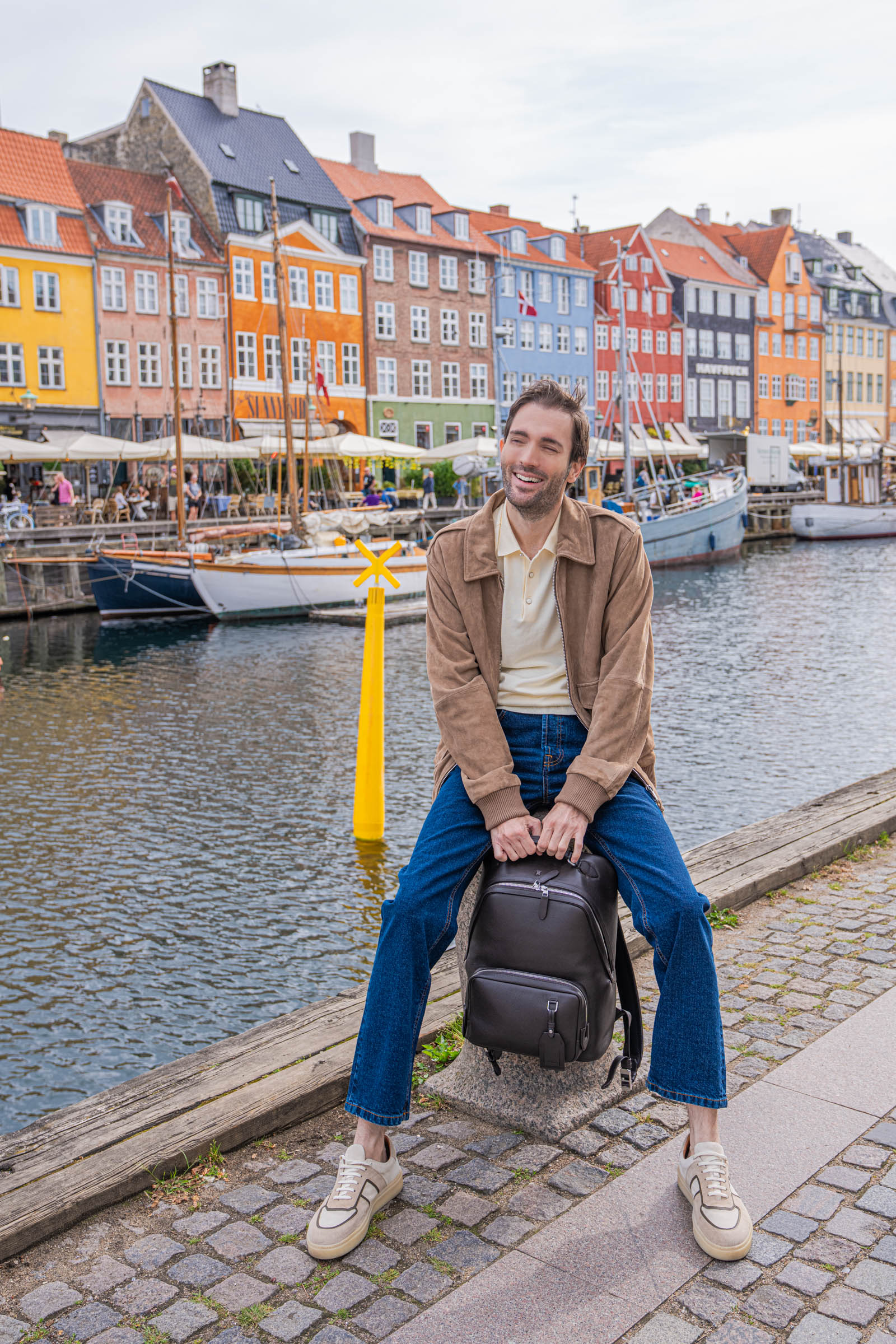
While sitting on a stone bollard by the canal, I noticed something interesting. A few passers-by stopped to look at the jacket, but nobody searched for a logo. People recognize quality even without a label. I spent those days at Manon Les Suites Guldsmeden, a ten-minute walk from here, which turned out to be the right choice for a trip built around walking.
If you’ve been thinking about investing in a quality suede jacket, take this text as a little encouragement. Pick a color you already have in your closet, try on a few cuts, and pick one that makes you forget you’re wearing something new. That’s a sign that you guessed it!
How did you like my outfit today? I really tried to prepare this post with lots of love and I hope you like it! If you have any questions, comments, suggestions or messages for me, you can write me below in the comments. Of course, as always, you can contact me via e-mail or social networks, which you can find on the CONTACT page. See you soon in new fashion adventures on the Mr.M blog!
With Love from Copenhagen,
Mr.M

This post is sponsored by Tod’s, Missoni, 1900 (Manifattura Ceraolo Moroni), Armand Nicolet and Carlos Santos brands. This post is my personal and honest product review.
Hi Marko, I have followed your fashion stories for quite some time, and this may be one of the best examples of your ability to make an outfit feel connected to a place. Nyhavn is visually busy enough on its own, with all those coloured façades and historic boats, so choosing a restrained palette was a very intelligent decision. The caramel suede jacket does not compete with the background, yet it still has enough texture to remain interesting in the photographs. I also liked your explanation of why suede changes with wear rather than simply deteriorating. That is exactly how… Read more »
Hej Marko, det här inlägget fångade min uppmärksamhet eftersom du inte bara visar kläderna utan också förklarar varför de fungerar tillsammans. Nyhavn är en plats som många fotograferar på ett ganska förutsägbart sätt, men den lugna färgskalan i din outfit skapar en fin kontrast mot husens starka färger. Jag tycker särskilt om kombinationen av den mörka indigon och de varma sandtonerna. Det är en färgkombination som fungerar utmärkt även utanför modefotografering. Jag har själv ett par äldre Tod’s Gommino och känner igen det du skriver om märkets fokus på material och komfort. Den stickade sidenpolon var dock den detalj som… Read more »
Bonjour Marko, j’ai particulièrement apprécié votre réflexion sur le fait qu’un vêtement intemporel ne doit pas nécessairement paraître ancien ou conservateur. Votre veste en daim possède une silhouette très classique, mais l’association avec le jean Missoni et les baskets Carlos Santos lui donne une lecture beaucoup plus actuelle. Je possède moi-même une veste en daim brun chocolat depuis plus de dix ans et je confirme qu’elle est devenue plus intéressante avec le temps. Le daim demande une certaine attention, mais c’est précisément ce rapport à la matière qui rend ce type de vêtement attachant. J’ai également trouvé passionnante l’histoire de… Read more »
Hola Marko, lo que más me ha gustado de este conjunto es que no intenta demostrar demasiado. Cada pieza tiene personalidad, pero ninguna parece colocada únicamente para llamar la atención. Tengo unas zapatillas de ante en tonos beige y siempre he dudado sobre combinarlas con vaqueros oscuros, pero tus fotografías demuestran que la transición funciona muy bien cuando los tonos superiores mantienen cierta calidez. El reloj Armand Nicolet también me parece una elección interesante porque añade un elemento técnico sin romper la tranquilidad general del look. He conocido Nyhavn varias veces y sé lo difícil que resulta fotografiarse allí sin… Read more »
Hei Marko, jeg liker måten du forklarer sammenhengen mellom klærne og materialene i stedet for bare å presentere en liste over merker. Semsket skinn har en helt annen dybde enn glatt skinn, spesielt i naturlig lys, og det kommer tydelig frem på bildene fra Nyhavn. Jeg har en gammel semsket jakke fra italienske Valstar som jeg fortsatt bruker hver høst. Den har fått små spor av bruk, men det er nettopp det som gjør at jeg ikke ønsker å erstatte den. Derfor forstår jeg godt tanken din om at en jakke som aldri forandrer seg kanskje heller aldri har blitt… Read more »
Ciao Marko, seguo con piacere le tue storie di moda perché riesci a parlare di lusso senza trasformarlo in una gara di loghi. In questo outfit mi ha colpito soprattutto la coerenza tra materiali diversi: pelle scamosciata, seta, denim, acciaio e pelle granulata dello zaino. Sono superfici differenti, ma nessuna sembra estranea alle altre. Possiedo alcune scarpe Tod’s e riconosco quella particolare ricerca della comodità di cui parli nel post. Trovo inoltre molto interessante la storia del Gommino, soprattutto perché un oggetto nato da un’ispirazione funzionale è diventato un simbolo internazionale di stile. Il tuo look dimostra che l’eleganza italiana… Read more »
Marko, the discussion about the relationship between colour and proportion was probably the most useful part of this article for me. Many men understand individual colours but do not think enough about how the eye travels through an outfit. Here, the warm jacket and shoes create a clear visual connection, while the dark denim acts as a quieter foundation. I have often made the mistake of introducing a completely unrelated shoe colour, which immediately breaks that continuity. Your explanation of using steel and dark brown as smaller points of contrast also made perfect sense. I own several pieces from Carlos… Read more »
Beste Marko, ik vond dit een bijzonder goed voorbeeld van hoe een rustige outfit sterker kan worden door een uitgesproken omgeving. In Nyhavn zou een kleurrijke combinatie al snel concurreren met de huizen en boten op de achtergrond. Door voor beige, karamel en donkerblauw te kiezen, laat je de locatie spreken zonder zelf in de achtergrond te verdwijnen. Mijn favoriete detail zijn eigenlijk de Missoni-jeans. Het verborgen gekleurde detail in het muntzakje is precies het soort luxe dat ik interessanter vind dan een groot logo. Ik bezit een paar Missoni-breisels, maar wist niet dat dergelijke subtiele verwijzingen ook in hun… Read more »
Olá Marko, gostei especialmente da parte em que falaste sobre construir um guarda-roupa ao longo dos anos em vez de procurar constantemente novidades. Essa ideia torna-se ainda mais convincente quando vemos uma peça como esta jaqueta de camurça. Não é uma peça que depende de uma tendência específica e pode mudar completamente de carácter com pequenas alterações no restante conjunto. Tenho um casaco de camurça azul-marinho que comprei depois de ler uma das tuas histórias anteriores sobre a importância de investir em bons materiais. Ainda o uso frequentemente e percebi que acabou por se tornar uma das peças mais fáceis… Read more »
Marko, najbardziej przekonało mnie w tym wpisie to, że potraktowałeś ubrania jako przedmioty, które mają własną historię i mogą starzeć się razem z właścicielem. Dzisiaj zbyt często mówi się o „nowości” tak, jakby była największą wartością. Tymczasem dobra skórzana kurtka wygląda lepiej wtedy, gdy rzeczywiście jest noszona. Sam mam kurtkę z zamszu kupioną kilkanaście lat temu i mimo kilku drobnych śladów nie wyobrażam sobie jej wymiany. Bardzo spodobało mi się także zestawienie z ciemnymi jeansami, ponieważ pokazuje, że zamsz nie musi być kojarzony wyłącznie z bardzo formalnym stylem. Nyhavn stanowi tutaj znakomite tło, szczególnie dzięki kontrastowi między spokojną paletą stroju… Read more »
Hello Marko, as someone who has collected mechanical watches for many years, I was pleased that the watch was not treated merely as an accessory at the end of the outfit. The Armand Nicolet M02-4 has enough visual interest to stand on its own, particularly with the guilloché dial catching changing light. I tend to prefer watches that reveal something new depending on the angle rather than relying on an oversized case or aggressive colours. Your observation that the steel details echo the jacket’s hardware was also very perceptive. Those small connections are often subconscious, but they make an outfit… Read more »
Hallo Marko, ich habe deinen Beitrag mit großem Interesse gelesen, vor allem wegen deiner Gedanken zum Thema Wildlederpflege. Viele Männer behandeln Wildleder immer noch so, als sei es ein Material, das man bei der kleinsten Wolke im Schrank lassen muss. Deine Erklärung wirkt wesentlich realistischer und entspricht auch meiner Erfahrung. Ich besitze eine hellbraune Wildlederjacke von Loro Piana, die ich seit Jahren regelmäßig trage und die einige Regenschauer ohne Drama überstanden hat. Entscheidend ist tatsächlich der richtige Umgang danach und nicht die panische Vermeidung jedes Wassertropfens. Die Farbe deiner Tod’s Jacke gefällt mir besonders, weil sie weder zu hell noch… Read more »
Excelente historia, Marko. Me parece muy acertada tu observación sobre la diferencia entre una chaqueta que simplemente envejece y una que desarrolla carácter. El ante tiene esa capacidad de registrar el uso de una forma mucho más personal que muchos tejidos técnicos modernos. Yo tengo una chaqueta de gamuza de Brunello Cucinelli que utilizo menos de lo que debería precisamente por miedo a estropearla. Después de leer tu texto, creo que he estado tratando una prenda pensada para acompañarme como si fuera una pieza de museo. También me gustó mucho el contraste entre el reloj de acero y la suavidad… Read more »
Hei Marko, pidin erityisesti siitä, että kirjoitit Nyhavnista osana kokonaisuutta etkä vain kauniina taustana. Paikan historia ja värikäs arkkitehtuuri tekevät siitä mielenkiintoisen vastaparin hillitylle pukeutumiselle. Olen käynyt Kööpenhaminassa kahdesti ja muistan hyvin, kuinka voimakkaasti kanavan värit muuttuvat eri säässä. Siksi ymmärrän hyvin, miksi et halunnut lisätä asuun liikaa värejä. Missonin tummansininen denim toimii mielestäni erinomaisesti tasapainottavana elementtinä. Pieni värikäs yksityiskohta taskun sisällä on paljon kiinnostavampi kuin näkyvä brändimerkki. Tällaiset yksityiskohdat ovat usein juuri niitä, jotka tekevät vaatteesta omistajalleen erityisen.
Hi Marko, I found the section about the silk polo particularly interesting because it addresses a garment category many men still overlook. A good knitted polo can solve the awkward space between a shirt and a casual T-shirt remarkably well. The butter tone you chose is also more sophisticated than plain white, especially next to caramel suede. I own a few knitted polos from John Smedley, but mine are mostly in navy and charcoal because I have always been cautious with lighter shades. Your combination makes me think I should reconsider that. The softer collar seems particularly well suited to… Read more »
Marko, la parte dedicata a Missoni mi ha fatto sorridere perché è proprio quel piccolo dettaglio nascosto che considero il vero lusso. Chi indossa il capo sa che esiste, ma non sente il bisogno di mostrarlo continuamente agli altri. Possiedo un vecchio cardigan Missoni con una lavorazione interna che probabilmente nessuno ha mai notato tranne me. Eppure è proprio quella particolarità che mi fa scegliere quel capo più spesso di altri molto più costosi. La storia della famiglia Missoni è inoltre un promemoria importante di quanto una firma estetica coerente possa durare nel tempo. Il denim scuro nel tuo outfit… Read more »
Cher Marko, je trouve votre réflexion sur la montre particulièrement juste. Dans de nombreuses histoires de mode masculine, la montre est photographiée comme un simple signe extérieur de luxe, alors qu’elle possède souvent une histoire technique bien plus intéressante. Le cadran guilloché de votre Armand Nicolet apporte une texture différente de celle du daim et du denim. J’aime aussi le fait que vous ayez choisi un chronographe en acier plutôt qu’une pièce en or qui aurait rendu l’ensemble beaucoup plus formel. Je possède quelques chronographes équipés de mouvements issus de la même grande tradition suisse et je comprends parfaitement l’attrait… Read more »
Hallo Marko, wat mij opviel is hoe goed de rugzak van 1900 in dit verhaal past zonder eruit te zien als een typisch modeaccessoire. Veel luxe rugzakken zijn tegenwoordig zo nadrukkelijk ontworpen dat ze na een paar seizoenen gedateerd lijken. Dit model lijkt juist te vertrouwen op leer, proportie en functionele details. De verwijzing naar horlogekasten en het werk van Gérald Genta vond ik bijzonder interessant, omdat het een onverwachte verbinding legt tussen accessoires en horlogevormgeving. Ik reis zelf veel met een leren tas en weet hoe belangrijk een goed ingedeeld interieur is. Een mooie buitenkant is weinig waard als… Read more »
Hola Marko, sigo tus historias de moda desde hace tiempo y una de las razones es que nunca presentas las prendas como objetos aislados. En este caso, incluso la historia de Nyhavn ayuda a entender por qué elegiste una combinación tan serena. Recuerdo haber visitado Copenhague antes de la pandemia y pasar bastante tiempo observando las fachadas del canal, que parecen casi irreales en determinadas horas del día. Tu elección de tonos tierra evita competir con esa explosión visual. También me ha gustado que menciones a Andersen y sus diferentes direcciones en Nyhavn, porque añade una dimensión cultural a una… Read more »
Hej Marko, jag uppskattar att du vågar försvara idén om att upprepa kläder. Det låter självklart, men i dagens modevärld behandlas ibland varje plagg som om det måste ersättas efter en säsong. En välgjord mockajacka borde tvärtom bli en del av ens personliga stil. Jag har haft samma mörkbruna jacka i nästan ett decennium och använder den fortfarande både med jeans och flanellbyxor. Din Tod’s-jacka visar hur mycket en bra neutral färg kan göra. Den fungerar som ett centrum utan att dominera hela klädseln. Jag håller också med om att den öppna dragkedjan skapar en bättre vertikal linje. Det är… Read more »
Marko, I was fascinated by the historical connection you drew between Tod’s and the restoration of the Colosseum. It is easy to discuss craftsmanship in abstract terms, but cultural patronage adds another dimension to how one sees a company. I do not believe philanthropy should automatically excuse every corporate decision, yet I appreciate when successful businesses contribute to preserving something larger than themselves. Your point about questioning what stands behind the price of a luxury item resonated with me. I have become far less interested in buying something merely because it is expensive. Knowing where a brand comes from and… Read more »
Olá Marko, o que retirei deste artigo foi uma ideia muito prática: uma boa combinação não precisa de muitos elementos para parecer pensada. A jaqueta, a polo e os ténis pertencem à mesma família de tons, mas não são exatamente da mesma cor. Essa diferença é importante, porque um look totalmente monocromático pode facilmente tornar-se demasiado calculado. Os jeans Missoni introduzem profundidade sem chamar excessivamente a atenção. Tenho um par de jeans escuros da Incotex que uso frequentemente com sapatos castanhos, mas nunca tinha pensado em utilizar ténis de camurça numa tonalidade semelhante à de uma jaqueta. As tuas fotografias… Read more »
Cześć Marko, bardzo spodobało mi się Twoje podejście do pakowania na wyjazdy. Sam coraz częściej staram się zabierać mniej rzeczy, ale takich, które można łączyć na kilka sposobów. Ograniczona paleta kolorów rzeczywiście bardzo ułatwia tworzenie zestawów. Na przykład ciemne jeansy mogą pracować zarówno z jasną koszulą, jak i z dzianinowym polo czy lekką kurtką. Twój zestaw z Kopenhagi jest dobrym przykładem garderoby, która nie wymaga dodatkowego „specjalnego” elementu na każdą okazję. Szczególnie podoba mi się pomysł, aby wieczorem zmienić tylko buty i spodnie. Czy podczas tej podróży udało Ci się wykorzystać tę samą kurtkę również w zupełnie innej stylizacji?
Buongiorno Marko, da italiano ho letto con particolare interesse la parte dedicata alla nascita di Tod’s nelle Marche. È curioso come alcune delle più importanti storie della moda internazionale siano iniziate in luoghi che molti stranieri non saprebbero nemmeno indicare su una mappa. La tradizione calzaturiera della regione ha prodotto un tipo di conoscenza che non può essere creato semplicemente attraverso una buona campagna pubblicitaria. Possiedo un paio di Gommino da anni e, nonostante siano molto diversi dalla giacca che indossi, riconosco una filosofia comune nella morbidezza e nell’assenza di decorazioni inutili. Mi piace quando un marchio mantiene una coerenza… Read more »
Hello Marko, I have to admit that the Carlos Santos sneakers were the unexpected highlight of this look for me. I have known the brand primarily through its excellent Goodyear-welted shoes, so seeing a sneaker interpreted through a more traditional shoemaker’s perspective was refreshing. The two shades of suede are subtle enough to create depth without turning the shoe into a colour-blocking exercise. I also agree completely with your point about the beige sole. A bright white sole would have introduced a much sharper and more athletic note into an otherwise warm outfit. I have walked extensively in Copenhagen and… Read more »
Marko, det var intressant att läsa dina tankar om Köpenhamns sätt att klä sig. Som nordbo känner jag igen kontrasten mellan den ganska djärva personliga stilen på gatan och den mer återhållsamma designtradition som många förknippar med Skandinavien. Det är just därför jag tycker att din outfit fungerar så bra i staden. Den försöker inte imitera lokal street style utan behåller sin egen identitet. Nyhavn blir nästan en färgstark ram runt en mycket italiensk syn på material och proportioner. Jag uppskattar också att du inte försöker göra ”quiet luxury” till en uniform. För mig handlar bra stil snarare om att… Read more »
Marko, votre texte sur le vieillissement des objets m’a particulièrement parlé. Nous vivons dans une époque où l’on veut souvent conserver les choses dans leur état d’origine, comme si l’usage représentait une forme d’échec. Pourtant, un beau cuir, un sac bien conçu ou une montre mécanique sont précisément destinés à accompagner une vie. Les premières traces sur un objet de qualité peuvent être plus intéressantes qu’une perfection artificielle. J’ai un vieux sac en cuir italien qui a voyagé avec moi dans une grande partie de l’Europe et je serais incapable de le remplacer. Votre réflexion sur la veste en daim… Read more »
Hi Marko, your styling advice about revealing the watch by keeping the ribbed cuff close to the wrist is a detail that many men would probably never consciously consider. Yet it makes a considerable difference when the outfit is photographed or simply viewed in movement. A watch should feel integrated into the clothing rather than hidden beneath a sleeve all day. I also liked that the Armand Nicolet was chosen for more than its brand name. The guilloché surface, chronograph layout and visible movement all give the piece enough character to justify attention. I have a similar relationship with my… Read more »
Olá Marko, a história da marca 1900 foi uma das partes mais inesperadas para mim. Eu não conhecia a ligação entre a empresa familiar por trás da marca e o universo das caixas e acessórios para relojoaria. Isso explica, de certa forma, porque o design do Grande Tempo parece pensar tanto nos detalhes metálicos. Gosto de acessórios que tenham uma razão estrutural para existirem em vez de simplesmente copiar uma tendência visual. A inspiração nos desenhos associados a Gérald Genta também cria uma ponte interessante com o relógio que usaste. Tenho uma mochila de couro que raramente uso porque é… Read more »
Hej Marko, jag tycker att Nyhavn var ett smart val för just den här berättelsen eftersom platsen själv handlar om kontraster mellan historia och nutid. De gamla segelfartygen, de färgade husen och mängden moderna turister skapar en miljö som redan innehåller flera tidslager. Din outfit fungerar på ett liknande sätt. Bomberjackans silhuett har historiska rötter, medan sneakers och ryggsäck gör helheten tydligt samtida. Jag gillade särskilt att du nämnde Andersens koppling till området utan att göra artikeln till en vanlig turistguide. Det gav platsen mer djup. När man fotograferar mode på en välkänd plats är det lätt att bara använda… Read more »
Marko, tenho de elogiar a forma como explicaste a diferença entre branco e amarelo quando falaste da cor da polo. “Butter” é uma tonalidade difícil de escolher corretamente, porque um tom demasiado amarelo pode tornar-se imediatamente datado. Aqui, porém, parece funcionar como uma ponte entre o bege dos ténis e o caramelo da jaqueta. Essa é uma lição útil para quem acredita que as cores neutras precisam de ser cinzentas, pretas ou brancas. Existem muitos neutros quentes que podem tornar um guarda-roupa masculino muito mais interessante. Tenho uma polo de seda em tom marfim e agora estou a pensar que… Read more »
Bonjour Marko, j’ai apprécié la manière dont vous décrivez la construction d’une silhouette sans utiliser de règles rigides. Vous expliquez les lignes verticales créées par la fermeture ouverte, le rapport entre la longueur des manches et la montre, puis la continuité visuelle entre la veste et les chaussures. Ce sont des observations très concrètes. Trop souvent, les conseils de style masculin se limitent à des phrases vagues sur « l’élégance » sans jamais expliquer ce qui produit réellement une impression harmonieuse. Je possède plusieurs vestes courtes et je reconnais que la façon de les porter ouvertes ou fermées modifie complètement… Read more »
Marko, one aspect of the article that deserves attention is your refusal to separate craftsmanship from practicality. There is a tendency among enthusiasts to admire construction techniques while forgetting whether an object is pleasant to use. The best example here may be the Carlos Santos sneakers. Knowing that a shoe has a particular construction is interesting, but it becomes meaningful when you can walk comfortably for an entire day on Copenhagen’s streets. The same principle applies to the backpack and even to the jacket’s pocket placement. Good design is often invisible precisely because it works without demanding attention. I suspect… Read more »
Ciao Marko, mi è piaciuto molto il passaggio in cui dici che un capo costoso dovrebbe essere valutato nell’arco di molte stagioni e non soltanto al momento dell’acquisto. È un concetto semplice, ma cambia completamente il modo in cui si percepisce il prezzo. Una giacca ben fatta che viene indossata per dieci anni può avere più senso di cinque giacche economiche acquistate e dimenticate nello stesso periodo. Ho applicato questo ragionamento quando ho comprato il mio primo cappotto serio e non me ne sono mai pentito. Nel caso della tua Tod’s, la versatilità sembra essere l’argomento più forte a favore… Read more »
Hi Marko, I was struck by the way the different brands in this outfit occupy very different cultural territories without making the combination feel fragmented. Tod’s brings Italian leather craftsmanship, Missoni contributes its textile heritage, Armand Nicolet adds Swiss watchmaking, 1900 introduces a connection between Italian leatherwork and Swiss engineering, and Carlos Santos represents Portuguese shoemaking. On paper, that could easily become a collection of labels rather than an outfit. What prevents that is the restraint in colour and the absence of obvious logos. I think this is an excellent lesson for anyone who enjoys luxury fashion but does not… Read more »
Hei Marko, pidin siitä, että käsittelit mekaanista kelloa osana pitkäikäistä vaatekaappia. Usein puhutaan vain takeista ja kengistä, vaikka hyvä kello voi olla yksi henkilökohtaisimmista esineistä, joita mies käyttää vuosikymmeniä. Armand Nicoletin historia kvartsikriisin läpi selviytyneenä merkkinä tekee siitä mielestäni kiinnostavamman kuin monista uusista mikrobrändeistä. Myös 42 millimetrin koko tuntuu sopivalta urheilulliselle kronografille, vaikka itse suosin yleensä hieman pienempiä kelloja. Hopeanvärinen guilloché-taulu sopii hyvin Kööpenhaminan vaihtelevaan valoon. Onko kellon ranneke mielestäsi mukava lämpimällä säällä vai vaihtaisitko kesällä nahkaiseen vaihtoehtoon?
Lieber Marko, ich musste bei deinem Hinweis auf die Angst vor Regen schmunzeln. Ich kenne viele Männer, die Wildlederschuhe besitzen und dann jeden Wetterbericht wie eine militärische Operation studieren. Natürlich sollte man hochwertige Materialien nicht mutwillig ruinieren, aber ein Kleidungsstück muss am Ende getragen werden. Gerade die Vorstellung, dass ein kurzer Regenschauer nicht automatisch das Ende einer Wildlederjacke bedeutet, ist beruhigend. Deine Pflegehinweise wirken zudem erfreulich unkompliziert. Eine weiche Bürste, Geduld und keine künstliche Hitze klingen wesentlich vernünftiger als die unzähligen Spezialprodukte, die einem heute verkauft werden. Ich finde, diese praktische Seite deines Beitrags macht ihn besonders nützlich. Welches Pflegeprodukt… Read more »
Marko, me parece muy interesante que hayas relacionado la filosofía de un armario reducido con la forma de viajar. Cuando una persona prepara una maleta con demasiadas piezas incompatibles, termina llevando mucho más peso del necesario. Tu combinación demuestra que una paleta coherente permite crear diferentes conjuntos sin parecer que se repite exactamente el mismo look. Yo viajo bastante por trabajo y he aprendido a construir mis maletas alrededor de dos pares de zapatos y una chaqueta principal. Sin embargo, todavía me cuesta elegir colores claros porque temo las manchas durante el viaje. La chaqueta de ante de Tod’s me… Read more »
Marko, ik vond je beschrijving van de Nyhavn-brug verrassend interessant, vooral omdat je daar letterlijk een verbinding maakt tussen de omgeving en de foto’s. Een modestory krijgt vaak meer betekenis wanneer je begrijpt waarom een bepaalde hoek of achtergrond gekozen is. De oude brug, de schepen en de gekleurde gevels geven het geheel een gevoel van continuïteit, terwijl de outfit duidelijk hedendaags blijft. Ik ben zelf een paar jaar geleden in Kopenhagen geweest en herinner me vooral hoe snel Nyhavn van rustig naar extreem druk kan veranderen. Daarom vraag ik me af hoeveel planning er achter deze fotosessie zat. Heb… Read more »
Hello Marko, your remarks about the first excellent outerwear piece being the foundation of a man’s wardrobe resonated with me strongly. When I was younger, I spent far too much money on shirts, accessories and novelty items before understanding that a good coat or jacket changes almost everything underneath it. A strong outer layer is seen first and worn most often. The Tod’s jacket in this article is a particularly convincing example because it has enough personality to define the look while remaining neutral in colour. I own a suede trucker jacket, but the ribbed collar and softer bomber shape… Read more »
Olá Marko, a tua história sobre Carlos Santos chamou-me especialmente a atenção como português. São João da Madeira tem uma longa ligação à indústria do calçado, e é sempre interessante ver uma marca portuguesa ser apreciada internacionalmente pelo seu trabalho artesanal. Conhecia a Carlos Santos sobretudo pelos sapatos clássicos, por isso o modelo Lonnie foi uma surpresa agradável. Gosto do facto de os ténis não tentarem parecer demasiado tecnológicos. A construção e os materiais parecem falar por si mesmos. No teu conjunto, eles funcionam também como uma ligação visual muito clara com a jaqueta. Achas que este tipo de ténis… Read more »
Marko, je trouve très intéressante votre idée selon laquelle le regard peut voyager de haut en bas grâce à la répétition subtile des tons. C’est une manière presque architecturale de penser une tenue. La veste établit la première impression, puis les chaussures reprennent sa chaleur quelques nuances plus bas. Entre les deux, le denim foncé crée une pause visuelle. Je n’avais jamais formulé ce principe ainsi, mais je réalise que mes tenues préférées fonctionnent souvent de cette manière. Votre choix d’éviter des baskets blanches est également très juste. Le blanc aurait créé une interruption beaucoup plus brutale dans cette composition.
Marko, I enjoyed the article precisely because it moved beyond the predictable definition of timeless style. Timelessness is often presented as an instruction to wear navy blazers, white shirts and grey trousers forever. Your Copenhagen outfit proves that it can also include suede, silk, a mechanical chronograph and even contemporary sneakers. The important thing is not whether a garment looks old-fashioned but whether its design depends entirely on a short-lived trend. I bought a Tod’s leather jacket several years ago after discovering the brand through one of your earlier articles, and it remains one of my most worn pieces. What… Read more »
Bonjour Marko, j’ai été sensible à votre passage consacré à Hans Christian Andersen et à ses différentes adresses à Nyhavn. C’est exactement le genre de détail qui transforme un lieu célèbre en un endroit plus humain. On voit souvent les mêmes photographies du canal, mais on oublie que des personnes ont réellement vécu derrière ces façades pendant des siècles. J’aime que votre tenue adopte la même approche : elle paraît simple au premier regard, mais chaque élément possède une histoire plus profonde. La veste raconte une tradition artisanale italienne, le jean porte discrètement l’héritage de Missoni et la montre renvoie… Read more »
Marko, ho trovato molto convincente la tua osservazione sul fatto che una buona giacca non dovrebbe richiedere di costruire ogni volta un outfit completamente nuovo intorno a lei. È il contrario: dovrebbe aiutare gli altri capi a funzionare meglio. La tonalità della tua Tod’s sembra particolarmente adatta a questo scopo perché dialoga facilmente con blu, grigio, bianco e crema. Ho una giacca color tabacco che indosso spesso con pantaloni verde oliva e mi chiedevo se avessi mai provato questa combinazione con il tuo modello. Credo che il verde potrebbe creare un risultato più autunnale senza perdere la stessa sobrietà. Le… Read more »
Hi Marko, I was interested in your distinction between visible luxury and felt luxury. The best details in this outfit are not necessarily the ones a stranger would identify immediately. The silk polo has its texture, the Missoni denim has a hidden lining detail, the watch reveals its mechanism from the reverse side, and the backpack appears to focus on hardware and organisation rather than branding. That is a much more rewarding way to build a wardrobe than simply buying recognisable objects. I have reached a point where I actually prefer discovering an interesting construction detail after owning something for… Read more »
Hei Marko, jeg synes artikkelen din viser en interessant forskjell mellom å være velkledd og å være overdressed. Nyhavn er et av de mest fotograferte områdene i København, og det ville vært lett å bruke en svært formell eller spektakulær antrekkskombinasjon for å konkurrere med omgivelsene. I stedet valgte du klær som ser ut som noe man faktisk kunne ha gått rundt i byen med hele dagen. Det gjør bildene mer troverdige. Jeg liker spesielt at ryggsekken ikke ble erstattet av en liten, upraktisk veske bare for fotografiets skyld. En god reisehistorie bør også vise hva som fungerer i virkeligheten.… Read more »
Hola Marko, la sección dedicada a Gommino me hizo recordar mi primer par de mocasines de conducción. Los compré pensando que serían una pieza exclusivamente veraniega, pero con el tiempo descubrí que funcionan en muchas más situaciones de las que imaginaba. Esa capacidad de un objeto para superar su propósito original es una de las cosas que más admiro en el buen diseño. Me parece interesante que hayas encontrado una lógica similar en la chaqueta de Tod’s. Aunque su silueta procede de prendas asociadas a la aviación, hoy se integra fácilmente en un armario urbano. La historia de una prenda… Read more »
Hej Marko, jag vill särskilt lyfta fram hur bra ljuset verkar fungera tillsammans med materialet i jackan. Mocka är ett av de material som förändras mest beroende på omgivningen, och vid vattnet i Nyhavn får ytan nästan en egen rörelse. Det gör att outfiten får mer djup än om samma färg hade fotograferats mot en neutral studiobakgrund. Jag uppskattar också att du inte har försökt matcha varje detalj exakt. För mycket samordning kan snabbt se konstgjort ut. Här finns i stället en familj av färger som får vara lite olika. Det är enligt min mening ett mycket mer moget sätt… Read more »
Dear Marko, I think your comments on mechanical watches and regular servicing deserve to be applied more broadly to clothing as well. We often accept that a fine watch should be maintained for decades, yet many people hesitate to repair or care for a quality jacket or pair of shoes. A wardrobe built around longevity requires maintenance, but that maintenance becomes part of ownership rather than an inconvenience. My oldest pair of handmade shoes has been resoled twice, and I value them far more now than when they were new. Your approach to the suede jacket seems similar. The object… Read more »