
My dear fashionistas, welcome to a new fashion story on the Mr.M blog. Let me start with a small confession. I packed sunglasses for Stockholm in October. Anyone who knows the Swedish autumn sky will smile at that decision. Most days it hangs low, pale and silver, like a cashmere throw that nobody bothered to fold. Still, one case went into my bag before my shirts and even before my watch roll. Inside waited a pair of Cartier Clash sunglasses, in the new brown shade.
I received them from Céline Roland Opticien Lunetier, a French optician with a very personal way of working. Her story deserves its own chapter, and you will find it below. First, though, let me explain why sunglasses made perfect sense under a cloudy sky. On a man’s face, good eyewear is never only protection from the sun. It works like jewelry, and few houses understand jewelry better than Cartier.
So this story is about gold, water and a Taiwanese watch inspired by Dante. It is also about a beige outfit built with one clear purpose: to let a single piece shine.


WHY PACK CARTIER CLASH SUNGLASSES FOR AN OCTOBER TRIP TO STOCKHOLM?
Stockholm is a city built on water, and you feel it at every corner. We began the shoot on the quay along Norrström, the fast stream that runs through the heart of the city. Across the water lay Riddarholmen, a small island with a long aristocratic past. The Norstedt Building dominates its skyline, the red brick home of the publisher P.A. Norstedt & Söner. Architect Magnus Isæus designed it, and it rose between 1882 and 1891. Its name still glows in blue letters across the facade, as you can see in many of my photos.
Behind me stood the Swedish Parliament on Helgeandsholmen, while the iron arches of Vasabron crossed the stream ahead. The wind never rested for a second. It kept rearranging my hair, and you will notice that I simply stopped fighting it.
This setting told me exactly how to dress. The buildings showed warm red and soft ochre, while the sky stayed pale and silver. Therefore, I chose beige, cream and taupe, a palette that sits comfortably between both worlds. Bold colors would have competed with the architecture. In contrast, tonal dressing let the city speak first.
The only real accent came from gold. It shone on the Cartier Clash sunglasses at my temples and in the opal flashes of my watch. When a backdrop is this rich, I believe the outfit should whisper. Then the accessories can deliver the final line of the story.


CÉLINE ROLAND: THE OPTICIAN WHO UNDERSTANDS THE ART OF THE FACE
Every great accessory has a person behind it. In the case of my Cartier Clash sunglasses, that person is Céline Roland, an optician from Alsace in eastern France. In 2010, she earned her BTS diploma as an optician and eyewear specialist at CCI Campus. Soon after, she realized she wanted independence more than a safe job behind someone else’s counter.
Her entrepreneurial journey began in 2013, when she bought a struggling optical shop in Riedisheim. Four years later, in 2017, she created her own brand, Céline Roland Opticien Lunetier. However, the real turning point came in 2020 with the launch of her online boutique. The growth that followed was remarkable for an independent house. According to a regional business profile, the company counted 35 employees and 7.5 million euros in revenue in 2024. In 2025, Céline went one step further and launched her own franchise network across France.
What I admire most is her philosophy. For Céline, glasses are a fashion accessory that should mirror the personality of the person wearing them. She is a qualified face shape specialist, or visagiste, as the French say. She studies the lines of a face, the expression of the eyes and the character of the client. Only then does she suggest a frame.
This approach is exactly what a confident man needs. Sooner or later, we all stop buying trends and start buying what truly suits us. That is precisely the service her team offers, whether you walk into a boutique or write from the other side of the world.



HOW CÉLINE ROLAND OPTICIEN LUNETIER CREATES A PERSONALIZED EYEWEAR EXPERIENCE
A beautiful frame can still disappoint if the service around it is careless. Fortunately, this house treats every purchase as the beginning of a relationship. Their team states clearly that support does not end the day you leave with your glasses. Fitting, adjustments and follow-up care are part of the craft.
The medical side remains at the heart of Céline’s work, so eye health always comes first. Her workshops also champion French lens making. That matters to me. I travel constantly, and well-crafted lenses make long days far easier on the eyes.
Their service crosses borders in a very modern way. Céline offers video consultations to clients across America, Asia, Europe and the Middle East. During these calls, she applies her face shape expertise at a distance and helps each person find the right frame. In addition, she travels to international showrooms to present the most exclusive models in person.
For online shoppers, the practical details are reassuring. Every pair arrives 100% authentic, with its original case and a certificate of authenticity. There is a two-year warranty, and you can return or exchange a purchase within 14 days. The house ships internationally, and it can fit optical lenses into many sunglass frames, including the Cartier Clash CT0544S sunglasses I wear here. According to the house, it has supported more than 500,000 clients since 2014. That number tells its own quiet story.

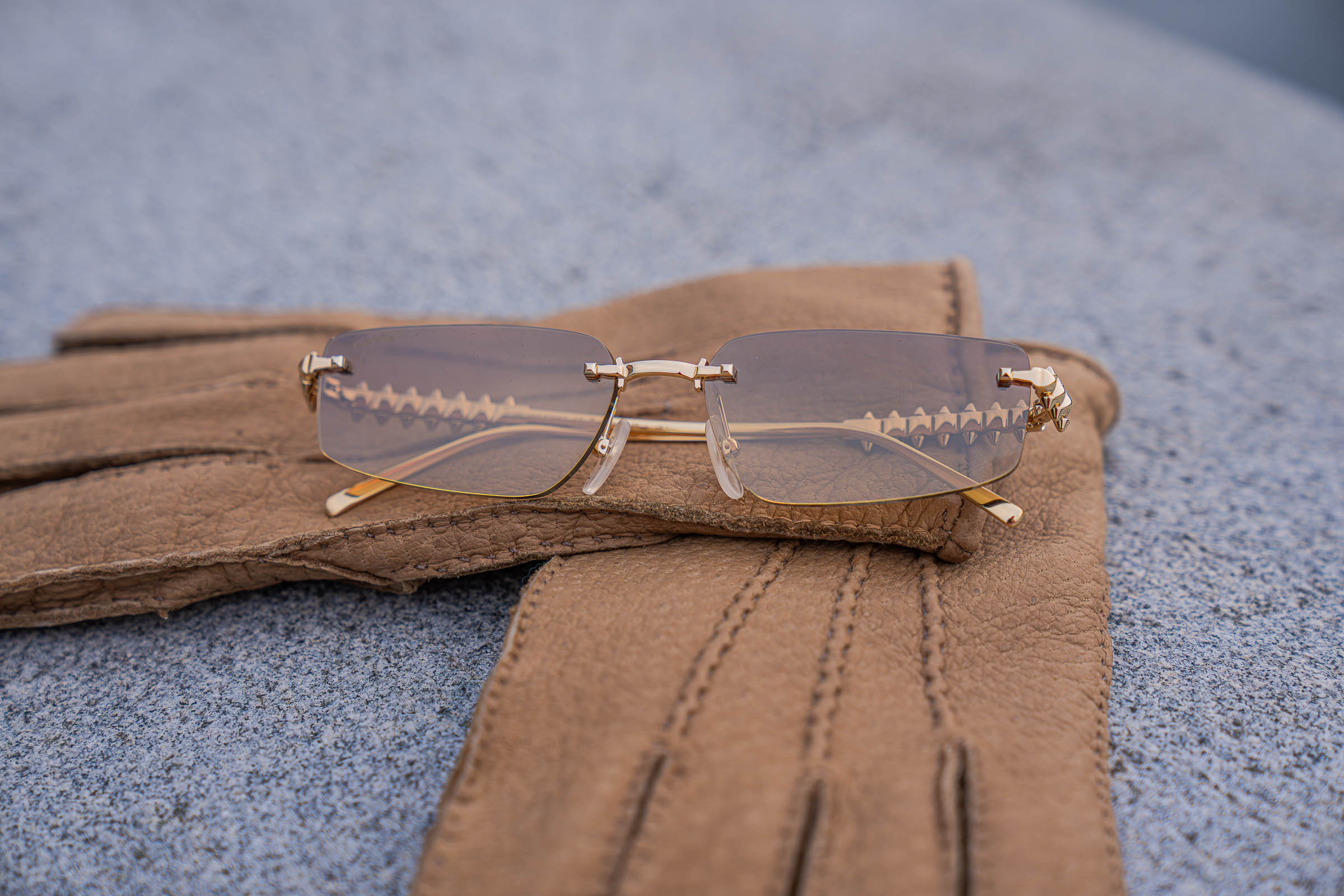
INSIDE THE CURATED EYEWEAR COLLECTION AT CÉLINE ROLAND OPTICIEN LUNETIER
Browsing their selection feels like opening a well-curated library of eyewear. It mixes great fashion houses with true specialist makers. You will find Cartier, CELINE, Dior, Prada, Miu Miu, Gucci, Loewe, Fendi, Saint Laurent, Valentino, Versace, Tom Ford and Balenciaga. Then come the connoisseur names, such as Maybach, Fred, Persol, Oliver Peoples, Moscot and Mykita. Japanese craftsmanship arrives with Masunaga and Eyevan. Finally, Cutler and Gross, Thierry Lasry, Emmanuelle Khanh, T Henri and John Dalia complete the picture.
Above all, Céline Roland Opticien Lunetier is an official Cartier retailer. For a house like Cartier, that status is not a small detail. It guarantees authenticity, proper after-sales care and access to the latest collections. In fact, that is how I could wear the newest 006 color of these Cartier Clash sunglasses so early in the season.
The physical boutiques sit in Alsace, close to the borders with Germany and Switzerland. You can visit them in three towns: Riedisheim, Mulhouse and Colmar. Each store welcomes clients from Tuesday to Saturday, and you can book an appointment for a personal fitting with expert advice.
If Alsace is not on your route, the online boutique ships internationally. I always say that buying luxury online requires trust. Here, that trust comes from an authorized status, clear guarantees and a team you can actually talk to before you buy.


CARTIER: FROM A PARIS WORKSHOP TO THE JEWELER OF KINGS
To understand these sunglasses, we need to travel back to 1847. That year, Louis-François Cartier took over the Paris workshop of his master, Adolphe Picard. It was a modest start for a name that would later serve royal courts across the world.
In 1874, his son Alfred took over the company. Yet it was Alfred’s three sons, Louis, Pierre and Jacques, who truly made Cartier international. Louis ran Paris, Pierre led New York, and Jacques built London. Under their direction, the house came to dominate jewelry design in the early twentieth century. In 1899, Louis moved the Paris boutique to the Rue de la Paix, an address that became legendary.
Royal recognition soon followed. King Edward VII famously called Cartier “the jeweller of kings and the king of jewellers.” He ordered 27 tiaras for his coronation in 1902 and granted the house a royal warrant in 1904. Watch lovers will also remember the Santos of 1904, a flat wristwatch named after the aviator Alberto Santos-Dumont.
Eyewear arrived much later. Cartier presented its first eyewear collection in 1983, and from the very start, it treated frames like jewels. Gold finishes, refined hinges and signature details moved from the jewelry cases to the face. That philosophy still guides every pair today. When I wear my Cartier Clash sunglasses, I never feel I am wearing a simple accessory. I feel I am carrying a small piece of the Rue de la Paix.


THE DESIGN DETAILS THAT MAKE CARTIER CLASH SUNGLASSES STAND OUT
The design story of my Cartier Clash sunglasses begins with jewelry, not with eyewear. In 2019, Cartier launched Clash de Cartier, a new signature collection with a rebellious spirit. The house described it as a clash of attitudes. A spectacular gala at the Conciergerie in Paris marked the launch, inside the former medieval prison where Marie Antoinette was once held.
The collection plays with three historic Cartier motifs. First comes the clou carré, a square, pyramid-shaped stud. Then there are the conical picot studs and the smooth round beads. Together, they look sharp and almost punk, yet they feel soft to the touch. Interestingly, these geometric elements echo the fondness for geometry that Cartier showed in the 1930s. In the jewelry, many studs can swivel freely, which gives each piece a living, almost mechanical feel.
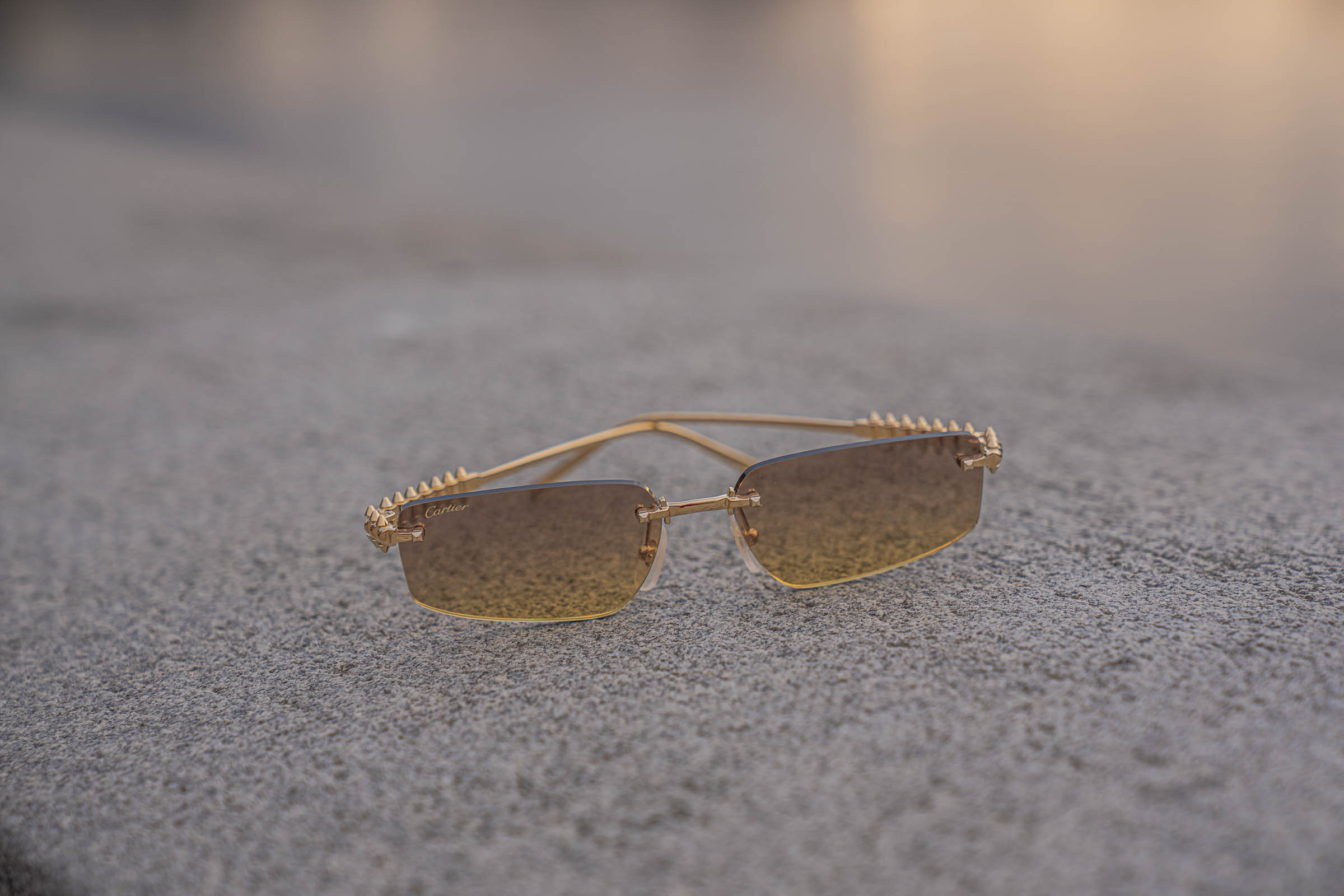
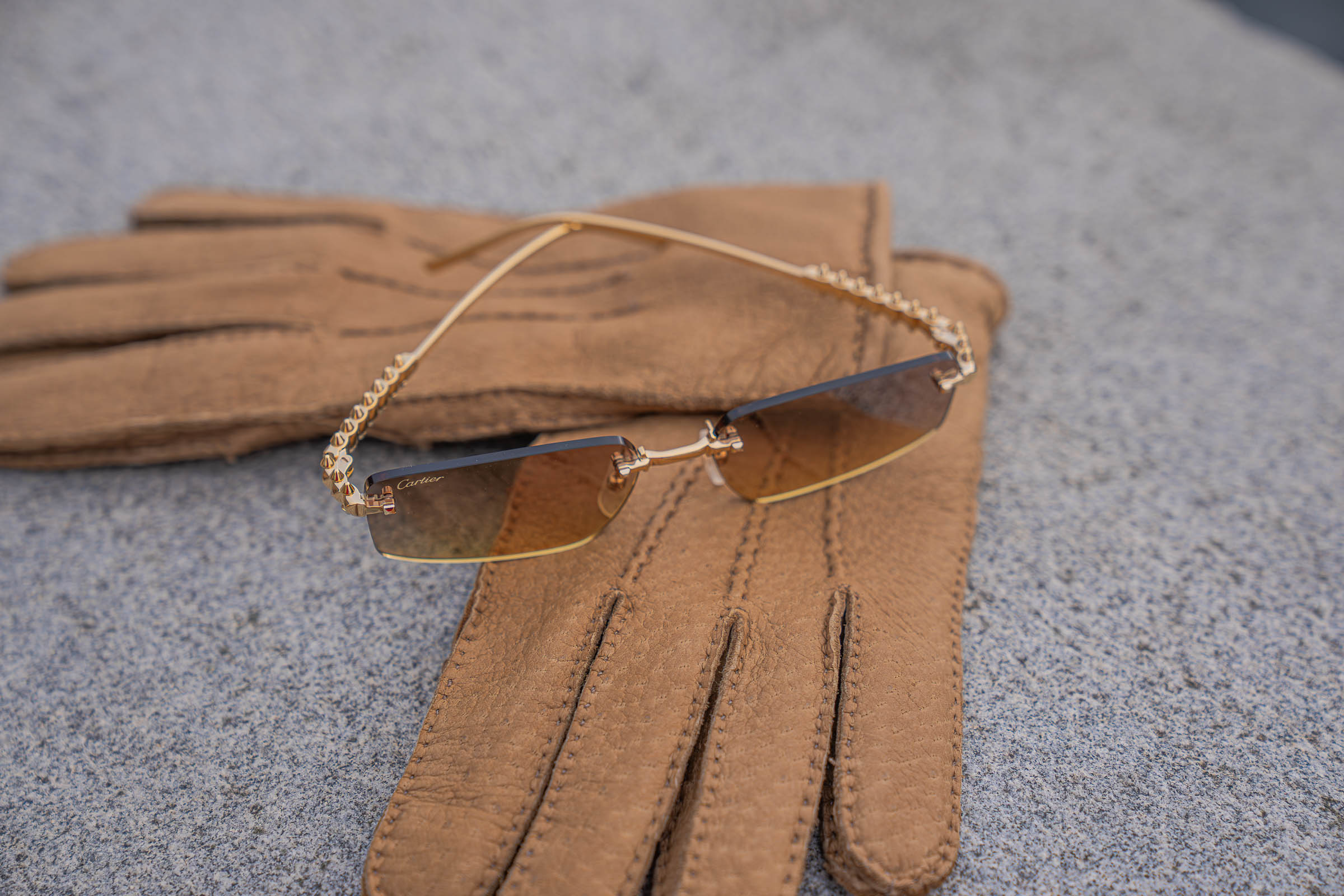
Now imagine that vocabulary on a pair of Cartier Clash sunglasses. On the CT0544S, a row of golden studs runs along each temple like a jeweled spine. Seen from the side, the frame reads almost like a bracelet. From the front, however, the design stays clean and calm.
That contrast is the secret of Cartier Clash sunglasses. They are bold, but only when someone looks closer. For a man who dislikes loud logos, this is the ideal kind of luxury. It rewards attention instead of demanding it, and I find that deeply elegant.


CARTIER CLASH CT0544S: DISCOVERING THE ELEGANCE OF 006 BROWN
Let me describe the exact model you see in these photos. Among all Cartier Clash sunglasses, the CT0544S is the purest design: rimless, rectangular and built on a slim metal structure. The lens measures 58 millimeters, the bridge 16 and the temples 140. These proportions suit a wide range of faces, including mine.
My pair is the 006 colorway, which combines a gold frame with brown lenses. It is the newest color of this model, and retailers began adding it only this autumn. Other versions come with gray gradient, dark gray or light blue lenses. However, brown feels like the most natural partner for the colder months. In daylight, the tint flows from warm coffee at the top to a soft amber glow below. As a result, the lenses flatter the skin and soften the eyes instead of hiding them.
The details deserve a close look. The Cartier signature sits discreetly in the upper outer corner of the right lens. Tiny geometric hinges connect each lens to the bridge and temples, almost like jewelry clasps. Then the Clash studs take over, marching toward the ears in a neat golden line.
Because the frame is rimless, it almost disappears on the face. What remains visible is gold, color and attitude. In my experience, that is exactly the balance a mature wardrobe needs. You get presence without weight, and a statement without noise. I also loved how the lenses caught the reflections of Stockholm’s water during the shoot.


CARTIER CLASH SUNGLASSES AND THE ELEGANCE OF TONAL DRESSING
Golden eyewear like Cartier Clash sunglasses can look flashy if the rest of the outfit competes with it. That is why I followed three simple rules on this shoot, and I gladly share them with you.
First, keep the clothes within one color family. Beige, cream, camel and taupe create a calm canvas around the face. The gold then becomes the natural focal point, exactly where you want attention.
Second, repeat the warm tone once more, but not too often. My peccary gloves echo the brown of the lenses, while the cream turtleneck reflects light toward the face. Two echoes are enough. More would start to feel like a costume.
Third, think about the frame and your face together. In my opinion, a slim rectangular shape softens strong features and adds structure to rounder faces. If you are unsure, this is exactly where an optician who studies face shapes becomes valuable. Céline Roland and her team can guide you in a boutique or through a video call.
One more tip for readers who wear prescription glasses. Many of us need correction, especially for reading or driving. Fortunately, Céline Roland can fit these Cartier Clash sunglasses with optical lenses made in France, so you never have to choose between sharp vision and style. To me, that is a very grown-up kind of luxury.


OUTFIT
Peacoat: Jil Sander
Trousers: Jil Sander
Turtleneck: Aida Barni
Watch: Bard’s Whisper
Sunglasses: Cartier Clash CT0544S
Gloves: Restelli Guanti
Sneakers: Fratelli Rossetti
Discount code for Mr.M readers: MRM10 (10% off Cartier frames at Céline Roland Opticien Lunetier, valid until December 31, 2026)

FROM TAIWAN TO GENEVA: THE STORY BEHIND BARD’S WHISPER
Now let me turn to my wrist, because watch lovers have been patient. My watch comes from Bard’s Whisper, an independent house from Taiwan. Its Chinese name means the murmur of the bard, which already tells you this brand lives for stories.
Bard’s Whisper was founded in 2015 as an accessories label. At first, the team created beaded bracelets that combined natural stones and metal, developing more than 150 pieces in-house. Later, founder and independent watchmaker Chang Sen-Chieh turned the brand toward mechanical watches. His background in the travel industry, together with a deep love of history and literature, shaped every design.
The road was not easy. In an interview published by the brand, he recalls the company nearly going under six times. He even sold his home to fund the venture. Personally, I deeply respect that kind of stubborn devotion. You can feel it in the work.
Today, Bard’s Whisper unites Taiwanese sculptors, painters, gem setters and other artisans around each project. The brand openly supports local workshops as part of its sustainability mission. Its great ambition has long been the Grand Prix d’Horlogerie de Genève, often called the Oscars of watchmaking. This year, a member of the GPHG Academy recommended one of its creations for the 2026 competition. The winners were announced in Geneva on November 7. Whatever the outcome, a small Taiwanese studio has already made Geneva listen.

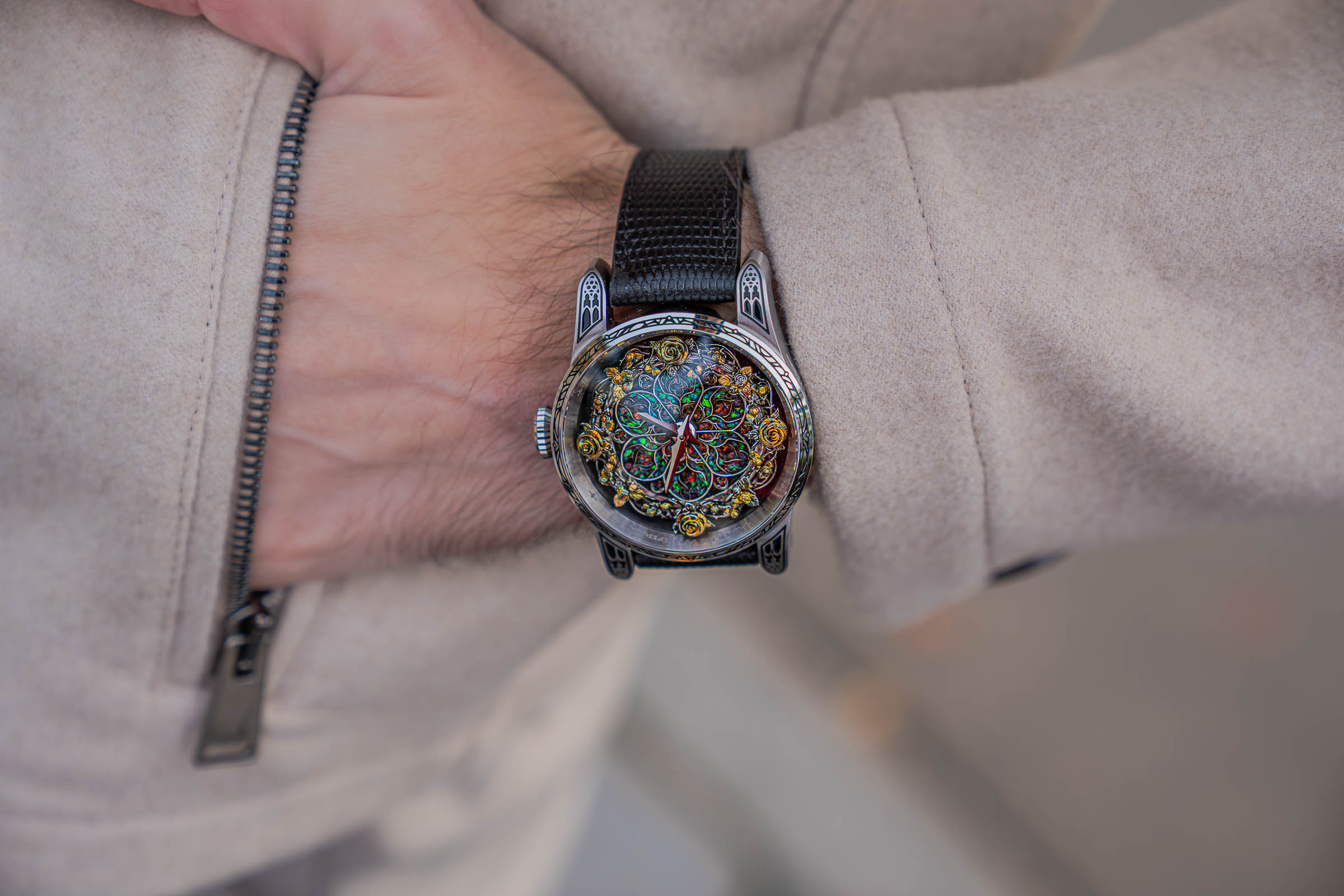
DANTE ON MY WRIST: DISCOVERING THE PURGATORIO OPAL CRYSTAL EDITION
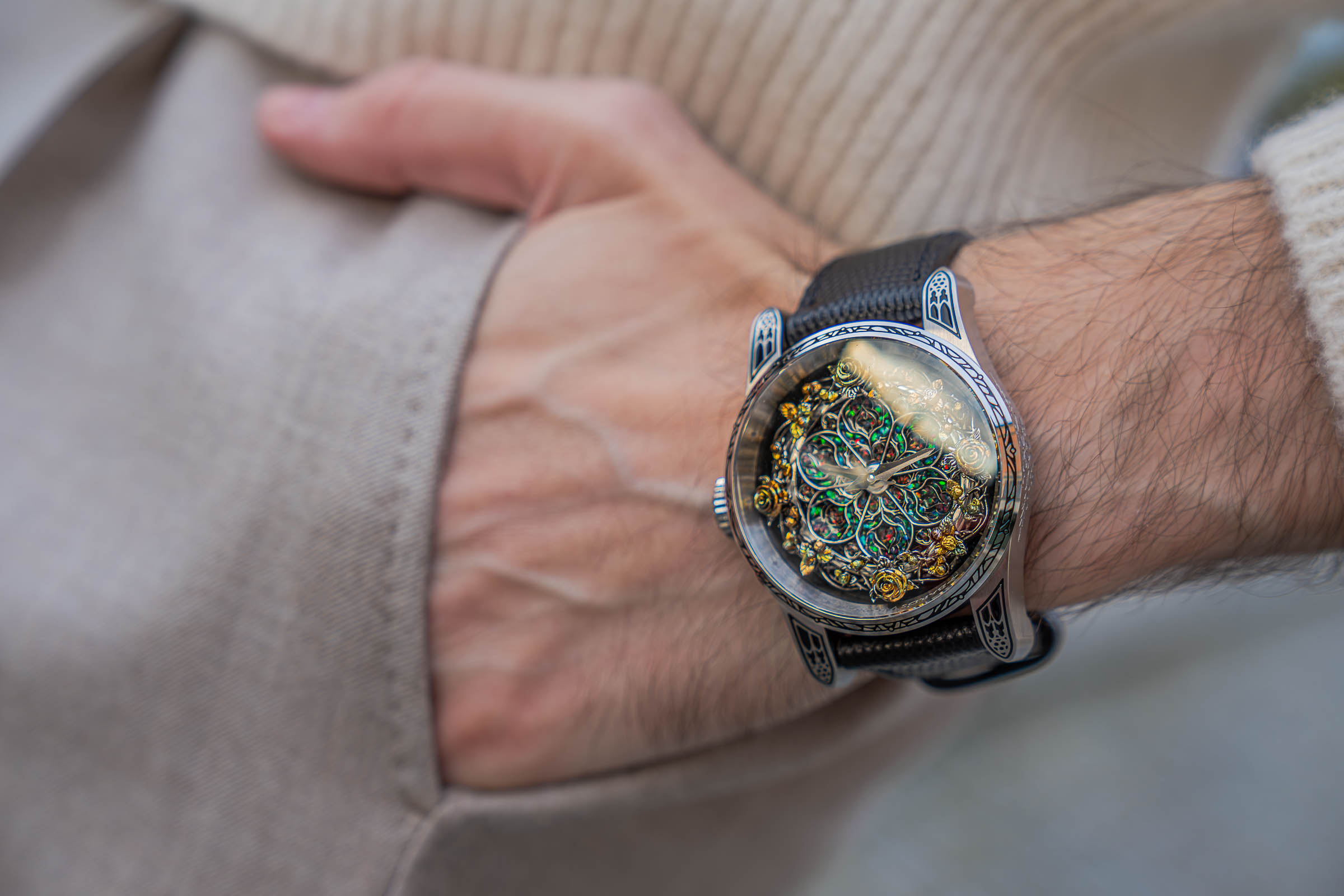
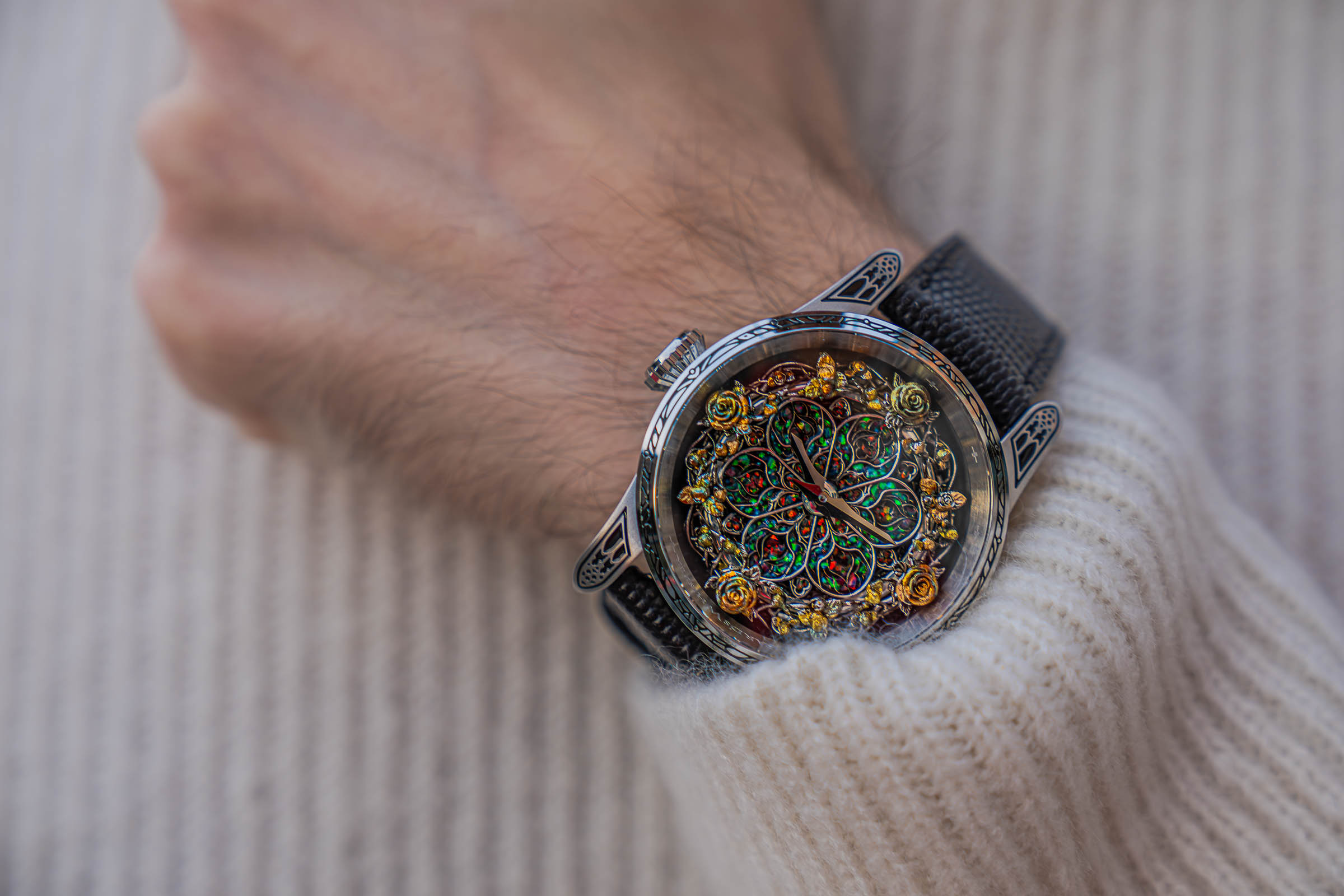
The model I wear belongs to the Divine Comedy collection. Its full name is Dante’s Purgatorio ver. Opal Crystal, a limited edition in sterling silver and gemstone. The inspiration is Dante Alighieri’s great poem, written about 700 years ago. In it, Dante travels through Hell and Purgatory with the Roman poet Virgil as his guide. Then, through Beatrice’s grace, he finally reaches Paradise.
According to Bard’s Whisper, more than 20 Taiwanese specialists worked on this project for seven months. They researched medieval history, culture and manuscripts before shaping a single detail. You can sense that research the moment you look at the dial.
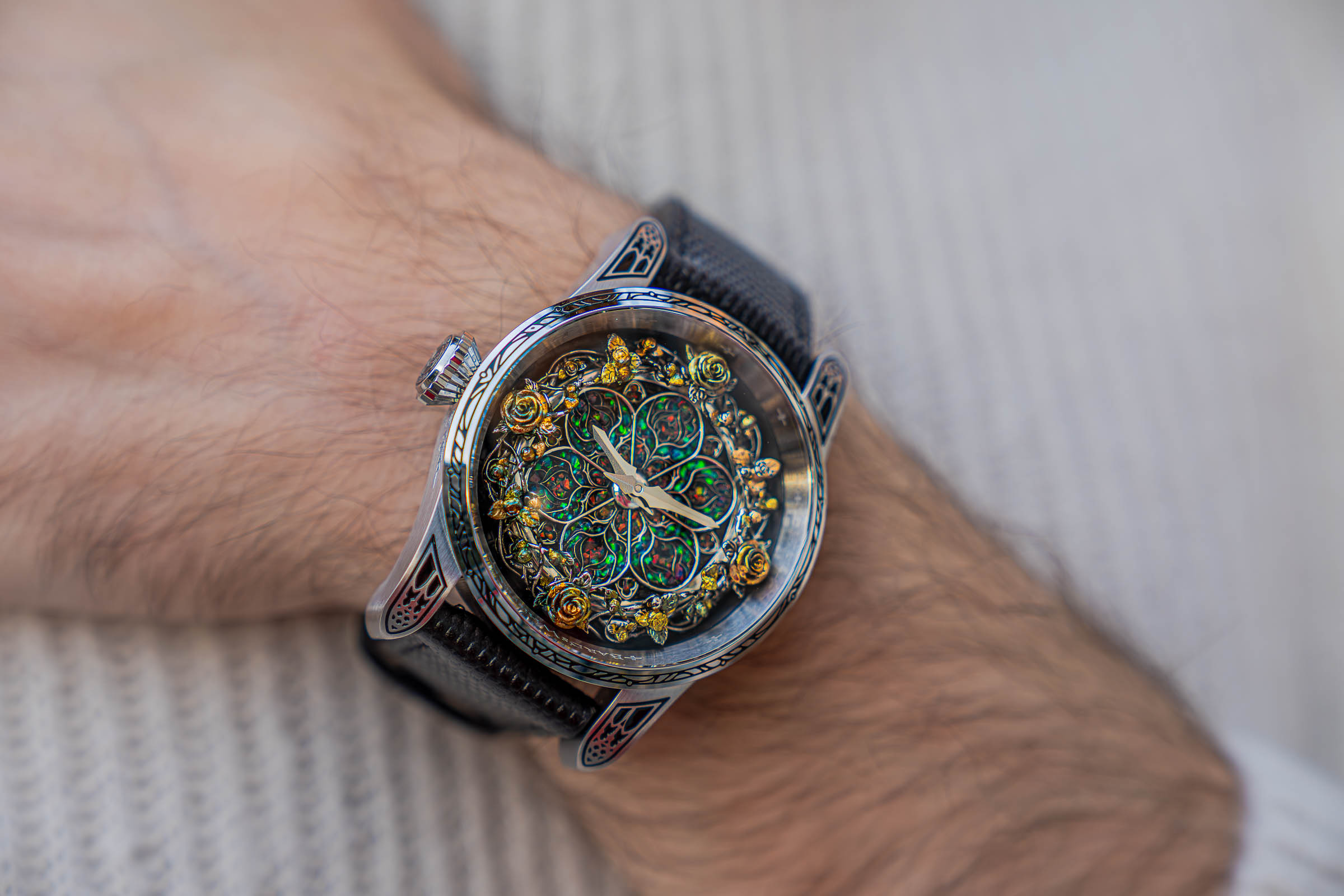
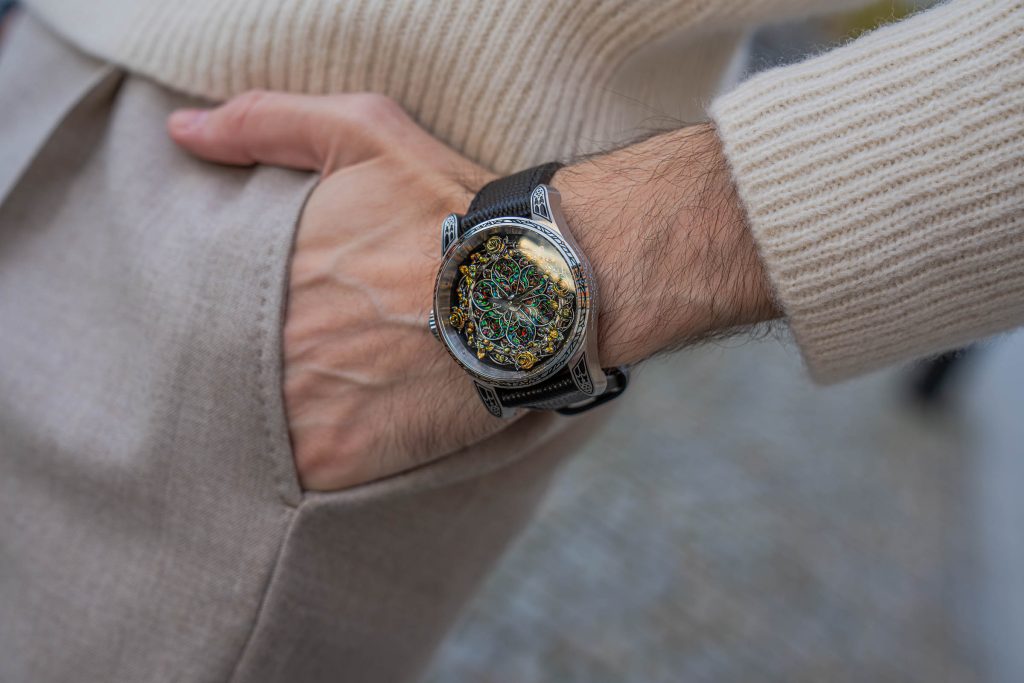
At its center glows a Gothic rose window. Fine silver tracery divides it into petals, and each petal holds genuine precious opal. In daylight, the stone flashes green, red, orange and blue, just like cathedral glass. Master painter Zhao Jia-mi set the opal inlay.
Around the window climbs a wreath of sculpted roses and leaves. Their golden glow comes from copper-foil gilding applied by hand. Meanwhile, the lugs carry engraved Gothic arches, so the cathedral theme continues onto the case itself.
Most impressive is the sense of depth. The brand uses a four-layer micro-section technique that makes a dial of about three millimeters look surprisingly deep. Some relief details reach a fineness of just 0.3 millimeters. Even under Stockholm’s gray sky, the opal found every scrap of light.
BARD’S WHISPER PURGATORIO OPAL CRYSTAL EDITION: TECHNICAL DETAILS
For those who read the specifications before the poetry, here are the essentials. The 45-millimeter case is made of 316L stainless steel with a solid S925 sterling silver sculpture on top, and inside beats the Swiss Sellita SW200 automatic movement. Each piece is individually numbered and comes with a blockchain certificate of authenticity. I covered every technical detail of this watch in my dedicated Bard’s Whisper review.

JIL SANDER: THE QUIET POWER OF A BEIGE PEACOAT
Every luxury accessory needs a calm stage, and Jil Sander builds calm better than most. Heidemarie Jiline Sander founded the house in Hamburg in 1968, when she opened her first boutique at 24. In 1973, she launched her first collection under her own name. Her clean, precise style soon earned her the nickname Queen of Less.
The brand’s history has known many chapters. In 1999, Prada Group bought a 75% stake, and creative differences followed. Jil Sander left, returned and left again, while designers such as Raf Simons and later Lucie and Luke Meier led the house. In March 2021, the Italian group OTB acquired the brand. Since March 2025, Simone Bellotti has served as creative director, keeping the purist spirit alive.
My peacoat shows that heritage perfectly. It is a short beige piece cut with the ease of an overshirt. Two flap pockets sit on the chest, and two zipped pockets hide at the sides. Dark horn-effect buttons add a quiet contrast. Under the collar, a warmer brown band adds depth, which you only notice when the wind lifts it. The cloth is soft and brushed, with a matte surface that absorbs light rather than reflecting it.
That matte quality is essential here. It allows the gold of the Cartier Clash sunglasses and the opal of my watch to shine without competition. This is the real art of Jil Sander: clothes that make everything around them look better.


AIDA BARNI TURTLENECK AND JIL SANDER CASHMERE TROUSERS: A STUDY IN QUIET LUXURY
The trousers come from the same house, and they complete the Jil Sander silhouette. They are made of beige cashmere and cut with a high waist and front pleats. The extra room at the hip creates a soft, fluid line, while the leg narrows gently toward the ankle. A buttoned flap pocket adds a subtle tailoring touch.
High-waisted trousers flatter almost every male figure. They lengthen the legs, and they keep a knit neatly in place. For this reason, I often pair them with sweaters that end right at the waistband.
My sweater is a cream cashmere turtleneck by Aida Barni. The brand belongs to the Annapurna group, founded in 1978 in Prato, Italy. Mrs. Aida Barni, the company’s president and art director, was among the first to spread Italian cashmere knitwear around the world. To this day, the entire production cycle takes place at the company’s plant in Prato. I also wore Aida Barni cashmere in my story from the bamboo forest of Arashiyama in Kyoto.
This turtleneck has a vertical rib that catches the light in thin lines. The collar folds high and soft, framing the face like a natural scarf. Because the cream shade is lighter than the coat, it brightens the complexion beautifully. Next to the brown lenses of my Cartier Clash sunglasses, it creates a warm gradient from neck to brow. In the Swedish wind, I was grateful for every gram of that cashmere.


RESTELLI GUANTI: THE ART OF ITALIAN PECCARY GLOVES
Some accessories are both practical and poetic, and gloves belong in that category. Mine come from Restelli Guanti, a Milanese family company founded in 1920. Remarkably, its boutique and workshop still stand on Corso Sempione, just as they did more than a century ago. Today, Raffaella Restelli leads the business as the third generation of the family.
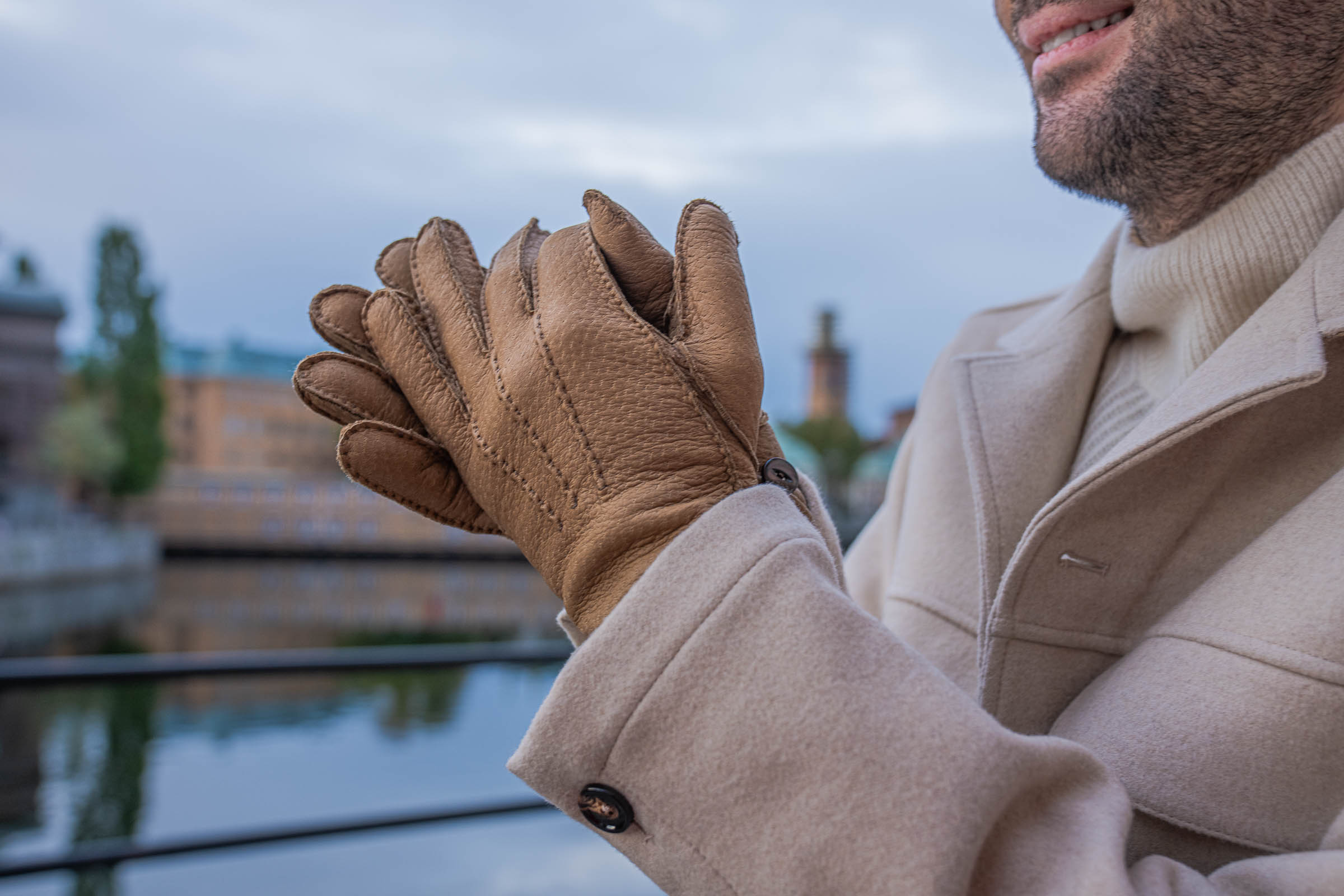
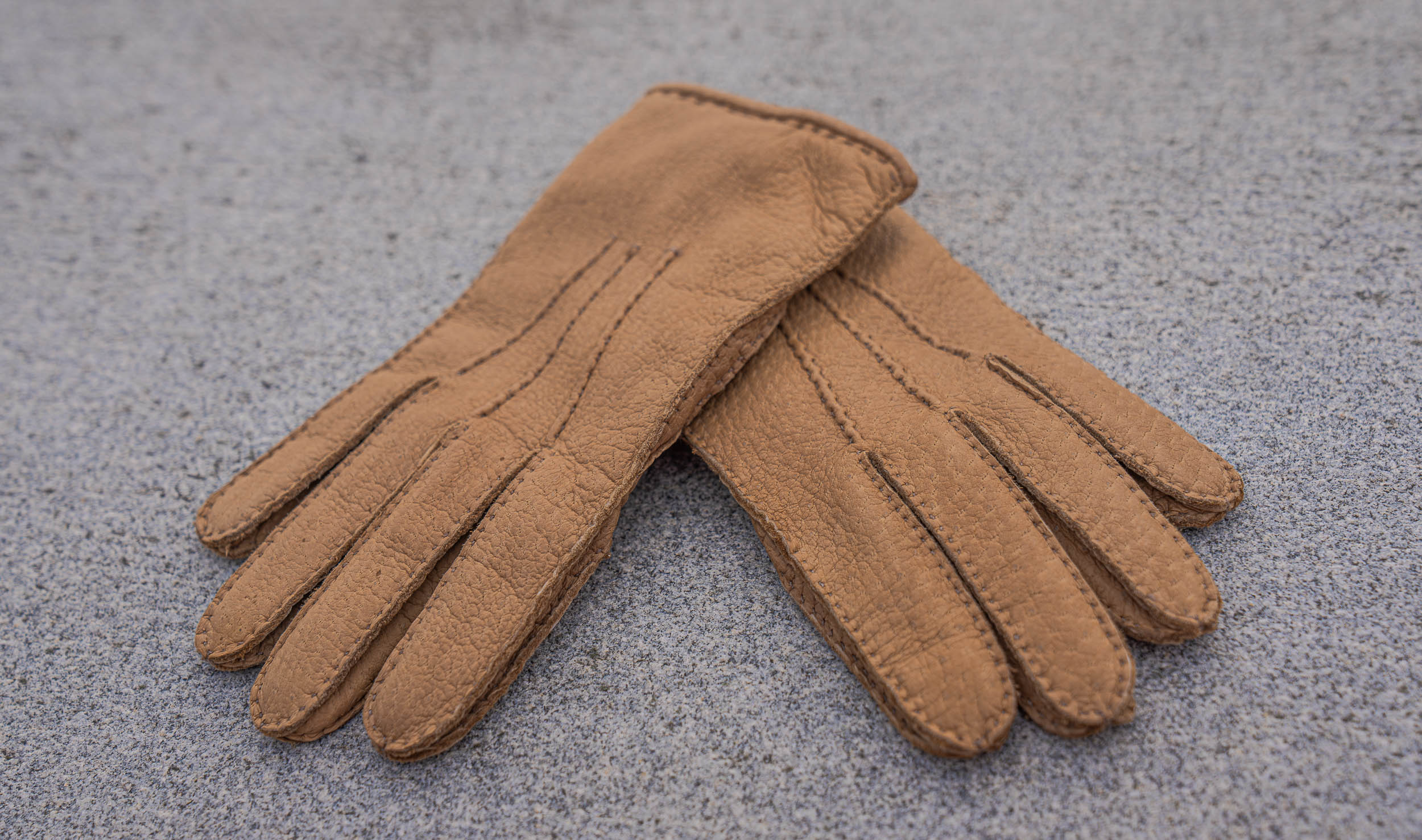
The model is Art. 42, made of peccary leather. The peccary is a wild relative of the pig, native to Central and South America. Glove makers prize its leather for softness, durability and natural stretch. You can always recognize genuine peccary by one detail: the bristle holes in the grain appear in small groups of three.
Restelli makes this glove entirely unlined, so the suede reverse touches the skin directly. As a result, the fit feels like a second skin, and the leather slowly molds to your hand. Triple cord stitching decorates the back, while the cuff stays clean, without vents or closures. Naturally, everything is made in Italy.
The warm tan color you see here was a deliberate choice. It sits right between the beige coat and the brown lenses, which ties the whole look together. When I placed the Cartier Clash sunglasses on the gloves for a still-life photo, the colors matched almost too well. The textures, however, could not be more different: polished gold against rugged, living leather.
FRATELLI ROSSETTI SNEAKERS: REDISCOVERING THE BRAND’S SPORTY SIDE
Footwear finished the look with a nod to Italian history. My sneakers come from Fratelli Rossetti, founded in 1953 in Parabiago, a shoemaking town just outside Milan. The founder, Renzo Rossetti, did not start with loafers. After World War II, he made soft, lightweight cycling shoes under the name Rossetti Yankee.
In the 1960s, the brand launched two icons: the Brera loafer and the Yacht, a shoe designed to be worn without socks. During the 1970s, Renzo worked alongside legendary names such as Armani, Valentino, Yves Saint Laurent and Karl Lagerfeld. In 2003, the Italian postal service even issued a commemorative stamp for the company’s 50th anniversary. Today, his sons Diego, Dario and Luca run the family business, and production remains anchored in Parabiago.
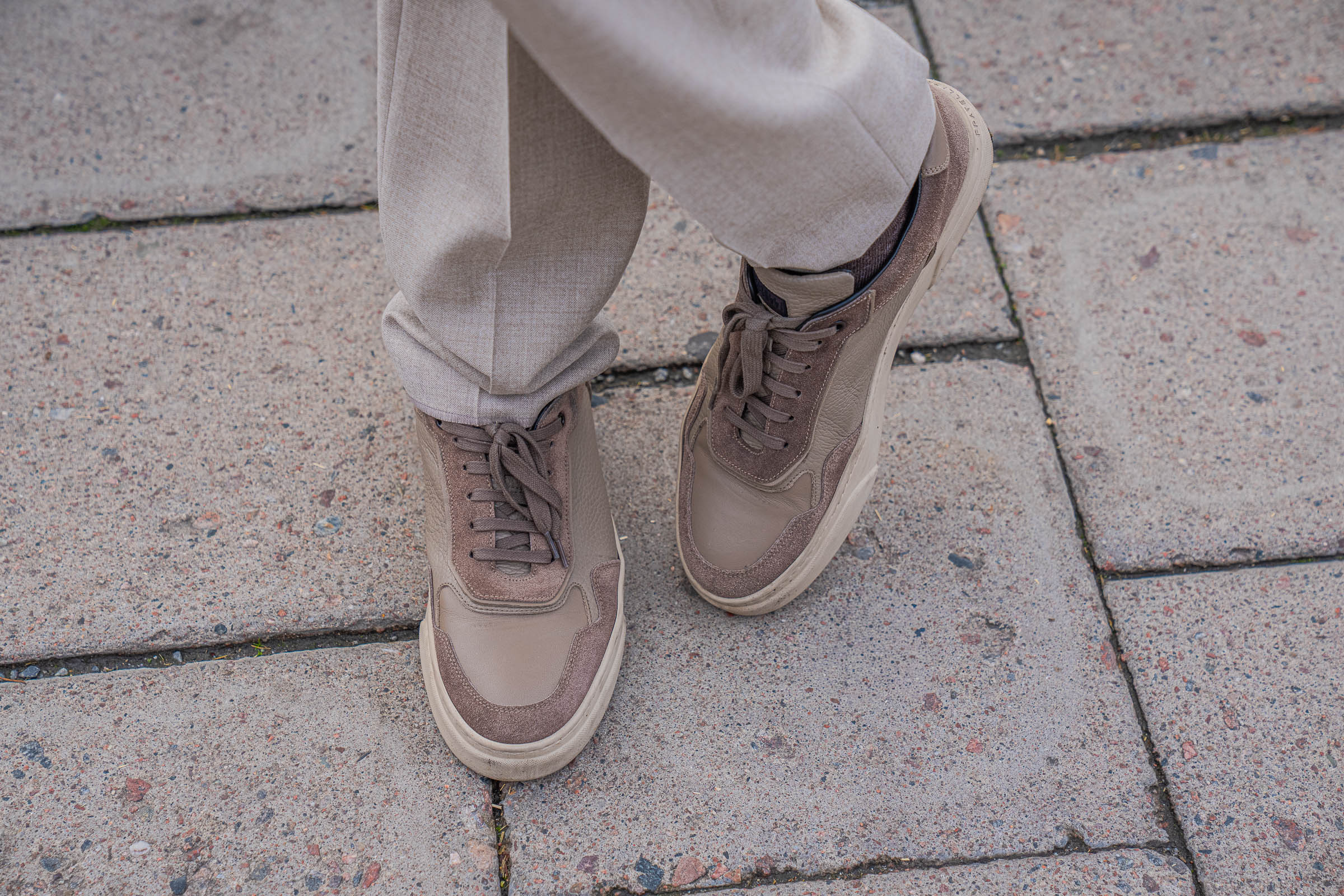
So when I wear Fratelli Rossetti sneakers, it feels like a return to the brand’s sporty beginnings. This pair combines smooth taupe leather with darker suede panels and a cream rubber sole. The tones relate to the trousers and gloves without copying them.
Sneakers with cashmere trousers may sound casual on paper. In reality, quality leather sneakers make tailoring look relaxed and modern, especially on a day of walking. Stockholm’s cobblestones confirmed that choice within the first hour.

THE GOLDEN SIDE OF STOCKHOLM: FROM NORRBRO TO GUSTAV ADOLFS TORG
Later, a short walk took us to Norrbro, the North Bridge. Completed in 1807, it is the only bridge in Stockholm with preserved stone vaulting. It links Gustav Adolfs torg with the Royal Palace, crossing the small island of Helgeandsholmen. Carl Fredrik Adelcrantz and Erik Palmstedt shaped its neoclassical design, and its granite balustrade became my favorite prop of the day. I wrote more about this part of the city in my Stockholm travel guide.
From the bridge, the view opens toward the Grand Hôtel and its green copper roof. The hotel opened on June 14, 1874, and Nobel laureates have stayed there since 1901. Right next to it stands the Nationalmuseum. As the clouds finally parted, a soft golden light reached the water. At that moment, my Cartier Clash sunglasses looked their very best, gold against gold.
At the northern end of Norrbro lies Gustav Adolfs torg. In its center rises the bronze equestrian statue of King Gustav II Adolf by the French sculptor Pierre Hubert L’Archevêque. It was the first equestrian statue in Sweden. On one side stands the Royal Swedish Opera, and on the other, Arvfurstens palats, home of the Ministry for Foreign Affairs since 1906.
Here is a lovely detail for history fans. Erik Palmstedt also designed Arvfurstens palats, so one architect helped shape both the bridge and the palace. Walking between them felt like moving through a single, carefully planned idea. Honestly, that is also how I like to build an outfit.

MR.M READERS EXCLUSIVE: 10% OFF CARTIER CLASH SUNGLASSES
I promised myself that this story would bring you more than inspiration. Thanks to Céline Roland Opticien Lunetier, I can offer my loyal readers a special gift. Use the code MRM10 for a 10% discount on any Cartier frame, whether prescription glasses or sunglasses. The code is valid until December 31, 2026, so you have time to choose carefully.
You can shop online at celine-opticien-lunetier.com, where the Cartier Clash CT0544S sunglasses are available in several colors, including the new 006 brown. If you prefer to try frames in person, the boutiques in Riedisheim, Mulhouse and Colmar will welcome you.
My advice is simple. Before you order your Cartier Clash sunglasses, think about how you will wear the frame, not only how it looks in a photo. If you have doubts, ask the team for guidance. After all, that personal advice is exactly what makes this house different.

STOCKHOLM, CARTIER CLASH AND THE ART OF AUTUMN STYLE
Looking back at this shoot, I smile at my opening confession. I packed sunglasses for a gray Swedish October, and they became the most valuable thing in my bag. Not because of the sun, but because of the light they brought to everything else.
This outfit worked like a quiet orchestra. Jil Sander provided the calm base, Aida Barni added softness, and Restelli brought texture. Fratelli Rossetti kept the look grounded, both literally and stylistically. Meanwhile, Bard’s Whisper offered the watch lovers among you a small cathedral to admire, with Dante’s road from Purgatory toward Paradise on the dial.
Yet the melody came from the frame on my face. Cartier Clash sunglasses prove that a jewel does not need to be loud to be noticed. And Céline Roland Opticien Lunetier proves that buying such a jewel should feel personal, careful and honest. For me, that combination is a small piece of heaven.
So, my friends, my wish for you is simple: choose fewer things, but choose them well. Then wear them with confidence, whatever the weather says.
How did you like my Stockholm outfit and my new Cartier Clash sunglasses? I prepared this story with a lot of love, and I truly hope you enjoyed it. If you have any questions, comments, suggestions or messages for me, write them below in the comments. Of course, as always, you can also reach me by email or on social media. You will find all the details on the CONTACT page. Before you go, remember that code MRM10 brings you 10% off Cartier frames at Céline Roland Opticien Lunetier until December 31, 2026. See you soon in new fashion adventures on the Mr.M blog, somewhere between the water and the light!
With love from Stockholm,
Mr.M


This post is sponsored by Céline Roland Opticien Lunetier, Jil Sander, Aida Barni, Bard’s Whisper, Restelli Guanti and Fratelli Rossetti brands. This post is my personal and honest product review.