
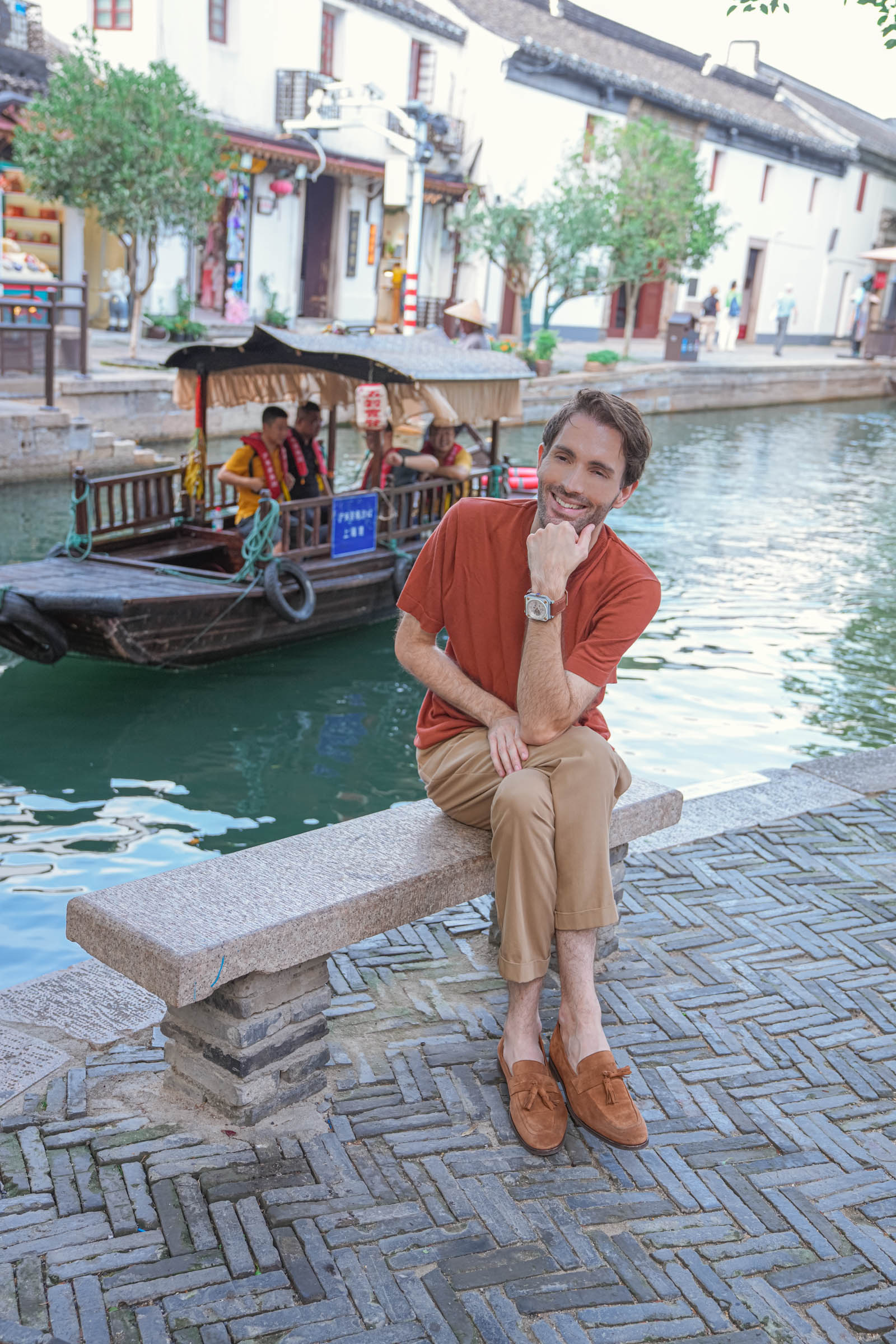
My dear fashionistas, welcome to another fashion adventure on the Mr.M blog! Some places do not need long descriptions, because they speak for themselves. Zhujiajiao, an old water town on the outskirts of Shanghai, is exactly such a place. When I stepped onto its stone paths, surrounded by canals and houses from the Ming and Qing dynasties, I felt that nothing here needed to change. In fact, a place this authentic asks for authenticity in the way you approach it, and in what you wear.
That is why I chose a quiet outfit for this walk: a Cifonelli T-shirt and trousers, Carlos Santos tassel loafers and a ROMAGO Swiss watch. In this post, I will tell you the story behind each piece, and the story of the town where we took the photos.
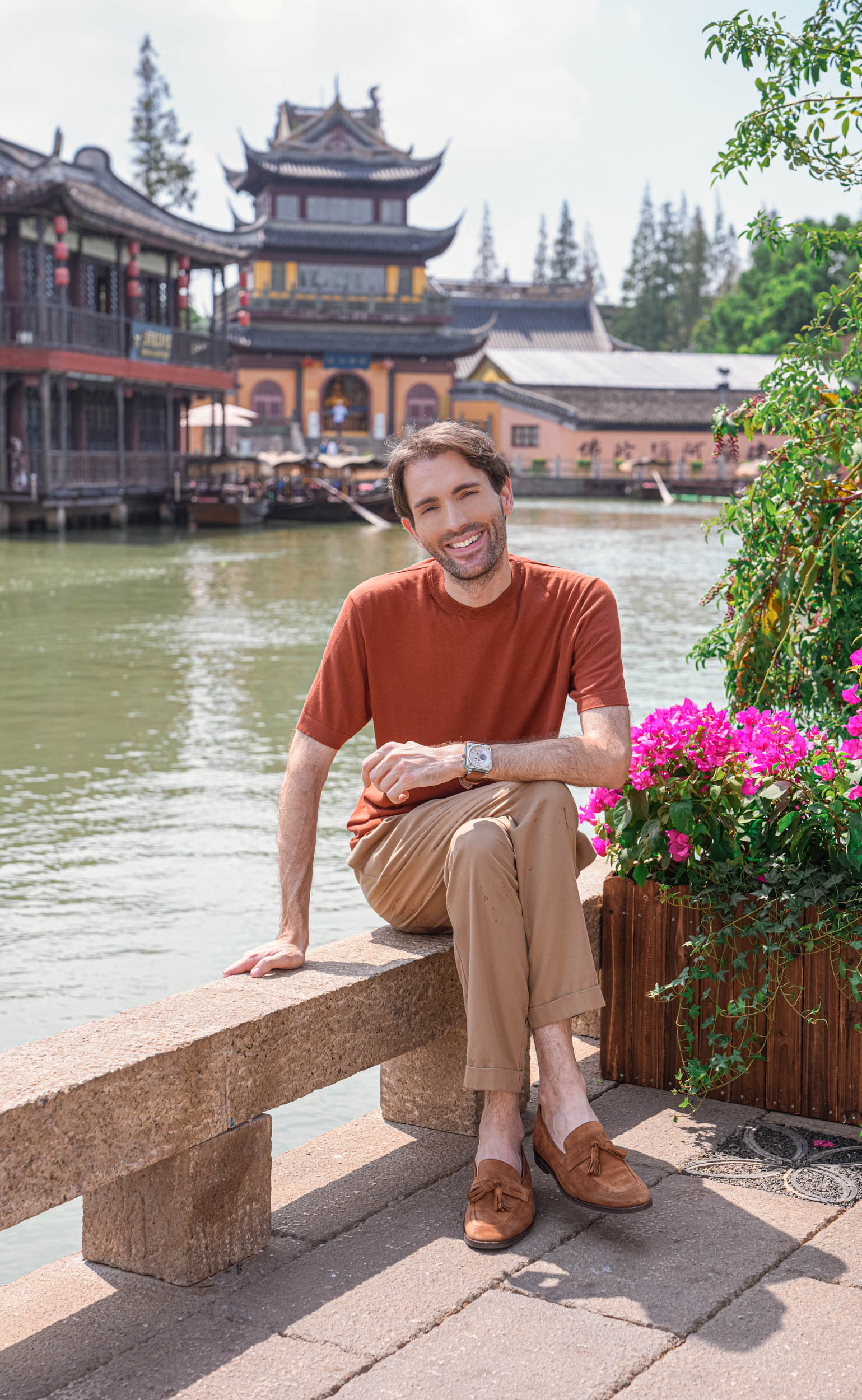
THE CIFONELLI STORY: FROM ROME TO RUE MARBEUF
The Cifonelli story begins in 1880, when Giuseppe Cifonelli opened his first tailoring workshop in Rome. His son Arturo wanted to take the family name beyond Italy. First, he trained at the Minister’s Cutting Academy in London, and the house still keeps his diploma in its workshop.
In 1926, Arturo moved to Paris and opened his first atelier on Rue de Courcelles. Then, in 1936, he settled permanently on Rue Marbeuf, in the “Golden Triangle” of the French capital. The house has stayed there ever since.
According to the house itself, its style is a clever blend of British technique, Italian flair and French finishing. Over the decades, Cary Grant, Fred Astaire and Marcello Mastroianni were among its clients. Moreover, from 1992 to 2007, Cifonelli produced the exclusive bespoke line Hermès par Cifonelli.
Today, the cousins Lorenzo and Massimo Cifonelli lead the house as the fourth generation of the family. They took control of the bespoke workshop in 2003, and they still welcome clients personally.
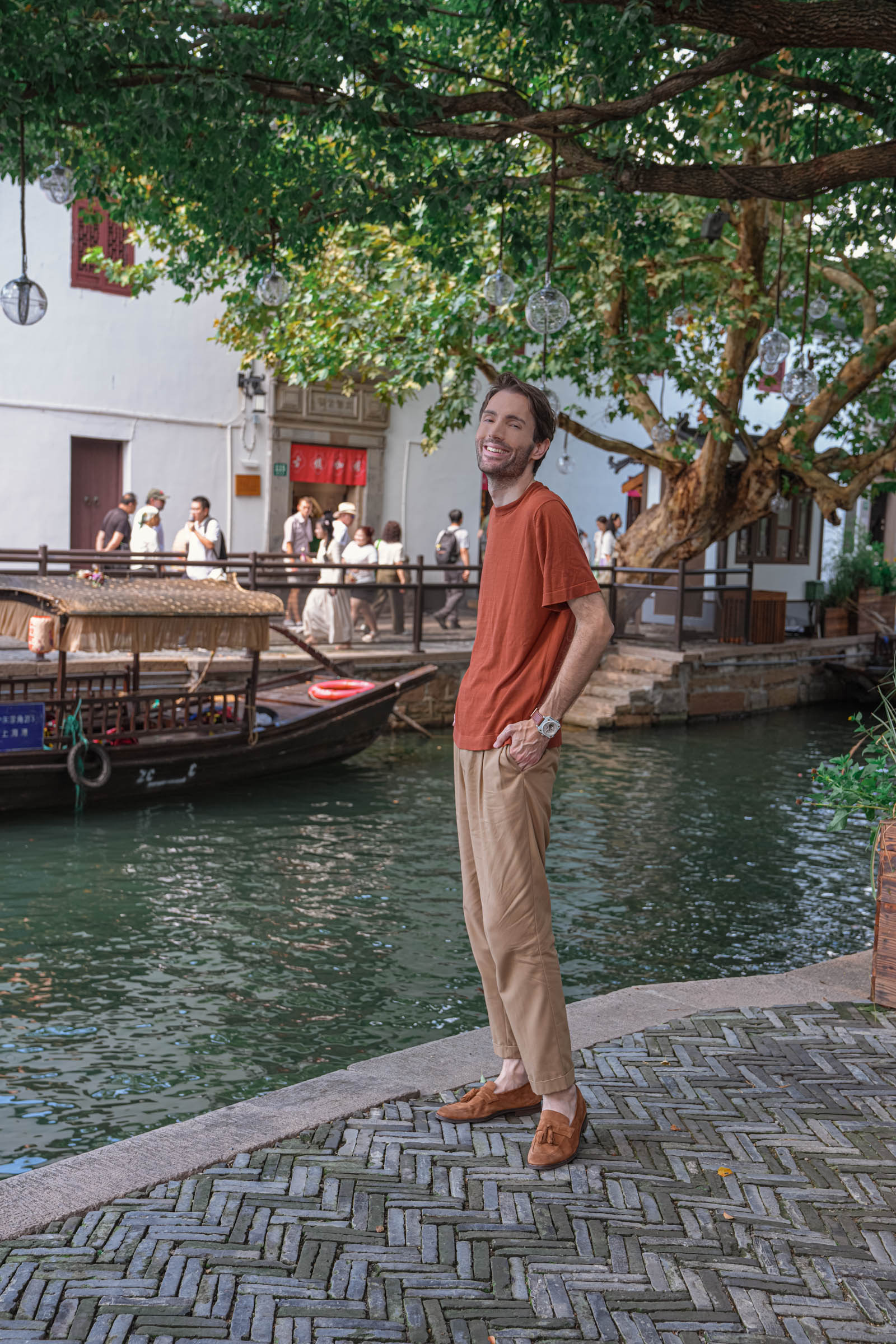
WHY CIFONELLI TAILORING IS STILL DONE BY HAND
Every day, more than forty craftsmen arrive at the famous workshop at 31 Rue Marbeuf. Over the course of a year, they produce a few hundred bespoke suits and garments. For each client, the tailors cut an individual paper pattern by hand. The house keeps that pattern as a unique piece for every future order.
After that, the client usually goes through three fittings. On the first one, the tailors adjust the volume, balance and general line of a temporary garment. On the second, they refine the length, drape, waist, shoulders and sleeves. Finally, at the third fitting, the tailor decides whether a fourth one is necessary.
The most famous detail of the house is the so-called cigarette shoulder. Arturo invented it to combine a perfect shape with freedom of movement. The tailors shape the hand padding at the top of the sleeve into an elegant, rounded roll. Karl Lagerfeld once said he could recognize a Cifonelli shoulder from a hundred meters away.
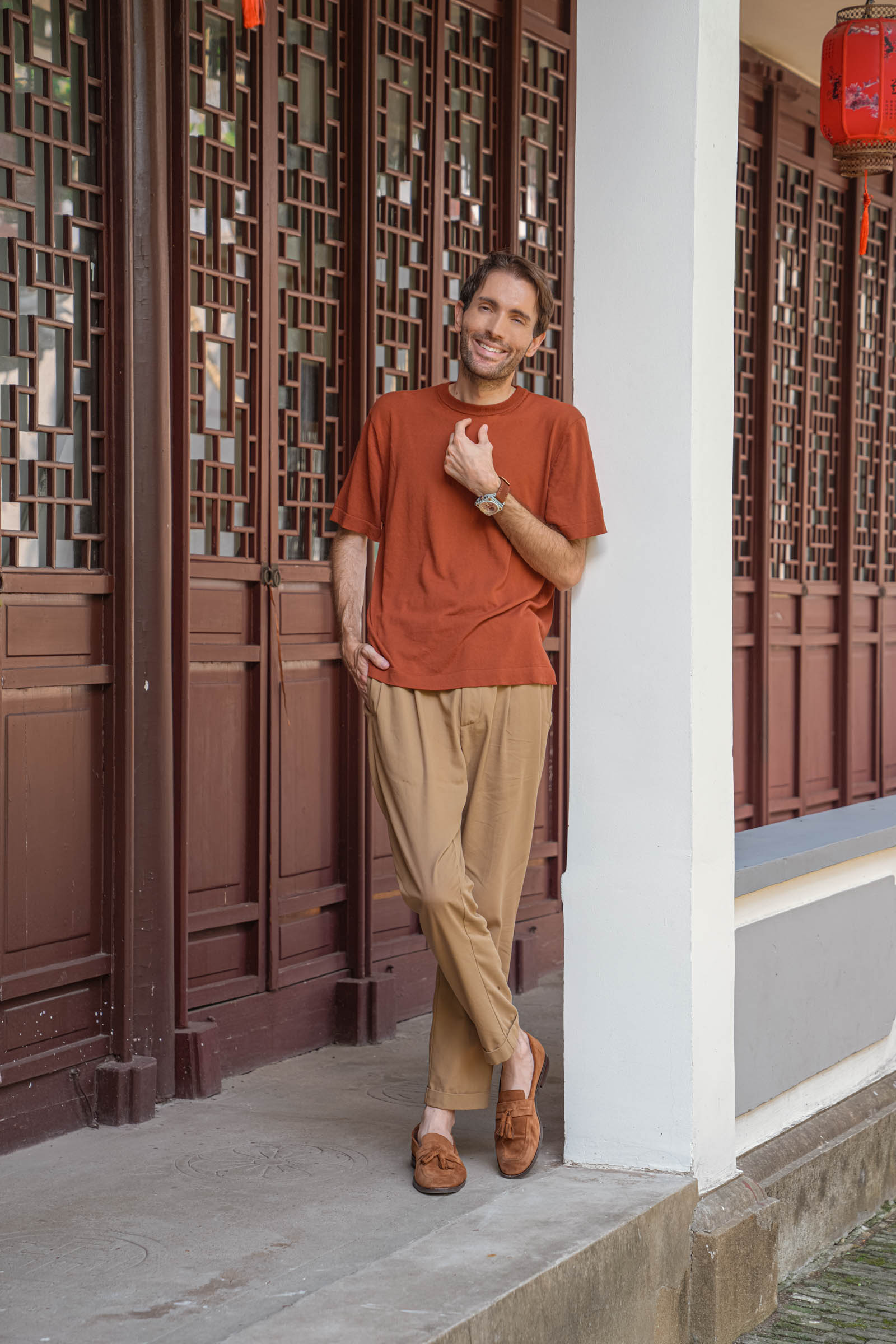
A CIFONELLI T-SHIRT FOR A DAY ON THE CANALS
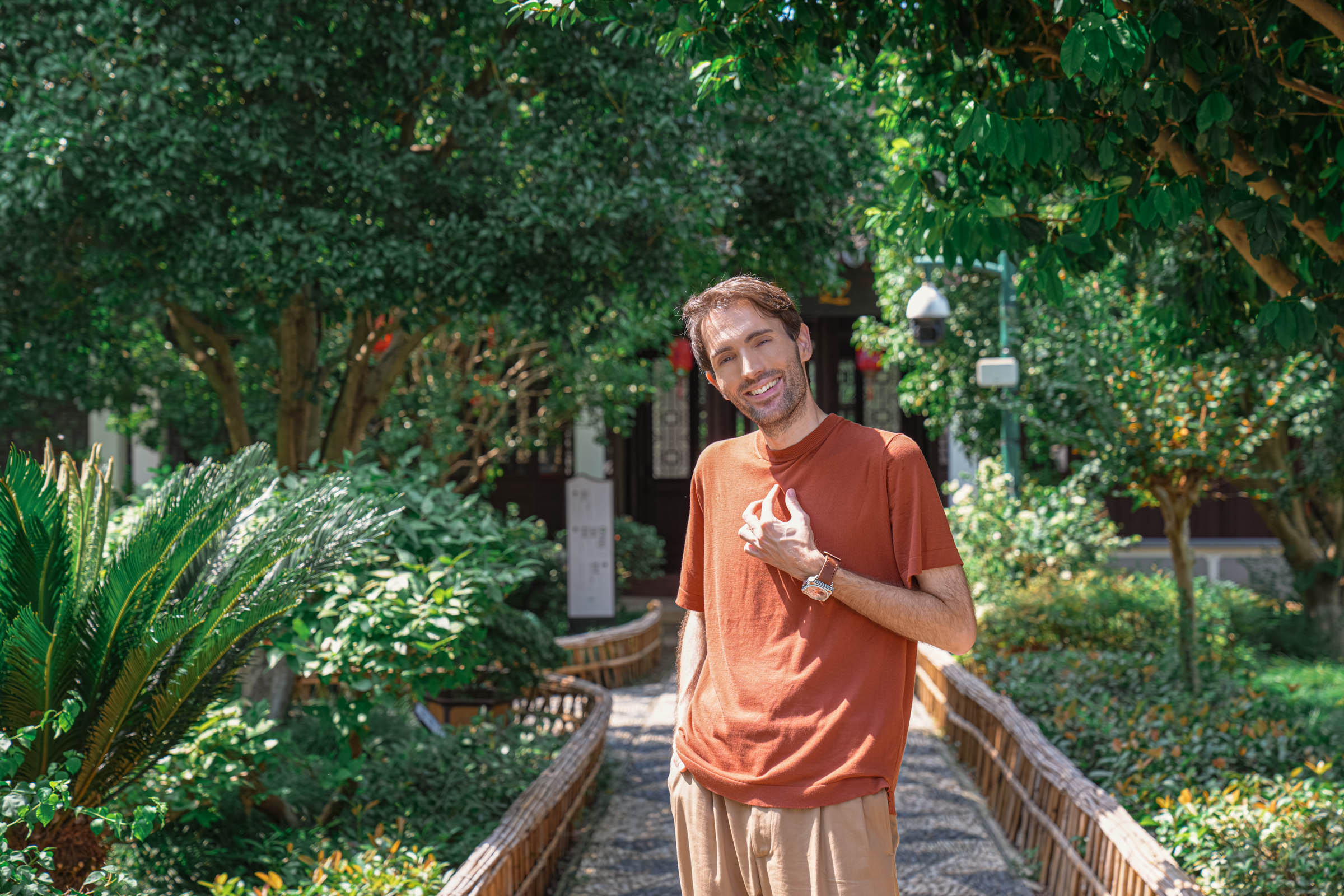
In 2014, Lorenzo and Massimo launched a ready-to-wear collection, and they design it personally. Many of the suppliers they work with are Italian, which is a nice return to the roots of the house. The cotton knit T-shirt I wore in Zhujiajiao comes from this line.
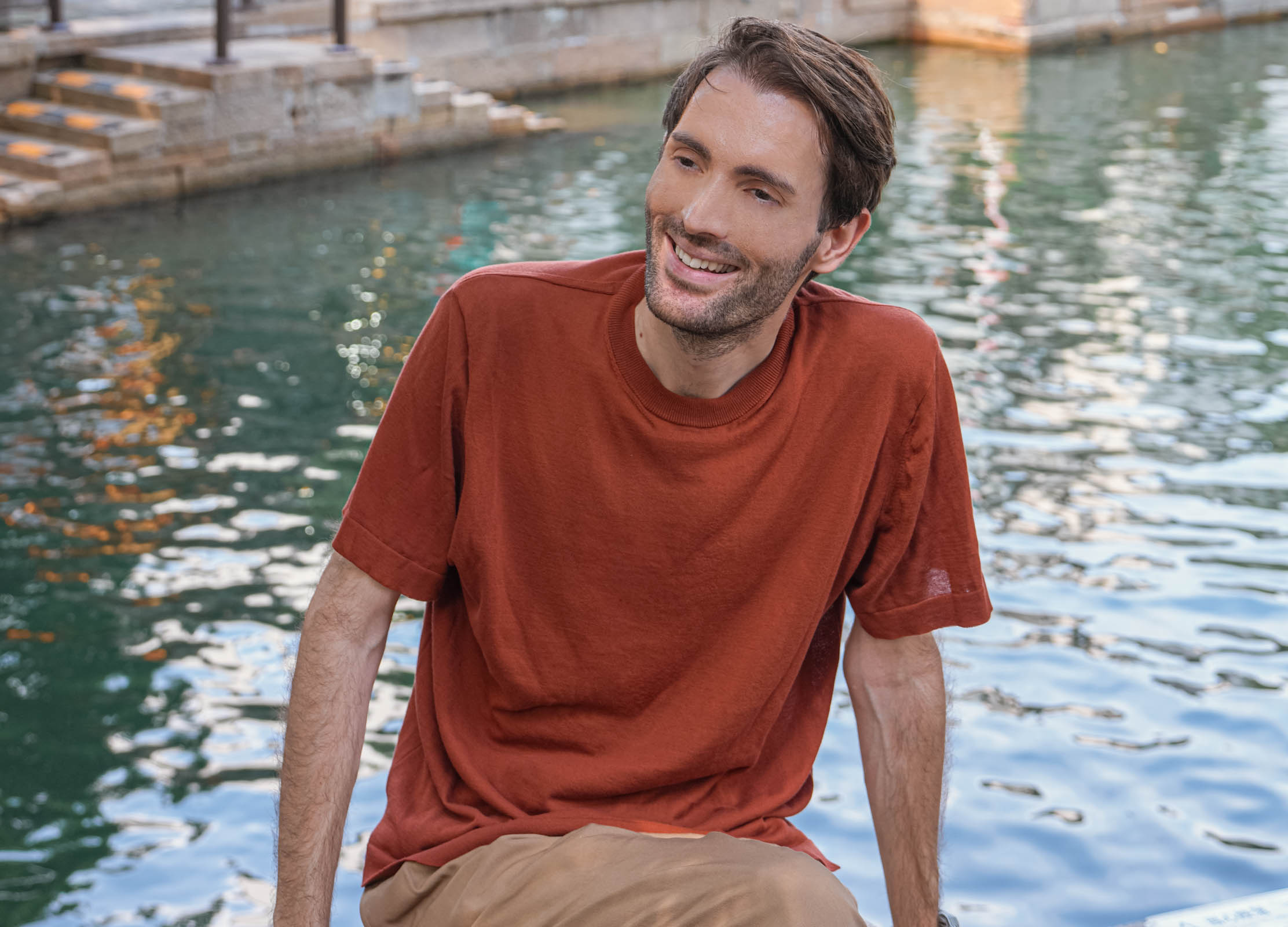
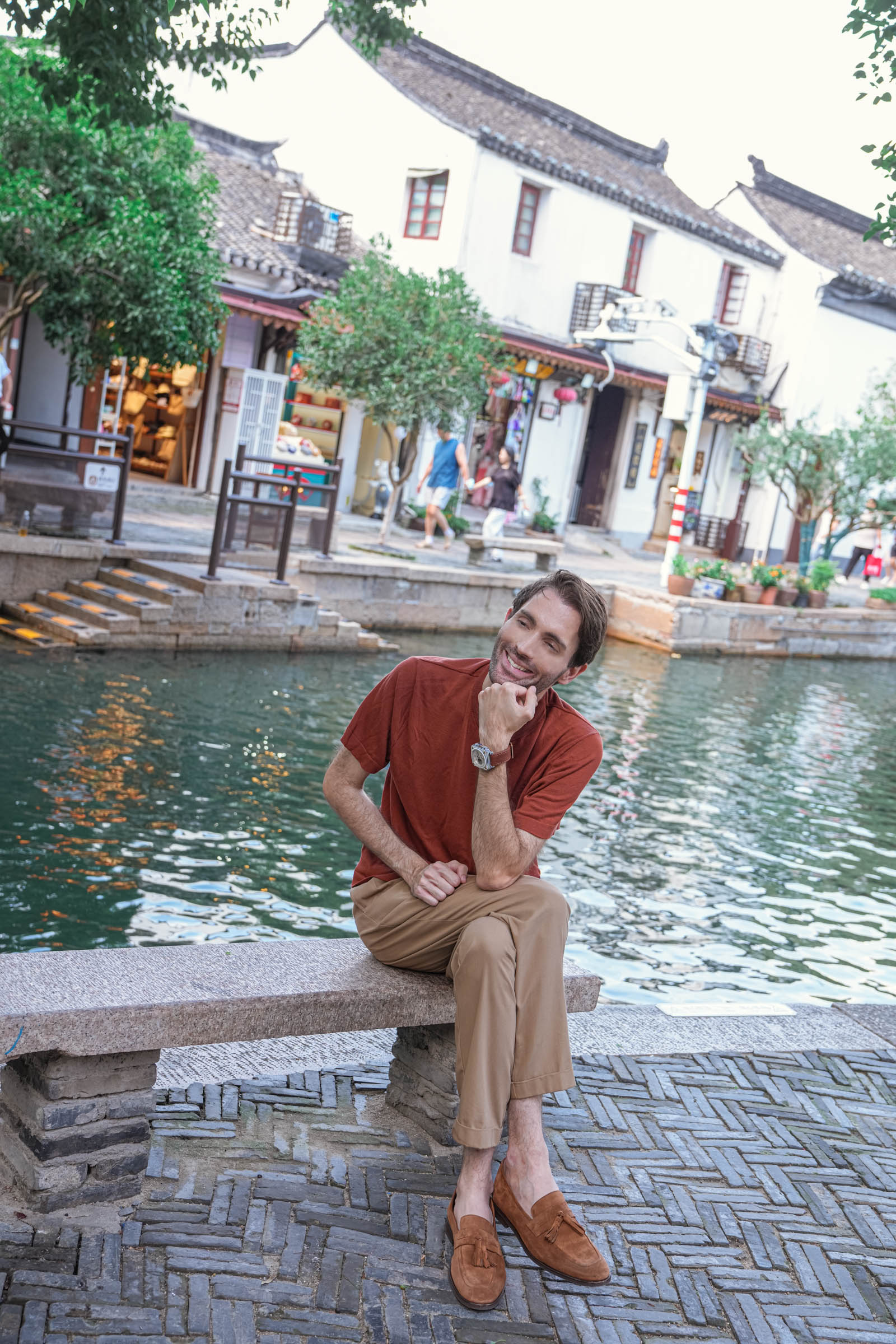
At first glance, it is a simple T-shirt. However, to me, the dense cotton knit gives it a structure that a regular T-shirt does not have, so it never looks too casual.
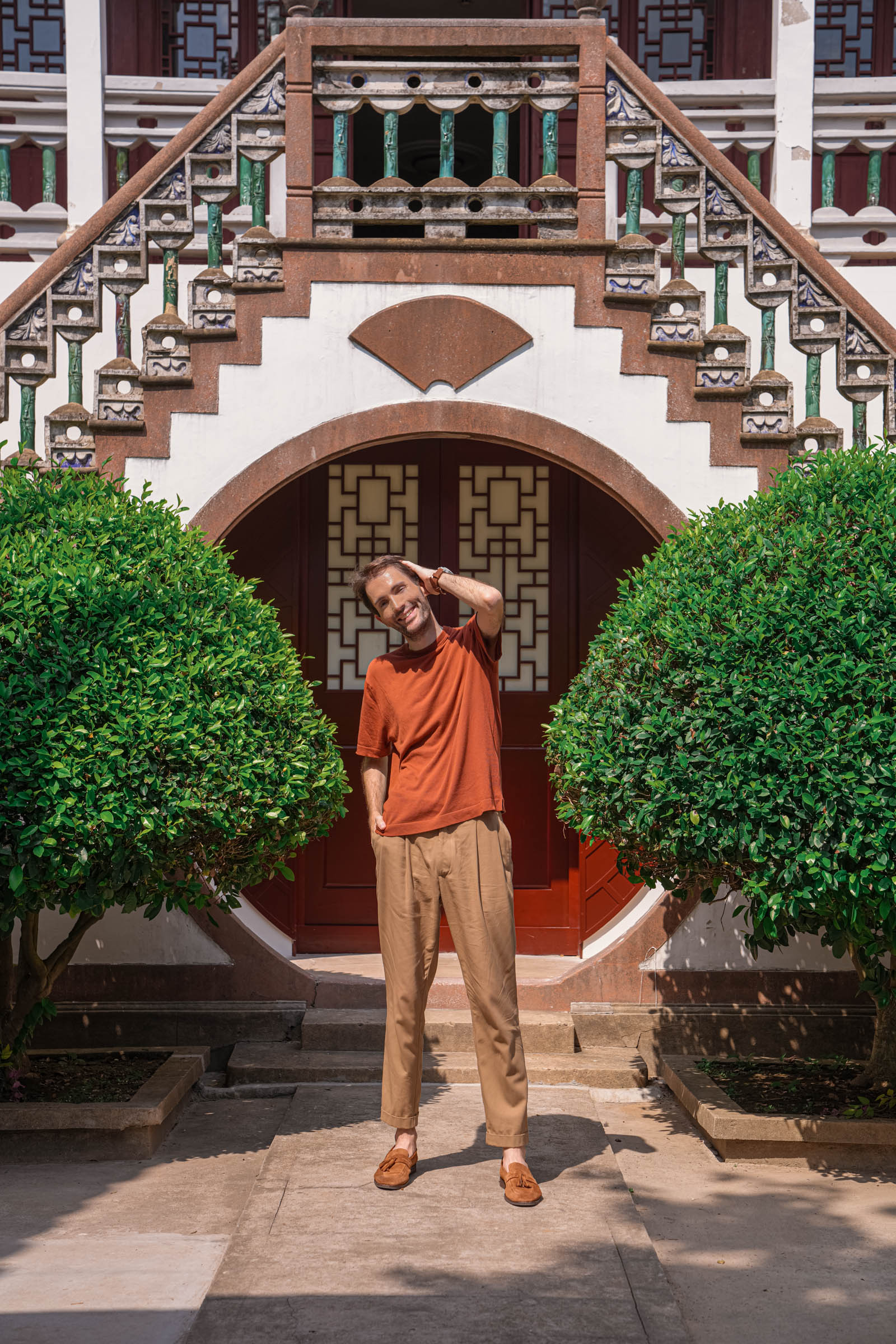
I chose a warm cinnamon-brown shade on purpose. In my opinion, it is the perfect bridge between warmth and freshness, between relaxed summer dressing and elegance. Next to the gray stone, the white walls and the green water of Zhujiajiao, this color simply became part of the natural palette around me.
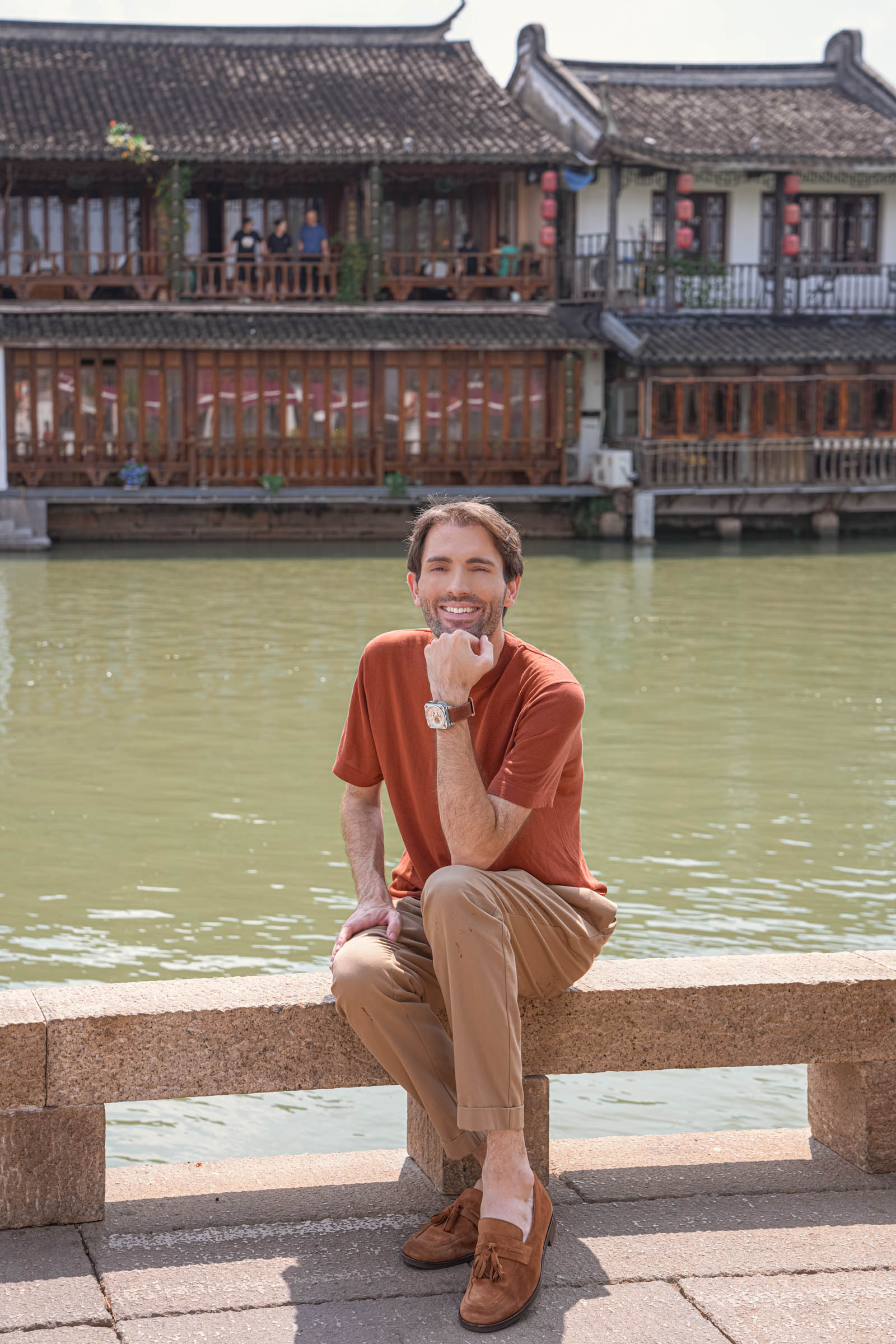
TOBACCO CIFONELLI TROUSERS AND THE ART OF FIT
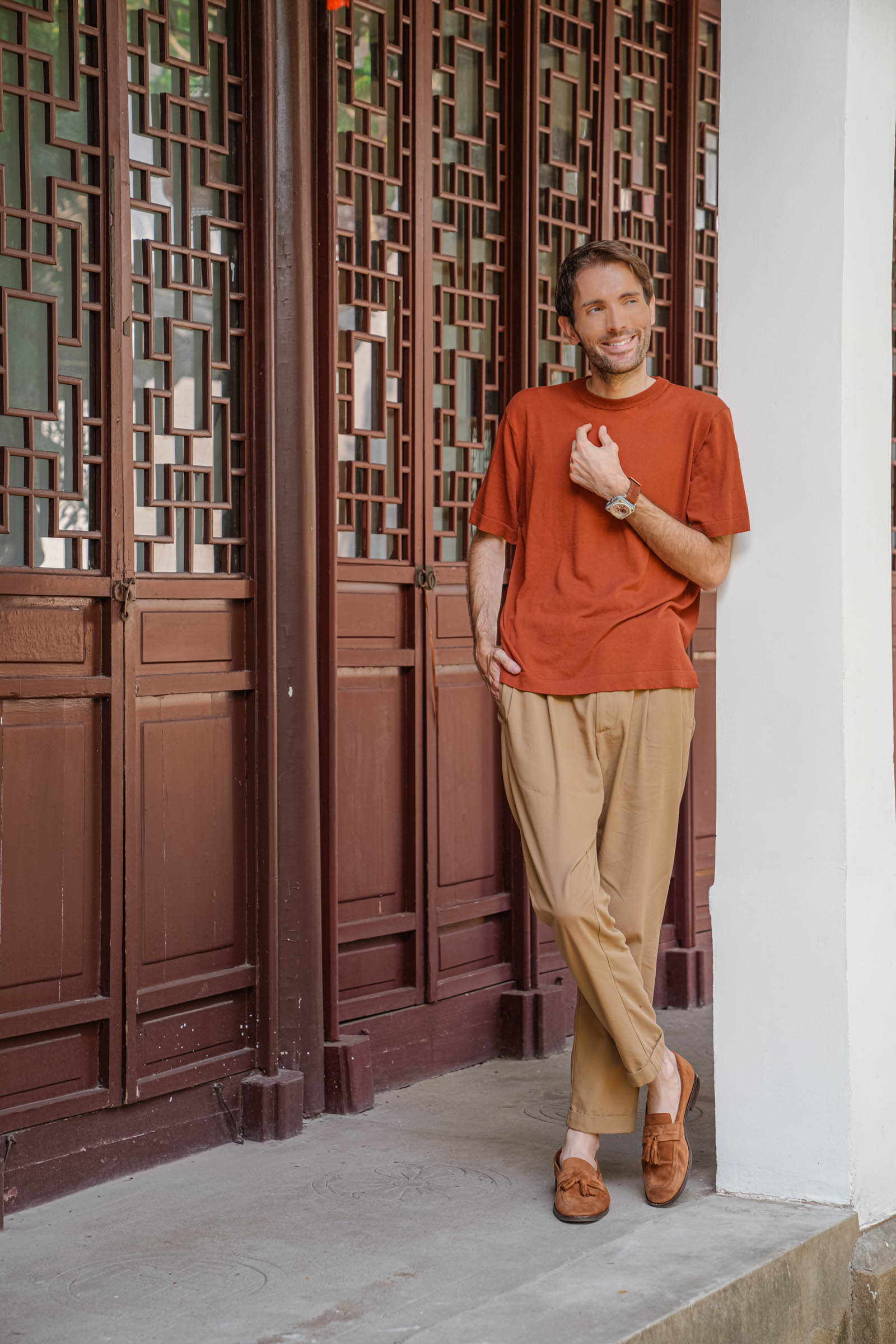
The cotton trousers also come from the Cifonelli collection, in a light shade the house calls tobacco. They have a classic, straight silhouette, so I can wear them with shirts and jackets just as easily as with a T-shirt. As a result, they are an investment that will last for years.
Camel and tobacco tones belong among the noblest shades in a man’s wardrobe. They fit almost any context, from a business lunch to a completely relaxed day in the city. In Zhujiajiao, where gray, white and green dominate, the trousers created a warm contrast that did not disturb the harmony of the space.
As I walked over the old stone slabs, I noticed how well the color matched the earthy tones of the town. Together with the cinnamon-brown T-shirt, it formed a tonal look without any harsh lines.
ROMAGO SUPER CARBON X ON MY WRIST
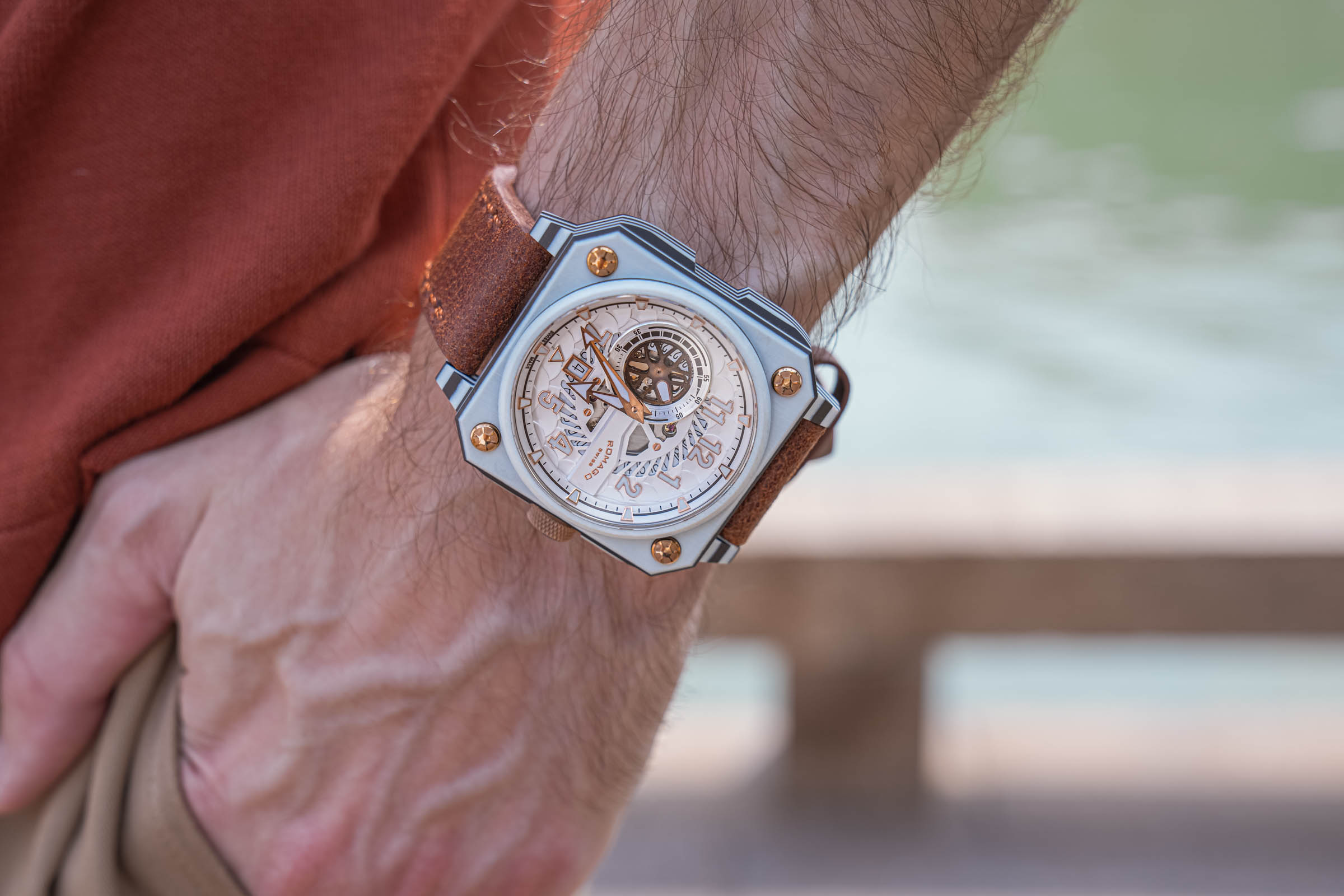
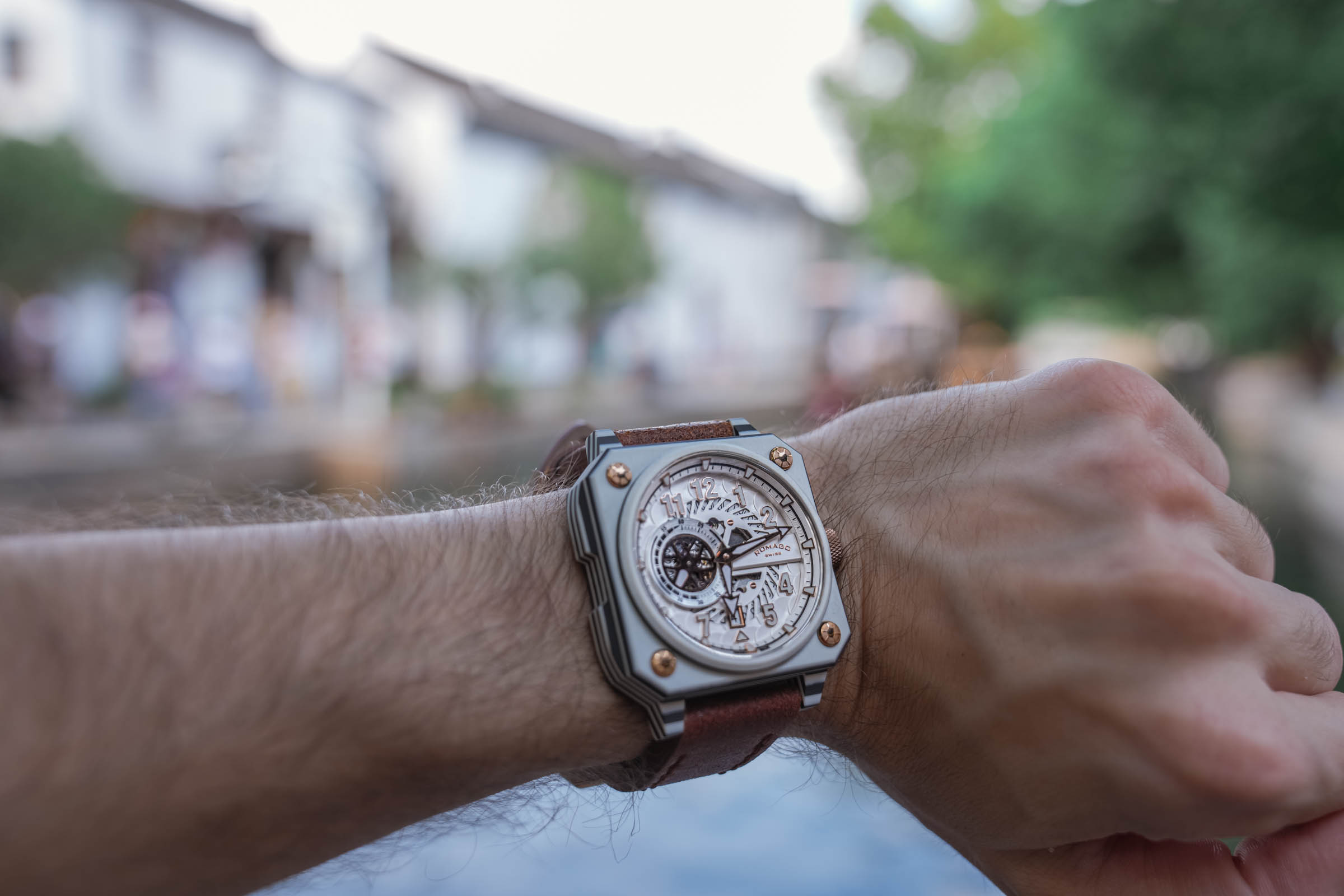
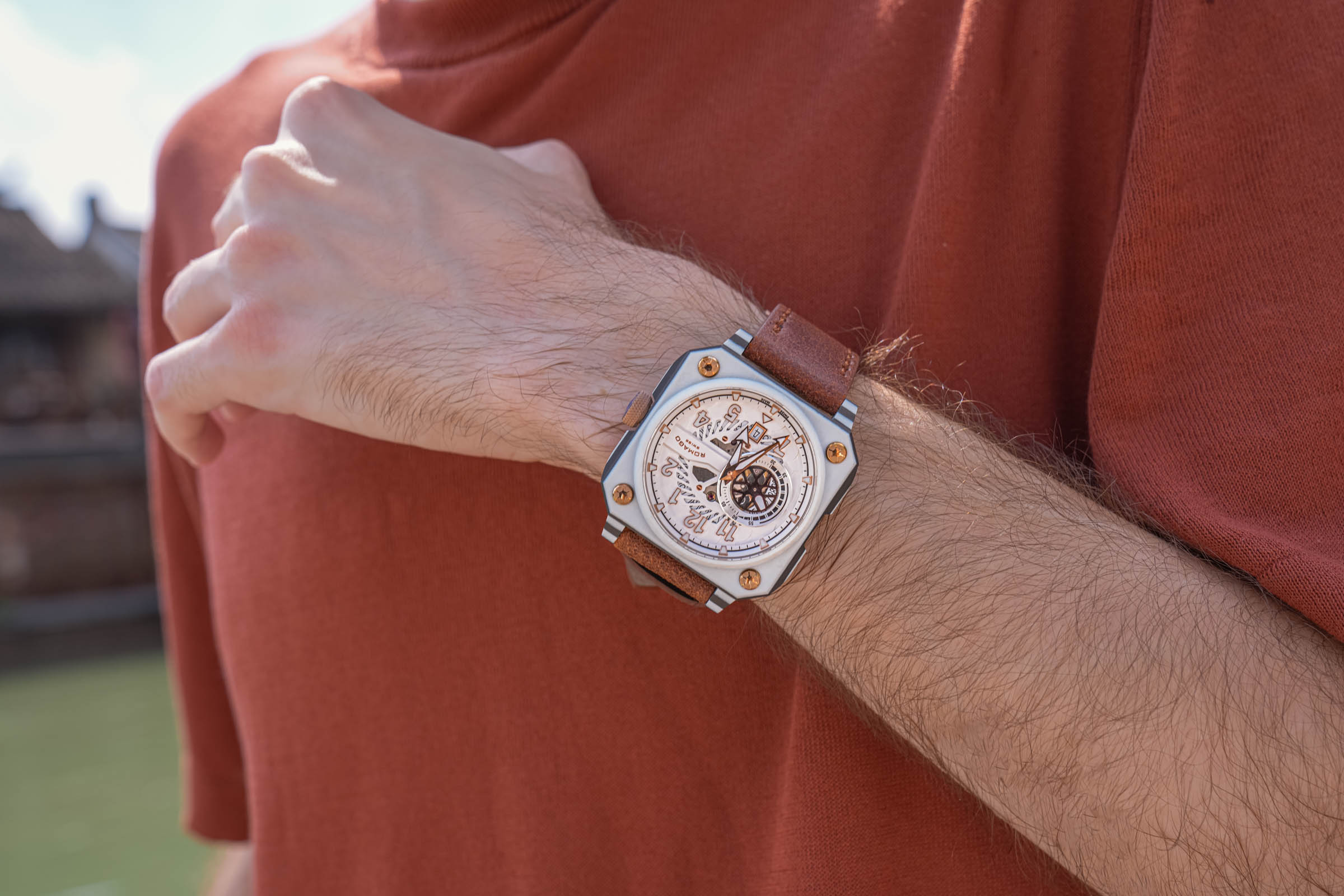
On my wrist, I wore the ROMAGO Swiss Super Carbon X in the Victory Lap version, reference RM097-WH. ROMAGO describes it as a contemporary classic with a design inspired by racing cars. The brand produced this model in a limited edition of 300 pieces.
The case is milled from carbon fiber composites, so the whole watch weighs only 98 grams. It measures 46.5 millimeters in diameter and 16.5 millimeters in thickness. Inside, a Swiss automatic movement offers a power reserve of 36 to 44 hours. In addition, the watch has a sapphire crystal and water resistance of 5 ATM.
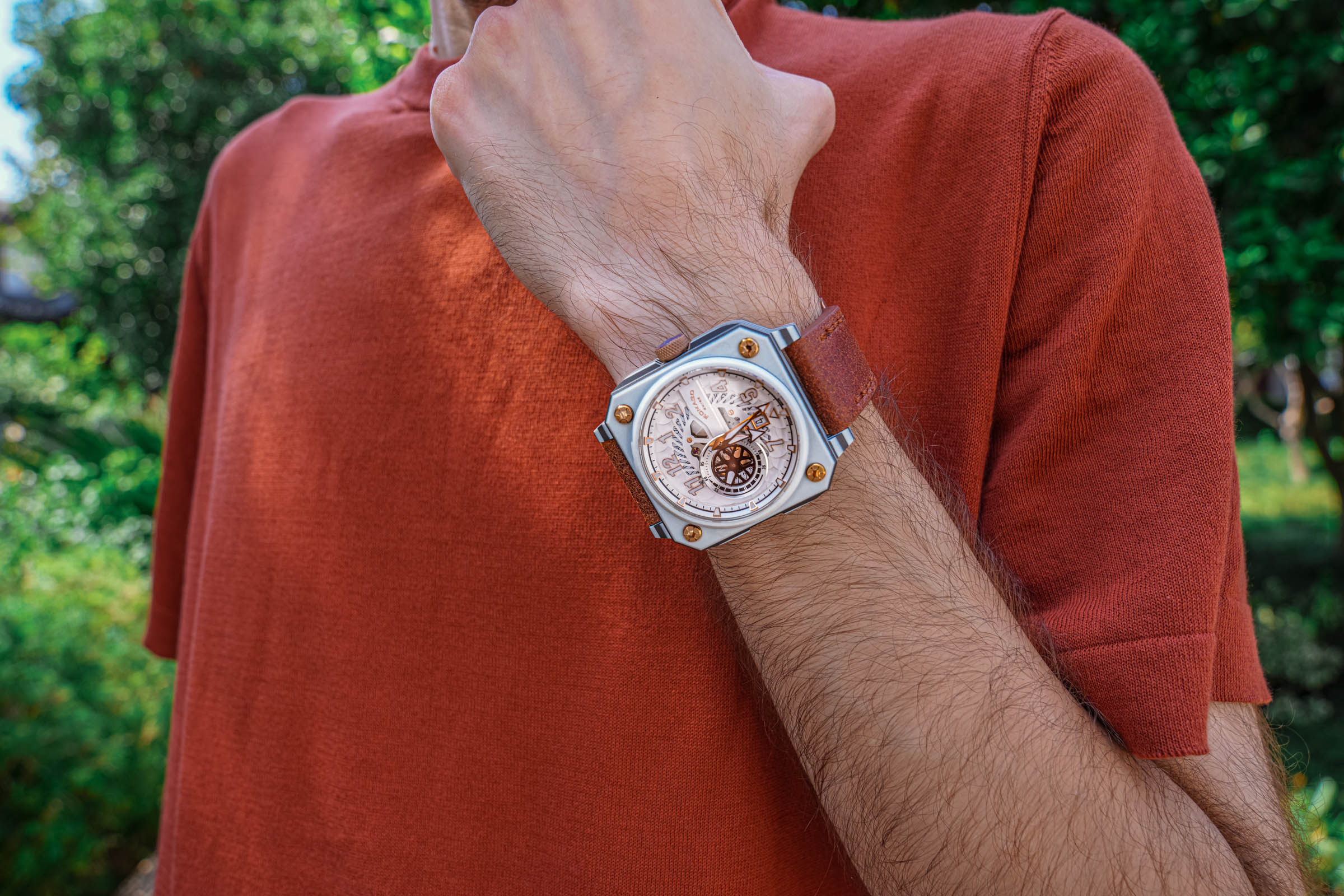
The square case is a bold departure from classic round Swiss watches. In my outfit, it was the only piece with a distinctly modern design. That is exactly why I liked it: it created an interesting contrast with the timeless clothes. I paired it with a brown strap, which echoed the color of my loafers. If you want to know more about this model, read my full review of this carbon watch.
OUTFIT
T-Shirt: Cifonelli
Watch: ROMAGO Swiss
Trousers: Cifonelli
Loafers: Carlos Santos
A SWISS TRADITION THAT BEGAN IN GENEVA
The roots of Swiss watchmaking go back to Geneva in the 16th century. At that time, the reformer John Calvin banned the wearing of ornamental objects in the city. As a result, goldsmiths and jewelers had to turn their skills to a different art: watchmaking. In 1601, the watchmakers of Geneva founded their own guild.
ROMAGO Swiss is a much younger chapter of that story. The brand was established in Switzerland, and in its early years, experienced watchmakers custom-made and handcrafted each piece. Its debut on the global watch market came in 2006, with a premiere in Asia. Since then, the skeleton style has become the foundation of its mechanical designs.
That is also what I like about the Super Carbon X. Through the open dial, you can see the movement at work, and the watch still feels light on the wrist.
CARLOS SANTOS TASSEL LOAFERS FROM PORTUGAL
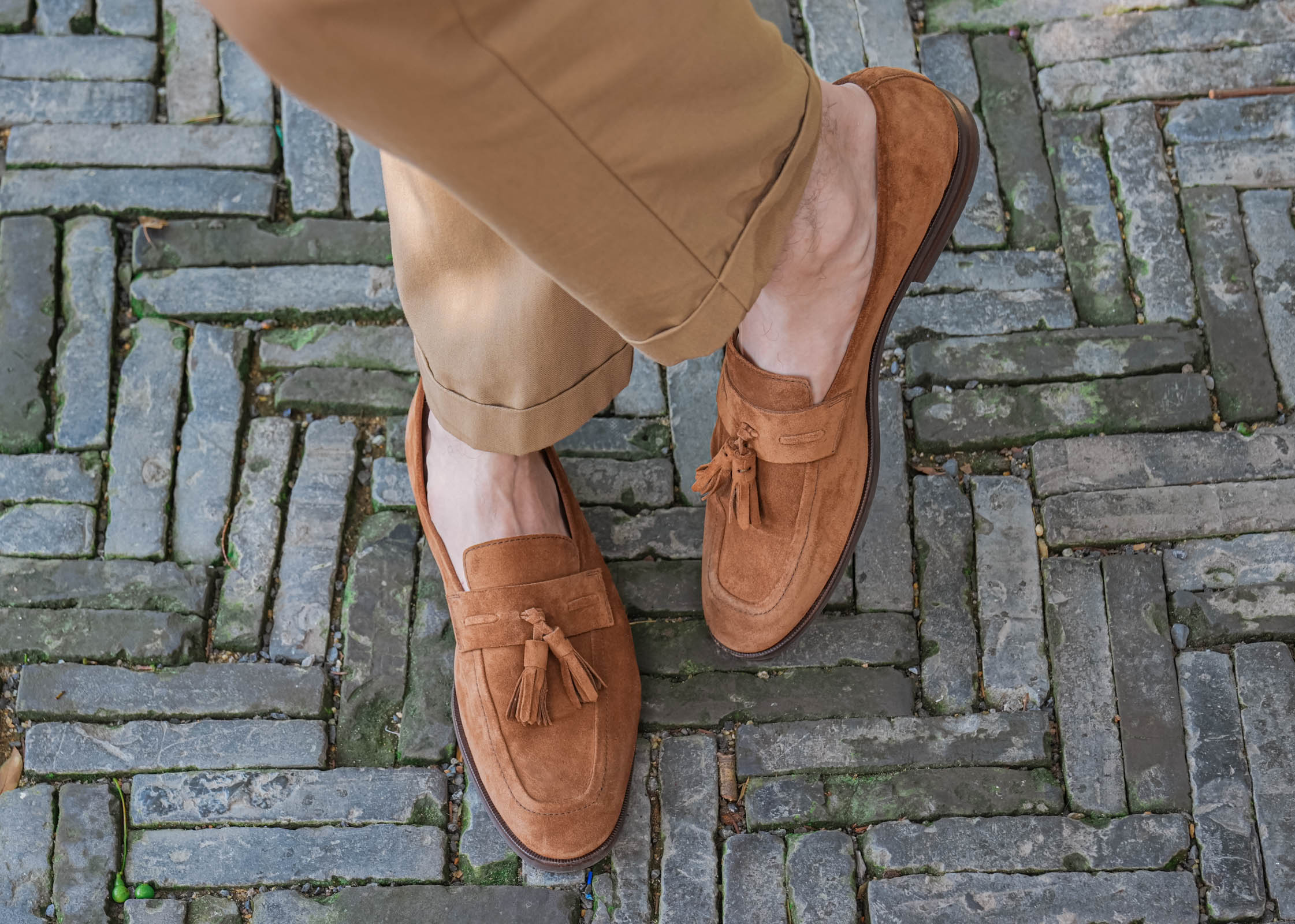
My tassel loafers come from Carlos Santos, a Portuguese brand from São João da Madeira, a town at the heart of Portugal’s shoe industry. The story began there in 1942 with the Zarco shoe factory. Carlos Santos joined Zarco in its founding year and became a partner in 1986. Later, he gave his own name to the brand.
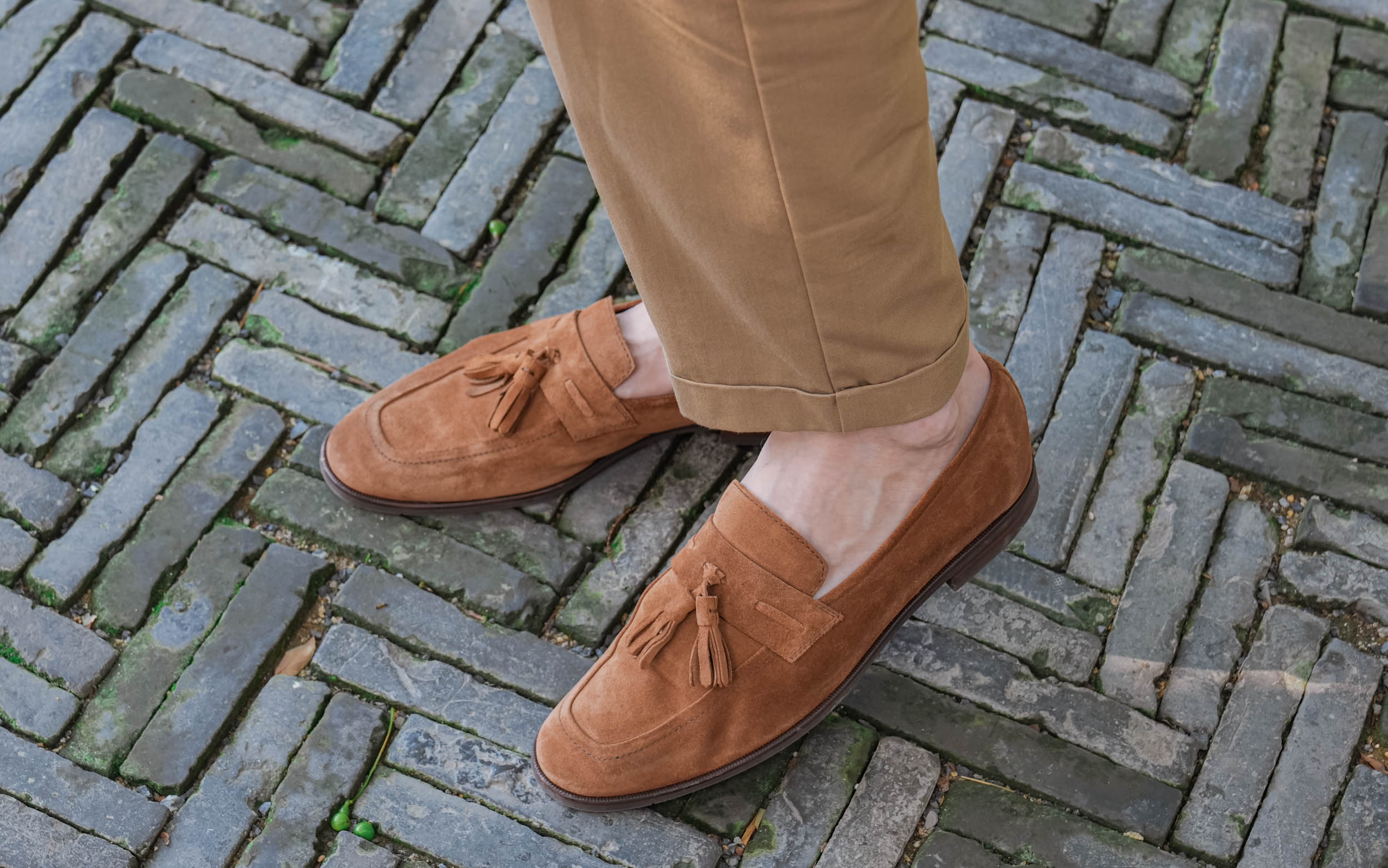
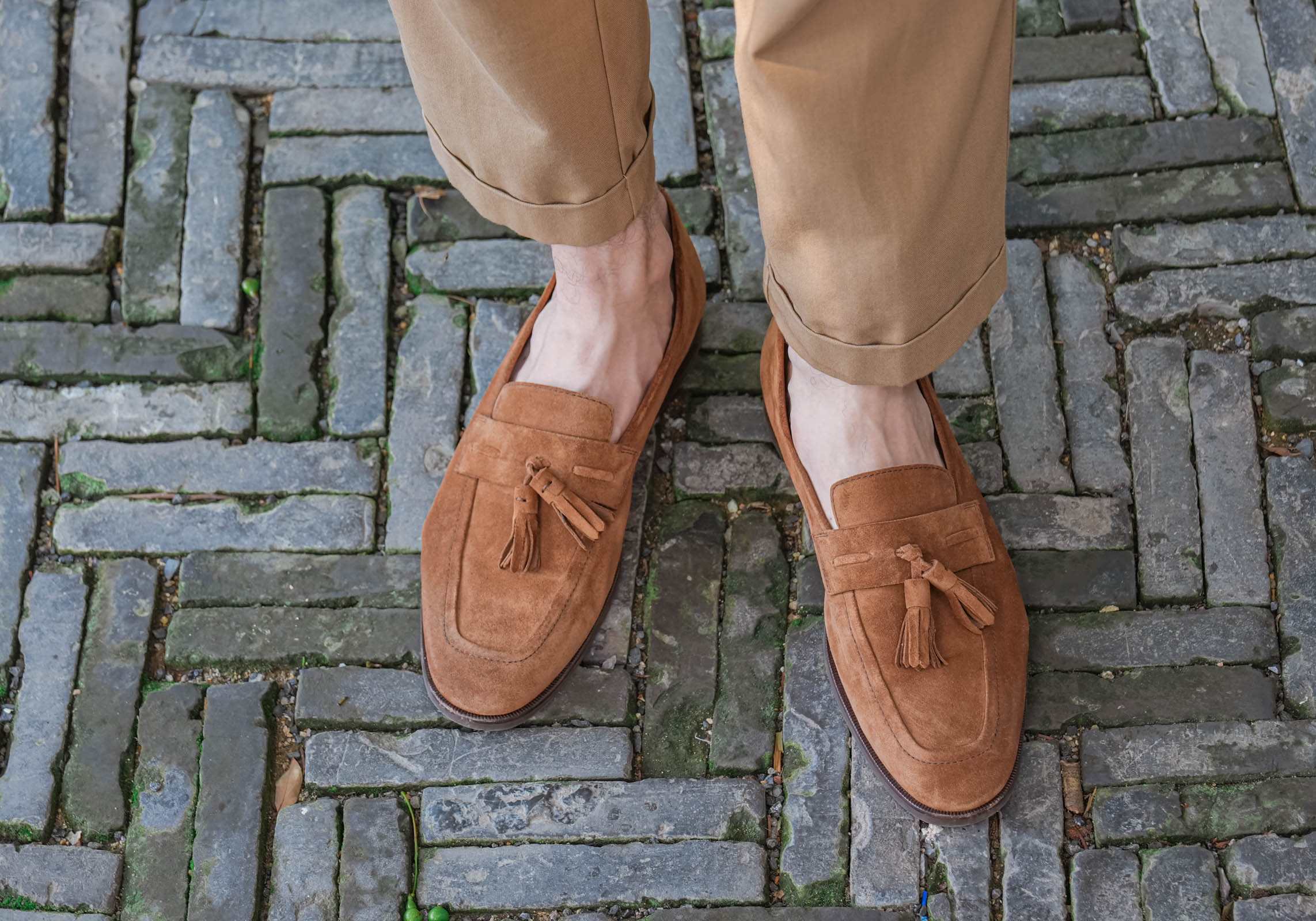
The model I wore is the Whindersson 1989. It is a handcrafted slip-on in a warm brown suede that the brand calls Camurça Sonia Brucciato. The shoe has a Blake stitch construction, which keeps it light and flexible.
Suede is a special challenge in the world of quality footwear. Unlike smooth leather, it is much more sensitive to water and stains. However, when it is well made and properly maintained, it has a texture and warmth that no other material can give.
HOW THE TASSEL LOAFER WAS BORN
Compared with oxfords or derbies, the tassel loafer is a young classic. Its story begins after the Second World War with Paul Lukas, an actor born in Budapest. He came back from Europe with a pair of oxfords that had small tassels at the ends of the laces. Because he wanted his own version, two shops, Lefcourt in New York and Morris Bootmakers in Los Angeles, took on the job.
Both of them turned to the American shoemaker Alden for help. Alden kept the leather lace and tassel as decoration on a slip-on shoe, and in 1948 the tassel loafer was born.
On the uneven cobblestones of Zhujiajiao, I was grateful for my choice. The flexible sole and the soft suede gave me comfort that a stiff leather shoe could not. In addition, the brown color created a natural link with the earthy tones of this ancient town.
WHY ZHUJIAJIAO IS CALLED THE VENICE OF SHANGHAI
Zhujiajiao is not just a backdrop for a fashion story. It is a place that tells stories by itself. The town lies in Shanghai’s Qingpu District, and its history goes back more than 1,700 years, to the Three Kingdoms period. Its name translates as “Zhu Family Corner.”
During the Ming dynasty, Zhujiajiao grew into a busy commercial and trade center. Boats brought rice and cloth from the surrounding countryside straight to the doors of local merchants. Today, 36 stone bridges connect its streets. The most famous one is Fangsheng Bridge from 1571, the largest five-arch stone bridge in the Shanghai area.
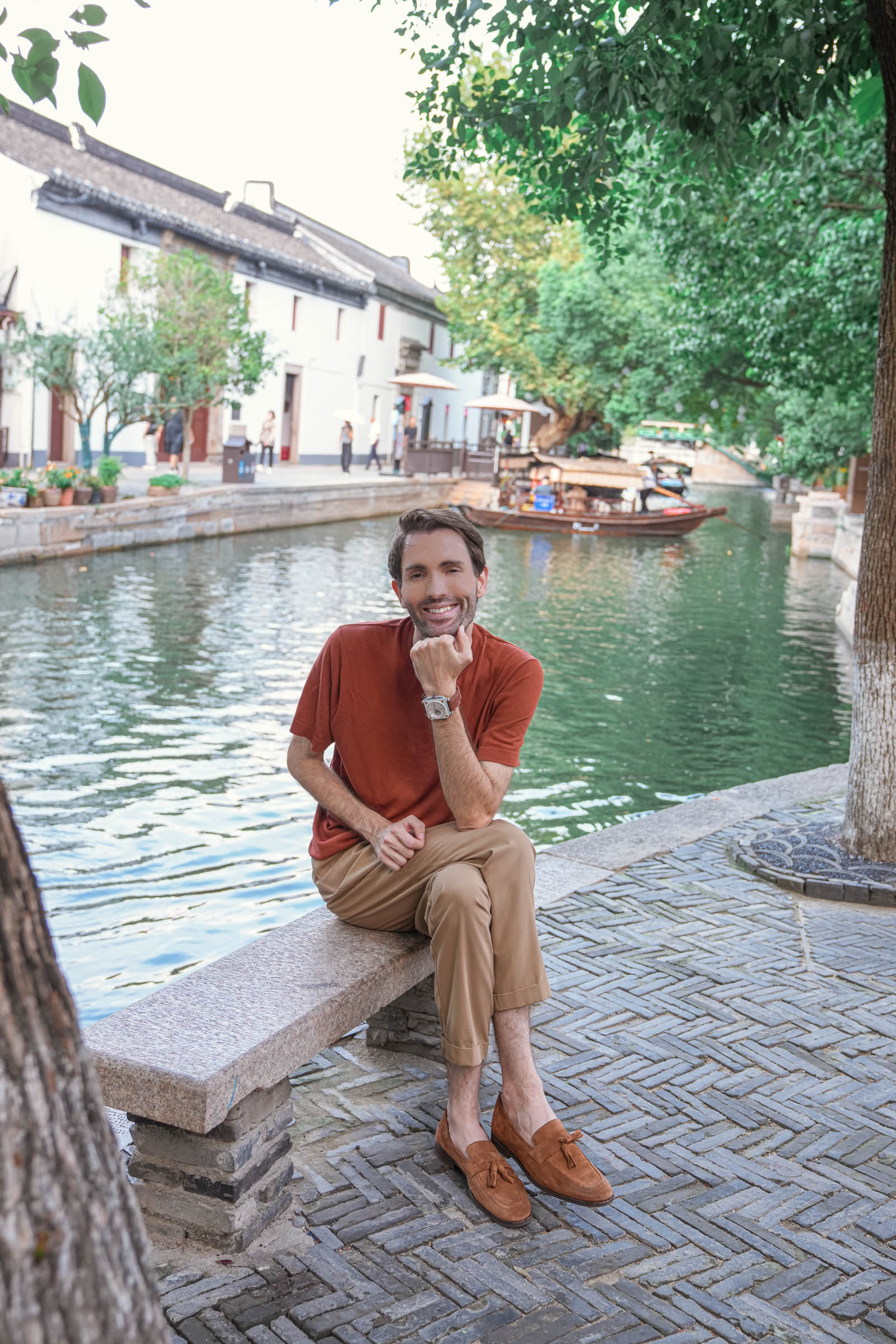
Walking through the narrow streets, surrounded by canals where traditional wooden boats still sail, I felt that time had become a relative term. White walls, dark wooden windows, curved roofs and stone paths polished by countless feet create an atmosphere where the past and present live together.
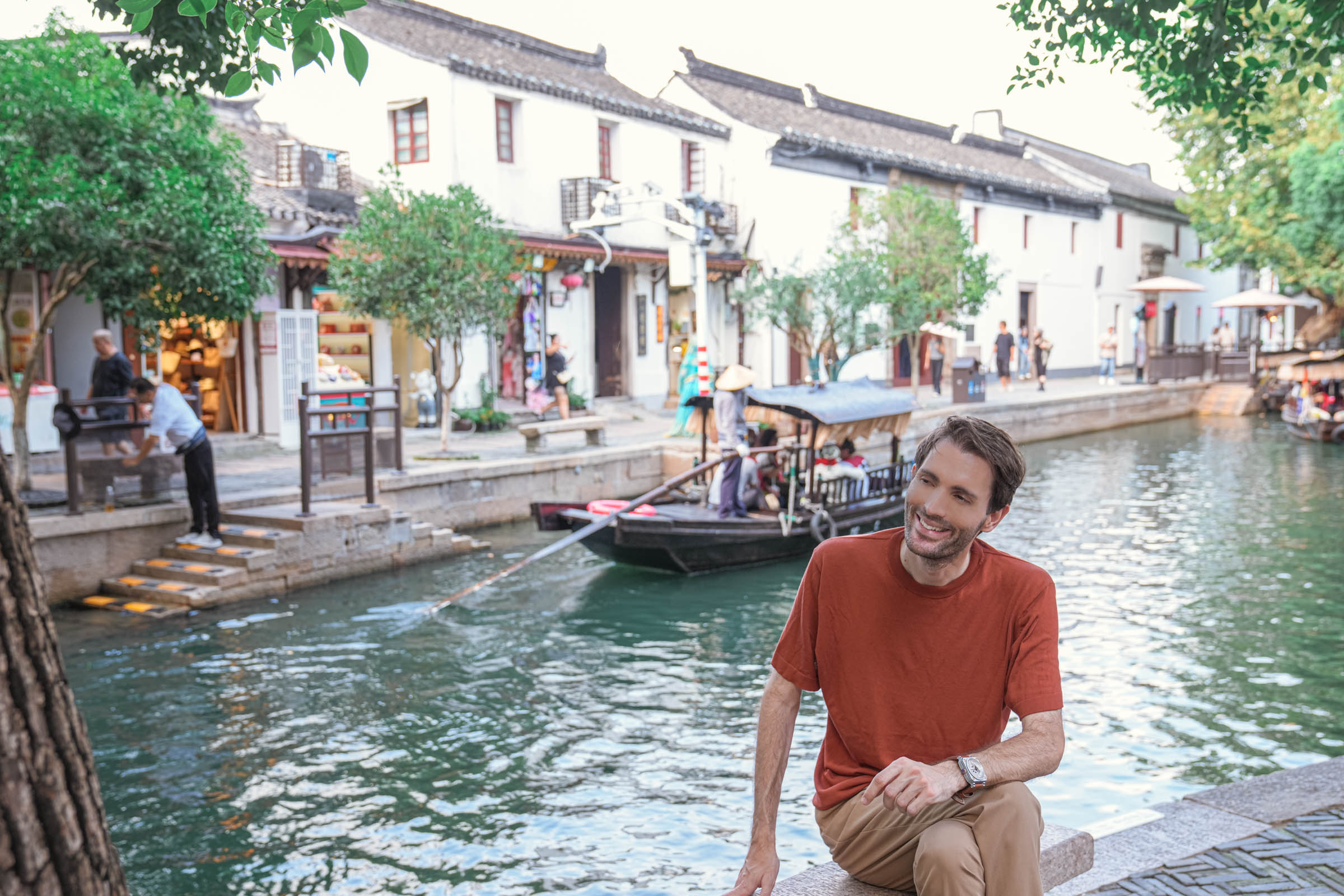
Getting there is easy. Metro Line 17 stops at Zhujiajiao Station, and according to the Shanghai government, the trip from the Hongqiao transport hub takes around 40 minutes. If you are planning a longer stay, my Shanghai travel letter will tell you more about the city.
DRESSING IN CIFONELLI FOR AN ANCIENT WATER TOWN
For me, choosing this outfit was an act of respect for the place. I did not want to be a tourist who stands out. Instead, I wanted to blend in with the atmosphere, so that my clothes would echo the modesty and elegance of the town.
The basis of this look lies in a principle that all great fashion houses share: simplicity is the height of sophistication. The watch was the only element that brought a different dimension, and that was my decision. I simply wanted a touch of modern design next to the classics.
Textures played a key role in this story. The dense cotton knit of the T-shirt and the soft suede of the loafers each have their own way of reflecting light and their own feel to the touch. In a tonal outfit like this one, texture is what separates a boring look from an interesting one. I followed the same idea in my Aida Barni cashmere look by the Huangpu River.
The fit of each piece was the key to success. The T-shirt is elegant enough for tailored trousers, but relaxed enough for a day in the old town. Meanwhile, the tassel loafers are dressy enough for an evening out and casual enough for daytime walks.
CARING FOR CIFONELLI COTTON AND SUEDE LOAFERS
Owning pieces of this quality brings the responsibility of proper care. I wash a cotton knit T-shirt at a lower temperature and never put it in the dryer. Aggressive washing can damage the structure of the knit, so a little extra time pays off in a longer life for the piece.
After wearing my trousers, I brush them with a soft brush to remove surface dust and refresh the fibers. I keep professional cleaning to a minimum, because every treatment wears the fabric a little. Instead, I often air them out in the open.
Suede loafers need special attention. After each wear, I brush them with a suede brush to lift the nap and remove dirt. I also use a protective spray made for suede, which creates an invisible barrier against water and stains. Finally, I put shoe trees into my loafers right after I take them off, which helps them keep their shape for years.
SAYING GOODBYE TO ZHUJIAJIAO IN MY CIFONELLI OUTFIT
As I sat on the bank of a canal, watching the old houses reflected in the still water, I realized that style is not something you achieve. It is something you live. Every piece I wore that day expressed values I carry with me wherever I go.
The Cifonelli T-shirt and trousers stand for respect for craftsmanship and tradition. The Carlos Santos loafers show that quality does not always have to come from the most famous fashion capitals. And the ROMAGO watch symbolizes an openness to the modern without giving up the value of tradition.
Zhujiajiao was the perfect setting for this story because, just like my outfit, it brings the past and present together. So when you choose what to wear, do not just choose clothes; choose the story you want to tell. After all, true elegance is not about being noticed. True elegance lies in being remembered.
Which piece from this outfit would you add to your wardrobe first: the Cifonelli T-shirt, the ROMAGO watch or the Carlos Santos tassel loafers?
Feel free to leave your impressions, comments or questions below, or contact me by email and on social networks. All information is on the CONTACT page.
With love from Zhujiajiao,
Mr.M
This post is sponsored by Cifonelli, ROMAGO Swiss, Carlos Santos brands. This post represents my personal and honest review of the destination, services and products provided.
Hello Marko, what a beautiful combination of fashion and travel storytelling! The tobacco-colored Cifonelli T-shirt against the ancient water town backdrop is truly stunning. I’ve been a Cifonelli customer for several years now, mostly for their suits, but this post has convinced me to explore their casual pieces as well. The fact that they’ve maintained the same principles since Giuseppe Cifonelli founded the atelier in 1880 is remarkable in today’s fast fashion world.
Fantastischer Beitrag, Marko! Ich kenne Cifonelli hauptsächlich für ihre maßgeschneiderten Anzüge, aber diese Kombination aus T-Shirt und Hose zeigt eine ganz andere Seite der Marke. Die Tatsache, dass ihr Atelier noch immer in der Rue Marbeuf 31 im 8. Arrondissement von Paris arbeitet, zeigt ihre Treue zur Tradition. Die Kamelfarbe der Hose harmoniert perfekt mit den erdigen Tönen von Zhujiajiao.
Cher Marko, quelle belle découverte que Zhujiajiao! Je ne connaissais pas cette ville d’eau près de Shanghai. L’histoire de ce lieu qui date de plus de 1700 ans et ses trente-six ponts anciens, dont le célèbre pont Fangsheng de 1571, est fascinante. Ton outfit Cifonelli s’intègre parfaitement dans ce décor historique. La philosophie de la marque, combinant tradition italienne et élégance française raffinée, se reflète vraiment dans ces pièces.
Hi Marko, I have a question about the Cifonelli cotton knit T-shirt. You mentioned it requires careful washing at lower temperatures. What specific temperature would you recommend, and do you hand wash it or use a gentle machine cycle? I’m considering investing in one but want to make sure I can properly maintain it. The tobacco color looks incredibly versatile and sophisticated.
Ciao Marko! Possiedo già due giacche Cifonelli e posso confermare che la qualità è eccezionale. La cosa che mi ha sempre impressionato è che i loro maestri artigiani devono completare un apprendistato di dieci anni prima di lavorare indipendentemente. Questo post mi ha fatto scoprire che producono anche T-shirt in maglia di cotone di questa qualità. La combinazione con i mocassini Carlos Santos Whindersson è perfetta per un look casual ma elegante.
Marko, your point about textures being key in a monochrome outfit really resonated with me. The cotton knit of the T-shirt combined with the suede leather of the moccasins creates visual interest without relying on contrasting colors. I’ve been wearing Cifonelli pieces for years and their attention to detail is unmatched. The camel trousers look like they have that perfect balance between structure and comfort you described.
Hola Marko! Me encanta cómo has explicado la historia del color camel, que originalmente viene de la lana de camello utilizada durante siglos en regiones frías. Nunca había pensado en el origen histórico de este tono. Los mocassines Carlos Santos con borlas son preciosos, y el hecho de que Portugal tenga una tradición zapatera que rivaliza con las marcas italianas pero a precios más accesibles es una información muy útil para quienes buscamos calidad.
Bonjour Marko! J’ai une question concernant les mocassins Carlos Santos Whindersson en daim. Tu mentionnes que tu utilises des sprays protecteurs spécifiques pour le cuir retourné. Pourrais-tu recommander une marque particulière? J’ai des chaussures en daim mais j’ai toujours peur de les porter par temps incertain. Tes conseils sur le brossage après chaque utilisation sont très utiles aussi.
Hervorragender Artikel, Marko! Die Romago Super Carbon X Uhr ist ein interessanter Kontrast zu den klassischen Cifonelli-Stücken. Die Information, dass Kohlefaser fünfmal leichter als Stahl aber dennoch stärker ist, macht sie zu einer praktischen Wahl für Reisen. Die quadratische Form des Zifferblatts ist mutig und modern, und ich finde es klug, wie du dieses moderne Element mit zeitlosen Kleidungsstücken kombiniert hast.
This post perfectly captures why Cifonelli remains one of the most respected names in tailoring. I own several of their pieces and the craftsmanship is simply outstanding. Your description of their “Cifonelli cut” and how they apply the same attention to detail to every piece, including trousers, explains why their garments feel so different from mass-produced clothing. Zhujiajiao looks like an incredible destination as well.
Marko, ho una domanda sulla vestibilità dei pantaloni Cifonelli color cammello. Dici che hanno una silhouette classica che può essere abbinata sia a camicie e giacche che a T-shirt. Come descriveresti la vita, è alta o media? E il taglio della gamba è dritto o leggermente affusolato? Sto cercando pantaloni versatili per il mio guardaroba e questi sembrano perfetti.
Cher Marko, ton article est une véritable leçon de style! La phrase “la vraie élégance n’est pas d’être remarqué, mais d’être mémorable” résume parfaitement ta philosophie. J’achète souvent des vêtements pour mon mari et cette combinaison de couleurs neutres avec des textures différentes est exactement ce qu’il recherche. Le fait que Cifonelli existe depuis 1880 et maintient les mêmes principes de qualité est vraiment impressionnant.
Hola Marko! Excelente artículo como siempre. Me fascina cómo describes la tradición relojera suiza que se remonta al siglo XVI, cuando las restricciones calvinistas sobre las joyas obligaron a los orfebres a dedicarse a la relojería. Este tipo de contexto histórico hace que tu blog sea mucho más que un simple blog de moda. La combinación de tonos tierra con el entorno de Zhujiajiao es visualmente perfecta.
Hallo Marko! Als jemand, der die Marke Cifonelli bereits kannte, hat mich dieser Beitrag überzeugt, ihre Freizeitkollektion auszuprobieren. Die tabakbraune Farbe des T-Shirts ist wirklich zeitlos und vielseitig. Dein Ratschlag, Wollhosen regelmäßig mit einer weichen Bürste zu pflegen anstatt sie häufig chemisch reinigen zu lassen, ist sehr praktisch. Die Fotos in der antiken Wasserstadt sind absolut atemberaubend.
Marko, I appreciate the depth of research you put into these posts. Learning that Zhujiajiao literally means “corner of the Zhu family” and dates back to the Three Kingdoms period adds so much context to the photographs. Your outfit choice of earth tones shows real understanding of how to dress appropriately for a location while maintaining personal style. The Carlos Santos loafers look incredibly comfortable for walking on those ancient cobblestones.
Bellissimo post, Marko! La filosofia che condividi alla fine, “non scegliere solo vestiti, scegli la storia che vuoi raccontare”, è qualcosa che ogni uomo interessato alla moda dovrebbe ricordare. Ho visitato il loro atelier a Parigi l’anno scorso e posso confermare che l’atmosfera è davvero speciale. Vedere i maestri artigiani al lavoro ti fa capire perché i pezzi Cifonelli sono così diversi da tutto il resto sul mercato.
Salut Marko! J’adore comment tu as choisi de ne pas être un touriste qui se démarque mais plutôt de t’intégrer à l’ambiance de Zhujiajiao. C’est exactement l’approche que j’essaie d’adopter lors de mes voyages. Les tons tabac et camel de Cifonelli créent effectivement un contraste chaleureux avec les couleurs dominantes grises, blanches et vertes de la ville d’eau. Merci pour cette inspiration vestimentaire et culturelle!