
My dear travellers and lovers of unusual journeys, welcome to the new travelogue on the Mr.M blog. After a series of travelogues from Asia that won your hearts, it’s time to focus on European metropolises. There are cities that you visit and there are cities that you are always happy to return to. Rome belongs to that other group of cities that always leave an extraordinary impression on tourists that they simply want to return to this eternal city. This city is a place where centuries permeate at every turn, where ancient columns abut 18th-century buildings and narrow streets lead you from one discovery to another. I came to Rome with expectations, but this city, for the umpteenth time, exceeded them. In this travelogue I take you through what makes Rome one of the most visited cities in the world, through the places I visited, the hotel I stayed in and what I felt again walking the streets of the eternal city.
Before starting today’s travelogue about Rome, I want to express my special thanks to the United Nations World Tourism Organization – UN Tourism and Master Trevi Rome Hotel for supporting and promoting quality tourism around the world. Their dedication to connecting cultures and destinations is an inspiration to all of us who believe that travel enriches the soul.


WHY IS ROME ONE OF THE MOST VISITED CITIES ON THE PLANET?
Rome is a city that is visited annually by more than twenty million tourists. In 2024 alone, according to data from the Rome Tourism Organization, the city recorded a record 22.2 million arrivals and an incredible 51.4 million overnight stays. This makes it the most visited city in all of Italy, far ahead of Venice, Florence and Milan. The reason for this popularity is not only in the sights, although they are on every corner. Rome attracts because it offers something that hardly any city can, which is the ancient experience of thousands of years of human civilization, concentrated in a relatively small area of the historic center.
The ancient Romans ruled the entire Mediterranean, North Africa and parts of the Middle East. Their legacy is visible at every turn. Then Rome became the center of Christianity, the city where the Pope still lives today, and this spiritual meaning attracts pilgrims from all over the world. During the Renaissance, the city was one of the most important centers of art and education in Europe. Later, in the 18th and 19th centuries, Rome was a mandatory stop on the so-called Great Journey, when young European aristocrats came to learn about ancient culture, philosophy and architecture. That spirit never went away.


ARRIVAL IN ROME AND FIRST IMPRESSIONS
Rome welcomes you with warmth, energy and an unusual crowd that simply cannot be described in words. As soon as you step out into the street, you feel the rhythm of the city, Vespa scooters whizzing past you, the smell of freshly baked bread from the bakery and famous Italian pasta from local restaurants, the sound of water flowing from one of the thousand fountains. The historic center is compact enough to be comfortably explored on foot, and that’s exactly how I spent my days in Rome, walking from one landmark to another, stopping for sweet breaks when I needed a break.
What surprises me every time is how much Rome is a living city. This is not an open-air museum in the sense that everything is preserved and protected behind glass. People live in buildings that are hundreds of years old, do laundry on terraces above baroque churches, drink espresso leaning on columns dating back to the time of the empire. This mixture of the everyday and the eternal makes Rome different from all other cities in Europe and the world.


TREVI FOUNTAIN: THE HEART OF ROME
Every trip to Rome starts or ends at the Trevi Fountain. This baroque fountain, twenty-six meters high and almost fifty meters wide, is the largest fountain in Rome. It was designed by Nikola Salvi and completed in 1762. The central figure represents the god Ocean standing on a chariot drawn by two horses, one calm and one wild, symbolizing the two faces of the sea.

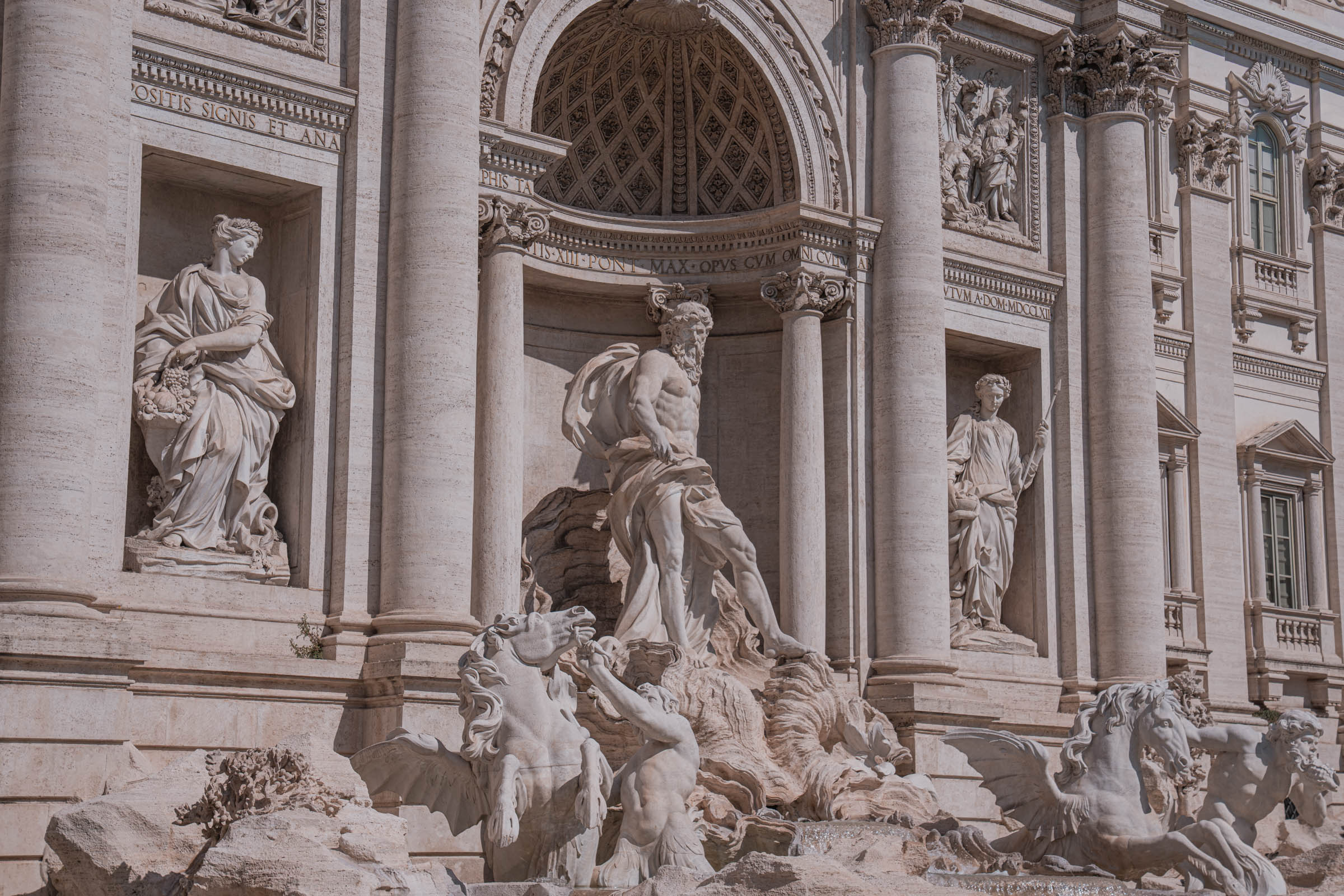
I came early in the morning, before the mass of tourists appeared, and was rewarded with a breathtaking sight. The light of the early sun illuminates the white marble and creates a play of shadows on the sculptures that look as if they could come to life at any moment. Tradition says that if you toss a coin with your right hand over your left shoulder, it will take you back to Rome. Every year, tourists throw around a million and a half euros into the fountain, and that money is collected and donated to Roman charities.

The new rules for visiting the Trevi Fountain bring a small but significant change for tourists in Rome. Although access to the fountain itself is still completely free, as of February 2026, a symbolic fee of around €2 will be introduced for access to the nearest zone by the water, the place where visitors traditionally throw coins. This measure aims to better control crowds and preserve one of the most famous symbols of the city. For most visitors, nothing fundamentally changes: enjoying the view and taking photos remain free, while the additional experience from the front row is now charged.
TRINITA DEI MONTI STAIRCASE (SPANISH STEPS) AND PIAZZA DI SPAGNA
From the Trevi Fountain, it is a short walk to the Spanish Steps, one of the most famous staircases in the world. Built between 1723 and 1725, this 135-step staircase connects Piazza di Spagna at the bottom with the Trinita dei Monti church at the top. In the square itself, in front of the staircase, there is a fountain in the shape of a boat, known as Barcaccia, the work of Pietro Bernini, the father of the more famous Gianlorenzo Bernini.


I stood at the top of the stairs and looked down at the colorful mass of people, the elegant facades of the surrounding buildings, and the Via dei Condotti, which leads straight from the square. This street is a paradise for lovers of luxury fashion, with stores of houses such as Cartier and Bulgari, whose signs are visible from the staircase itself. Piazza di Spagna is a place where elegance and everyday life meet, where tourists mingle with Romans rushing to work.


PIAZZA DEL POPOLO: THE ANCIENT GATE OF ROME
At the northern end of the historic center is Piazza del Popolo, one of the most beautiful squares in the city. This ellipsoidal square was the main entrance to Rome for travelers coming from the north, through the Porta del Popolo, a monumental gate in the Aurelian Walls. In the middle of the square rises an Egyptian obelisk three thousand three hundred years old, one of the thirteen obelisks in Rome, which Emperor Augustus brought from Egypt.


The two ends of the square are flanked by identical twin baroque churches: Santa Maria dei Miracoli and Santa Maria in Montesanto, which create perfect symmetry. Three fan-shaped streets start from the square: Via del Corso, Via del Babujino and Via di Ripeta, which lead deeper into the heart of the city. On the east side of the square, the terrace on the Pincho Hill offers one of the most beautiful views of Rome, with the dome of St. Peter’s Basilica dominating the skyline. A fountain at the foot of the terrace, with a sculpture of the goddess Rome flanked by the rivers Tiber and Aniene, completes this space perfectly.


PANTHEON: THE PERFECTION OF ROMAN ARCHITECTURE
The Pantheon is perhaps the most fascinating building in Rome. Built around 125 AD during the reign of Emperor Hadrian, this is the best-preserved ancient building in the city. An inscription on the facade says that it was built by Marcus Agrippa, because Hadrian wanted to honor the original temple that Agrippa built on the site. The dome of the Pantheon, forty-three meters in diameter, was the largest dome in the world for thirteen hundred years, until Brunelleschi built the dome of the Florence Cathedral.
I entered through the massive bronze doors and immediately looked up at the occlus, a circular opening at the top of the dome, nine meters in diameter, through which light and, sometimes, rain pours in. The effect is theatrical and modest at the same time. The light that penetrates the occlusum moves around the interior like a giant clock, marking the passage of time in the same way for almost two thousand years. The Pantheon has been a church dedicated to All Saints since the seventh century and contains the tombs of the painter Raphael and several Italian kings.


PIAZZA NAVONA: THE STAGE OF ROMAN LIFE
Piazza Navona occupies the space of the former Domitian Stadium from the first century and the elliptical shape of the square follows the contours of the former race track. Three fountains adorn this square, and the central Fountain of the Four Rivers by Gianlorenzo Bernini is one of the masterpieces of Baroque sculpture. The four figures represent the great rivers of the then known world: the Danube, the Ganges, the Nile and the Rio de la Plata. The obelisk above the fountain was part of Maxentius’ circus on the Via Appia.


The square is always alive. Artists sell paintings, street musicians play, and the terraces of the surrounding cafes are full to capacity. At the northern end of the square is the Neptune Fountain, and at the southern end is the Fontana del Moro. The Church of Saint Agnes in Agonja, whose project was started by Borromini, dominates one side of the square. Between Bernini’s fountain and Borromini’s church there is a famous legendary rivalry between the two artists, although art historians claim that the story of their mutual subterfuge in this square is more myth than truth.


THE COLOSSEUM: A MAGNIFICENT WITNESS OF THE ROMAN PAST
The Colosseum is a symbol of Rome and one of the new seven wonders of the world. Built between 70 and 80 AD, this amphitheater could accommodate between fifty and eighty thousand spectators. Its real name is the Flavian Amphitheater, and the Colosseum was named after the colossal statue of Emperor Nero that once stood nearby. It is visited annually by about twelve million people, which makes it the most visited cultural attraction in all of Italy.


I stood in front of it and tried to imagine what this space looked like when it was filled with Roman citizens watching gladiatorial fights, hunting wild animals and other spectacles. The underground corridors, known as the hypogeum, served as a backdrop where fighters and animals were prepared before being lifted into the arena by elevators. This underground network of tunnels and rooms was a true engineering marvel of its time.


Next to the Colosseum is the Arch of Constantine, a triumphal arch from the fourth century, one of the best preserved in Rome. It was built in 315 to celebrate Constantine’s victory on the Milvian Bridge, and it is decorated with reliefs that were partly taken from older monuments.

TRAJAN’S FORUM AND ROMAN MARKETS
The Roman Forums are perhaps the most impressive archaeological site in the city. Trajan’s Forum, built at the beginning of the second century, was the last and largest of the imperial forums. Trajan’s column, thirty-eight meters high, still stands today, with a spiral relief frieze depicting scenes from Trajan’s wars in Dacia. About two thousand five hundred figures are carved in marble on a frieze almost two hundred meters long.


Behind the column are the remains of Trajan’s Markets, a semi-circular brick structure believed to be the first shopping center in history. There were about one hundred and fifty shops in it spread over several levels. When you stand in front of these ruins and look towards the hill on which rises the Renaissance dome of the Church of the Holy Name of Jesus, you realize how many layers of history Rome hides.

VATICAN: THE HOLY STATE IN THE CITY
The Vatican is the smallest independent state in the world, with an area of only forty-four hectares, but its importance is immeasurable. St. Peter’s Basilica, the largest church in the world, dominates St. Peter’s Square designed by Bernini. The colonnade with two hundred and eighty-four columns forms an embrace that symbolically welcomes the faithful into the fold of the church.


I entered the basilica and as prepared as I was, the size and opulence of the interior was breathtaking. The dome, designed by Michelangelo, rises to a height of one hundred and thirty-six meters and is painted with mosaics depicting saints and angels. Bernie’s canopy above the papal altar, twenty-nine meters high, was made of bronzes taken from the Pantheon. The Pieta, Michelangelo’s sculpture of the Virgin holding the body of Christ, is in the first chapel on the right and is the only work signed by Michelangelo.


Beneath the basilica, in the crypt, are the tombs of the popes, including those of the most recently deceased. St. Peter’s Square, with its central Egyptian obelisk, provides a view to remember forever, especially when clouds roll over the dome and create a dramatic backdrop for Bernini’s statues of saints atop the colonnade.


CHURCHES OF ROME: HIDDEN TREASURES
Rome has over nine hundred churches and many of them hide artistic treasures that can be compared to any museum in the world. The Basilica of Santa Maria del Popolo, in Piazza Popolo itself, contains two paintings by Caravaggio in the Cerazi Chapel, the Crucifixion of St. Peter and the Conversion of St. Paul. Entrance is free, and the experience is priceless.


The Basilica of St. John Lateran is actually the cathedral of Rome, not St. Peter’s Basilica as many think. This church is the mother of all the churches of the Catholic world. The interior was remodeled in the seventeenth century and exudes baroque opulence: a golden ceiling, huge frescoes on the walls and a mosaic in the apse dating from the thirteenth century. The papal cathedra, a wooden throne in the apse, is a symbol of papal authority.

The Basilica of Santa Maria Maggiore is one of the four great papal basilicas and the only one that has preserved its early Christian structure. The coffered wood ceiling is gilded with the first gold brought from America. The interior is spectacular, with fifth-century mosaics depicting scenes from the Old Testament.


THE STREETS OF ROME: A WALK THROUGH THE CENTURIES
Via del Corso is Rome’s main shopping street, about one and a half kilometers long, connecting Piazza del Popolo with Piazza Venezia. The street got its name from the horse race that took place during the carnival. Today it is a place where chain stores mix with traditional Italian boutiques.


Via dei Condotti, the most elegant street in Rome, starts from Piazza di Spagna and is home to the world’s most famous fashion houses. Via del Babujino, parallel to Via dei Condotti, belongs to the same luxury fashion triangle known as the Tridete. To walk these streets is to walk between the past and the present, between eighteenth-century facades and shop windows displaying the latest collections.

But the real charm of Rome lies in the side streets. The narrow streets behind the Pantheon, where there are small workshops and family-run trattorias, offer a Rome that no guidebook describes. Ocher and terra cotta facades, with green shutters on the windows and ivy climbing the walls, create scenes that have inspired generations of artists and writers.
THE CASTLE OF SAINT ANGEL AND THE TIBER
The Castle of St. Angelo, originally built as a mausoleum of Emperor Hadrian in the second century, went through many transformations, was a fortress, a prison, a papal shelter and today a museum. Its round shape and massive walls testify to Roman engineering genius. It got its name from a legend from the sixth century, when the Archangel Michael allegedly appeared on top of the building and returned the sword to its scabbard, which marked the end of the plague that was ravaging Rome. The bronze statue of an angel on top of the castle reminds of that legend.

A secret passage known as Passeto di Borgo connects the castle to the Vatican and served as an escape route for the popes in case of danger. Pope Clement VII used this passage in 1527 during the sack of Rome by the armies of Charles V. The interior of the castle hides richly decorated papal chambers with frescoes from the sixteenth century and terraces with a view of the entire city.
The Bridge of Saint Angelo, decorated with ten angels designed by Bernini, is one of the most photographed sights in Rome. Each angel holds an object related to Christ’s Passion: a cross, a crown of thorns, a spear, a sponge. I arrived at the castle just as the sky was clouding over, and the dramatic contrast of the dark clouds behind the brick castle made for an unforgettable sight.

The Tiber, the river that flows through Rome, is not as wide or imposing as some other European rivers, but the bridges that cross it provide some of the best views of the city. The view from Ponte Umberto towards St. Peter’s dome is one of those places where you stop and just look. Along the river, especially in the evening, the light takes on that warm Roman color that inspired Caravaggio and other masters of light and shadow.
SISTINE CHAPEL AND VATICAN MUSEUMS
It is impossible to talk about the Vatican without mentioning the Sistine Chapel, perhaps the most famous room in the world. Michelangelo’s ceiling, painted between 1508 and 1512, depicts scenes from the Book of Genesis, from the Creation of Adam to Noah’s Flood. Twenty years later, Michelangelo returned to paint the Last Judgment on the altar wall, a work that shocked contemporaries with its drama and the nudity of the figures.
The Vatican Museums, which you pass through on the way to the Sistine Chapel, contain one of the most important art collections in the world. The Gallery of Geographical Maps, the Raphael Rooms, the Pio-Clementino Museum with ancient sculptures, each of these units could be an independent museum. Every year, about six million visitors pass through these corridors, which speaks of their importance.

MASTER TREVI: MY HOME IN ROME
For my stay in Rome, I chose the Master Trevi Rome, a boutique aparthotel located at Via dei Maroniti 19, just a few minutes’ walk from the Trevi Fountain. This facility offers 27 carefully designed suites that combine contemporary minimalism with Scandinavian-inspired interior design. I stayed in a one bedroom suite which offered something that classic hotel accommodation rarely does, the feeling of actually living in Rome and not just passing through.


The apartment was spacious and bright, with large floor-to-ceiling windows that let in natural light and create a sense of openness. The bed was comfortable, the linens were of good quality, and the bedside lamps gave the room a warm, cozy atmosphere. On the walls above the bed hung two framed graphics in neutral tones, which perfectly fit into the overall design of the space. The bathroom was equipped with a rain shower, bathrobes and slippers, details that make the difference between ordinary accommodation and a real experience.

What sets Master Trevi Rome apart from classic hotels is the aparthotel concept. Each apartment has a small kitchen with a coffee machine, a refrigerator and everything you need to prepare a light meal. This means you can start your morning with an espresso in your suite before hitting the streets of Rome. The common area on the ground floor serves as a living room where you can work, read or simply relax.


Breakfast was served in a pleasant environment with open shelves on which stood bottles of wine, fruit, fresh juice and a basket of pastries. Croissants, sweets and various foods were displayed under glass covers, and small plates with olives, pistachios and homemade toppings gave the meal a real Italian character. The atmosphere was intimate and far from the chaos of large hotel restaurants.

The location is impeccable. You go out into the street and in two minutes you are at the Trevi Fountain. The Spanish Steps, Pantheon, Via del Corso are all within a ten minute walk. The quiet courtyard of the complex where Master Trevi Rome is located offers peace from the noise of Rome, but as soon as you cross the threshold, you are in the very heart of the city. It is this balance between apartment comfort and hotel service that makes this concept ideal for travelers who want to spend more than one night in Rome and get to know the city at their own pace.

On a notepad with the Master Trevi logo, I wrote my list of must-sees in Rome: Colosseum, Roman Forum, Pantheon, Spanish Steps, Vatican Museum, Piazza Navona, Sistine Chapel and slowly visited them one by one during my stay.
VITTORIANO AND PIAZZA VENICE: THE MONUMENTAL CENTER
Piazza Venezia is the crossroads where all the roads of Rome intersect. On the south side of the square rises Vittoriano, a monumental monument dedicated to the first king of united Italy, Victor Emmanuel II. The Romans jokingly call it “wedding cake” or “typewriter” because of its bulky white marble that contrasts with the warm tones of the surrounding architecture. Nevertheless, the view from the top of this monument, which is reached by a glass elevator, offers one of the best panoramas of Rome from the Colosseum on one side to the dome of St. Peter on the other.
Via dei Fori Imperiali starts from Piazza Venezia, a wide boulevard that Emperor Mussolini cut through the heart of ancient Rome in the 1930s. This street leads straight to the Colosseum and offers views of the Roman Forum on both sides. On weekends, this street is closed to traffic and becomes the most beautiful pedestrian zone in the city.

TRASTEVERE AND THE ROMAN CHARACTER
Trastevere, a district on the right bank of the Tiber, has preserved that Roman character that has been partially lost in the city center under the burden of mass tourism. Narrow streets, ivy-covered facades, small trattorias with checkered tablecloths and laundry drying on the windows, all give Trastevere an authenticity that is hard to find elsewhere. This neighborhood was home to Roman artisans and workers, and that spirit is still felt today in its untidy charm.
The Basilica of Santa Maria in Trastevere, one of the oldest churches in Rome dedicated to the Virgin Mary, is located in the central square of this district. The mosaics on the facade and in the apse date from the 12th and 13th centuries and are among the most beautiful in the city. In the evening, the square becomes a gathering place, musicians play, people sit on the steps of the fountain and enjoy the atmosphere reminiscent of Rome as it was before the era of mass tourism.


ROMAN FOUNTAINS: THE MUSIC OF WATER
Rome is a city of fountains. More than two thousand fountains are scattered around the city, from monumental Baroque buildings to small fountains on street corners known as nazoni. These small fountains with drinking water were installed at the end of the nineteenth century and still serve their purpose today, you can fill a bottle with water that is clean, cold and free.
The Barcaccia fountain in Piazza di Spagna, in the shape of a sunken boat, was made in a shape adapted to the low water pressure in that place. Fountains in Piazza Navona The Fountain of the Four Rivers in the center, the Fountain of Neptune in the north and the Fountain of Moro in the south make this square one of the most photogenic places in Rome. In Piazza della Rotonda, in front of the Pantheon, a fountain with an obelisk from the time of Ramesses II adds an Egyptian accent to this Roman square.
Every fountain in Rome has its own story, its own symbolism and its own beauty. They are not just decorations, they have been a vital part of the Roman infrastructure since the time of the ancient aqueducts that brought water to the city from the surrounding hills.

ROMAN CUISINE: A TASTE TO REMEMBER
One cannot write about Rome without mentioning the food. Roman cuisine is simple, based on quality ingredients and recipes passed down from generation to generation. Four classic Roman dishes are carborana, amatricana, cacho e pepe and ginger. Each of these dishes has its own rule – carborana is made with guanciale, eggs, pecorino and black pepper, without sour cream and without onions. Whoever puts sour cream in the carbonara has not cooked the carbonara.
Roman pizza is different from Neapolitan, the dough is thinner and crispier, especially the variant known as pizza al taglio, which is sold in slices and measured on a scale. For dessert, there’s maritozzo, a soft brioche filled with whipped cream, which has become a Roman culinary symbol on social media in recent years.
Supalji is another Roman specialty, fried rice balls filled with mozzarella and ragout, with a crispy exterior. These dishes are best tried in trattorias away from the main tourist routes, in districts such as Trastevere, Testacchio or San Lorenzo.

PRACTICAL TIPS FOR TRAVELING TO ROME
Rome is a city that is best explored on foot, but comfortable shoes are a must, cobblestones can be unforgiving. Spring and autumn are ideal periods to visit, when the temperatures are pleasant and the crowds are slightly less than in summer. Be sure to buy tickets for the Colosseum and the Vatican Museums in advance, as ticket lines can sometimes be longer than an hour.
Roman cuisine deserves a separate text, but it is worth mentioning that carborana, amatricana, cacho e pepe and ginger are four basic Roman dishes that you must try. Avoid restaurants that have pictures of dishes on the menu and photographers outside the door, this is a sure sign that they are aimed at tourists, not Romans.
Rome has two main railway stations, Termini and Tiburtina, and two airports, Fiumicino and Campino. The fastest way to get from Fiumicino to the city center is the Leonardo Express train, which takes thirty-two minutes to Termini station. There is public transportation, but the subway only has three lines because every excavation inevitably reveals new archaeological finds and stops work.

ROME AS ETERNAL INSPIRATION
At the end of every trip to Rome, I’m left with the same feeling that I haven’t seen enough, that I haven’t spent enough time, that I have to go back. Rome is a city that has that rare ability to give you something new every time you visit. You can come ten times and each time discover a street, a church, a fountain or a view that you didn’t notice before.
Rome is not only the capital of Italy. It is the capital of a civilization that shaped the entire Western world. To walk the streets of Rome is to walk on the same stones that were walked on by emperors, popes, artists and thinkers who shaped the world we live in today. That sense of continuity, that thread that connects the past with the present, makes Rome one of those rare cities that truly deserve the epithet – eternal.
I went back to my suite in Master Trevi, sat on the bed and looked at the list on the writing pad. Each item was circled. I’ve been to all of those places, but Rome, as always, taught me that true travel isn’t about checking items off a list. The real journeys are in those moments in between in the coffee drunk in some unknown square, in the light falling on the brightly colored facade, in the sound of the fountain around the corner. That’s what keeps you coming back. So, dear Rima, thank you for reminding me every time why I travel. See you again for the umpteenth time, because the coin has already been thrown into the fountain.
Have you already had the opportunity to visit Rome, this eternal city where ancient columns rise next to baroque fountains, and two thousand years of history live on every step of the streets where emperors, popes and the greatest artists of Western civilization walked? Or maybe you are just planning to step into this magnificent labyrinth, get lost in the narrow streets behind the Pantheon, feel the energy of the city that breathes through its squares and fountains, but also find moments of silence in hidden churches and courtyards that keep priceless masterpieces?
Feel free to leave your impressions, comments or questions below the text or contact me via email and social networks. All information is available on the CONTACT page.
See you soon, with a new story from the heart of old Europe!
With Love from Rome,
Mr.M

This post is sponsored by the United Nations World Tourism Organization (UN Tourism) and the Master Trevi Rome, as well as other local partners who have selflessly supported this project. This post is my personal and honest review of the destination experience.
Brilliant post, Marko. I’ve been following your blog for quite a while now and this Rome piece really stands out. The way you described walking through the streets near the Trevi Fountain brought me right back to my own visit in 2023. My wife and I stayed at the Hotel Artemide on Via Nazionale, which was lovely, but your Master Trevi aparthotel sounds like an entirely different experience, more intimate and residential. I especially liked how you highlighted the quiet courtyard; that kind of peaceful retreat in the middle of Rome is worth its weight in gold. Do you think… Read more »
Hallo Marko, was für ein wunderbarer Beitrag über Rom! Ich war vor zwei Jahren dort und habe im Hotel de Russie an der Piazza del Popolo übernachtet, was zweifellos ein fantastisches Erlebnis war. Dein Master Trevi klingt aber nach einer ganz anderen Art von Aufenthalt diese Mischung aus Apartment-Komfort und Hotelservice ist genau das, was ich mir für meinen nächsten Besuch wünsche. Besonders die skandinavisch inspirierte Einrichtung klingt nach einem angenehmen Kontrast zum barocken Rom. Wie weit ist es eigentlich zu Fuß vom Master Trevi bis zum Pantheon?
Fantástico artículo, Marko. Roma es una ciudad que te atrapa desde el primer momento y nunca te deja ir, exactamente como dice tu título. Yo estuve allí hace tres años con mi familia y nos alojamos cerca de la Piazza Navona, pero la ubicación del Master Trevi, tan cerca de la Fontana di Trevi y de la Via del Corso, me parece ideal. Tus fotografías capturan perfectamente esa luz dorada romana que hace que todo parezca sacado de una película de Fellini. Me gustaría saber si el aparthotel ofrece algún tipo de servicio de desayuno o si hay que prepararlo… Read more »
Fantástico artículo, Marko. Roma es una ciudad que te atrapa desde el primer momento y nunca te deja ir, exactamente como dice tu título. Yo estuve allí hace tres años con mi familia y nos alojamos cerca de la Piazza Navona, pero la ubicación del Master Trevi, tan cerca de la Fontana di Trevi y de la Via del Corso, me parece ideal. Tus fotografías capturan perfectamente esa luz dorada romana que hace que todo parezca sacado de una película de Fellini. Me gustaría saber si el aparthotel ofrece algún tipo de servicio de desayuno o si hay que prepararlo… Read more »
Cher Marko, quel plaisir de lire ton récit sur Rome. J’ai visité la Ville Éternelle à de nombreuses reprises et je suis toujours ému par la beauté du quartier autour de la Fontaine de Trevi. Le concept du Master Trevi me séduit beaucoup avoir un vrai appartement avec cuisine tout en étant à deux pas des plus grands monuments, c’est le meilleur des deux mondes. Ton style d’écriture donne l’impression d’être assis à une terrasse romaine en train de déguster un espresso. Est-ce que tu as eu l’occasion de visiter le quartier du Trastevere pendant ton séjour?
Marko, what a beautifully written piece. I’ve travelled extensively through Italy over the past decade and Rome always pulls me back. The aparthotel concept is something I’ve been exploring lately you get far more space and independence compared to a traditional hotel room. Your description of the Master Trevi’s minimalist Scandinavian design intrigued me because it’s so different from the ornate Roman aesthetic you see everywhere. I’m curious, did you find the neighbourhood around Via dei Maroniti quiet enough at night, or is it buzzing with tourists given the proximity to the fountain?
Geweldig artikel, Marko! Rome is een stad die je hart verovert en nooit meer loslaat, dat heb ik zelf ook ervaren toen ik er in 2022 was. Ik logeerde toen in een klein hotel vlak bij de Spaanse Trappen en vond het fantastisch, maar het concept van Master Trevi spreekt me enorm aan. Het idee van een eigen keuken waar je verse producten van de lokale markt kunt klaarmaken is voor mij de ultieme manier om een stad te beleven. Heb je toevallig ook de Campo de’ Fiori markt bezocht tijdens je verblijf? Die is geweldig voor verse groenten, kaas… Read more »
Caro Marko, complimenti per questo splendido racconto su Roma. Come italiano, leggere le impressioni di un viaggiatore straniero sulla nostra capitale è sempre emozionante e devo dire che hai colto perfettamente lo spirito della città. Il Master Trevi è una scelta eccellente la zona dei Maroniti è una delle più autentiche del centro storico, lontana dal caos ma vicinissima a tutto. Mi fa piacere che tu abbia apprezzato la tranquillità del cortile interno, perché è proprio in quei dettagli che si nasconde la vera Roma. Spero che tu sia riuscito ad assaggiare la cacio e pepe in qualche trattoria tipica… Read more »
Hello Marko, I’ve been reading your travel stories for some time now and your Rome post is absolutely wonderful. The photographs are stunning you and your photographer really have a gift for capturing the light and atmosphere of a place. I visited Rome with my husband back in 2021 and we stayed at the Portrait Roma near Via Condotti, which was exquisite but quite a different price point. The Master Trevi seems to offer that rare combination of style, location, and practicality. One question, you mentioned the apartment had a coffee machine. Was it a capsule machine or a proper… Read more »
Toller Beitrag, Marko! Deine Beschreibung von Rom hat bei mir sofort Fernweh ausgelöst. Ich war letztes Jahr im Frühjahr dort und habe die Stadt bei herrlichem Wetter genossen, besonders die Spaziergänge entlang des Tiber am Abend. Die Idee, in einem Aparthotel wie dem Master Trevi zu wohnen, finde ich großartig man fühlt sich wie ein Einheimischer und nicht wie ein Tourist. Hast du während deines Aufenthalts auch das Viertel Monti besucht? Das ist mein Lieblingsquartier in Rom mit seinen kleinen Vintage-Läden und gemütlichen Weinbars.
Excelente crónica de viaje, Marko. Se nota que Roma te ha llegado al corazón, y eso se transmite en cada párrafo de tu artículo. Yo estuve en Roma hace dos años y me alojé en el Hotel Hassler, cerca de la Piazza di Spagna, una experiencia maravillosa pero con un presupuesto considerable. El Master Trevi me parece una alternativa muy inteligente tienes una ubicación inmejorable sin sacrificar la comodidad ni el diseño. Me encantó tu reflexión sobre la dolce vita y cómo Roma te enseña a disfrutar del momento presente. ¿Tuviste oportunidad de cenar en algún restaurante con terraza con… Read more »
Marko, this is one of the finest Rome travel pieces I’ve read in years. Your writing has a warmth and sincerity that makes the reader feel they’re right there beside you. I’ve visited Rome four times now and I’m still discovering new corners and hidden gems every trip. The Master Trevi’s location on Via dei Maroniti is superb you’re essentially equidistant from the Trevi Fountain, the Spanish Steps, and the Pantheon, which makes it a perfect base. Did you happen to walk down to the Roman Forum and the Colosseum during your stay, and if so, how long did it… Read more »
Bonjour Marko, merci pour ce magnifique récit de voyage. Rome est une ville que j’ai visitée à maintes reprises et ton article m’a donné envie d’y retourner immédiatement. Le Master Trevi semble être l’endroit idéal pour ceux qui, comme moi, préfèrent avoir un espace de vie plutôt qu’une simple chambre d’hôtel. Les grandes fenêtres laissant entrer la lumière naturelle et le design scandinave épuré offrent certainement un havre de paix après une longue journée de marche dans les rues romaines. As-tu trouvé que le quartier proposait de bons restaurants à proximité, ou as-tu surtout cuisiné dans l’appartement?
Superb article, Marko. I particularly appreciated your honest and thoughtful description of the Master Trevi, it’s refreshing to read a travel blog that focuses on substance over flash. Too many travel writers today chase the most luxurious option without considering what actually makes a stay memorable. The idea of waking up in a well-designed apartment, making your own espresso, and then stepping out into the heart of ancient Rome appeals to me enormously. I stayed at the Elizabeth Unique Hotel on Via Vittoria last year, and while it was charming, I missed having a kitchen. The Master Trevi seems to… Read more »
Prachtig geschreven, Marko! Ik lees je blog al een paar jaar en dit stuk over Rome is een van mijn favorieten. De manier waarop je de sfeer van de stad beschrijft, die mix van oud en nieuw, van chaos en rust, is precies hoe ik Rome ook ervaar. Mijn vrouw en ik waren er vorig jaar in oktober en het was heerlijk minder toeristen, aangenaam weer en overal de geur van verse pasta. Wij logeerden bij Chapter Roma in de wijk Regola, maar voor onze volgende reis overweeg ik zeker het Master Trevi. Hoe vond je de bedden en het… Read more »
Great read, Marko. I’ve just returned from Florence last month and I’m already planning a Rome trip for the autumn. Your blog post has moved the Master Trevi to the top of my accommodation shortlist. The fact that it’s a proper aparthotel with Scandinavian-inspired interiors and a kitchenette is very appealing my wife has dietary requirements that make restaurant-only trips quite challenging. The proximity to the Trevi Fountain is obviously a major draw, but I wonder if the fountain crowds spill over into the surrounding streets. Is it possible to enjoy a quiet evening stroll from the aparthotel, or is… Read more »
Marko, ton article est un vrai bijou littéraire. On sent que tu ne te contentes pas de visiter les lieux touristiques mais que tu cherches à comprendre l’âme de la ville. Ta description de la Piazza Navona avec les artistes de rue et les fontaines de Bernini illuminées le soir était tellement vivante que j’avais l’impression d’y être. J’ai aussi beaucoup aimé ton passage sur la cuisine romaine quand tu parles de cette carbonara parfaite dans une petite trattoria cachée, on sent le plaisir d’un repas authentique. Tes photos capturent magnifiquement la lumière de Rome, cette teinte dorée si particulière.… Read more »
Marko, che bel racconto di viaggio! Sono romano e devo ammettere che leggere il tuo articolo mi ha fatto riscoprire la mia città con occhi nuovi. Spesso noi romani diamo per scontata la bellezza che ci circonda, ma tu hai saputo descrivere con grande sensibilità quel momento magico quando si attraversa il Foro Romano al tramonto e le rovine sembrano prendere vita. La tua riflessione sulla dolce vita è molto azzeccata vivere a Roma significa davvero imparare l’arte di rallentare e gustare ogni momento. Le foto sono eccezionali, soprattutto quella del Colosseo con la luce dorata del pomeriggio. Ti consiglio,… Read more »
Marko, this is the kind of travel writing that actually transports you to a place. I’ve been to Rome twice and each time the city reveals something new, exactly as you describe. Your passage about the Vatican and St. Peter’s Basilica was incredibly moving the way you described the scale and the silence inside that enormous space resonated deeply with me. But what I loved most were the smaller moments in your narrative the old man reading a newspaper in a piazza, the sound of a Vespa echoing through a narrow alley, the taste of gelato on a warm afternoon.… Read more »
Hallo Marko, herzlichen Dank für diesen wunderschönen Reisebericht! Dein Schreibstil ist so lebendig und bildhaft, dass ich beim Lesen das Gefühl hatte, selbst durch die Straßen Roms zu wandeln. Besonders beeindruckt hat mich deine Beschreibung der Via dei Fori Imperiali mit dem Blick auf das Kolosseum dieses Bild hat mich an meinen eigenen ersten Besuch erinnert, als ich vor drei Jahren völlig überwältigt vor diesem monumentalen Bauwerk stand. Deine Fotografien sind herausragend, besonders die Aufnahmen vom Pantheon und den kleinen Gassen im Zentrum. Was mich interessiert: Hast du auch die unterirdischen Ebenen des Kolosseums besichtigt, wo die Gladiatoren und wilden… Read more »
Excellent piece of writing, Marko. Your Rome travelogue stands out because it goes beyond the typical tourist narrative and really captures the philosophy of the city. When you wrote about la dolce vita being not just a phrase but a genuine way of experiencing life, I found myself nodding along. Rome taught me the same lesson when I visited two years ago I arrived with a packed itinerary and quickly learned that the best moments happen when you simply wander and let the city guide you. Your photographs of the Roman Forum at golden hour are absolutely breathtaking. I noticed… Read more »
Marko, wat een heerlijk stuk over Rome! Je schrijft zo beeldend dat ik het gevoel had zelf door de straten te wandelen. De passage over het Pantheon was bijzonder mooi die beschrijving van het licht dat door het oculus naar binnen valt en de enorme ruimte die je doet beseffen hoe geniaal de Romeinse bouwmeesters waren. Ik was er twee jaar geleden en stond precies op dezelfde plek waar jij staat op die prachtige foto, compleet overdonderd door de schoonheid van dat gebouw. Je beschrijving van de Romeinse keuken heeft me ook erg aangesproken de eenvoud van een perfecte pasta… Read more »
Hola Marko, enhorabuena por este magnífico reportaje sobre Roma. He visitado Italia varias veces, principalmente Milán y Florencia, pero tu artículo me ha convencido de que necesito dedicar más tiempo a la Ciudad Eterna. Lo que más me ha impresionado es cómo describes la transición entre el pasado y el presente cómo puedes estar contemplando las ruinas del Foro Romano y, al doblar la esquina, encontrarte con una animada terraza donde los romanos disfrutan de su aperitivo como si dos mil años de historia fueran simplemente el telón de fondo de su vida cotidiana. Tus fotos del Vaticano y la… Read more »
Marko, what a thoughtful and beautifully composed piece on Rome. I travel frequently through Europe and have visited many of the great cities, but Rome occupies a special place and you’ve articulated exactly why. Your description of walking from the Colosseum through the Forum and then emerging onto the busy modern streets felt like a journey through time itself. The contrast between the silent grandeur of the ruins and the vibrant chaos of contemporary Roman life is something you captured perfectly, both in your writing and your photographs. I was particularly moved by your reflections on the Trevi Fountain and… Read more »
Salut Marko, encore un article remarquable! J’ai voyagé à Rome l’automne dernier et ton récit a ravivé tous mes souvenirs. Ta description de la Piazza di Spagna et des Escaliers de la Trinité-des-Monts au coucher du soleil est magnifique c’est exactement l’atmosphère que j’ai ressentie quand j’y étais. Ce qui distingue ton écriture, c’est ta capacité à mêler l’histoire et l’émotion personnelle. Quand tu parles du Colisée, on ne lit pas un guide touristique mais le témoignage d’un homme profondément touché par la beauté et la grandeur du lieu. J’ai aussi adoré tes passages sur la gastronomie romaine la description… Read more »
Hello Marko, I discovered your blog recently and I must say, this Rome travelogue is exceptional. You have a rare ability to convey not just what you see but what you feel in a place. The moment in your post where you describe standing in the Pantheon and looking up through the oculus at the sky was beautifully written there’s something about that building that makes you feel simultaneously insignificant and connected to something eternal. Your photographs throughout the post are museum quality the composition, the light, the colours. I’ve been to Rome three times and your images capture angles… Read more »
Marko, was für ein großartiger Blogbeitrag! Ich lese dein Blog regelmäßig und bewundere deine Art, Reisegeschichten zu erzählen. Dein Passage über die Via del Corso und das pulsierende Leben auf dieser berühmten Einkaufsstraße hat mich sofort angesprochen ich erinnere mich genau an dieses Gefühl, wenn man zwischen den eleganten Geschäften schlendert und plötzlich einen Blick auf eine antike Ruine erhascht. Das ist der Zauber Roms. Deine Beschreibung der Piazza Navona am Abend, mit den Straßenkünstlern und dem Licht der Laternen auf Berninis Brunnen, war unglaublich atmosphärisch. Hast du bei deinem Aufenthalt auch die Galleria Borghese besucht? Die Sammlung mit Berninis… Read more »
Really enjoyed this, Marko. Your Rome post captures something that many travel writers miss the emotional rhythm of the city. You don’t just describe what you saw at the Roman Forum; you describe the feeling of watching the sunset paint the ancient columns in shades of gold and amber, and how the silence of the ruins contrasts with the bustling trattorias just a few streets away. That interplay between ancient and modern is what makes Rome unique, and you’ve nailed it perfectly. The fashion elements woven into your travel narrative also add an interesting dimension the way Romans dress with… Read more »
Caro Marko, bellissimo articolo! Leggere il tuo racconto di viaggio è stato come fare una passeggiata virtuale per le vie del centro storico. Come italiano, posso confermare che hai colto perfettamente quello spirito romano che noi chiamiamo “romanità” quella miscela unica di grandezza storica e semplicità quotidiana. La tua descrizione del Colosseo è potente, ma ancora più belle sono le immagini delle piccole strade e dei vicoli che raccontano la Roma vera, quella dei mercati rionali, delle fontanelle di acqua fresca e dei gatti che dormono sulle rovine antiche. Mi ha commosso la tua riflessione sulla dolce vita. Quando tornerai… Read more »
Marko, this might be your best travel piece yet. The way you structured this narrative starting with the grand historical sweep and gradually moving into the intimate personal moments is masterful storytelling. Your description of the Colosseum was appropriately grand, but what really stayed with me was the passage about sitting at a small cafe near the Pantheon, watching Roman life unfold around you while sipping an espresso. That’s when a city truly reveals itself not in its monuments but in its everyday rhythms. Your photography throughout the post is consistently stunning. Was there a particular neighbourhood that felt the… Read more »
Marko, cet article m’a profondément touché. Rome est une ville que je porte dans mon cœur depuis ma première visite il y a quinze ans, et chaque retour est comme retrouver un vieil ami. Ton récit sur le Colisée et le Forum Romain est magistral, mais ce qui m’a le plus ému, c’est ta description des petits moments l’odeur du café le matin dans une ruelle étroite, le son des cloches d’église qui résonne entre les palazzi, la lumière dorée qui baigne les toits de Rome en fin d’après-midi. Tu as parfaitement capturé cette atmosphère unique. Pour ton prochain voyage,… Read more »
Wonderful post, Marko. I’ve read hundreds of travel articles about Rome over the years, and yours stands apart because of its sincerity and depth. You’re clearly not just ticking boxes, you’re genuinely moved by what you see, and that emotion comes through on every page. The section where you describe the Vatican and the overwhelming scale of St. Peter’s Square was particularly powerful. I also appreciated how you included the fashion dimension noting how Romans integrate style into their daily lives is a perspective that most travel writers overlook entirely. Your photographs are exceptional, especially the panoramic shots from elevated… Read more »
Hallo Marko, wat een prachtig verhaal over Rome! Ik ben vorig jaar in november naar Rome geweest en het was de perfecte tijd minder toeristen en dat prachtige herfstlicht dat je zo goed hebt vastgelegd in je foto’s. Jouw beschrijving van de wandeling door het Foro Romano bij zonsondergang raakte me diep er is iets ontzettend ontroerends aan het lopen over dezelfde stenen waar duizenden jaren geleden senatoren en keizers hebben gelopen. De foto’s van het Colosseum en de Piazza Navona zijn spectaculair. Wat ik ook erg waardeer is hoe je de Italiaanse keuken beschrijft, niet als een toerist maar… Read more »
Marko, me ha encantado tu relato sobre Roma. Hay algo en tu manera de escribir que te transporta directamente al corazón de la Ciudad Eterna. Cuando describes el momento de entrar al Panteón y levantar la vista hacia ese óculo abierto al cielo, sentí exactamente lo que sentí yo hace tres años cuando lo visité por primera vez una mezcla de asombro y humildad ante la genialidad de los ingenieros romanos. Tus fotos son espectaculares, especialmente las del atardecer sobre los tejados de Roma. Me llamó mucho la atención tu reflexión sobre cómo cada calle de Roma cuenta una historia… Read more »
Marko, what a splendid read. You have a talent for transporting your readers directly into the scene. I particularly loved the passage where you described the contrast between the monumental scale of the Colosseum and the intimate, almost village-like feel of the streets just a few hundred metres away. That’s the magic of Rome grandeur and intimacy exist side by side. Your photographs of the Spanish Steps and the view from the top looking over the rooftops were breathtaking. I visited Rome last spring and spent an entire afternoon just wandering the streets near the Pantheon, discovering hidden churches and… Read more »
Hallo Marko, ich habe deinen Blogbeitrag über Rom mit großem Vergnügen gelesen. Als jemand der die kleinen Details schätzt, hat mich besonders deine Beschreibung der römischen Küche begeistert die Einfachheit und Perfektion einer echten Carbonara oder Cacio e Pepe in einer versteckten Trattoria ist tatsächlich eines der größten Vergnügen, die Rom zu bieten hat. Deine Passage über den Petersdom und die Vatikanischen Museen war eindrucksvoll, und die Fotos der Sixtinischen Kapelle zeigen, warum Michelangelo als einer der größten Künstler aller Zeiten gilt. Aber am meisten hat mich deine philosophische Reflexion über die Ewigkeit Roms berührt diese Idee, dass die Stadt… Read more »
Marko, a genuinely engaging travelogue. I particularly liked that you balanced the grand monuments with the quieter, more personal moments the morning coffee rituals, the evening passeggiata through the piazzas, the joy of stumbling upon a perfect gelato shop. That’s what separates a great travel writer from someone who just describes buildings. Your photography throughout the piece is remarkable the way you’ve captured the Roman light, especially in the shots around the Forum and the Tiber, shows real artistic sensibility. I’m planning a Rome trip for autumn and your article has convinced me to approach it as you did slowly,… Read more »
Bonjour Marko, merci pour ce superbe article. Je suis un lecteur fidèle de ton blog et je dois dire que tes récits de voyage ont une qualité littéraire exceptionnelle. Ton passage sur la Via dei Fori Imperiali, avec le Colisée qui se dresse majestueusement au bout de la perspective, était si bien écrit que j’avais l’impression de marcher à tes côtés. Les photos sont magnifiques on sent la chaleur de la pierre romaine et cette lumière dorée si caractéristique de la Ville Éternelle. J’ai particulièrement aimé ta réflexion sur le fait que Rome ne se visite pas, elle se vit.… Read more »
Marko, che articolo meraviglioso! Seguo il tuo blog da tempo e ogni volta mi sorprendi con la qualità dei tuoi contenuti. Il tuo racconto di Roma è poesia pura quando descrivi il tramonto sul Foro Romano con quelle colonne dorate dalla luce del sole che tramonta, si capisce che sei un vero amante della bellezza. Come italiano che vive a Milano, i tuoi scatti mi ricordano perché Roma resta la città più bella del mondo nonostante il caos e la confusione. La tua descrizione del Colosseo non è la solita lista di fatti storici ma un racconto emotivo e profondo.… Read more »
Hello Marko, this is a truly excellent piece of travel writing. Your Rome travelogue manages to be simultaneously grand and intimate, historical and deeply personal. The photographs are spectacular whoever is behind the camera has a remarkable eye for composition and light. I’ve visited Rome many times over the years and your description of the evening atmosphere in Piazza Navona, with the Baroque fountains lit up and the sound of street musicians drifting through the air, captured it perfectly. What I find most impressive is how you wove the story of Rome’s history into a personal narrative about what the… Read more »
Hoi Marko, ik ben al jaren fan van je blog en dit artikel over Rome is weer fantastisch. De manier waarop je schrijft over het Colosseum niet alleen als een gebouw maar als een symbool van menselijke ambitie en vergankelijkheid is diepzinnig en mooi. Ik was er drie jaar geleden en herinner me precies dat gevoel van ontzag wanneer je voor het eerst die enorme bogen ziet en je realiseert dat dit gebouw bijna tweeduizend jaar oud is. Jouw foto’s van de Trevifontein bij avondlicht en de kleine straatjes rond de Piazza Navona zijn adembenemend. Weet je of het mogelijk… Read more »
Querido Marko, muchas gracias por compartir esta joya de artículo. Tu descripción del Panteón me dejó sin palabras hay algo místico en ese edificio que has sabido transmitir perfectamente. Cuando describes la luz entrando por el óculo y creando un haz luminoso en el interior, casi puedo sentir esa energía espiritual que desprende el lugar. También me encantó tu pasaje sobre las Escalinatas Españolas y el ambiente elegante de la Piazza di Spagna. Las fotos son de una calidad excepcional cada imagen parece una obra de arte en sí misma. ¿Recomendarías visitar Roma en primavera o consideras que el otoño… Read more »
Marko, terrific article. What struck me most about your writing is the way you balance the monumental with the mundane in the best sense of that word. After describing the breathtaking grandeur of St. Peter’s Basilica, you shift to the simple pleasure of an evening aperitivo at a neighbourhood bar, and somehow both moments carry equal weight in your narrative. That’s what makes Rome special and that’s what makes your writing special. I visited Rome with my wife a few years ago and we found ourselves doing exactly what you describe abandoning the guidebook and simply following our instincts through… Read more »
Marko, vielen Dank für diesen herrlichen Reisebericht über Rom! Die Art und Weise, wie du die Geschichte der Stadt mit deinen persönlichen Erfahrungen verwebst, ist wirklich meisterhaft. Deine Beschreibung des Spaziergangs vom Kolosseum zum Palatin und dann hinunter zum Forum Romanum hat mich zutiefst bewegt man spürt, wie die Vergangenheit in Rom allgegenwärtig ist und sich mit dem modernen Leben vermischt. Die Fotografien sind durchgehend herausragend, besonders die Aufnahmen der Fontana di Trevi und der Spanischen Treppe. Dein Absatz über die römische Küche und die Bedeutung der einfachen, qualitativ hochwertigen Zutaten hat mich sehr angesprochen. Ist die Gegend um den… Read more »
Marko, I must commend you on this piece. Having spent three weeks in Italy last autumn visiting Milan, Florence, and Rome, I can confidently say that your description of Rome’s unique energy is spot on. The city has a rhythm unlike any other European capital slower, more sensual, more deeply connected to its past. Your passage about the Piazza del Popolo and its twin churches framing the entrance to the Via del Corso was beautifully written. I also appreciated your fashion observations the way Roman men dress with seemingly effortless sophistication is something I noticed immediately during my visit. The… Read more »
Marko, wat een fantastisch artikel! Je hebt me echt geïnspireerd om Rome opnieuw te bezoeken. Ik was er voor het laatst in 2022 en jouw beschrijving van de stad bracht alle herinneringen terug het geluid van de fontein op de Piazza Navona, de geur van pizza die uit een houtoven komt, het warme licht op de oude gevels in de avonduren. Jouw passage over het Foro Romano was bijzonder krachtig geschreven, en de foto’s van het Colosseum zijn werkelijk schitterend. Wat ik ook waardeer is dat je Rome beschrijft als een stad die je moet beleven, niet alleen bezoeken dat… Read more »
Marko, un racconto di viaggio davvero straordinario! Il tuo modo di descrivere Roma è poetico e allo stesso tempo autentico riesci a catturare l’essenza della città senza cadere nei soliti cliché. Mi ha colpito particolarmente la tua descrizione della passeggiata serale lungo il Tevere, con le luci della città che si riflettono sull’acqua e il profilo di Castel Sant’Angelo sullo sfondo. Quell’immagine è la quintessenza del romanticismo romano. Le foto sono magnifiche, soprattutto quelle del Pantheon e delle stradine del centro storico. Per il tuo prossimo viaggio a Roma, ti suggerisco di visitare il Quartiere Coppedè vicino a Piazza Buenos… Read more »
Great article, Marko. I stumbled upon your blog while planning my own Rome trip and I’m genuinely glad I did. Your travelogue goes far beyond the typical sightseeing guide it’s a love letter to the city, and that passion is evident in every paragraph and every photograph. The way you described the light inside the Pantheon, the atmosphere of the Roman Forum at dusk, and the joy of discovering a quiet piazza tucked away behind a busy street these are the moments that make travel meaningful. I also appreciated your insights about the Master Trevi aparthotel the concept of living… Read more »
Cher Marko, quel beau récit de voyage. J’ai visité Rome l’an dernier pour la cinquième fois et je suis toujours aussi émerveillé par cette ville, exactement comme tu le décris. Ton article m’a fait redécouvrir des lieux que je connais bien le Colisée, le Panthéon, la Place d’Espagne mais à travers un regard neuf et plein de sensibilité. Ce que j’ai particulièrement aimé, c’est ta capacité à tisser ensemble l’histoire millénaire de Rome et tes impressions personnelles du moment. La description de ton repas dans une trattoria romaine, avec une simple mais parfaite pasta, m’a rappelé pourquoi la cuisine italienne… Read more »
Marko, I thoroughly enjoyed reading this. Your Rome travelogue has a reflective, almost philosophical quality that sets it apart from typical travel content. When you wrote about Rome being a city that teaches you the meaning of eternity, I understood exactly what you meant it’s a place where time seems to fold in on itself, where you can touch a column that’s been standing for two millennia and then walk ten metres to buy a modern espresso. Your photographs throughout the piece are outstanding the shot of the Colosseum against the late afternoon sky, the atmospheric images of the narrow… Read more »