
My dear fashionistas, welcome to a new fashion story on the Mr.M blog. Some outfits announce themselves immediately. This Valentino summer outfit did not. I circled it for nearly three weeks, pulling pieces out of the wardrobe and putting them back again. Nothing felt wrong, yet nothing felt finished either. Then one warm morning above the confluence of the Sava and the Danube, everything finally settled into place.
The formula sounds almost too simple. White linen, blue denim, white leather and one watch. Men have worn some version of that for decades, and most of them have worn it badly. What separates a good version from a forgettable one is never the concept. It comes down to proportion, fabric weight, and the handful of details that reward a second look.
That last element deserves a warning. The tourbillon on my wrist carries a dial struck by hand more than a thousand times, and I have given it a proper chapter further down. Read that part slowly if watches interest you at all.
Below, I want to walk you through everything: how the pieces behave in real heat, why Maison Valentino still matters more than six decades after it opened in Rome and how a watch factory in northeast China ended up making one of the more surprising watches I own.



VALENTINO: WHY THIS SUMMER LOOK WORKS
Start with the silhouette, because everything else follows from it. The shirt runs long and wide. The jeans run straight and full. Together they create volume without shapelessness, which is a harder balance than it looks.
Most men default to the opposite. They buy slim shirts and slim jeans, then wonder why they look constricted rather than composed. Volume, used deliberately, reads as confidence. Volume by accident reads as a bad size guess.

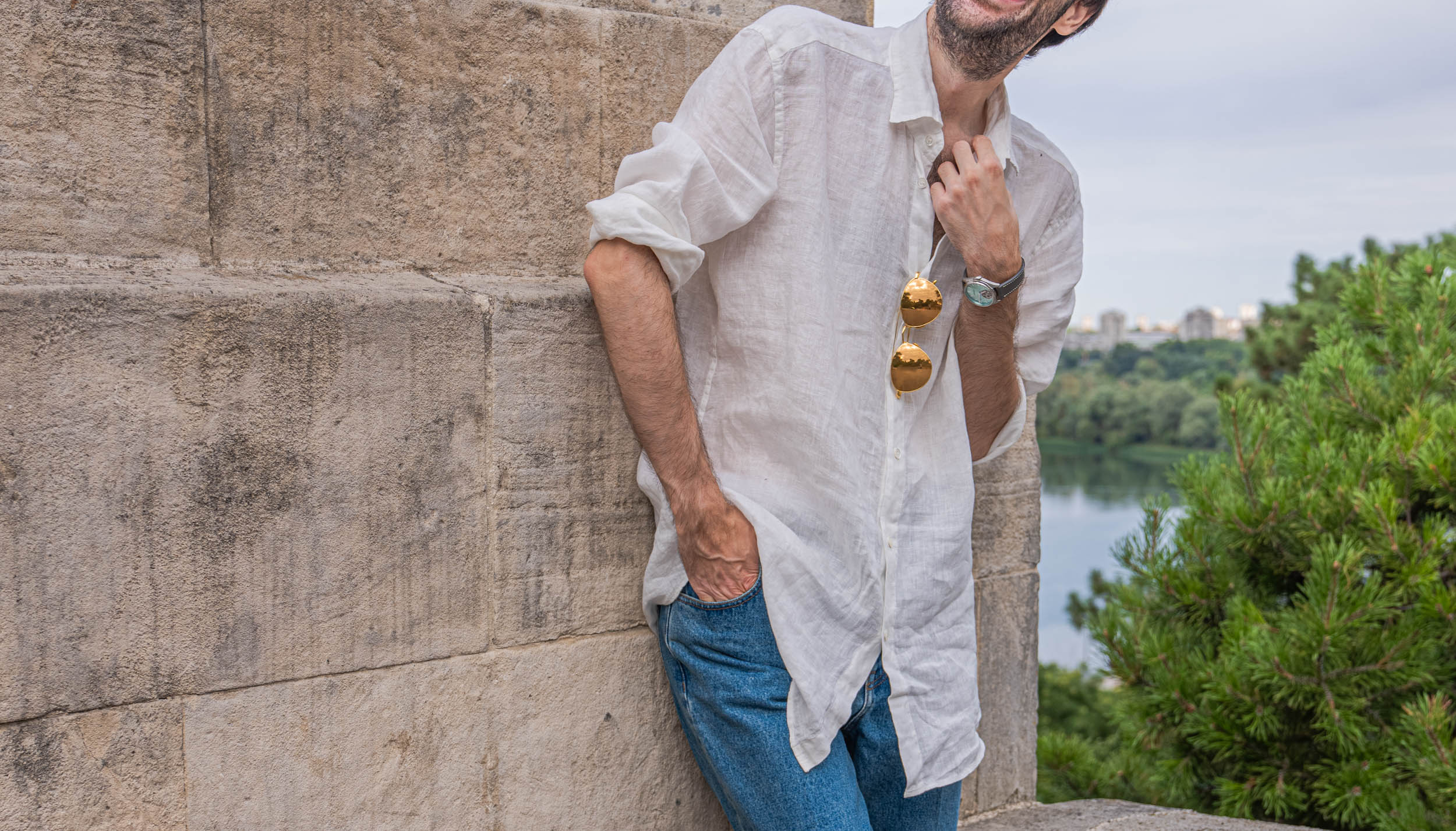
The color story stays equally disciplined. Optic white on top, mid-blue denim below, white leather on the feet. Three tones, nothing more. Consequently, the eye has nowhere to snag, and the small metallic details do all the talking. Those details matter enormously here. Silver studs ring the hem of the jeans. Gold sits on the bridge of the sunglasses. A pale glacial-green dial glows on the wrist. Each one is small. Each one is placed where a person actually looks.
Finally, there is the question of ease. This Valentino summer outfit does not require me to hold my posture or check a mirror every twenty minutes. I wore it for a full morning of walking across uneven stone, and it never fought me once. For me, that has become the real test of good clothing.

VALENTINO OVERSIZED WHITE LINEN SHIRT: THE SUMMER ESSENTIAL
The shirt is the anchor of the whole look and it is a Valentino runway piece. It arrives in a fine, almost translucent linen, cut long enough to sit well below the hip. Two side vents open at the bottom so the fabric moves instead of bunching.
Look closely at the photographs and you can see light passing straight through the weave. That transparency is not a flaw. Rather, it tells you exactly how open the yarn is, and open yarn is the entire point of summer linen.

HOW LINEN ACTUALLY BEHAVES IN REAL HEAT
Linen comes from flax, and flax fiber is hollow. As a result, it absorbs moisture readily and releases it fast. The fabric lifts away from the skin instead of clinging, which creates a small pocket of moving air across your back.
Cotton does the opposite once you sweat. It holds water, turns heavy, and sticks. Anyone who has spent August in a Mediterranean city already knows the difference without needing the science.
The trade-off, of course, is wrinkles. Linen creases the moment you sit down, and no finishing process fully prevents it. Personally, I stopped fighting this years ago. Those creases are the signature of the fiber, and a perfectly flat linen shirt usually means the blend has been compromised.
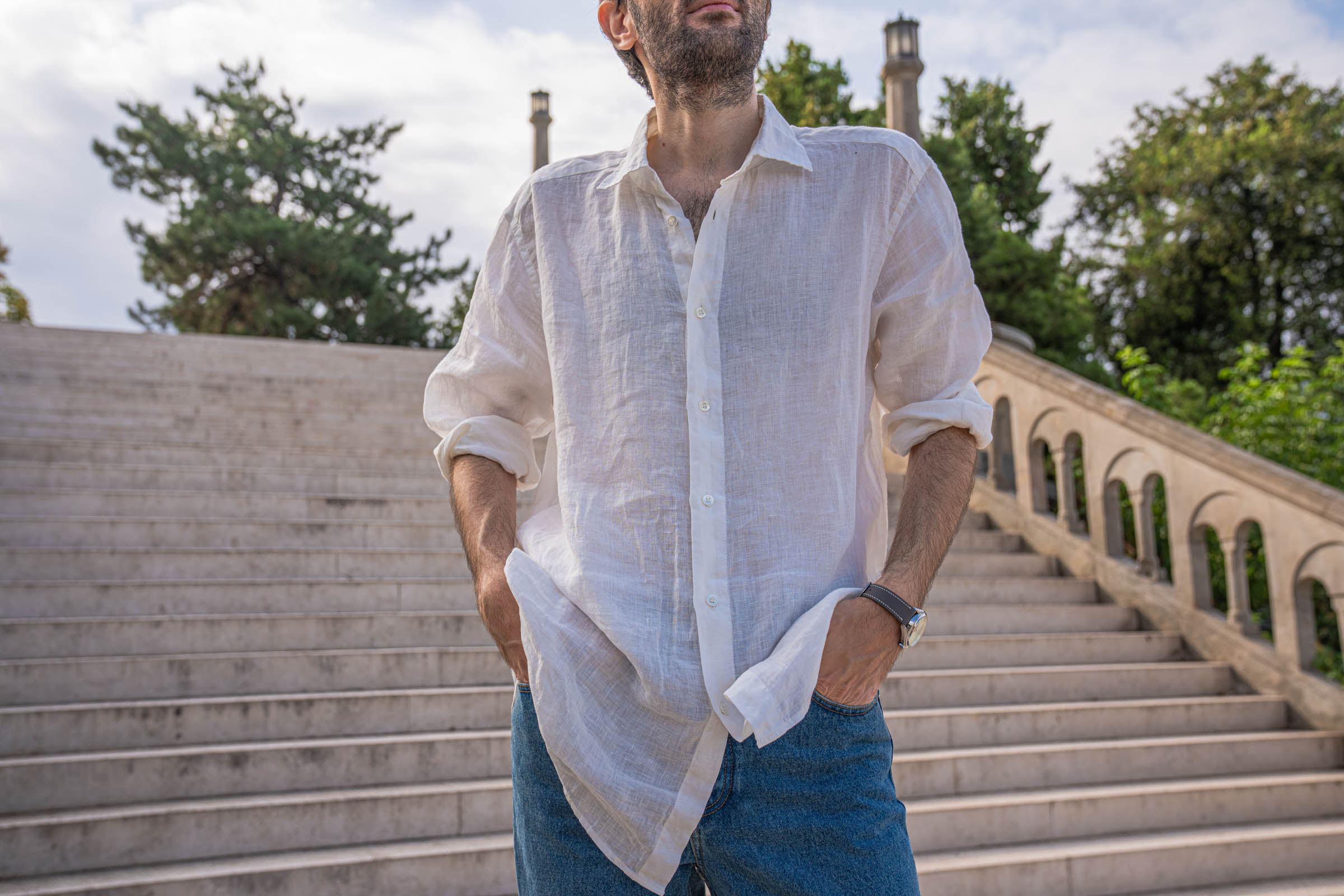
HOW I SIZE AN OVERSIZED SHIRT
Oversized does not mean “buy two sizes up.” That approach produces a tent, not a silhouette. Instead, I look at three fixed points.
First, the shoulder seam should fall past the natural shoulder, but not halfway down the arm. Second, the cuff should still close properly, because rolled sleeves need structure to hold their shape. Third, the hem should clear the hip without reaching mid-thigh.
Get those three right and the extra volume reads as intentional. Get them wrong and it simply reads as borrowed.

VALENTINO JEANS: STUDS, EYELETS & A TOUCH OF ATTITUDE
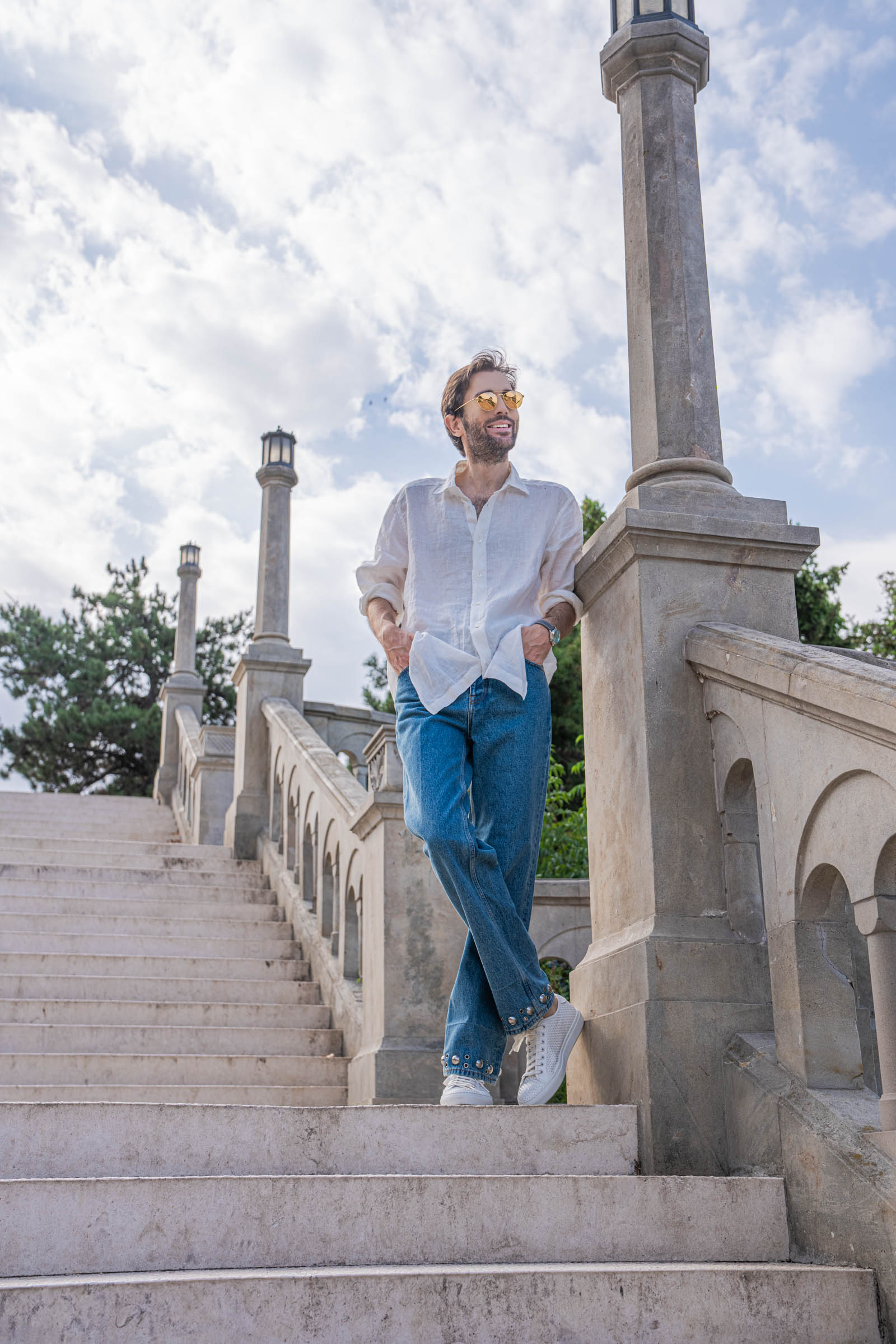
The denim is where this Valentino summer outfit stops being a familiar formula and becomes something specific. These are Valentino’s five-pocket jeans with studs and eyelets in color 558, from the Spring/Summer 2026 collection. They are 100% cotton, made in Italy.
The cut stays deliberately conventional. Regular fit, straight leg, mid-rise waist, belt loops, button fly. No distressing, no fashion washes, no exaggerated taper. On their own, they would pass for excellent plain denim.


WHAT THE HEM ACTUALLY DOES
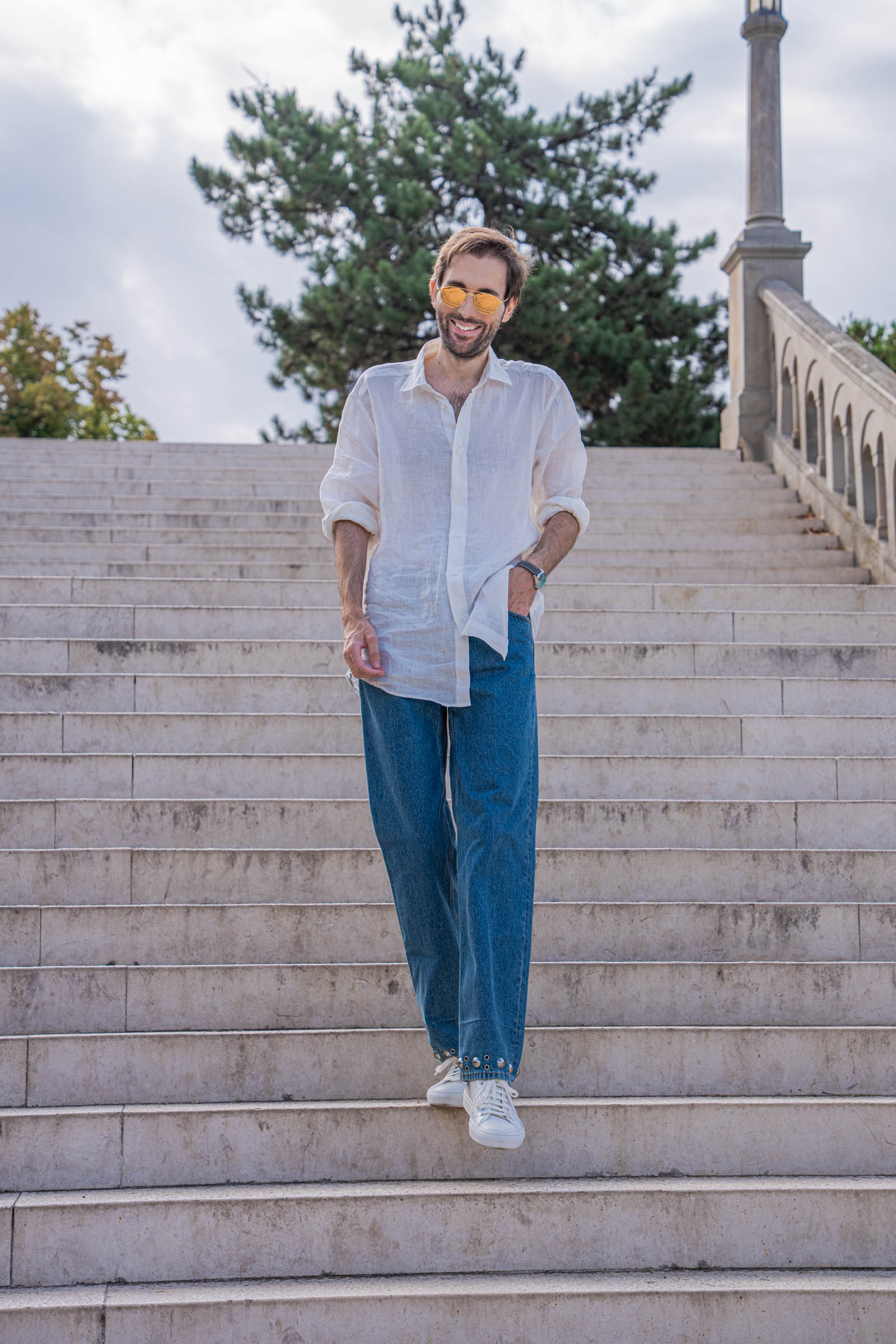
Then you reach the bottom of the leg. Valentino rings each cuff with silver-finished metal eyelets alternating with large semi-spherical studs, set in a continuous band around the opening.
The effect is quietly clever. Because the hardware carries weight, the hem hangs with a slight authority that ordinary denim never achieves. Moreover, the studs catch light exactly at ankle height, which draws the eye downward toward the shoes.
Studs have a long history at this house, as the next section explains. Here, though, the reference stays understated. Nobody would call these jeans loud.
VALENTINO: THE “CHEZ VALENTINO” PATCH
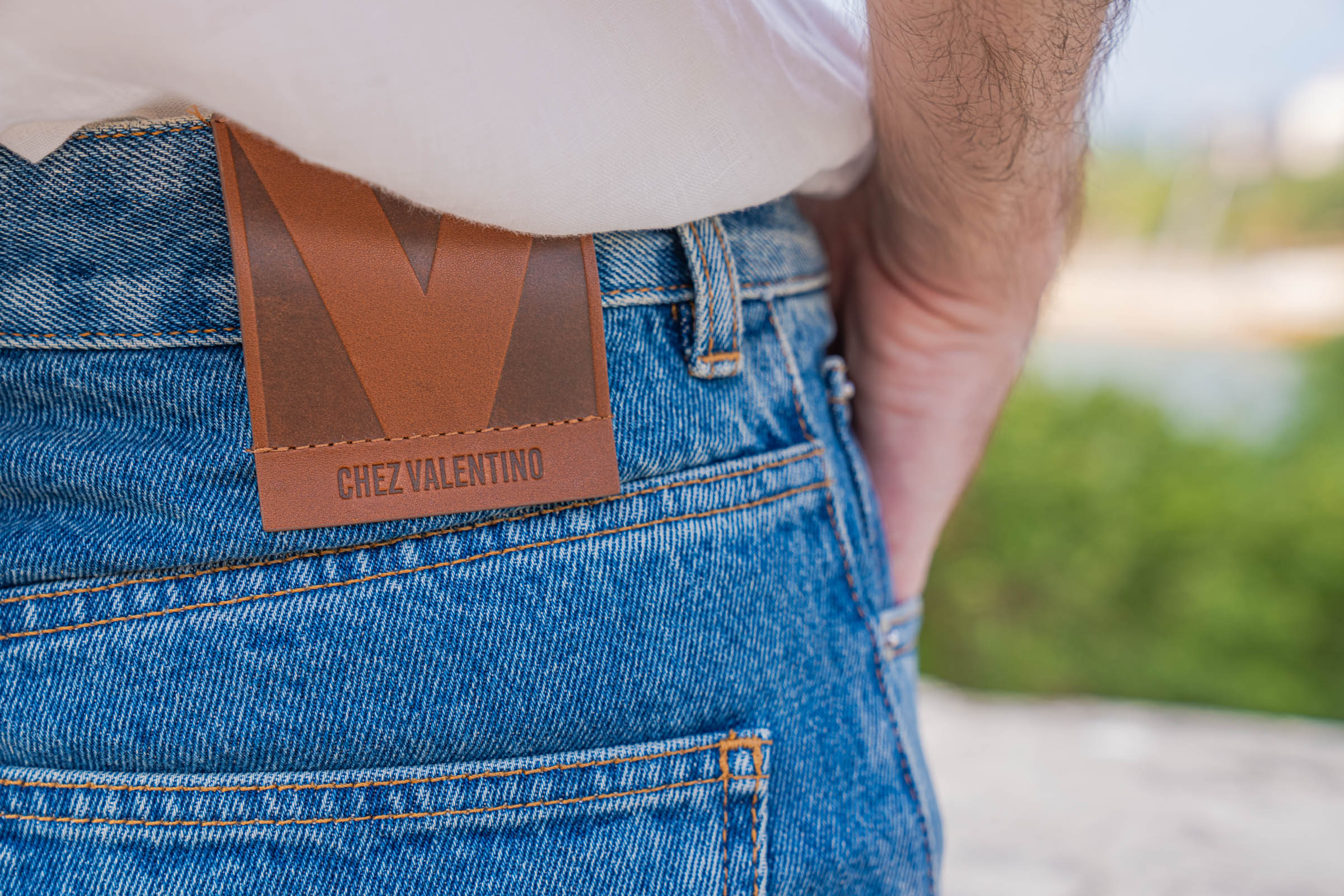
Turn around and you find a tan leather label at the back of the waistband. A large V fills the upper half. Beneath it, embossed in small capitals, sits the phrase “Chez Valentino.”
Alessandro Michele introduced that marking after taking creative control in 2024, and it functions as a kind of house address rather than a logo shout. I appreciate that restraint. The patch is the only place on the entire garment where the brand name appears at all.

OUTFIT
Linen Shirt: Valentino
Watch: Peacock
Denim (Jeans): Valentino
Sunglasses: Linda Farrow
Sneakers: Valentino
VALENTINO WOVEN LEATHER SNEAKERS: TEXTURE WITH A LUXURY EDGE
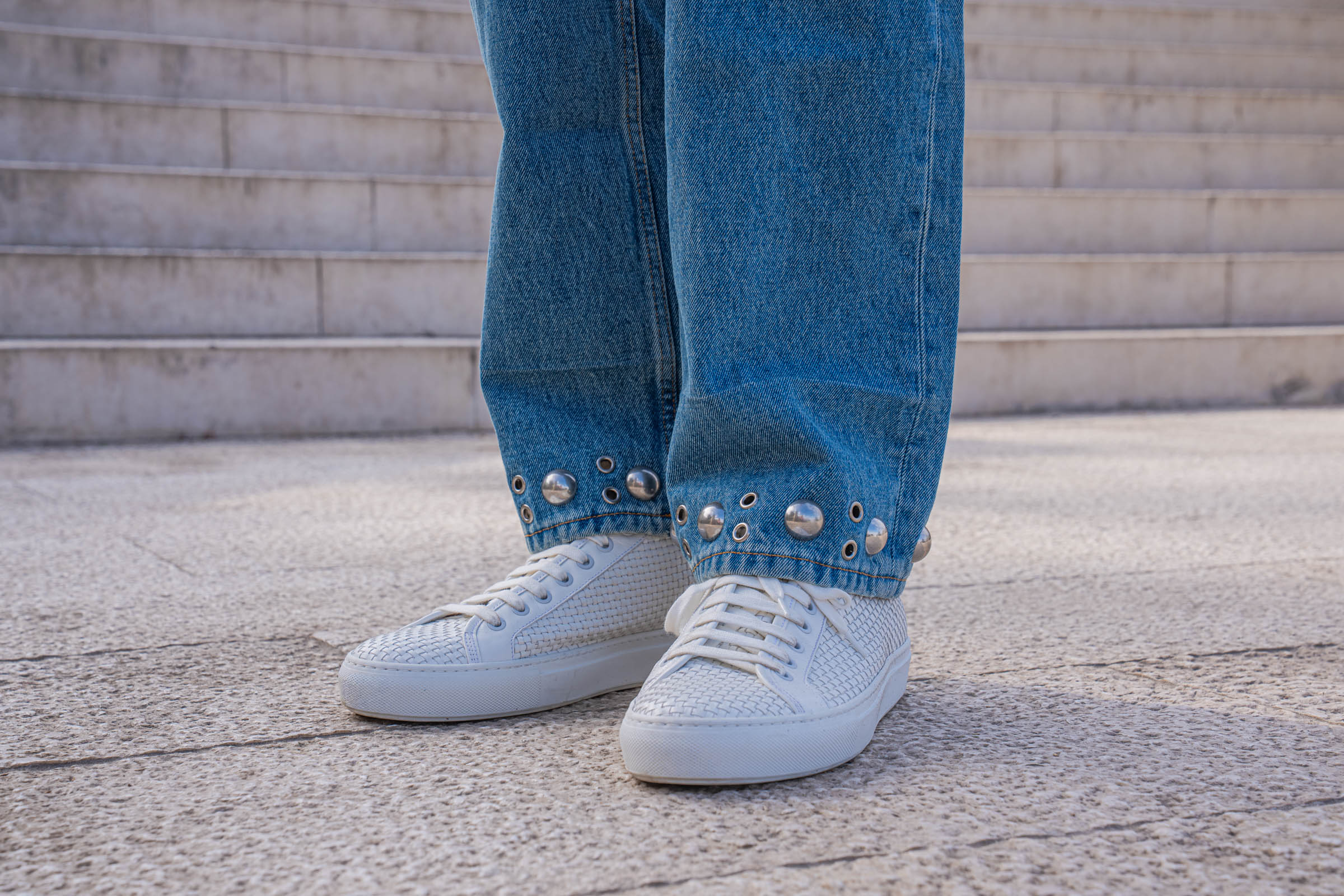
White sneakers have become the most over-supplied category in menswear. Practically every house makes a version, and most of them look identical at three meters.
These escape that trap through texture alone. The uppers are woven leather, with a tight basket pattern running across the toe, the quarter, and the heel counter. Everything else stays deliberately plain: white laces, white cupsole, no contrast panels, no visible branding.

Consequently, they photograph beautifully in close-up and disappear politely in full-length shots. That is exactly what I want from a shoe in a look like this. The sneakers support the outfit rather than competing with it.
Woven leather also ages differently from smooth calf. Each strand flexes independently, so the surface develops a soft, irregular patina instead of sharp creases across the vamp. In practice, they look better after a season than they did in the box.
One practical note. Woven uppers trap dust in the gaps, so a soft brush works far better than a cloth. I clean mine every few wears, and they still look close to new.
MAISON VALENTINO: SIX DECADES OF ROMAN ELEGANCE
A post like this deserves proper context, because the name on these labels carries real weight.
Valentino Garavani opened his fashion house in Rome in 1960, backed by his father and by Giancarlo Giammetti, who would remain his partner for the rest of his life. The first atelier stood on Via Condotti. In 1967, the maison moved into Palazzo Gabrielli-Mignanelli near the Spanish Steps, where its creative direction still sits today.
Garavani had trained in Paris, at the École des Beaux-Arts and the Chambre Syndicale, before working in the ateliers of Jean Dessès and Guy Laroche. He returned to Italy with French couture technique and Roman instincts, and that combination defined everything he made afterward. His international breakthrough came in Florence in 1962, then the Italian fashion capital of the day.

VALENTINO RED: THE COLOR THAT EARNED ITS OWN PANTONE
Valentino red began, according to the designer himself, at the opera in Barcelona. Watching Bizet’s Carmen as a young man, he noticed a woman in red velvet standing out among all the other colors in the boxes.
That memory stayed with him. He introduced the shade in his 1959 Fiesta collection, shown just before the house opened. Afterward, every single collection contained at least one red look. Pantone eventually codified the hue, an honor almost no designer receives.
VALENTINO: THE WHITE COLLECTION & THE ICONIC V
In 1967 and 1968, Valentino showed his famous “no color” collection, built entirely from white, beige and ivory while the rest of fashion chased psychedelic prints. The V logo appeared at the same moment. Jacqueline Kennedy Onassis wore a dress from that collection to her wedding, which pushed the house into global recognition almost overnight.
Menswear followed much later. Valentino staged its first men’s show at Milan Fashion Week in 1985.

VALENTINO: THE ROCKSTUD ERA & WHY IT MATTERS HERE
Garavani retired in 2007. Maria Grazia Chiuri and Pierpaolo Piccioli took over creative direction in 2008, having joined the house in 1999 to develop accessories.
Their defining contribution arrived in 2010. The Rockstud carried small pyramid studs across pumps, ballet flats and bags, and the reference was architectural rather than punk. Those pyramids echo bugnato, the rusticated stonework that faces Roman palazzi. Look at the base of almost any grand building in Rome and you will see the shape immediately.
Commercially, the line transformed the company. Sales of Rockstud sandals alone reportedly reached 152 million dollars between 2014 and 2019. Interestingly, American trademark examiners later refused protection for the design, arguing that the studs read as decoration rather than as a source identifier. The Rockrunner sneaker followed and became equally recognizable.
Michele has now revived the motif for his own tenure, with an updated version shown for pre-fall 2026.
I mention all this because the hardware on my jeans sits inside that lineage. The studs here are domed rather than pyramidal, and the scale is far quieter. Nevertheless, the instinct is identical: take a classical garment, then interrupt it with metal in exactly one place.

VALENTINO: PM23 & THE FONDAZIONE
In May 2025, Garavani and Giammetti opened PM23 at Piazza Mignanelli 23, steps from the original atelier. The space serves the Fondazione Valentino Garavani e Giancarlo Giammetti, which works across three pillars: philanthropy, arts and culture, and support for young talent through workshops and scholarships. Giammetti summarized the guiding idea simply. Beauty creates beauty.
The inaugural exhibition, “Orizzonti/Rosso,” opened to the public on 25 May 2025. Pamela Golbin curated the fashion, and Anna Coliva curated the art. Around thirty modern and contemporary works, including pieces by Jeff Koons, Gerhard Richter and Jean-Michel Basquiat, hung alongside fifty red haute couture creations spanning five decades. Golbin made a striking observation about that body of work: you cannot tell which dress belongs to which period.
A second exhibition followed. “VENUS,” built around twelve works by Portuguese artist Joana Vasconcelos in dialogue with thirty-three Garavani creations, opened on 18 January 2026. Garavani died the next day.
His public viewing then took place at Piazza Mignanelli, inside that exhibition, in the building his house has occupied since 1967. Few endings in fashion have felt so precisely composed.

REMEMBERING VALENTINO GARAVANI
Valentino Garavani died at his Roman residence on 19 January 2026, aged 93. Thousands queued during the two-day lying in state, and the funeral took place on 23 January at the Basilica di Santa Maria degli Angeli e dei Martiri.
Ownership of the house has shifted several times since he and Giammetti sold in 1998. Today Mayhoola holds 70 percent and Kering holds 30 percent, following Kering’s purchase in July 2023. Alessandro Michele has led creative direction since April 2024, and Riccardo Bellini became chief executive in August 2025.
I dressed for this shoot several months after that January morning. Wearing the house now carries a slightly different weight than it did before, and I think that is appropriate. A wardrobe should hold memory as well as taste.


PEACOCK DIVINE CRAFT TOURBILLON: WHERE CRAFT MEETS CHARACTER
Now to the watch, because the collectors reading this deserve genuine detail rather than adjectives.
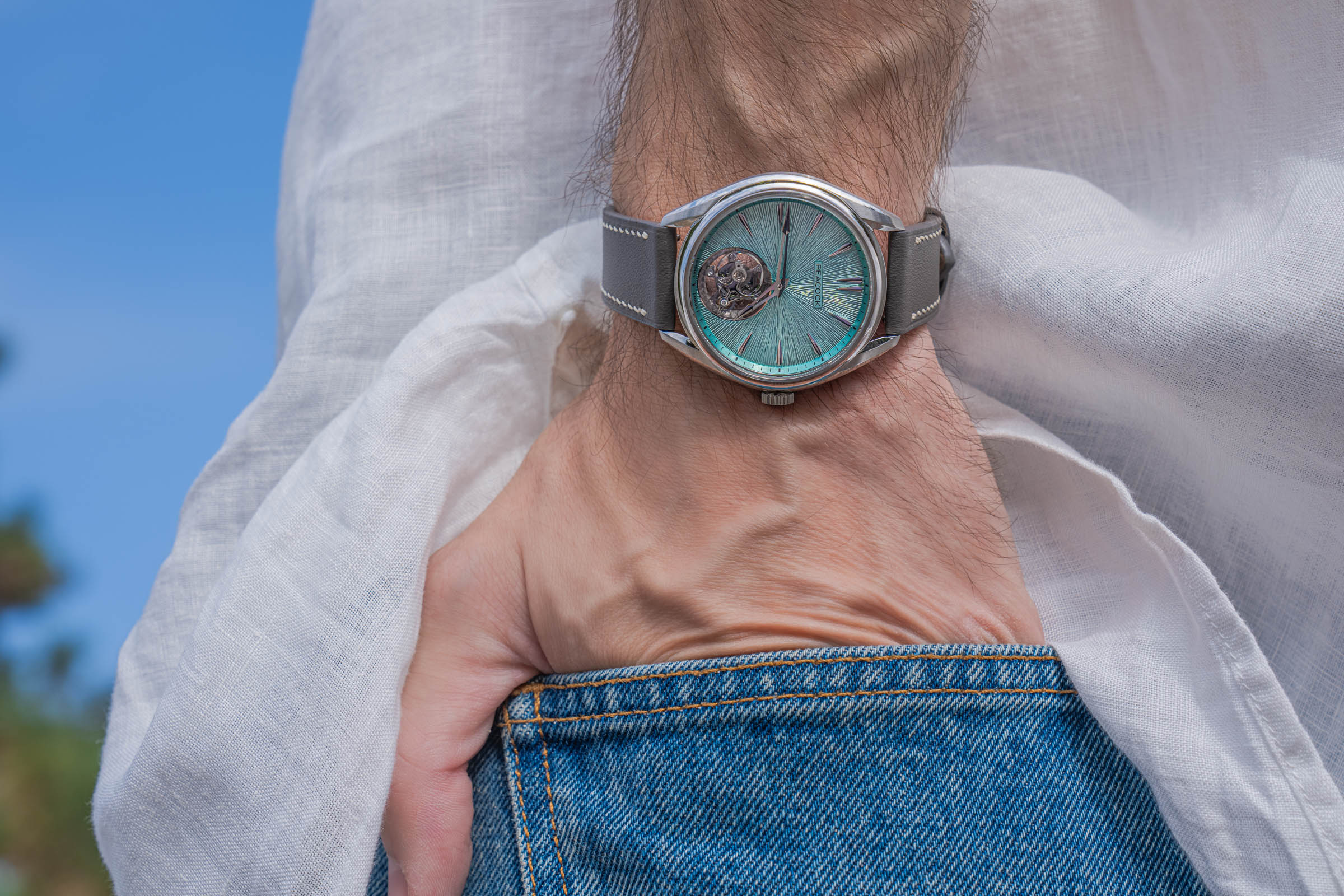
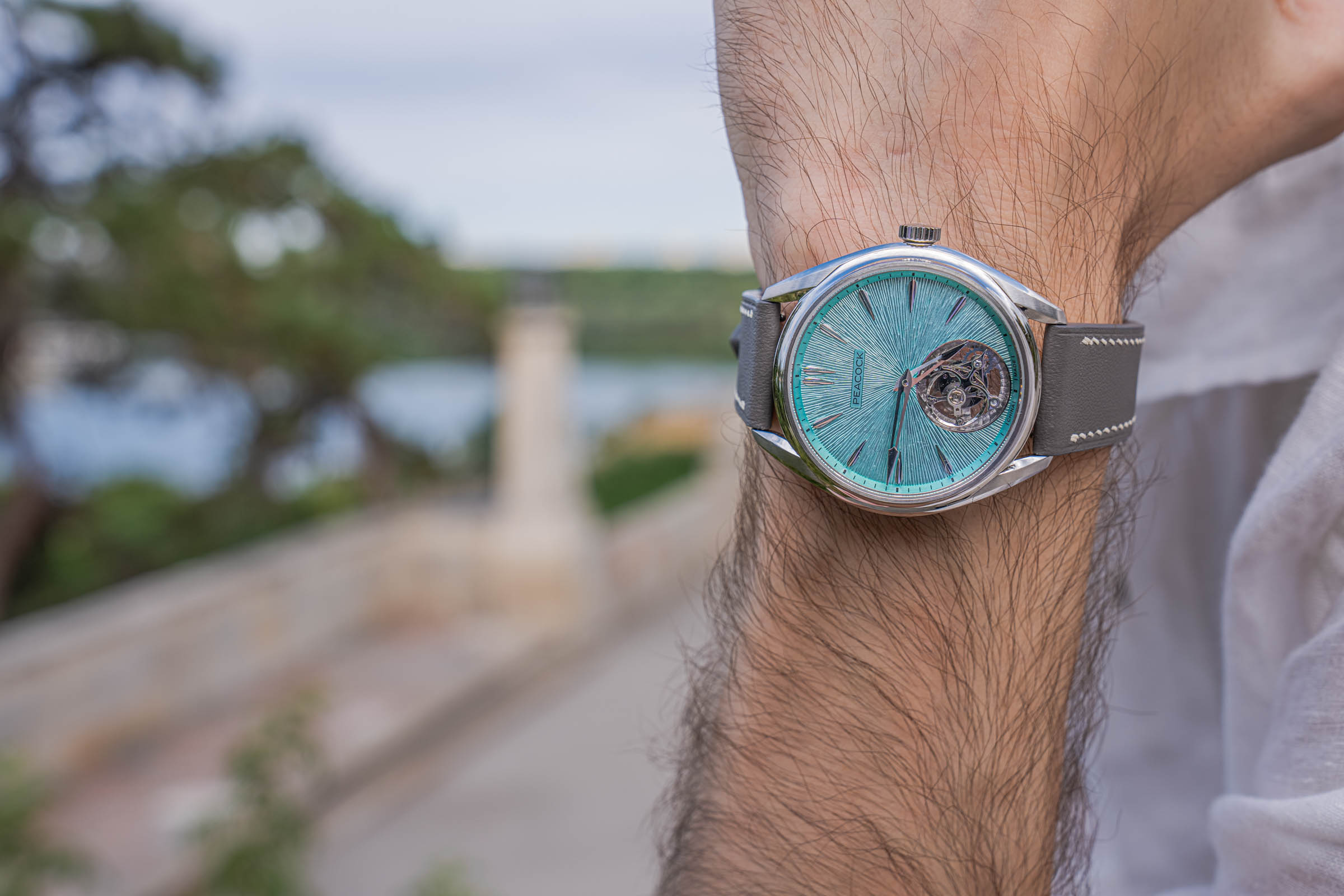
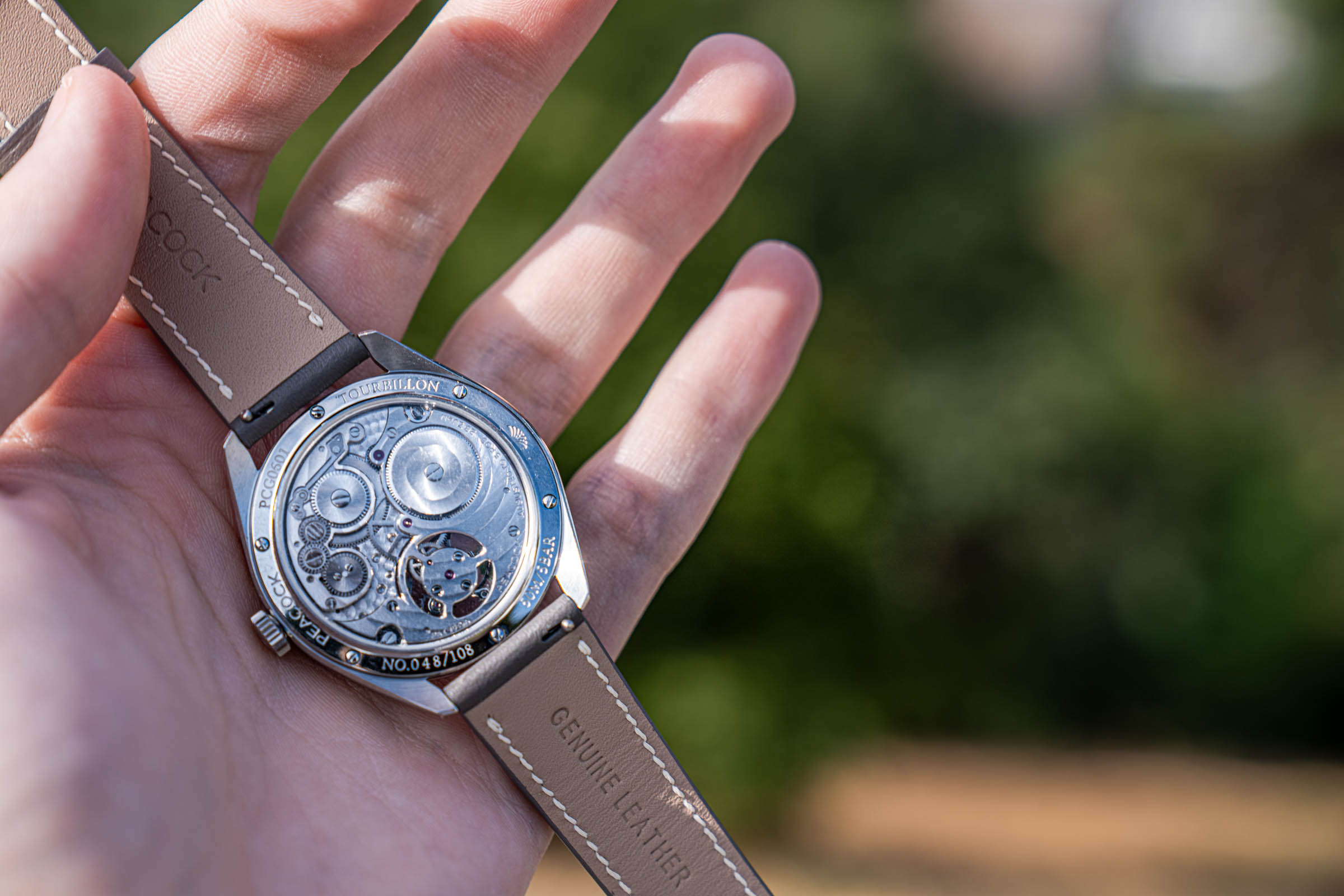
The piece on my wrist is the Peacock Divine Craft Hand-Made Micro-Engraved Ultra-Thin Tourbillon, in the Glacial Green colorway that the brand writes as 泠. Peacock limits each color to 108 pieces. Mine is number 48, engraved on the caseback alongside the reference PCG0601.
PEACOCK DIVINE CRAFT: A DIAL STRUCK BY HAND MORE THAN A THOUSAND TIMES
The dial is not stamped, printed or machine-guilloché. Instead, it is micro-chased, a traditional metal-sculpting craft rarely attempted at this scale in watchmaking.
Peacock explains the process in unusual detail. The artisan works on a surface only 30 mm across, using three custom-made chasing tools of different thicknesses. Each line begins as a hairline guide, followed by controlled hammering. A deviation of one degree, or a difference of one gram in force, breaks the balance of the whole field.
The finished dial carries over a thousand individually struck lines arranged in three radial layers, moving from coarse at the edge to dense at the center.
You can see the consequence across my photographs. In open shade, the dial reads as pale frosted mint. In direct sun, it deepens toward a proper glacial green, and the outer minute track sits noticeably darker than the center. No two images show quite the same color, which is precisely the point of a hand-worked surface.

MASTER ZHAO YI: THE ARTIST BEHIND THE DIAL
The dial comes from Professor Zhao Yi, a contemporary jewelry artist at the Beijing Institute of Fashion Technology. Her work bridges ancient metal craftsmanship with modern artistic language, combining lacquer with metal and reviving techniques such as chasing and forging.
In 2018 she won the Cominelli Prize in Italy, one of Europe’s highest honors in contemporary jewelry. Peacock states that the development of this dial took roughly six months.

PEACOCK DIVINE CRAFT: INSIDE THE PAX9610A
The movement is the Peacock caliber PAX9610A, a hand-wound flying tourbillon measuring just 3.5 mm thick. It runs at 28,800 vibrations per hour with 24 jewels and a 68-hour power reserve.
Two elements deserve attention. First, the flying tourbillon carries no upper bridge over the rotating cage, a construction originally developed in Glashütte. Second, the balance is free-sprung, with adjustable inertia weights that preserve the hairspring’s geometry and improve isochronism.
The tip of the cage carries a small diamond and functions as a running seconds indicator, although the aperture holds no scale for it.
FINISHING YOU ONLY SEE THROUGH THE CASEBACK
Turn the watch over and the sapphire display back reveals where most of the labor actually went.
The main plate carries hand-finished perlage, laid beneath hand-applied circular Geneva stripes. Those two treatments sit in layers rather than side by side, which is considerably harder to execute cleanly. The great wheel then adds a dual rotational motif, while the smaller wheels receive a micro-spiral pattern. Each of these requires hand-calibrated pressure, since too much force flattens the texture and too little leaves it invisible.
Beveling is where Peacock pushes hardest. The movement carries four internal sharp angles and one external angle, polished by hand until the edges reflect light like silk. Internal angles cannot be produced by machine at all, which is why watch collectors treat them as a genuine marker of hand work rather than marketing language.
Even the screws received attention. The tourbillon’s “Peacock Eye” screws have 200-micron recesses formed by precision chemical etching instead of machining. Peacock then had to redesign the matching screwdrivers repeatedly, moving from brass to 316 steel and finally to high-carbon T10 steel, because the earlier versions kept breaking under torque.
None of this is visible on the wrist. That is rather the point. A caseback like this exists for the owner and for the watchmaker, not for anyone across the table from you.
PEACOCK DIVINE CRAFT: HANDS, MARKERS & STRAP
The small components repay close inspection too, and my macro shots show them clearly.
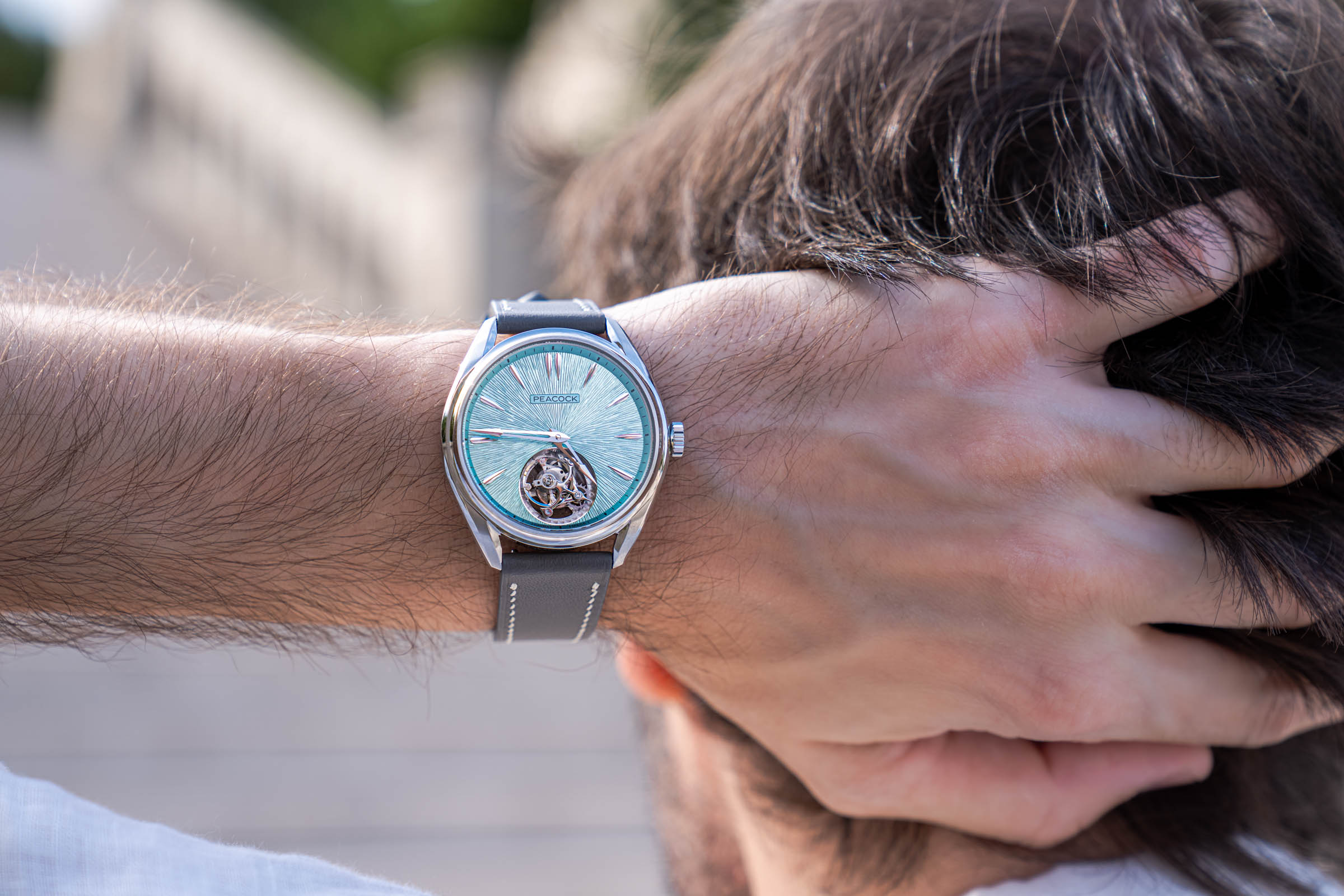
Each hand is hollowed on two surfaces and split by contrasting brushing, in a treatment Peacock describes as yin and yang. The tips then finish in a polished dome, which keeps them legible against the busy dial texture.
The markers follow similar logic. Every index is chiseled on four sides, with brushed flanks framing a recessed core. That recess catches shadow, so the markers read as three-dimensional objects rather than applied batons. Under the sun at Kalemegdan they picked up a warm rose tone against the cool green field.
The strap is premium fine-grain calfskin, reinforced with hand-stitched waxed threading. Waxed thread locks the fibers in place, improves durability, and ages more gracefully than machine stitching. Mine reads grey in shade and slightly warmer in direct light, which suits a dial that behaves the same way.


PEACOCK DIVINE CRAFT: CASE, PROPORTIONS & WRIST FEEL
The case is machined from 904L stainless steel, more corrosion-resistant than the common 316L and noticeably whiter when polished. It measures 39.5 mm across and only 8.9 mm thick, with 5 ATM of water resistance.
Peacock calls the construction “Wrapped Vision,” built through a multi-zone process so each surface behaves differently. The edges and inner lugs take a mirror polish. The upper and lower case surfaces receive fine brushing instead, which adds tactile contrast and hides scratches.
A recessed inner bezel then pulls the visual diameter closer to 38 mm. In person, therefore, the watch wears smaller than the specification suggests. Six structural screws secure the caseback directly to the bezel.
For comparison, Peacock’s previous Classic-Grandeur Tourbillon measured 43 mm. Dropping to 39.5 mm while keeping a display caseback represents genuine engineering progress, not marketing.


PEACOCK: FROM DANDONG TO HAUTE HORLOGERIE
The roots of Peacock run deeper than most people outside China realize. In late 1957, seven technical workers at the Andong Metal Products Factory in Dandong, Liaoning, built their first four watches using homemade equipment.
The factory grew steadily through the following decades. It developed its first independently designed movement in 1970, and introduced the Peacock brand name in 1978. By the mid-1980s it employed twelve thousand people.
Knowing that history changes how the Peacock Divine Craft feels on the wrist. A hand-chased tourbillon from Dandong is not an obvious outcome of that story, and I find that genuinely moving.


LINDA FARROW SUNGLASSES: GOLD ON JAPANESE TITANIUM
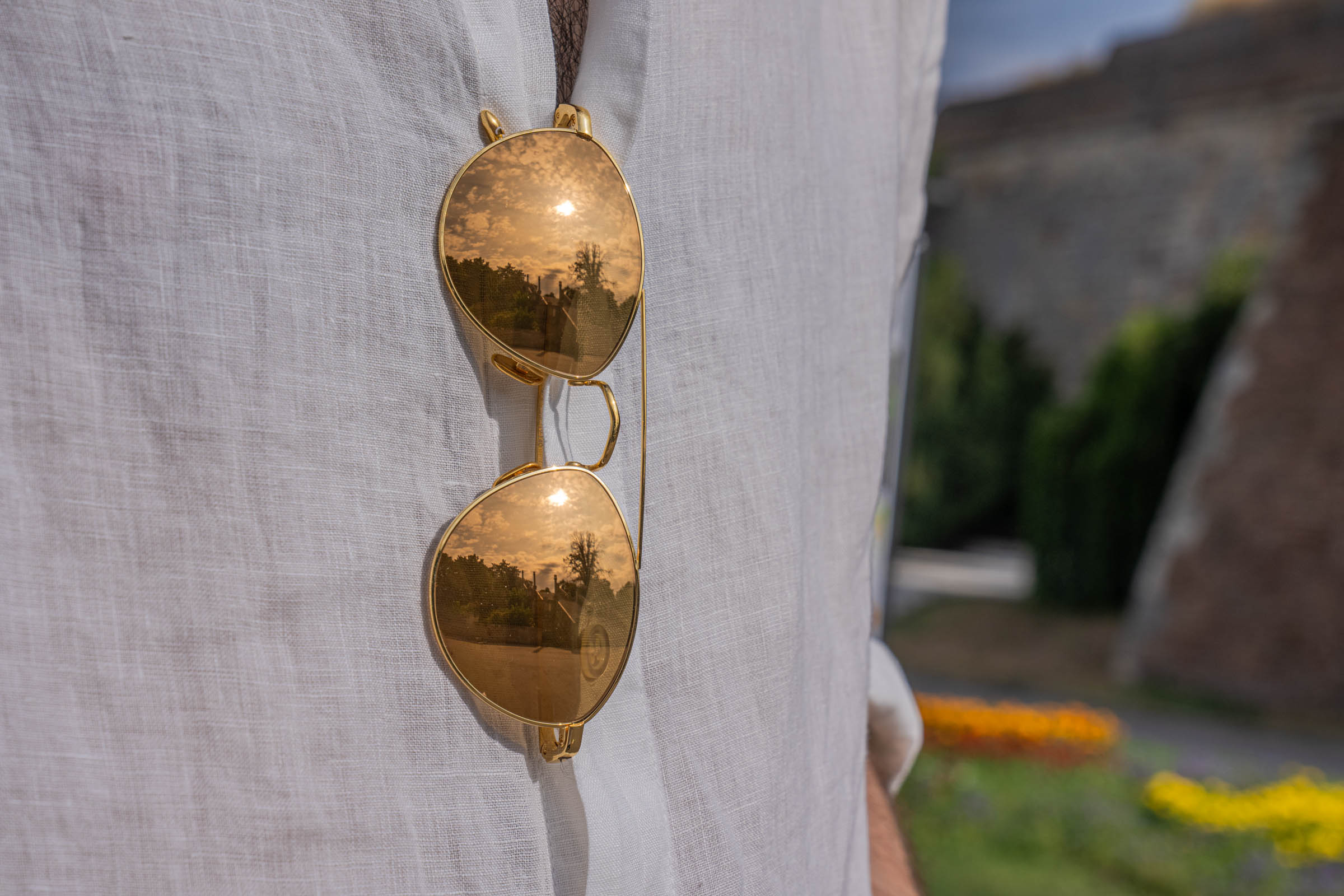
The sunglasses are Linda Farrow, and they do a specific job in this look. Thin gold frames and mirrored amber lenses introduce the only warm tone in the entire outfit. Without them, the palette would run slightly cold.
The shape sits between a panto and an aviator. Rounded lenses, a slim double bridge, and wire temples so fine they almost disappear in profile. Notice how much sky the mirrored lenses pick up across these photographs. On the stone steps they hold an entire cloud bank, which is exactly what a gold mirror coating is supposed to do.

LINDA FARROW: LONDON, 1970
Linda Farrow founded her label in London in 1970. She had trained as a fashion designer, not an optician, and that background shaped everything that followed. Farrow was among the first people anywhere to treat sunglasses as a fashion object rather than a functional one.
Her timing was remarkable. Through the seventies and eighties she produced eyewear for Balenciaga, Yves Saint Laurent and Pucci, at a point when designer houses had no eyewear licensing partners at all. She essentially invented the category those licences now occupy.
Production stopped in the nineties, and the name went quiet for roughly two decades. Then in 2003, her son Simon Jablon went to sort out the family warehouse and found thousands of pairs of original frames still boxed. He was 24.
Jablon relaunched the archive as Linda Farrow Vintage, and Browns and Harvey Nichols placed orders almost immediately. Today he runs the company as creative director and chief executive.

LINDA FARROW: WHY THE MATERIALS MATTER
Linda Farrow builds in Japan, and the specification explains the weight in your hand.
Frames use pure Japanese titanium, plated in 18 to 22 carat gold. Titanium delivers strength at roughly half the density of steel, so a frame this fine still resists bending. Moreover, it does not corrode from skin contact, which matters enormously in summer.
The gold plating is the second half of that equation. Thicker carat plating keeps its color far longer than standard flash gold, and it develops a softer sheen rather than wearing through to base metal.
Adjustable titanium nose pads finish the fit. Consequently, these sit level on my face all day, which cheap wire frames never manage.

BELGRADE FORTRESS: THE PERFECT BACKDROP
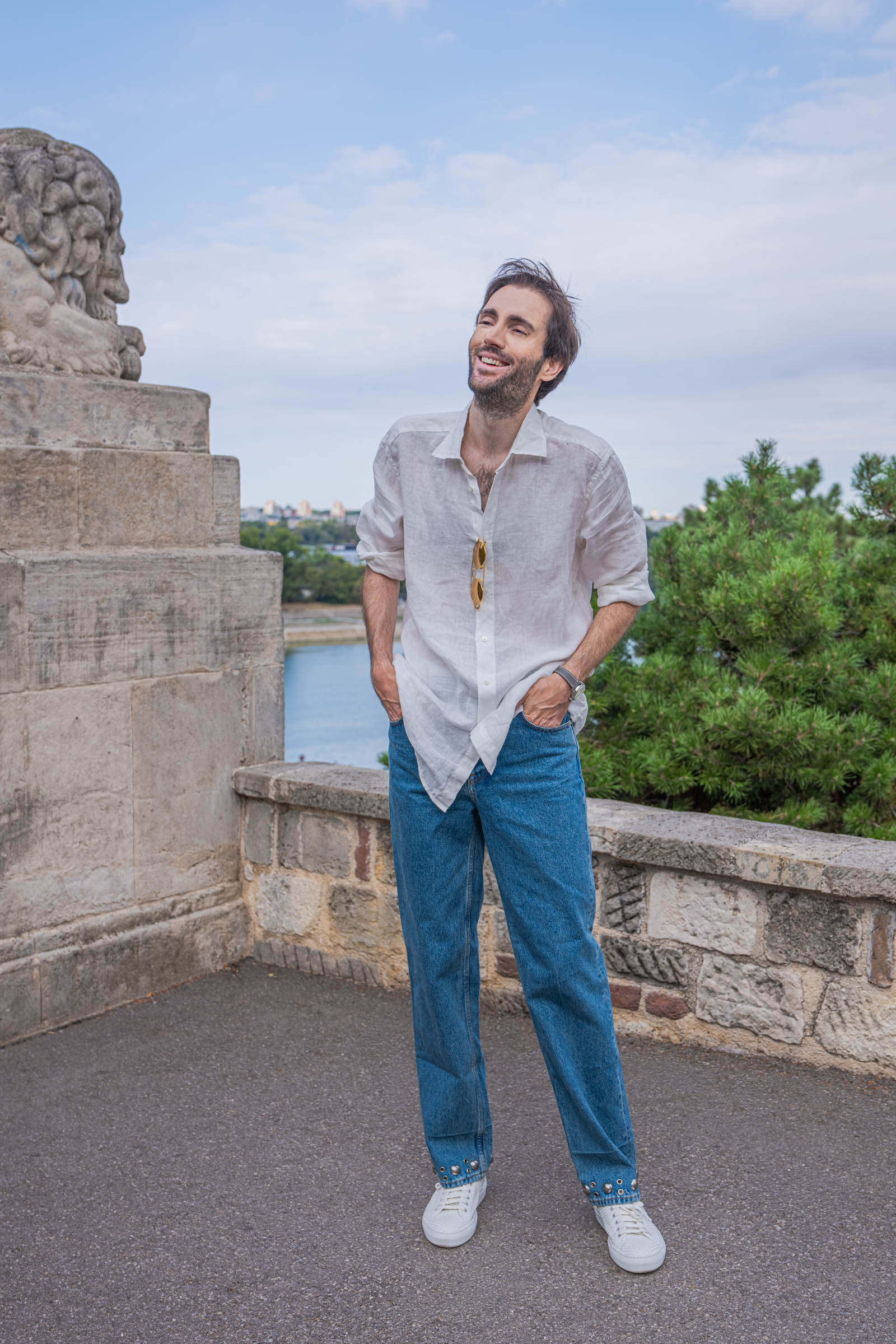
We shot everything at Kalemegdan, on the ridge where the Sava meets the Danube. My photographer and I have worked this location before, yet it keeps offering new angles.
The stone lion on its plinth gave us the first sequence. Warm limestone against optic white linen produces a natural contrast that no studio setup replicates convincingly.
From there we moved to the arched belvedere, where New Belgrade rises across the water. Glass towers behind nineteenth-century balustrades create exactly the kind of tension I like in an editorial: old structure, modern city, contemporary clothes.
The grand staircase closed the morning. Long horizontal treads make an excellent frame for a full-length silhouette and the low September light came in from the side rather than overhead. Consequently, the linen picked up texture instead of blowing out to flat white.


HOW TO RECREATE THIS VALENTINO LOOK YOURSELF
You do not need these exact pieces, and I would never suggest otherwise. However, the principles transfer cleanly. Begin with the shirt. Buy real linen, ideally in a lighter weight, and size it so the shoulder seam drops slightly. Wear it open over a plain white tee if the transparency feels like too much.
Choose denim in a mid-blue wash with a straight leg and a mid rise. Avoid black denim entirely in summer, because it absorbs heat and flattens the whole palette. Length should break just once over the shoe, never twice.
For footwear, pick white leather with genuine texture. Woven, grained or lightly perforated uppers all photograph better than flat calf, and they hide scuffs more forgivingly.
Then add exactly one metallic element. Sunglasses, a watch, or hardware on the trousers. Two competing metals will fight; one will read as deliberate. Finally, iron nothing on the day itself. Hang the shirt in a steamy bathroom for ten minutes and let it fall naturally. Perfectly pressed linen defeats the entire purpose of the fabric.


VALENTINO: THE FINAL WORD
I keep returning to how little this Valentino summer outfit actually asks of the wearer. Three colors, four garments, one watch. Nothing complicated, nothing that requires explanation at the door.
Yet the details hold up under close inspection, which is the only standard that really matters. The linen has weight and translucency. The hem hardware has genuine heft. The dial holds over a thousand marks left by a human hand, and the caseback hides several hundred more that nobody will ever see.
That combination, ordinary at a glance and extraordinary up close, is the version of luxury I have come to prefer. Loud clothing gets noticed once. Considered clothing gets remembered.
Thank you for reading and my thanks to Valentino, Linda Farrow and Peacock Watches for making this story possible.
I put a lot of care into this one. The research alone took longer than usual, partly because all three houses in this story deserve more than a caption, and partly because I wanted to get every detail right rather than close enough. If you reached this paragraph, thank you for staying with me.
Tell me what you think in the comments below. I read all of them. I am especially curious whether the watch people and the fashion people land in the same place on this look, because those two audiences rarely agree with each other.
You can also reach me by e-mail or through social networks, all listed on the CONTACT page.
Until the next fashion adventure on the Mr.M blog.
With Love,
Mr.M


This post is sponsored by Maison Valentino, Peacock Watches and Linda Farrow. This post is my personal and honest product review.
Hi Marko, I have been following your fashion stories for quite a while, and what I enjoyed most here was the fact that you did not arrive at this combination immediately. The part about spending almost three weeks taking pieces in and out of the wardrobe actually felt very familiar to me. I have done exactly the same thing before travelling, especially when I know I will be photographed and suddenly become much more critical of proportions than I normally am. The Valentino shirt is a particularly good example because an oversized linen shirt can look wonderful or simply look… Read more »
Hej Marko, jag fastnade direkt för hur du har byggt hela looken kring väldigt få färger. Vitt, mellanblått och den där mycket ljusa gröna tonen från Peacock-klockan låter enkelt, men bilderna visar att materialen gör större skillnad än färgerna. Jag har själv en ganska omfattande samling skjortor i linne och märker alltid att de bästa ser bättre ut efter några timmars användning än när de precis kommer från kemtvätten. Därför håller jag helt med dig om att man inte ska försöka eliminera varje veck. Valentino-jeansen är också intressanta eftersom själva modellen är så klassisk och detaljerna sitter längst ner. Jag… Read more »
Bonjour Marko, j’ai particulièrement aimé votre manière de parler du volume parce que c’est un problème que je rencontre souvent lorsque j’achète des vêtements italiens. Je mesure toujours la taille d’un vêtement avant de l’essayer, mais cela ne garantit absolument pas que la silhouette sera correcte. Une chemise très large peut rapidement devenir informe si l’épaule tombe trop bas ou si les manches perdent leur structure. Vos trois points de contrôle sont donc beaucoup plus utiles que le simple conseil de prendre une taille supplémentaire. Je possède une vieille chemise en lin blanc que je porte principalement en vacances, mais… Read more »
Hola Marko, me ha gustado mucho que este conjunto no dependa de una sola pieza espectacular. Tengo varios vaqueros de corte recto y normalmente los combino con prendas bastante más ajustadas porque siempre he pensado que una camisa amplia encima podía hacerme perder toda la estructura. Después de ver tus fotografías, estoy reconsiderando esa regla. La proporción entre la camisa larga y el denim más lleno parece mucho más equilibrada de lo que imaginaba, especialmente porque el bajo del pantalón dirige la mirada hacia las zapatillas. También me parece muy acertado que las zapatillas sean blancas y no tengan un… Read more »
Hei Marko, jeg likte spesielt avsnittet om hvordan du faktisk bruker klærne i varmen. Mange moteartikler beskriver sommerklær som om de bare skal se bra ut på et fotografi, men man merker fort forskjellen når man går rundt i byen i flere timer. Jeg har flere linskjorter selv, og den største forskjellen jeg opplever mellom en god og en middelmådig skjorte er ikke nødvendigvis utseendet, men hvordan den beveger seg når kroppen blir varm. Derfor var beskrivelsen av de to åpningene på sidene interessant for meg. Jeg liker også at du ikke prøver å skjule at lin krøller seg. Det… Read more »
Ciao Marko, una delle cose che apprezzo maggiormente nei tuoi articoli è quando riesci a spiegare perché un capo funziona invece di limitarti a dire che è bello. Qui il punto delle proporzioni è particolarmente riuscito. Una camicia lunga e larga con un jeans altrettanto pieno può diventare facilmente un errore, mentre nel tuo caso la linea rimane molto pulita. Possiedo alcuni capi Valentino, soprattutto accessori, ma questo denim mi ha incuriosito più di quanto pensassi. Il taglio è abbastanza tradizionale da poter essere indossato spesso, mentre gli occhielli e le borchie sul fondo gli danno una personalità diversa. Mi… Read more »
Marko, the watch section was what kept me reading long after I had already decided that I liked the outfit. I am interested in mechanical watches, but I admit that I had never looked closely at Peacock before this article. The description of the dial being struck by hand more than a thousand times immediately changed my perception of it. What I find fascinating is that the result does not look “handmade” in the rustic sense; it looks extremely controlled. I have handled a few high-end guilloché watches and know how quickly a tiny inconsistency can change the whole surface.… Read more »
Beste Marko, ik vond vooral de combinatie van de locatie en de kleding geslaagd. Kalemegdan is natuurlijk een historische plek, maar op de foto’s voelt het niet alsof je de kleding probeert te laten aansluiten bij een bepaald historisch kostuum. Juist de combinatie van oude steen, het water en de moderne stad op de achtergrond maakt het interessant. Ik ben zelf een paar keer in Belgrado geweest en herinner me hoe sterk het licht daar kan veranderen gedurende de dag. Daarom begrijp ik ook waarom je schrijft dat het linnen in direct licht anders wordt weergegeven. De witte kleur had… Read more »
Olá Marko, a parte que mais me chamou a atenção foi a relação entre o branco da camisa e a pedra de Kalemegdan. À primeira vista parece uma escolha muito simples, mas o cenário mostra porque é que o tecido precisa de ter textura para não ficar completamente plano nas fotografias. Tenho algumas camisas de linho portuguesas e aprendi há muito tempo que tentar mantê-las impecavelmente passadas é quase uma batalha perdida. Hoje prefiro aceitar as rugas e concentrar-me no corte e na qualidade do tecido. A tua explicação sobre a camisa oversized também me parece muito prática. Já comprei… Read more »
Cześć Marko, najbardziej zainteresował mnie fragment o tym, że spędziłeś prawie trzy tygodnie, zanim uznałeś stylizację za skończoną. To brzmi znacznie bardziej realistycznie niż większość sesji modowych, gdzie wszystko wygląda tak, jakby zostało wybrane w pięć minut. Sam często mam problem z letnimi zestawami, bo przy wysokiej temperaturze trudno dodać coś więcej bez utraty wygody. Biała koszula z lnu jest oczywiście klasykiem, ale szeroki krój sprawia, że nie wygląda jak zwykła koszula wakacyjna. Podoba mi się też, że jeans pozostaje prosty, a metalowe elementy pojawiają się tylko przy nogawkach. Mam kilka par jeansów Valentino, ale żadnej z tej kolekcji. Czy… Read more »
Hello Marko, I have to admit that the Valentino denim was the piece I initially liked least when I saw the title, but the more I read, the more I understood why you chose it. I tend to avoid decorated jeans because many of them become dated very quickly. These are different because the basic cut is so conventional: regular fit, straight leg, mid-rise and no artificial wash. The hardware is concentrated at the hem, so the rest of the trouser remains quite quiet. I own a pair of dark Japanese selvedge jeans with almost no decoration, and that has… Read more »
Hallo Marko, ich fand den historischen Teil über Valentino fast genauso interessant wie die eigentliche Kleidung. Mir war zwar bekannt, dass Valentino Garavani sein Haus in Rom gegründet hat, aber die Verbindung zwischen seiner Ausbildung in Paris und seiner späteren römischen Ästhetik hatte ich bisher nicht so genau betrachtet. Besonders spannend finde ich die Geschichte der „no color“-Kollektion aus den Jahren 1967 und 1968. Gerade weil dein heutiger Look ebenfalls stark auf Weiß, Beige und sehr zurückhaltende Farben setzt, wirkt diese historische Verbindung nicht zufällig. Ich besitze einen alten Valentino-Schal aus einer früheren Zeit und habe ihn gerade wegen dieser… Read more »
Marko, me ha gustado especialmente la parte dedicada a los detalles metálicos porque siempre he pensado que un buen look masculino necesita algún elemento que rompa la uniformidad. Sin embargo, suelo hacerlo con el reloj y no con la ropa. Tengo varios pantalones con pequeños detalles metálicos, pero normalmente termino dejándolos en el armario porque me parecen demasiado llamativos. Tus vaqueros de Valentino me han hecho cambiar un poco de opinión. Al estar las piezas metálicas únicamente alrededor del bajo, no dominan el conjunto y además crean una transición interesante hacia las zapatillas. También me parece inteligente que el reloj… Read more »
Hej Marko, jag uppskattade verkligen delen om att linneskjortan inte behöver vara perfekt slät. Jag har arbetat i miljöer där man förväntas se mycket välklädd ut även under sommaren, och jag har därför försökt stryka mina linneskjortor alldeles för mycket. Resultatet har ofta blivit att de ser fina ut i tio minuter och sedan får exakt samma veck igen. Det du skriver om att låta materialet vara sig självt känns mycket mer logiskt. Jag tycker också att Valentino har lyckats bra med längden på skjortan. Den är tydligt oversized, men den når inte så långt att proportionerna blir konstiga. Kalemegdan… Read more »
Marko, j’ai beaucoup aimé votre remarque selon laquelle le volume doit être intentionnel. C’est probablement l’une des erreurs que je vois le plus souvent chez les hommes qui commencent à porter des vêtements plus amples. Ils prennent simplement une ou deux tailles supplémentaires et pensent obtenir une silhouette contemporaine. En réalité, la longueur de l’épaule, du poignet et de l’ourlet change complètement le résultat. Je possède une chemise blanche en lin assez large d’une maison italienne et j’ai dû la faire légèrement retoucher parce que les manches étaient trop longues. Depuis, je regarde beaucoup plus attentivement ces trois points avant… Read more »
I have been interested in watches for years, so the PAX9610A section was probably the part I read most carefully. A 3.5 mm hand-wound flying tourbillon with a 68-hour power reserve is already interesting, but what caught my attention was the finishing underneath the dial. I particularly liked your explanation of the internal angles because that is one of those details collectors talk about without always explaining why it matters. I have owned watches with beautiful casebacks that looked impressive but did not really change my understanding of the movement. Here, the combination of perlage, Geneva stripes and hand-polished angles… Read more »
Ciao Marko, la parte che mi ha colpito maggiormente è stata quella dedicata alla storia di Peacock. Conosco abbastanza bene la tradizione dell’orologeria svizzera, ma ammetto di avere sempre saputo molto poco della storia industriale dell’orologeria cinese. Il fatto che la fabbrica di Dandong sia nata alla fine degli anni Cinquanta con sette tecnici e attrezzature costruite in casa rende il percorso verso un tourbillon di questo livello davvero particolare. Non significa automaticamente che un prodotto sia migliore o peggiore, ma sicuramente cambia il modo in cui lo si guarda. Mi piace anche che tu abbia raccontato questa storia senza… Read more »
Marko, the Linda Farrow section was one of those parts I did not expect to spend so much time reading. I knew the name, of course, but I had never realised how early the brand treated sunglasses as a fashion category rather than simply an optical product. The story of Simon Jablon finding thousands of original frames in the family warehouse is particularly fascinating. I also appreciate why you chose this specific pair for the outfit. The thin gold frame introduces warmth without competing with the green watch or the silver details on the denim. I own a pair of… Read more »
Hei Marko, jeg likte veldig godt delen om Kalemegdan fordi stedet faktisk blir en del av historien og ikke bare en tilfeldig bakgrunn. Den varme steinen mot den hvite linskjorten fungerer spesielt godt på bildene. Jeg har fotografert noen egne antrekk på reise, og jeg vet hvor vanskelig hvite klær kan være når solen står høyt. Alt kan lett bli helt flatt, og man mister teksturen. Derfor var det interessant å lese at dere valgte den store trappen mot slutten av morgenen, da lyset kom fra siden. Det forklarer mye av forskjellen mellom bildene. Jeg liker også kontrasten mellom de… Read more »
I own several white linen shirts, and the one thing I have learned over the years is that the fabric tells you very quickly whether the cut is right. A beautifully woven linen shirt can still look terrible if it hangs too close to the body. That is why I found your sizing advice more useful than the usual “go oversized” recommendation. The detail about the cuff still needing to close properly is particularly good because it is something I had never consciously considered. I also like the way you have paired the shirt with straight rather than extremely wide… Read more »
Marko, bardzo spodobał mi się fragment o tym, że ubrania powinny być wygodne nawet wtedy, kiedy wyglądają luksusowo. Sam kiedyś kupowałem rzeczy głównie na podstawie tego, jak wyglądały przed lustrem, a dopiero później odkrywałem, że nie chcę ich nosić przez cały dzień. Szczególnie dotyczyło to butów i marynarek. Dlatego zdanie o przejściu przez nierówny kamień na Kalemegdanie jest dla mnie bardziej przekonujące niż zwykłe stwierdzenie, że coś jest wygodne. Białe sneakersy Valentino mają przy tym ciekawą plecioną skórę, która odróżnia je od setek podobnych modeli. Podoba mi się również informacja, że kurz należy usuwać miękką szczotką, a nie zwykłą szmatką.… Read more »