
My dear travelers and lovers of unusual journeys, welcome to the new series of travelogues on the Mr.M blog. May, as well as the following months, will be dedicated to one unusual continent – South America, I will show you the countries that I had the opportunity to visit and I am convinced that you will enjoy it and want to spend your vacation in one of the destinations. At the very beginning of today’s travelogue, where I will try to show you the capital of Colombia – Bogota, I would like to thank the United Nations World Tourism Organization (UN Tourism), local ministries of tourism, national tourism organizations, as well as other partners who selflessly supported my adventure in South America. With their help, travelogues from several countries were created, as well as numerous fashion stories that you will have the opportunity to read during this series of posts, and I sincerely hope that you will enjoy the new adventure.
Posts from Colombia were created with the unselfish help of the United Nations World Tourism Organization (UN Tourism), ProColombia, Ministry of Trade, Industry and Tourism of Colombia and Four Seasons Bogotá hotel.


Four Seasons Bogotá: An oasis of peace in the heart of the coffee capital
A stay at the Four Seasons Bogotá, in the heart of Colombia’s capital, was a true discovery of luxury and comfort before the start of our discovery of Bogotá, the tropical capital of coffee and art. My team and I had the privilege of staying in two One-Bedroom Premier Suites, connected together to practically become a spacious three-bedroom apartment of luxurious style. As soon as we entered through the sumptuous lobby of the hotel on Carrera 10, we realized that this would be the perfect base for exploring the city that lies beneath the Andes.
Luxury with a view of the Andes and the urban landscape
The large windows of the connected suites gave us a panoramic view of the northern districts of Bogotá and the silhouette of the Andes in the background. A neutral color palette, quality fabrics of Italian design and details in warm ginger tones have created an environment where the harmony of nature and urban elegance perfectly intertwine. When the sun sets behind Montserrat peak, the whole city seems like a scattered sea of lights, a sight to remember.

Four Seasons Bogota: Spaciousness and functionality
Each Premier Suite offers a separate bedroom with a king‑size bed and a luxurious bathroom, but connecting them creates a huge living room, two dining areas and two bathrooms. It is ideal for families or friends who like to travel together. Smart lamps and personalized fragrances refresh the space, while “Four Seasons” details emphasize exclusivity.
Four Seasons Bogota: Culinary and bar culture of Bogota
Breakfast in the suites was served with homemade croissants and coffee from plantations in the surrounding mountain valleys. Enjoy the culinary specialties of Bogotá at the Four Seasons restaurants. Enjoy Colombian coffee and specialty drinks at La Biblioteca Restaurant, or if you prefer privacy, you can order your meals in your room. Whether you’re craving fine dining or casual bites, we’ve got the perfect selection to suit everyone’s taste.
A wellness oasis in the heart of modern Bogotá
After a long day of exploring Bogotá, the hotel’s wellness center connected us with a thermal pool, sauna and fitness room overlooking the green atrium. Massages with local rosemary oils and meditation in a peaceful garden provided the perfect preparation for a tour of the colorful neighborhoods of Candelaria and Usaquén, places I will reveal to you in the next part of my travelogue.
The Four Seasons Bogotá proved to be the ideal base for a luxurious and carefree exploration of the capital. The warm welcome, impeccable service and top-notch details made my stay unforgettable. In the next post, I will share a detailed review of the Four Seasons Bogotá hotel, where you will have the opportunity to see for yourself the quality of service that Four Seasons hotels are known for all over the world.

Bogotá, the capital of Colombia, is located at an altitude of about 2,600 meters above sea level and impresses at first sight with its combination of rich history and modern glamour. Five days spent in this great city brought me many excitements: from the colorful colonial streets of La Candelaria, through the world-famous Gold Museum, to spectacular viewpoints and elegant restaurants. Bogotá is a city of contrasts, luxury hotels and bars with mountain views can be found at every turn, and immediately you will feel the charming local everyday life among the colorful streets.
Bogotá is the best starting point for discovering Colombia and wider South America. A visit to this city is a must for anyone who dreams of a mix of natural beauty and urban experiences. In this article, I will tell you how I planned a five-day stay: I will introduce you to the most important sights (the gold museum, the most important churches and streets), I will recommend the best luxury restaurants, and I will also share some useful tips. I sincerely hope that this travelogue will be inspiring and useful for your future travels.


Upon arrival at El Dorado airport, I was happy to see the bright light of the Colombian sun and the fresh air, unusual for travelers like me who are used to lower altitudes. The mountain air was mild, but soon I felt Bogota gradually rise below us. As we descended towards the valley, I was taken in by the sight of the vast green slopes of the Andes that surrounded the city. It was early autumn, the sun was still low, and Bogotá seemed to me like a city between peaks and clouds. When I later looked at the panorama of the city from the hotel, I got the first impression of its scattered network of streets and buildings, a real contrast to the lush greenery that surrounds it.

Day 1: Historical Center and Gold Museum
I start my walk in the very heart of old Bogotá, the grandiose Plaza de Bolívar, the city’s main square. The building that adorns this square is the neoclassical Primada Cathedral (Catedral Primada de Colombia), where Gonzalo Jiménez de Quesada (the founder of Bogotá) is buried. The cathedral is a national monument of exceptional importance, whose massive colonnades and impressive dome take your breath away. In the middle of the square is a large bronze equestrian monument to Simón Bolívar, the independence fighter, and behind it is the grandiose Palacio de Justicia (Supreme Court) with its monumental columns. Next to the cathedral is the presidential palace Casa de Nariño, whose facade is also a grandiose example of Colombian civil architecture. Such an important location exudes national pride, around the square you can see the buildings of the National Congress, as well as the old National Library.


After the Plaza de Bolívar Square, I continue through the narrow, colorful streets of the La Candelaria neighborhoods. I come across new churches at every corner. First I stopped in front of the Church of the Immaculate Conception (La Iglesia de la Candelaria), a pastel-yellow color, built at the end of the 17th century, known for the preserved paintings of the master Gregorio Vasquez. Then I visited the Church of the Daughter of the Virgin (Iglesia del Carmen), with its characteristic red and white striped facade in the neo-Gothic style.
On the south side of the square is the Church of St. Augustine (San Agustín) from 1637, whose sumptuous baroque altar testifies to the sublime spirit of the colonial era. Finally, along the eastern part of the Plaza, I saw the Church of St. Francis (San Francisco) from the 17th century, with a richly gilded altar and the famous statuette of Jesus with real hair. Each of these churches carries a special historical weight and enchanting architecture, so I stopped to buy a postcard and photograph the details of the holy altars and frescoes.


Not far from there is the Plazoleta del Chorro de Quevedo – an old fountain and square where, according to tradition, Bogota was founded in 1538, where Jiménez de Quesada supposedly collected the first water for the founding of the city. Although the fountain itself is modest, this setting carries the mythological weight of the city. Now it is a charming square painted with murals, with a small white chapel and an unusual sculpture of a donkey. In the middle of the day, I see a lot of people there, mostly students, artists painting and tourists taking photos of the colorful walls, which is a sign that today Plazoleta has become the cultural core of the bohemian part of Candelaria.


I continue to explore La Candelaria further, because this old quarter really feels like an open museum. For example, nearby I was walking along Calle del Embudo, a narrow picturesque street lined with murals. Bogotá is really famous for its street art, the walls here tell the stories of the city. I saw painted depictions of Andean tribes, scenes from the legends of El Dorado, as well as current social motifs. Unusual open-air galleries, street artists, as well as numerous fragrant coffee-stands that give the impression that every part of this quarter is an artistic canvas under a clear sky. As I walk through the brightly painted walls, I feel that the walls themselves are part of a story worth listening to, and every entrance to a workshop or gallery beckons to explore.


The afternoon part of the day was reserved for the Gold Museum (Museo del Oro), which I finally visited after enjoying the Colombian street architecture. This museum is a truly special institution, located at the foot of the Banco de la República and housing what is said to be the largest collection of Pre-Columbian gold in the world. There are almost 34,000 exhibits in the museum – from the smallest rings and figurines to huge gold vessels. The replica of the “Muisca balsa” is particularly fascinating – the golden boat with which the Muisca tribes worshiped their leader on the legendary lake (where the story of El Dorado comes from). It seemed to me that each exhibit was a small work of art: gold carved to resemble flowers, the sun or birds with numerous ethno-motifs.


As I looked around the glass display cases with extremely valuable objects made of pure gold, I realized how skilled the Colombian civilizations were in craftsmanship and unusual symbolism. I was also impressed by how different the glint of the gold under the reflectors was, to say the least, stunning. This museum was the highlight of the first day, I wandered for hours through the halls that were filled with gold, it was an interesting and fulfilling day in Bogota.
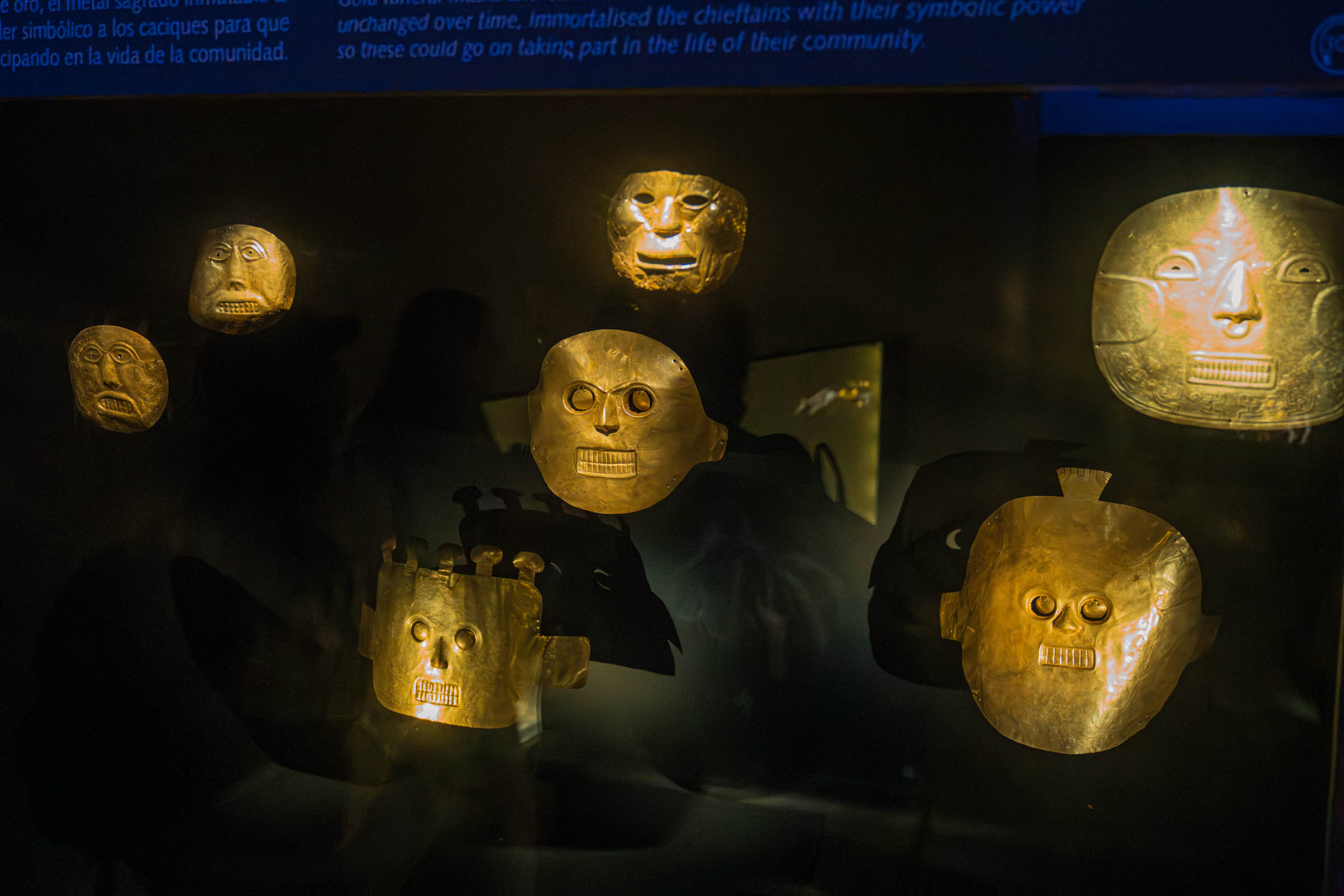


The Gold Museum in Bogotá is not only the most famous museum in Colombia, but also one of the most important museums of this type in the entire world. For any traveler who wants to understand the essence of pre-Columbian civilization, its values, art and spirituality, a visit to this museum is a must on the itinerary.
Located in the heart of the historic center of Bogotá, in a modern and elegant building in Parque de Santander, the Museum of Gold (Museo del Oro) offers more than 55,000 exhibits, of which about 6,000 are on permanent display. What immediately leaves you breathless is the refined aesthetics and technical perfection of objects made of gold and other precious metals – some dating back more than two thousand years. The exhibits come from various pre-Columbian cultures such as Muisca, Quimbaya, Tairona, Calima and Zenú, making this collection a unique ethnological and artistic treasure of Latin America.


But the Gold Museum is not just an impressive collection of objects. It is a carefully selected space that successfully connects art, history and spirituality. The exhibition is organized thematically, so visitors can gradually understand how the indigenous peoples of South America used gold not as a monetary resource, but as a symbol of heavenly power, an intermediary between the worlds of the living and the dead, a gift to the gods and often as a material for rites of transformation and initiation. A special impression is left by the “El Dorado Room”, which depicts the symbolic ritual immersion of the gold-covered ruler in Lake Guatavita – a myth that inspired hundreds of European conquerors to flood the continent in search of the mythical “Golden City”.


The museum is extremely modern with multimedia displays, interactive panels and perfectly lit display cases that give the objects an almost saintly aura. Even for a seasoned traveler like myself who has visited the Louvre, the Met or the British Museum, a visit to this museum left a strong impression on me because of its narrative clarity, aesthetic purity and the strength of the collective cultural heritage it conveys.
For travelers who want to learn more about Colombia, its past, identity and the strength of surviving cultures – the Gold Museum is not only a cultural content, but a real intellectual and emotional Colombian adventure. There is no better place in Bogotá to combine luxury, knowledge and the spirit of a continent that continues to fascinate the world.


Day 2: Art and History in Bogota
I start the second day with a tour of the Museo Botero. This museum in La Candelaria blew me away, it contains the largest collection of works by Fernando Botter in the world – 123 of his works that the artist donated to the city. In the spacious halls of the museum, I rested my eyes on his recognizable “oblim” figures – women, families, animals with inflated forms, as well as on the paintings of other greats such as Picasso, Dali and Miró. The interior of the museum with its high ceilings and pastel walls left an impression on me. What is important to note is that the entrance is free, which you have to keep in mind that there are sometimes bigger crowds. Botero depicts everyday life and night outs with a special humor, so I laughed a lot looking at his pictures of people with strangely small bodies in wheelchairs or oversized hats. It was a real refreshment after the colonial architecture. At the same second, I wanted to visit the remaining ten Botter sculptures in the park in front of the museum.

After the Botero Museum, I stopped by the celebrated Librería Lerner, a huge bookstore-salon that looks like a veritable literary palace. I felt a little tired after visiting the museum, but this place seems like a true oasis of tranquility. I walked among thousands of books and comfortable armchairs, so it was an ideal break. On the ground floor there are stalls with souvenirs, and on the first floor, separate corridors covered with tiles and glass cases make you feel like you are in a library of a past century. Curious tourists and students sit by the windows overlooking the square, and I hold my breath looking at the old maps of Colombia hanging on the wall. At one point, I found an interesting book on the shelf and I relaxed and immersed myself in the folk art of Colombia, interrupted by the sound of footsteps on the wooden floors and the soft rustling of pages, while surrounded by other visitors to this huge bookstore.


Then I continued through the colorful neighborhoods and admired the murals – Bogota is world famous for its street art. On the walls of La Candelaria and the surrounding streets, I noticed a lot of graffiti that reflected local themes: social commentary on society, colorful portraits of folklore, abstract compositions full of color. Walking around, I saw a group of artists on one wall creating another mural to the beat of street artists, and several tourists stopped to take pictures of the new piece of art. The sounds of urban life, like the slapping of paint on the wall, the smiles of passers-by, the smell of tacos from the next stand, made me feel like a part of that living outdoor gallery. This part of the day showed me how Bogotá is a rebellious city of modern trends where there is always an artistic surprise waiting for you in every shadow and corner.


I used the afternoon time to visit the National Museum of Colombia, the largest and oldest museum building in the country. Housed in a former panopticon (prison complex) from the 19th century, the national museum today houses over 20,000 exhibits dedicated to the history, art and culture of Colombia. Walking through the long exhibition halls, I felt like I was on a real journey through time.
First, I stayed in the archeology department where the prehistoric remains of indigenous peoples are exhibited, such as various stone figures, ceramics and gold objects from the period when the Muisca kings ceremonially threw gold into the lake. I then walked through the galleries dedicated to the liberation movement, the pictures of the Battle of Boyaca and the portraits of Simón Bolívar and Francisco Lisa Triano were a striking reminder of the dramatic past. During the tour, I also saw other art collections – for example sections of modern Colombian art and photo-documentaries from the 20th century, which completed this time postcard of the country.
The National Museum was an ideal contrast after yesterday, a true blend of traditional art such as museums and innovative art such as street art, it is important to note that both types of art are equally present in Bogotá.

Day 3: Monserrate and the panoramic view
The third day is reserved for the most famous natural attraction of Bogotá – the mountain of Monserrate. I took the cable car up to 3152 meters above sea level, to the small white temple Santuario del Señor Caído that dates back to the mid-17th century. The view from the top is breathtaking: the green of the mountain ring and the wide view of the city are below me. On one side I see thick clouds covering the ends of the city, and on the other an endless network of streets and buildings.
In the church at the top I lit a candle believing the local legend that wishes come true here. With that, I ordered a hot chocolate with cheese in a local cafe at the top, enjoying the panorama that evokes the contrast between the mountain peace and the hustle and bustle of the city. At the very top of Montserrat, I feel that Bogotá is both a wild landscape and a sophisticated city.


For me, visiting Montserrate was not just a tourist trip, but a kind of venture. It is possible to reach the top in three ways: by cable car (funicular), cable car (teleférico) or on foot, for those inclined to a real physical challenge. For those who like to experience the city in style, I recommend the cable car ride. The cabin rises gracefully above the forest and hills, revealing a postcard-like scene, a contrast between the urban rhythm of Bogotá and the serenity of its natural contours.
At the very top is the Basilica of the Lord of Montserrat, which still attracts pilgrims and believers from all over the country. The interior of the temple exudes simplicity, but also spiritual intensity. In its center is the statue of “Padre Jesús Caído”, which the local population deeply respects, believing that it fulfills prayers and brings peace. Regardless of your spiritual affiliation, a moment of silence in this space has a healing effect.


But Monserrate is much more than a religious place. Its panoramic terrace offers the most impressive view of all of Bogotá. During the day, the colors of the city overflow from the terracotta roofs to the modern glass buildings, while in the distance you can see the mountains that make Bogotá a uniquely closed valley.
For travelers with a luxurious sensibility, Monserrate offers another dimension of enjoyment: restaurants with a view. Casa San Isidro, an elegant colonial-style restaurant, offers superb French-Colombian cuisine, perfectly paired with local wines and digestifs. I enjoyed the meal with an unforgettable view, one of those moments where hedonism and contemplation meet in perfect balance.


Monserrate also has its own mythology. The ancient peoples, before the arrival of the Spaniards, considered this hill sacred, and later the colonizers “baptized” it after the example of Montserrat mountain in Catalonia. Today, it is a place where past and present meet, tradition and luxury, faith and aesthetics.
Being in Bogotá and not visiting Montserrate would be like visiting Paris and not seeing the Eiffel Tower, but with one difference: Montserrate is not only a symbol, but also a spiritual point of support, a place from which the city can be seen as a whole physically and metaphorically in Colombia.

On my way back down the hill that same afternoon, I stopped by the trendy areas just north of the city center. I experienced a moment of relaxation in the vicinity of Parque de la 93, a small urban park surrounded by restaurants, cafes and boutiques. I sat on a bench and absorbed the casual atmosphere, which reminded me that despite the hustle and bustle, Bogota can sometimes slow down. When I felt the beauty of the warm colors of the sunset filtering through the glass of tall buildings in the distance, I felt that I saw two Bogotás: the one high on Montserrat overlooking the city and the lower one, painted with the colorful colors of life.

Day 4: Usaquén and the chic quarter
On the fourth day, I devoted myself to the quieter and more exclusive parts of the city in the north. I headed to. Usaquén, a former colonial town now connected to Bogotá. In its charming core, I toured the authentic Church of Santa Bárbara and the colorful plaza-plato, a popular spot for a weekend market where local artisans and tourists congregate. In the square, I noticed shops from ancient times converted into pleasant restaurants with gardens. In that part of the city I felt the bohemian spirit and discovered many craft shops ideal for buying unique souvenirs from ceramic figurines to hand-woven carpets. As the afternoon slowly wore on, the streets of Usaquén were tucked into stunning tree-lined shade as locals and tourists patiently browsed the stalls. Refreshed with a traditional tres leches cake and homemade coffee liqueur in a pastry shop, I realized that Usaquén is a balm for the eyes and soul, here you can really feel the calmer rhythms of life in Colombia.

After walking around Usaquén, I headed back towards the center and headed through Zona G, Bogotá’s most famous gastronomic zone. The wide streets of this modern neighborhood are lined with luxury boutiques and elegant buildings with bright facades. As I walked past the strangely sophisticated shop windows with designer clothes and cars on display, I also noticed how the sidewalks were protected by tree lines, a real oasis of urban style. There I rested for lunch in one of the restaurants, enjoying top cuisine in a sophisticated atmosphere.

After that, I went on a tour of Zona T, also known as Zona Rosa – an elegant and urban part of the city that exudes the energy of the metropolis, but with a touch of refinement that is ideal for the sophisticated traveler. In the heart of this exclusive neighborhood is the Centro Comercial Andino, probably the most luxurious shopping center in Colombia, located at the intersection of Carrera 11 and Calle 82, in the northern part of Bogotá.
The first impression that Andino leaves is a sense of urban elegance. The environment of the shopping center itself says a lot about its character – the streets are clean, modern, with numerous designer boutiques, concept stores and galleries. The center building itself is architecturally discreet but imposing, with a luxurious interior in marble, glass and gold details. I left this zone for last because it is where the Four Seasons Bogotá hotel is located, where I stayed during my visit to Bogotá (Colombia).

Brands like Louis Vuitton, Salvatore Ferragamo, Carolina Herrera, as well as exclusive Colombian designers who mix local motifs with contemporary cuts welcome you in the Andino shopping center. I enjoyed leisurely exploring the shops and then took a break at Gato Negro Café, known for its superb local espresso and minimalist aesthetic.
After shopping at the Carolina Herrera store where I finally bought the jacket I’ve been dreaming about for a long time, I headed to the nearby restaurant Cacio & Pepe, a hidden gem of modern Italian cuisine with an authentic wine list. Zone T, especially in the evening, comes to life in an atmosphere similar to the best European districts, but with the tropical temperament of Latin America.
Remember, Andino is not just a place to shop, it’s an urban luxury experience that shows Bogotá and how it knows how to combine style, culture and modern lifestyle in Colombia.

Day 5: Relaxation and farewell to Bogotá
I spent the last day relaxing, enjoying the greenery of the northern districts. I visited the Jardín Botánico José Celestino Mutis, a vast botanical garden in the northern part of the city. I walked through the different sections of the garden, from the Mediterranean gardens to the tropical greenhouses, admiring the exotic orchids, cacti and other types of endemic plants. The observation deck above the park offers a view of the Botanical Garden building as a green oasis in the middle of the concrete jungle. That peace and fresh mountain air gave me refreshment after dynamic days of research. After a walk in the garden, I stopped for coffee and cake in a nearby cafe, summing up the impressions from this trip and watching the light breeze play with the petals.
These five days in Bogotá were the ultimate experience: the city combined history, natural beauty and modern luxury in a way that completely won me over. The colorful walls of La Candelaria, the magnificent vistas from Monserrata and the delicacies of top Colombian cuisine are what I will remember for a long time. From restaurants with fantastic mountain views to pintxos in hidden cafes, Bogotá has everything you need for all types of travelers. With a smile on my face, I greeted the Andes and the city skyline knowing that I would surely return to discover more of Colombia’s charms.

Streets You should visit in Bogota
- Carrera 7 (Seventh Avenue): the city’s main avenue that runs through the historic center and towards the north of the city. On Sunday, a large part of the avenue is closed to cars for ciclovíja (bicycle and pedestrian paths). Squares, museums and cafes are lined along it, so it is ideal for a leisurely walk and getting to know the lively city life in Bogotá (Colombia).
- Calle del Embudo (Calle 12): a picturesque narrow street in the La Candelaria district, known for its colorful murals and colonial houses. This charming alley seems a bit magical and is ideal for taking photos, passing through it means entering right into the artistic soul of the city.
- Zona T (Calle 82–85): the lifeblood of trendy entertainment and shopping in the Zona Rosa district. There are luxury boutiques, shopping malls and bars, known as a place to go out and relax. At night, despite the international scene, it is still a very safe place to gather.
- Parque de la 93 (Calle 73): a stylish park surrounded by stylish restaurants, cafes and clubs. Enjoying a coffee or a cocktail in this park is a must-do for every visit, as it provides an atmosphere of peaceful rest in the vertical “jungle” of the city in Colombia.
- Avenida Jiménez (Calle 13): an important thoroughfare that connects the city center with the eastern slopes. Along it are some of the oldest buildings in Bogota, and it is surrounded by boulevards and squares. Although busy, a walk in its landscaped part between Bolívar Square and Candelaria reveals the beauty of the old part of the city in Colombia.
- Calle 26 (Avenida El Dorado): the city’s main thoroughfare towards the airport, known for its modern buildings and murals dedicated to El Dorado. It is not a classic pedestrian zone, but a car ride along it will show a modern part of Bogotá with neon signs and a view of the mountains.


The Best Restaurants in Bogota
- Leo (Chapinero Alto): Famous chef Leonora Espinoza’s restaurant with Ciclo Bioma’s tasting menu using indigenous Colombian ingredients and named the best in Latin America in 2017. Every dish at Leo is a work of art in Colombia, from fish delicacies with South American spices to innovative coconut desserts.
- Harry Sasson (Zone G): A legendary steakhouse in a 106-year-old mansion, with a focus on juicy steaks and grilled seafood. The ambiance is elegant and the menu gourmet, the right choice for anyone who likes top quality skewers, shrimp or basmati rice prepared with local spices.
- Andrés DC (El Retiro, Zona T): A modern version of the iconic restaurant Andrés Carne de Res from Chia, known for its lively atmosphere and extensive menu of traditional dishes. Rich salads, grilled meat and powerful cocktails turn every meal into a spectacle full of colors and flavors. Although it is unusual for a luxury traveler due to its informality, it is a true icon of the Bogota scene and a delicious experience in Colombia.
- El Cielo (Zone G): Chef Juan Manuel Barrientos’ restaurant specializing in molecular gastronomy. From 2013 to 2015, it was listed among the 50 best restaurants in Latin America, and it offers a unique culinary experience through its interactive tasting menu. Each dish is surprising and it would be like staying at a sci-fi cocktail.
- Criterion (Zone G): The restaurant of the Raush brothers who is one of the pioneers of the degustation fine dining scene in Colombia. Elegant halls, carefully served menu and professional staff contribute to the atmosphere of a superior experience. The menu mainly includes sophisticated classics (filet mignon, beef tail) with a modern touch, along with a rich wine list.
- El Chato (Chapinero Alto): Chef Álvaro Clavi’s modern restaurant uses seasonal and local ingredients. From 2017 to 2023, it quickly gained a reputation, even reaching second place on the South American list of best restaurants. Each meal is like a story from small pots, and the interior is minimalist, which allows creative tastes to come to the fore.

Bogota: Practical Advice and tips
Bogotá is located at a high altitude (~2600 m), so I tried to drink enough water and take a moderate pace on the first days for acclimatization. Layered clothing helped me, as mornings and evenings can be cooler, while during the day it is quite warm in the sun due to the thin air. For transportation, I mostly used taxi apps (Uber/Beat) that allow payment by card in Colombia, which is convenient and safe. However, I also carried some cash for minor purchases and tips. It is advisable to avoid narrow streets without public lighting in the evening, as well as carrying valuables outside Zone T. In general, I felt safe in the tourist areas, but I was still careful and followed the guides’ advice.


My dear travellers, with this post about Colombia we end the first chapter in the series of travelogues around South America, this time from the beautiful Bogotá, a city of contrasts, art, history and irresistible energy. In September, we continue exploring the beautiful and exotic Venezuela. During the summer break, you’ll read travelogues from Madrid and Istanbul, as well as Mrs. Mom’s fashion stories.
This travelogue would not be possible without the support of United Nations World Tourism Organization (UN Tourism), ProColombia, Ministry of Trade, Industry and Tourism of Colombia, as well as the Four Seasons Hotel Bogotá, whose collaboration with local partners allowed me to convey this story first-hand with a lot of energy, playful mentality, flavours and colors that adorn the Colombian capital.
As always, I tried to share authentic impressions, the right atmosphere and recommendations for you who like to travel in style, but also with an open heart. Have you already had the opportunity to visit Bogotá? Or maybe you are just planning to discover this city of coffee, gold and creativity?
Feel free to leave your impressions, comments or questions below the text, or contact me via email and social networks, all information is available on the CONTACT page.
See you soon, with a new story from the other side of the world.
With Love from Bogota,
Mr.M

This post is sponsored by the United Nations World Tourism Organization (UN Tourism), ProColombia, Ministry of Trade, Industry and Tourism of Colombia and Four Seasons Bogotá hotel and other local partners. This post is my personal and honest review of the destination experience.
Dear Marko, your post completely transported me. I’ve never been to South America, because my travels have mostly taken me to Southeast Asia and the Middle East, but Bogotá now feels urgent on my list. I loved how you painted the city not just through its landmarks, but through atmosphere and emotion. The part about the Gold Museum gave me goosebumps. Thank you for reminding us that elegance and culture can go hand in hand with adventure.
Hello Marco, I visited Bogotá two years ago and reading this felt like going back. You captured the city’s rhythm, the contrasts, the colors, and the calm in the chaos. Most travel blogs gloss over the feeling of a place, but yours truly resonates. You’ve made me want to return and see the city with fresh eyes.
Dear Marco, what an inspiring post. I’ve always been drawn to unusual destinations, and Colombia has been on my radar, but this post makes me feel like it’s time to stop dreaming and start planning. The way you describe the art scene and the café culture is exactly what I look for in a trip. Your storytelling has a cinematic quality, I felt like I was walking beside you in La Candelaria.
Hi Marko, you write with such detail and clarity, I could almost taste the coffee and feel the city’s pulse. Bogotá always seemed too big and loud to me, but you’ve shown me it has hidden elegance. This kind of insight is rare in travel blogs. Thank you for offering a different lens.
South America has always seemed out of reach, but after reading this, I’m rethinking everything. Your post gave me both the dream and the roadmap. From the colonial architecture to street murals and luxury hotels, it’s a blend I didn’t know I was craving. Definitely bookmarking this for future planning!
I’ve been to Buenos Aires and Lima, but somehow I skipped Bogotá and now I regret it. Your post brings the city to life in a way that’s both sophisticated and inviting. I love your balance between fashion, history, and place. It’s the kind of travel content I always hope to find.
Ich reise oft nach Asien und Afrika, aber Südamerika war für mich bisher ein weißer Fleck auf der Karte. Dein Blogbeitrag über Bogotá hat das geändert. Die Art, wie du die Stadt beschreibst mit einem Gefühl für Kunst, Kaffee und Geschichte ist beeindruckend. Ich habe jetzt richtig Lust, die kolumbianische Hauptstadt selbst zu entdecken. Danke für diese Inspiration! Mit FG Laura
Lieber Marko, Ich war 2023 in Bogotá und habe dort eine unvergessliche Zeit verbracht. Dein Text hat mich emotional direkt zurückversetzt. Besonders schön fand ich, wie du das kulturelle Herz der Stadt eingefangen hast nicht nur Sehenswürdigkeiten, sondern auch Lebensgefühl. Man merkt, dass du mit viel Feingefühl schreibst.
Dein Beitrag hat meine Reiselust geweckt! Ich liebe es, besondere Orte zu entdecken – in Nepal, Namibia oder Japan. Bogotá hatte ich nie ernsthaft in Betracht gezogen, aber jetzt reizt mich genau diese Mischung aus urbanem Leben, Kunst und kolonialer Eleganz. Danke für diesen Blick über den Tellerrand. FG Anikka
Ich habe deinen Blog zufällig entdeckt und bin begeistert von deinem Stil. Bogotá klingt nach einer Stadt voller Kontraste und Charme. Besonders beeindruckt hat mich dein Abschnitt über das Museo del Oro – das steht jetzt ganz oben auf meiner Bucket List. Weiter so!
Wow, ich hätte nie gedacht, dass Bogotá so stilvoll und inspirierend sein kann. Bisher dachte ich eher an Chaos und Kriminalität, aber du hast ein ganz anderes Bild gezeigt. Ich mag, wie du Mode, Reisen und Kultur verbindest das ist selten und sehr besonders.
Il tuo racconto mi ha fatto venire voglia di partire subito. Non sono mai stato in Sud America, ma dopo aver letto questo post sento che Bogotá potrebbe essere la mia prossima destinazione. Adoro il modo in cui descrivi i dettagli della città, senza cadere nei soliti cliché turistici. Si sente il tuo amore per il viaggio e per l’estetica.
Sono stato in Colombia l’anno scorso e ho amato Bogotá. Rivedere quei luoghi attraverso le tue parole mi ha fatto emozionare. Hai descritto perfettamente il mix tra cultura, vita urbana e raffinatezza che si respira lì. Complimenti per la sensibilità e lo stile con cui scrivi.
Viaggio spesso in Africa e nel Sud-est asiatico, ma il tuo post mi ha fatto capire che sto sottovalutando l’America Latina. Bogotá mi sembra una città viva, colorata e sorprendente. Il tuo modo di raccontare mi ha coinvolto come pochi. Ora non vedo l’ora di organizzare un viaggio!
Che bellezza questo articolo. Mi sono immaginata a passeggiare tra i murales e a bere un caffè colombiano guardando le Ande. La tua scrittura è delicata e potente allo stesso tempo. Hai un dono nel raccontare i luoghi.
Ho visitato Lima e Buenos Aires, ma Bogotá è stata una rivelazione attraverso le tue parole. Mi piace la tua attenzione per l’eleganza nei dettagli e il rispetto per la cultura locale. È difficile trovare blog così autentici e ben scritti. Bravo davvero!
¡Qué maravilla de texto! Nunca había considerado Bogotá como una ciudad para visitar, pero ahora la veo con otros ojos. Me encantó cómo integraste la historia, el arte y la modernidad. Viajo mucho por Asia, pero tu blog me hizo soñar con América Latina. ¡Gracias por abrirme la mente!
Estuve en Colombia hace dos años y Bogotá me fascinó. Tu post me hizo revivir cada rincón, cada aroma, cada color. Es muy difícil encontrar escritores que capten la esencia de un lugar como tú lo haces. Ojalá más gente descubra tu trabajo.
Me encantó la forma en que relatas tu experiencia. Es un equilibrio perfecto entre elegancia y emoción. Viajar es mi pasión y ahora tengo muchísimas ganas de conocer Bogotá. Tus palabras son pura inspiración.
Lo que más me gustó fue cómo transmites los pequeños detalles: el café, la arquitectura, la gente. Se nota que viajas con el corazón y eso se siente en cada línea. Felicidades por este artículo tan cálido y profundo.
Bogotá ya era una ciudad que tenía en mente, pero después de leerte, se convirtió en prioridad. Gracias por mostrarla con tanta belleza y sensibilidad. Tu estilo es muy especial, y espero seguir leyendo muchas más aventuras tuyas.
Ton article m’a donné des frissons. Je ne suis jamais allé en Amérique du Sud, mais grâce à toi, Bogotá est désormais en haut de ma liste. J’ai adoré la façon dont tu parles du café, de l’art et de la chaleur humaine. Tu as capté quelque chose de rare.
Passionné par les destinations atypiques, je voyage souvent en Asie ou en Afrique. Mais là, tu m’as convaincu d’explorer une autre partie du monde. Ton style d’écriture est fluide, raffiné et très immersif. Bogotá semble magique.
Ayant déjà visité Lima et Quito, je pensais avoir une idée des villes sud-américaines. Mais ton article m’a montré un autre visage de Bogotá. C’est une ville d’art et de style, comme tu le dis si bien. Merci pour l’inspiration!