
There are cities that you visit and there are cities that you are always happy to return to. Rome belongs to that other group of cities that always leave an extraordinary impression on tourists that they simply want to return to this eternal city. This city is a place where centuries permeate at every turn, where ancient columns abut 18th-century buildings and narrow streets lead you from one discovery to another. I came to Rome with expectations, but this city, for the umpteenth time, exceeded them. In this travelogue I take you through what makes Rome one of the most visited cities in the world, through the places I visited, the hotel I stayed in and what I felt again walking the streets of the eternal city.
Before starting today’s travelogue about Rome, I want to express my special thanks to the United Nations World Tourism Organization – UN Tourism and Master Trevi Rome Hotel for supporting and promoting quality tourism around the world. Their dedication to connecting cultures and destinations is an inspiration to all of us who believe that travel enriches the soul.


WHY IS ROME ONE OF THE MOST VISITED CITIES ON THE PLANET?
Rome is a city that is visited annually by more than twenty million tourists. In 2024 alone, according to data from the Rome Tourism Organization, the city recorded a record 22.2 million arrivals and an incredible 51.4 million overnight stays. This makes it the most visited city in all of Italy, far ahead of Venice, Florence and Milan. The reason for this popularity is not only in the sights, although they are on every corner. Rome attracts because it offers something that hardly any city can, which is the ancient experience of thousands of years of human civilization, concentrated in a relatively small area of the historic center.
The ancient Romans ruled the entire Mediterranean, North Africa and parts of the Middle East. Their legacy is visible at every turn. Then Rome became the center of Christianity, the city where the Pope still lives today, and this spiritual meaning attracts pilgrims from all over the world. During the Renaissance, the city was one of the most important centers of art and education in Europe. Later, in the 18th and 19th centuries, Rome was a mandatory stop on the so-called Great Journey, when young European aristocrats came to learn about ancient culture, philosophy and architecture. That spirit never went away.


ARRIVAL IN ROME AND FIRST IMPRESSIONS
Rome welcomes you with warmth, energy and an unusual crowd that simply cannot be described in words. As soon as you step out into the street, you feel the rhythm of the city, Vespa scooters whizzing past you, the smell of freshly baked bread from the bakery and famous Italian pasta from local restaurants, the sound of water flowing from one of the thousand fountains. The historic center is compact enough to be comfortably explored on foot, and that’s exactly how I spent my days in Rome, walking from one landmark to another, stopping for sweet breaks when I needed a break.
What surprises me every time is how much Rome is a living city. This is not an open-air museum in the sense that everything is preserved and protected behind glass. People live in buildings that are hundreds of years old, do laundry on terraces above baroque churches, drink espresso leaning on columns dating back to the time of the empire. This mixture of the everyday and the eternal makes Rome different from all other cities in Europe and the world.


TREVI FOUNTAIN: THE HEART OF ROME
Every trip to Rome starts or ends at the Trevi Fountain. This baroque fountain, twenty-six meters high and almost fifty meters wide, is the largest fountain in Rome. It was designed by Nikola Salvi and completed in 1762. The central figure represents the god Ocean standing on a chariot drawn by two horses, one calm and one wild, symbolizing the two faces of the sea.

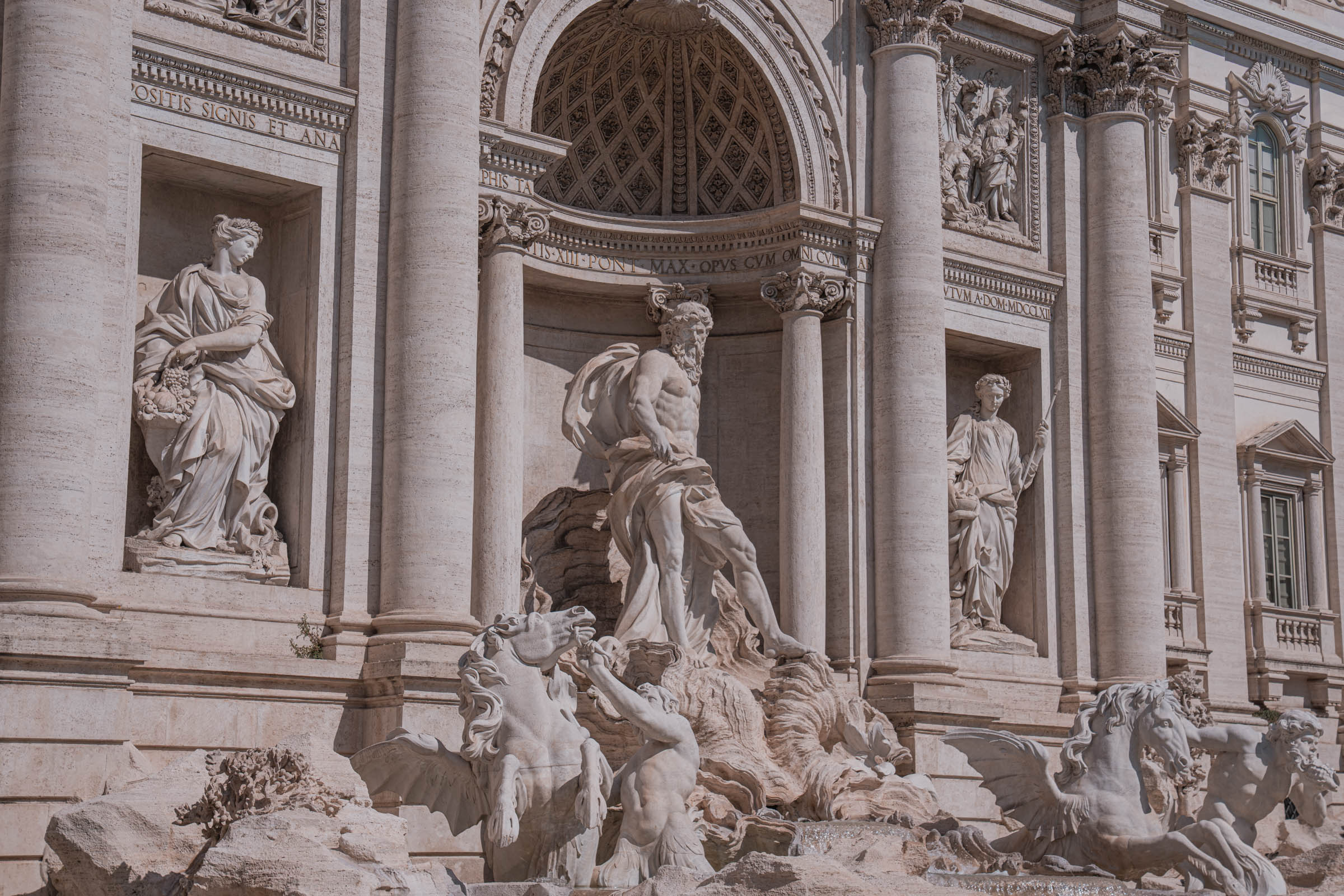
I came early in the morning, before the mass of tourists appeared, and was rewarded with a breathtaking sight. The light of the early sun illuminates the white marble and creates a play of shadows on the sculptures that look as if they could come to life at any moment. Tradition says that if you toss a coin with your right hand over your left shoulder, it will take you back to Rome. Every year, tourists throw around a million and a half euros into the fountain, and that money is collected and donated to Roman charities.

The new rules for visiting the Trevi Fountain bring a small but significant change for tourists in Rome. Although access to the fountain itself is still completely free, as of February 2026, a symbolic fee of around €2 will be introduced for access to the nearest zone by the water, the place where visitors traditionally throw coins. This measure aims to better control crowds and preserve one of the most famous symbols of the city. For most visitors, nothing fundamentally changes: enjoying the view and taking photos remain free, while the additional experience from the front row is now charged.
TRINITA DEI MONTI STAIRCASE (SPANISH STEPS) AND PIAZZA DI SPAGNA
From the Trevi Fountain, it is a short walk to the Spanish Steps, one of the most famous staircases in the world. Built between 1723 and 1725, this 135-step staircase connects Piazza di Spagna at the bottom with the Trinita dei Monti church at the top. In the square itself, in front of the staircase, there is a fountain in the shape of a boat, known as Barcaccia, the work of Pietro Bernini, the father of the more famous Gianlorenzo Bernini.


I stood at the top of the stairs and looked down at the colorful mass of people, the elegant facades of the surrounding buildings, and the Via dei Condotti, which leads straight from the square. This street is a paradise for lovers of luxury fashion, with stores of houses such as Cartier and Bulgari, whose signs are visible from the staircase itself. Piazza di Spagna is a place where elegance and everyday life meet, where tourists mingle with Romans rushing to work.


PIAZZA DEL POPOLO: THE ANCIENT GATE OF ROME
At the northern end of the historic center is Piazza del Popolo, one of the most beautiful squares in the city. This ellipsoidal square was the main entrance to Rome for travelers coming from the north, through the Porta del Popolo, a monumental gate in the Aurelian Walls. In the middle of the square rises an Egyptian obelisk three thousand three hundred years old, one of the thirteen obelisks in Rome, which Emperor Augustus brought from Egypt.


The two ends of the square are flanked by identical twin baroque churches: Santa Maria dei Miracoli and Santa Maria in Montesanto, which create perfect symmetry. Three fan-shaped streets start from the square: Via del Corso, Via del Babujino and Via di Ripeta, which lead deeper into the heart of the city. On the east side of the square, the terrace on the Pincho Hill offers one of the most beautiful views of Rome, with the dome of St. Peter’s Basilica dominating the skyline. A fountain at the foot of the terrace, with a sculpture of the goddess Rome flanked by the rivers Tiber and Aniene, completes this space perfectly.


PANTHEON: THE PERFECTION OF ROMAN ARCHITECTURE
The Pantheon is perhaps the most fascinating building in Rome. Built around 125 AD during the reign of Emperor Hadrian, this is the best-preserved ancient building in the city. An inscription on the facade says that it was built by Marcus Agrippa, because Hadrian wanted to honor the original temple that Agrippa built on the site. The dome of the Pantheon, forty-three meters in diameter, was the largest dome in the world for thirteen hundred years, until Brunelleschi built the dome of the Florence Cathedral.
I entered through the massive bronze doors and immediately looked up at the occlus, a circular opening at the top of the dome, nine meters in diameter, through which light and, sometimes, rain pours in. The effect is theatrical and modest at the same time. The light that penetrates the occlusum moves around the interior like a giant clock, marking the passage of time in the same way for almost two thousand years. The Pantheon has been a church dedicated to All Saints since the seventh century and contains the tombs of the painter Raphael and several Italian kings.


PIAZZA NAVONA: THE STAGE OF ROMAN LIFE
Piazza Navona occupies the space of the former Domitian Stadium from the first century and the elliptical shape of the square follows the contours of the former race track. Three fountains adorn this square, and the central Fountain of the Four Rivers by Gianlorenzo Bernini is one of the masterpieces of Baroque sculpture. The four figures represent the great rivers of the then known world: the Danube, the Ganges, the Nile and the Rio de la Plata. The obelisk above the fountain was part of Maxentius’ circus on the Via Appia.


The square is always alive. Artists sell paintings, street musicians play, and the terraces of the surrounding cafes are full to capacity. At the northern end of the square is the Neptune Fountain, and at the southern end is the Fontana del Moro. The Church of Saint Agnes in Agonja, whose project was started by Borromini, dominates one side of the square. Between Bernini’s fountain and Borromini’s church there is a famous legendary rivalry between the two artists, although art historians claim that the story of their mutual subterfuge in this square is more myth than truth.


THE COLOSSEUM: A MAGNIFICENT WITNESS OF THE ROMAN PAST
The Colosseum is a symbol of Rome and one of the new seven wonders of the world. Built between 70 and 80 AD, this amphitheater could accommodate between fifty and eighty thousand spectators. Its real name is the Flavian Amphitheater, and the Colosseum was named after the colossal statue of Emperor Nero that once stood nearby. It is visited annually by about twelve million people, which makes it the most visited cultural attraction in all of Italy.


I stood in front of it and tried to imagine what this space looked like when it was filled with Roman citizens watching gladiatorial fights, hunting wild animals and other spectacles. The underground corridors, known as the hypogeum, served as a backdrop where fighters and animals were prepared before being lifted into the arena by elevators. This underground network of tunnels and rooms was a true engineering marvel of its time.


Next to the Colosseum is the Arch of Constantine, a triumphal arch from the fourth century, one of the best preserved in Rome. It was built in 315 to celebrate Constantine’s victory on the Milvian Bridge, and it is decorated with reliefs that were partly taken from older monuments.

TRAJAN’S FORUM AND ROMAN MARKETS
The Roman Forums are perhaps the most impressive archaeological site in the city. Trajan’s Forum, built at the beginning of the second century, was the last and largest of the imperial forums. Trajan’s column, thirty-eight meters high, still stands today, with a spiral relief frieze depicting scenes from Trajan’s wars in Dacia. About two thousand five hundred figures are carved in marble on a frieze almost two hundred meters long.


Behind the column are the remains of Trajan’s Markets, a semi-circular brick structure believed to be the first shopping center in history. There were about one hundred and fifty shops in it spread over several levels. When you stand in front of these ruins and look towards the hill on which rises the Renaissance dome of the Church of the Holy Name of Jesus, you realize how many layers of history Rome hides.

VATICAN: THE HOLY STATE IN THE CITY
The Vatican is the smallest independent state in the world, with an area of only forty-four hectares, but its importance is immeasurable. St. Peter’s Basilica, the largest church in the world, dominates St. Peter’s Square designed by Bernini. The colonnade with two hundred and eighty-four columns forms an embrace that symbolically welcomes the faithful into the fold of the church.


I entered the basilica and as prepared as I was, the size and opulence of the interior was breathtaking. The dome, designed by Michelangelo, rises to a height of one hundred and thirty-six meters and is painted with mosaics depicting saints and angels. Bernie’s canopy above the papal altar, twenty-nine meters high, was made of bronzes taken from the Pantheon. The Pieta, Michelangelo’s sculpture of the Virgin holding the body of Christ, is in the first chapel on the right and is the only work signed by Michelangelo.


Beneath the basilica, in the crypt, are the tombs of the popes, including those of the most recently deceased. St. Peter’s Square, with its central Egyptian obelisk, provides a view to remember forever, especially when clouds roll over the dome and create a dramatic backdrop for Bernini’s statues of saints atop the colonnade.


CHURCHES OF ROME: HIDDEN TREASURES
Rome has over nine hundred churches and many of them hide artistic treasures that can be compared to any museum in the world. The Basilica of Santa Maria del Popolo, in Piazza Popolo itself, contains two paintings by Caravaggio in the Cerazi Chapel, the Crucifixion of St. Peter and the Conversion of St. Paul. Entrance is free, and the experience is priceless.


The Basilica of St. John Lateran is actually the cathedral of Rome, not St. Peter’s Basilica as many think. This church is the mother of all the churches of the Catholic world. The interior was remodeled in the seventeenth century and exudes baroque opulence: a golden ceiling, huge frescoes on the walls and a mosaic in the apse dating from the thirteenth century. The papal cathedra, a wooden throne in the apse, is a symbol of papal authority.

The Basilica of Santa Maria Maggiore is one of the four great papal basilicas and the only one that has preserved its early Christian structure. The coffered wood ceiling is gilded with the first gold brought from America. The interior is spectacular, with fifth-century mosaics depicting scenes from the Old Testament.


THE STREETS OF ROME: A WALK THROUGH THE CENTURIES
Via del Corso is Rome’s main shopping street, about one and a half kilometers long, connecting Piazza del Popolo with Piazza Venezia. The street got its name from the horse race that took place during the carnival. Today it is a place where chain stores mix with traditional Italian boutiques.


Via dei Condotti, the most elegant street in Rome, starts from Piazza di Spagna and is home to the world’s most famous fashion houses. Via del Babujino, parallel to Via dei Condotti, belongs to the same luxury fashion triangle known as the Tridete. To walk these streets is to walk between the past and the present, between eighteenth-century facades and shop windows displaying the latest collections.

But the real charm of Rome lies in the side streets. The narrow streets behind the Pantheon, where there are small workshops and family-run trattorias, offer a Rome that no guidebook describes. Ocher and terra cotta facades, with green shutters on the windows and ivy climbing the walls, create scenes that have inspired generations of artists and writers.
THE CASTLE OF SAINT ANGEL AND THE TIBER
The Castle of St. Angelo, originally built as a mausoleum of Emperor Hadrian in the second century, went through many transformations, was a fortress, a prison, a papal shelter and today a museum. Its round shape and massive walls testify to Roman engineering genius. It got its name from a legend from the sixth century, when the Archangel Michael allegedly appeared on top of the building and returned the sword to its scabbard, which marked the end of the plague that was ravaging Rome. The bronze statue of an angel on top of the castle reminds of that legend.

A secret passage known as Passeto di Borgo connects the castle to the Vatican and served as an escape route for the popes in case of danger. Pope Clement VII used this passage in 1527 during the sack of Rome by the armies of Charles V. The interior of the castle hides richly decorated papal chambers with frescoes from the sixteenth century and terraces with a view of the entire city.
The Bridge of Saint Angelo, decorated with ten angels designed by Bernini, is one of the most photographed sights in Rome. Each angel holds an object related to Christ’s Passion: a cross, a crown of thorns, a spear, a sponge. I arrived at the castle just as the sky was clouding over, and the dramatic contrast of the dark clouds behind the brick castle made for an unforgettable sight.

The Tiber, the river that flows through Rome, is not as wide or imposing as some other European rivers, but the bridges that cross it provide some of the best views of the city. The view from Ponte Umberto towards St. Peter’s dome is one of those places where you stop and just look. Along the river, especially in the evening, the light takes on that warm Roman color that inspired Caravaggio and other masters of light and shadow.
SISTINE CHAPEL AND VATICAN MUSEUMS
It is impossible to talk about the Vatican without mentioning the Sistine Chapel, perhaps the most famous room in the world. Michelangelo’s ceiling, painted between 1508 and 1512, depicts scenes from the Book of Genesis, from the Creation of Adam to Noah’s Flood. Twenty years later, Michelangelo returned to paint the Last Judgment on the altar wall, a work that shocked contemporaries with its drama and the nudity of the figures.
The Vatican Museums, which you pass through on the way to the Sistine Chapel, contain one of the most important art collections in the world. The Gallery of Geographical Maps, the Raphael Rooms, the Pio-Clementino Museum with ancient sculptures, each of these units could be an independent museum. Every year, about six million visitors pass through these corridors, which speaks of their importance.

MASTER TREVI: MY HOME IN ROME
For my stay in Rome, I chose the Master Trevi Rome, a boutique aparthotel located at Via dei Maroniti 19, just a few minutes’ walk from the Trevi Fountain. This facility offers 27 carefully designed suites that combine contemporary minimalism with Scandinavian-inspired interior design. I stayed in a one bedroom suite which offered something that classic hotel accommodation rarely does, the feeling of actually living in Rome and not just passing through.


The apartment was spacious and bright, with large floor-to-ceiling windows that let in natural light and create a sense of openness. The bed was comfortable, the linens were of good quality, and the bedside lamps gave the room a warm, cozy atmosphere. On the walls above the bed hung two framed graphics in neutral tones, which perfectly fit into the overall design of the space. The bathroom was equipped with a rain shower, bathrobes and slippers, details that make the difference between ordinary accommodation and a real experience.

What sets Master Trevi Rome apart from classic hotels is the aparthotel concept. Each apartment has a small kitchen with a coffee machine, a refrigerator and everything you need to prepare a light meal. This means you can start your morning with an espresso in your suite before hitting the streets of Rome. The common area on the ground floor serves as a living room where you can work, read or simply relax.


Breakfast was served in a pleasant environment with open shelves on which stood bottles of wine, fruit, fresh juice and a basket of pastries. Croissants, sweets and various foods were displayed under glass covers, and small plates with olives, pistachios and homemade toppings gave the meal a real Italian character. The atmosphere was intimate and far from the chaos of large hotel restaurants.

The location is impeccable. You go out into the street and in two minutes you are at the Trevi Fountain. The Spanish Steps, Pantheon, Via del Corso are all within a ten minute walk. The quiet courtyard of the complex where Master Trevi Rome is located offers peace from the noise of Rome, but as soon as you cross the threshold, you are in the very heart of the city. It is this balance between apartment comfort and hotel service that makes this concept ideal for travelers who want to spend more than one night in Rome and get to know the city at their own pace.

On a notepad with the Master Trevi logo, I wrote my list of must-sees in Rome: Colosseum, Roman Forum, Pantheon, Spanish Steps, Vatican Museum, Piazza Navona, Sistine Chapel and slowly visited them one by one during my stay.
VITTORIANO AND PIAZZA VENICE: THE MONUMENTAL CENTER
Piazza Venezia is the crossroads where all the roads of Rome intersect. On the south side of the square rises Vittoriano, a monumental monument dedicated to the first king of united Italy, Victor Emmanuel II. The Romans jokingly call it “wedding cake” or “typewriter” because of its bulky white marble that contrasts with the warm tones of the surrounding architecture. Nevertheless, the view from the top of this monument, which is reached by a glass elevator, offers one of the best panoramas of Rome from the Colosseum on one side to the dome of St. Peter on the other.
Via dei Fori Imperiali starts from Piazza Venezia, a wide boulevard that Emperor Mussolini cut through the heart of ancient Rome in the 1930s. This street leads straight to the Colosseum and offers views of the Roman Forum on both sides. On weekends, this street is closed to traffic and becomes the most beautiful pedestrian zone in the city.

TRASTEVERE AND THE ROMAN CHARACTER
Trastevere, a district on the right bank of the Tiber, has preserved that Roman character that has been partially lost in the city center under the burden of mass tourism. Narrow streets, ivy-covered facades, small trattorias with checkered tablecloths and laundry drying on the windows, all give Trastevere an authenticity that is hard to find elsewhere. This neighborhood was home to Roman artisans and workers, and that spirit is still felt today in its untidy charm.
The Basilica of Santa Maria in Trastevere, one of the oldest churches in Rome dedicated to the Virgin Mary, is located in the central square of this district. The mosaics on the facade and in the apse date from the 12th and 13th centuries and are among the most beautiful in the city. In the evening, the square becomes a gathering place, musicians play, people sit on the steps of the fountain and enjoy the atmosphere reminiscent of Rome as it was before the era of mass tourism.


ROMAN FOUNTAINS: THE MUSIC OF WATER
Rome is a city of fountains. More than two thousand fountains are scattered around the city, from monumental Baroque buildings to small fountains on street corners known as nazoni. These small fountains with drinking water were installed at the end of the nineteenth century and still serve their purpose today, you can fill a bottle with water that is clean, cold and free.
The Barcaccia fountain in Piazza di Spagna, in the shape of a sunken boat, was made in a shape adapted to the low water pressure in that place. Fountains in Piazza Navona The Fountain of the Four Rivers in the center, the Fountain of Neptune in the north and the Fountain of Moro in the south make this square one of the most photogenic places in Rome. In Piazza della Rotonda, in front of the Pantheon, a fountain with an obelisk from the time of Ramesses II adds an Egyptian accent to this Roman square.
Every fountain in Rome has its own story, its own symbolism and its own beauty. They are not just decorations, they have been a vital part of the Roman infrastructure since the time of the ancient aqueducts that brought water to the city from the surrounding hills.

ROMAN CUISINE: A TASTE TO REMEMBER
One cannot write about Rome without mentioning the food. Roman cuisine is simple, based on quality ingredients and recipes passed down from generation to generation. Four classic Roman dishes are carborana, amatricana, cacho e pepe and ginger. Each of these dishes has its own rule – carborana is made with guanciale, eggs, pecorino and black pepper, without sour cream and without onions. Whoever puts sour cream in the carbonara has not cooked the carbonara.
Roman pizza is different from Neapolitan, the dough is thinner and crispier, especially the variant known as pizza al taglio, which is sold in slices and measured on a scale. For dessert, there’s maritozzo, a soft brioche filled with whipped cream, which has become a Roman culinary symbol on social media in recent years.
Supalji is another Roman specialty, fried rice balls filled with mozzarella and ragout, with a crispy exterior. These dishes are best tried in trattorias away from the main tourist routes, in districts such as Trastevere, Testacchio or San Lorenzo.

PRACTICAL TIPS FOR TRAVELING TO ROME
Rome is a city that is best explored on foot, but comfortable shoes are a must, cobblestones can be unforgiving. Spring and autumn are ideal periods to visit, when the temperatures are pleasant and the crowds are slightly less than in summer. Be sure to buy tickets for the Colosseum and the Vatican Museums in advance, as ticket lines can sometimes be longer than an hour.
Roman cuisine deserves a separate text, but it is worth mentioning that carborana, amatricana, cacho e pepe and ginger are four basic Roman dishes that you must try. Avoid restaurants that have pictures of dishes on the menu and photographers outside the door, this is a sure sign that they are aimed at tourists, not Romans.
Rome has two main railway stations, Termini and Tiburtina, and two airports, Fiumicino and Campino. The fastest way to get from Fiumicino to the city center is the Leonardo Express train, which takes thirty-two minutes to Termini station. There is public transportation, but the subway only has three lines because every excavation inevitably reveals new archaeological finds and stops work.

ROME AS ETERNAL INSPIRATION
At the end of every trip to Rome, I’m left with the same feeling that I haven’t seen enough, that I haven’t spent enough time, that I have to go back. Rome is a city that has that rare ability to give you something new every time you visit. You can come ten times and each time discover a street, a church, a fountain or a view that you didn’t notice before.
Rome is not only the capital of Italy. It is the capital of a civilization that shaped the entire Western world. To walk the streets of Rome is to walk on the same stones that were walked on by emperors, popes, artists and thinkers who shaped the world we live in today. That sense of continuity, that thread that connects the past with the present, makes Rome one of those rare cities that truly deserve the epithet – eternal.
I went back to my suite in Master Trevi, sat on the bed and looked at the list on the writing pad. Each item was circled. I’ve been to all of those places, but Rome, as always, taught me that true travel isn’t about checking items off a list. The real journeys are in those moments in between in the coffee drunk in some unknown square, in the light falling on the brightly colored facade, in the sound of the fountain around the corner. That’s what keeps you coming back. So, dear Rima, thank you for reminding me every time why I travel. See you again for the umpteenth time, because the coin has already been thrown into the fountain.
Have you already had the opportunity to visit Rome, this eternal city where ancient columns rise next to baroque fountains, and two thousand years of history live on every step of the streets where emperors, popes and the greatest artists of Western civilization walked? Or maybe you are just planning to step into this magnificent labyrinth, get lost in the narrow streets behind the Pantheon, feel the energy of the city that breathes through its squares and fountains, but also find moments of silence in hidden churches and courtyards that keep priceless masterpieces?
Feel free to leave your impressions, comments or questions below the text or contact me via email and social networks. All information is available on the CONTACT page.
See you soon, with a new story from the heart of old Europe!
With Love from Rome,
Mr.M

This post is sponsored by the United Nations World Tourism Organization (UN Tourism) and the Master Trevi Rome, as well as other local partners who have selflessly supported this project. This post is my personal and honest review of the destination experience.