
My dear travellers and lovers of unusual journeys, welcome to the new travelogue on the Mr.M blog. After travelogues from Italy, France, Monaco, the Czech Republic, Austria and Slovakia that won your hearts, it’s time to focus on another underrated pearl of Europe – Poland. Warsaw has been a destination I’ve been putting off for a long time. The Polish capital was not at the top of my list for years and today it is clear to me that I was wrong. I spent five days there and came back with a suitcase full of impressions and unusual memories that I really did not expect.
Before starting today’s travelogue about Warsaw, I want to express my special thanks to the United Nations World Tourism Organization – UN Tourism and the Sheraton Grand Warsaw Hotel for supporting and promoting quality tourism around the world. Their dedication to connecting cultures and destinations is an inspiration to all of us who believe that travel enriches the soul.
Warsaw is a hidden gem of Central Europe and belongs to the Mazovia region. It does not have one square that takes your breath away as soon as you step out of the taxi. It draws you in slowly, street by street, story by story. When you understand what happened to this city and how it was rebuilt, you start looking at it with different eyes.
In this travelogue, I will take you through everything I visited in the capital of Poland. I wrote it as a guide, but also as a personal diary. You will enjoy historical facts, specific tips for visiting Warsaw, as well as an honest review of the hotel where I stayed.


WHY WARSAW IS ONE OF EUROPE’S MOST UNDERRATED CAPITALS
Warsaw is the largest city in Poland and is home to more than 1,86 million people. It has been the capital since the end of the sixteenth century, and today it is also the business heart of the country. That is why two worlds that are rarely so close collide in it.
On one side you have the restored old center with narrow streets and baroque churches. On the other side, there are glass towers that are among the highest in Europe. That difference is not the city’s fault, but its most interesting feature.
In addition, Warsaw is still more affordable than most Western European capitals. The food is great, the public transportation works flawlessly, and the people are friendlier than the rumors tell you. You don’t have to plan for all of this months in advance.
However, the most important reason to come is the one that is not visible in the photos. This city was practically wiped off the face of the earth, so people rebuilt it with their own hands. When you know that, each facade gets a different weight.


WARSAW’S HISTORY: HOW POLAND’S CAPITAL ROSE FROM THE ASHES
Warsaw has not always been the capital of Poland. That role has long belonged to Kraków, which was both the royal capital and the place of coronation. The upheaval came at the end of the sixteenth century, during the reign of King Sigismund the Third Vasa.
The king moved the court to Warsaw, and the city thus got a completely new destiny. His son, Władysław IV, later erected a monument to his father that still stands today on the Castle Square. That column is the oldest secular monument in the city.
The following two centuries brought prosperity to Warsaw, but also heavy blows. The city was plundered by the Swedes, divided by its neighbors, and Poland disappeared from the map of Europe for a long time. Despite this, Warsaw remained the cultural center of the nation.
The nineteenth century brought Russian control and a slow, stubbornly resistant urban culture. In that period, some of the most beautiful classicist buildings that we visit today were created. Independence returned only after the First World War, but only briefly.
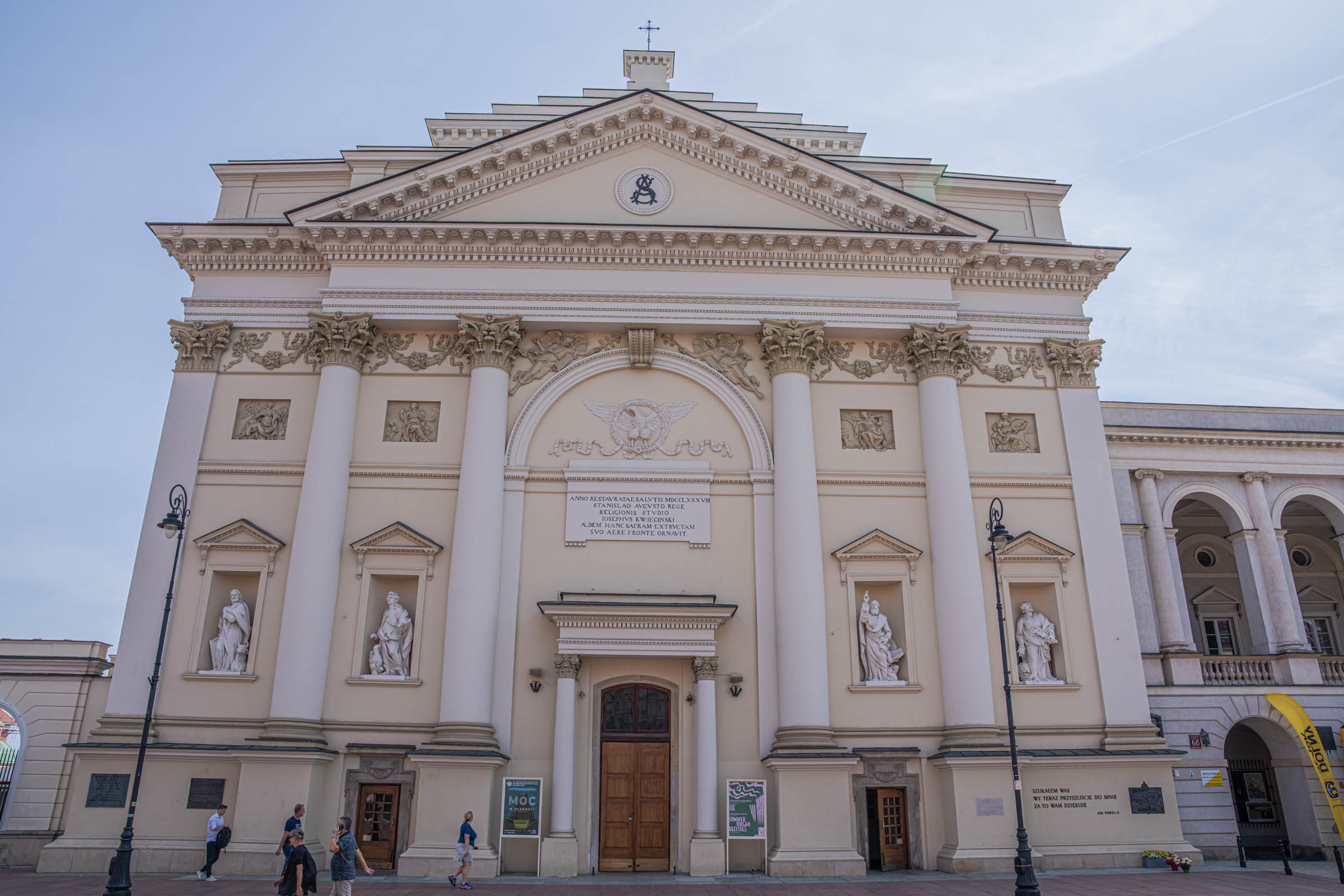
WARSAW IN WORLD WAR II: THE TRAGEDY THAT CHANGED THE CITY FOREVER
This is the part of the story that you must understand before you set foot in the old center. During the war, and especially after the Warsaw Uprising in 1944, the city was systematically destroyed. The historical core was almost completely destroyed.
According to UNESCO data, more than eighty-five percent of the historic city center was destroyed. Certain sources for the Stare Miasto itself state a percentage of about ninety-five. Empty facades, piles of bricks and streets without houses remained.
The decision to rebuild was already made in January 1945, before the dust had settled. Polish architects and conservators worked according to old plans, paintings and photographs. They also used the vedutes of Bernardo Bellotto, known as Canaletto.
The result is unique in the world. In 1980, on the second of September to be exact, the historic center of Warsaw was registered on the UNESCO World Heritage List. It was the thirtieth entry on that list, not because of its age, but because of the scale of the renovation.

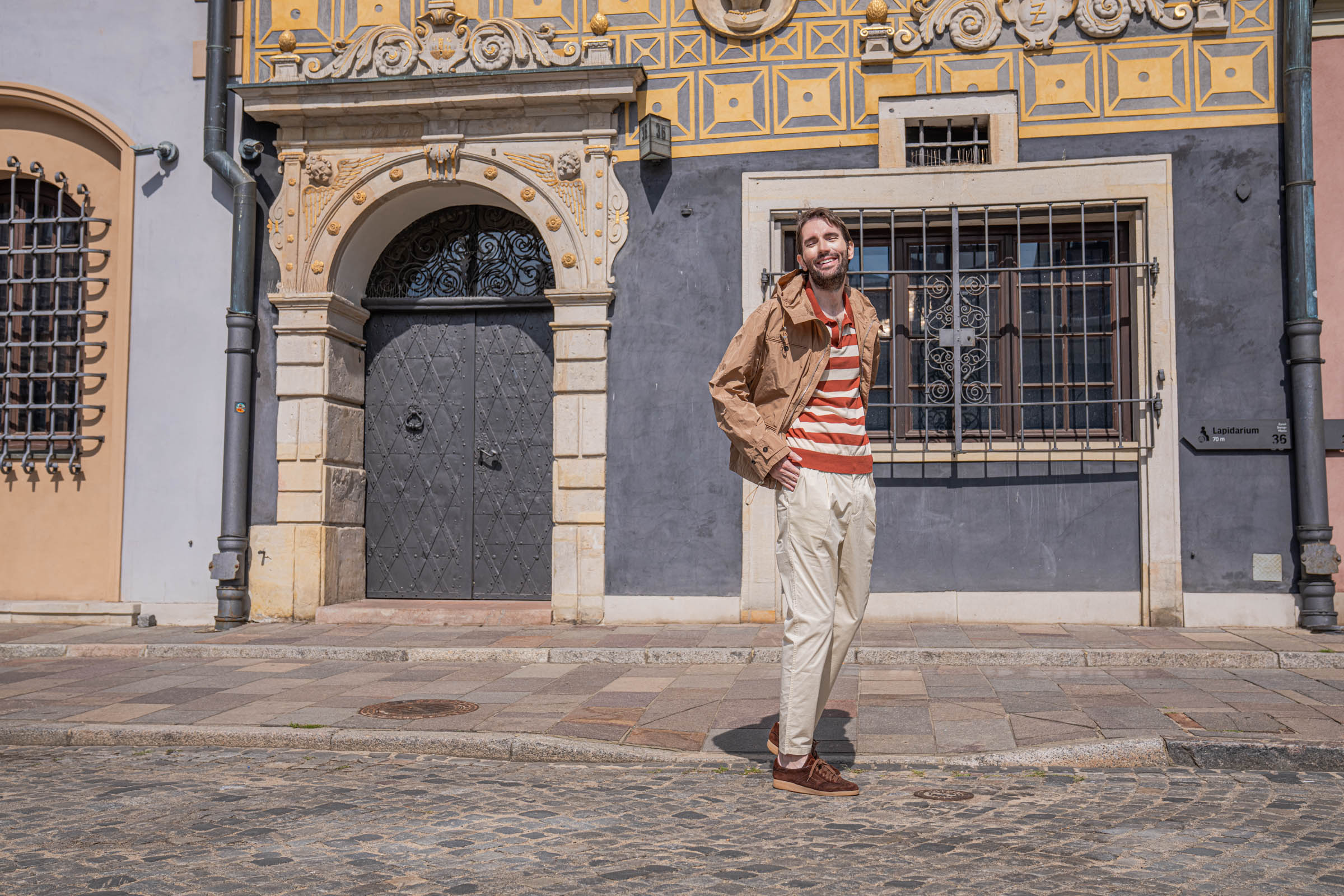
WARSAW OLD TOWN: THE HISTORIC SQUARE REBORN FROM THE RUINS
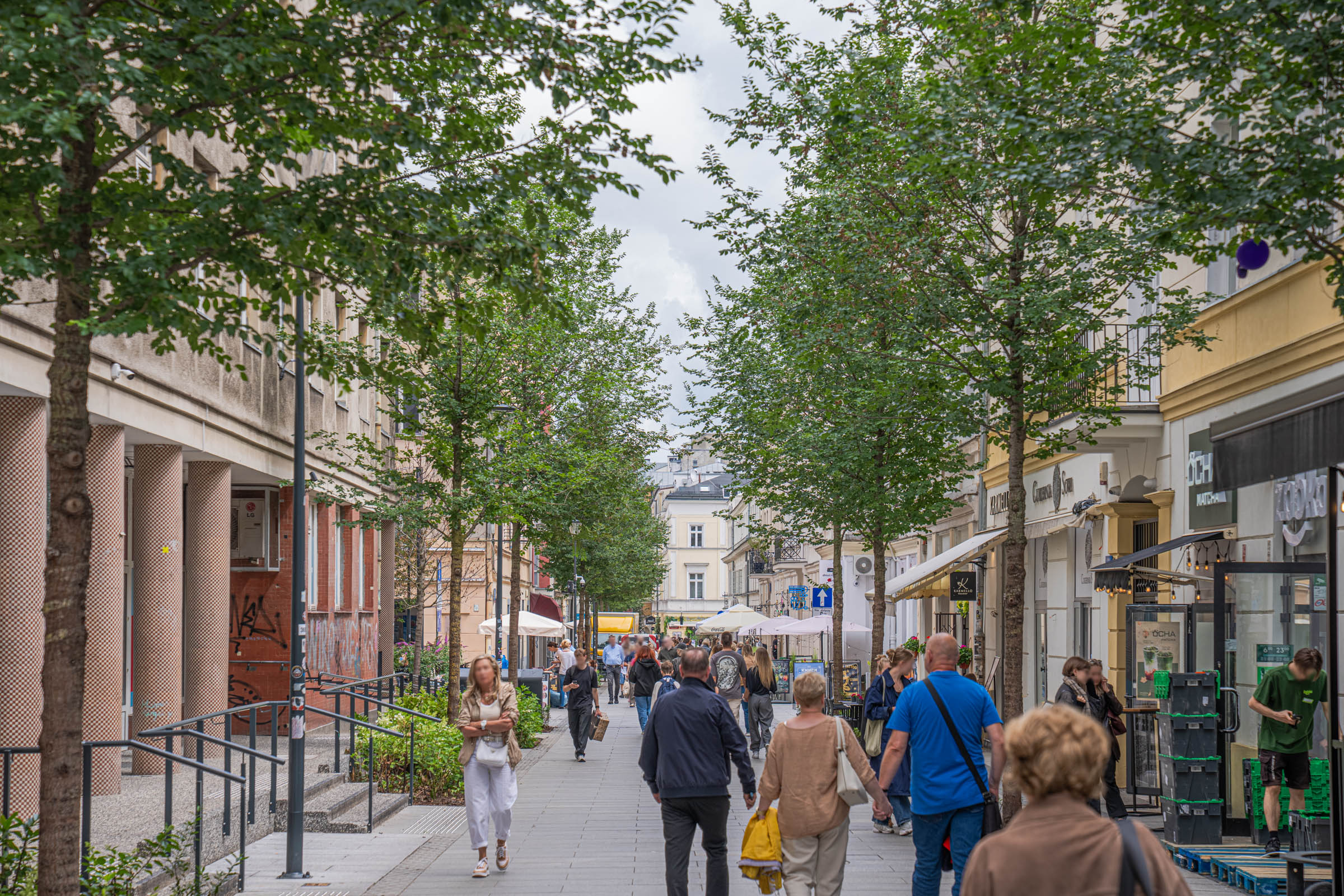
The first morning I started in the Old Town Market Square, the heart of the Old Town. The houses around the square have those rich colors that immediately catch the eye: ocher, brick, gray, pale blue. Tables spread under the awning of the restaurant and pots of geraniums stand in a row.
Stop for a moment and take a closer look. Everything you see was built after 1945, brick by brick. However, it does not act as a backdrop, but as a living neighborhood in which people still live today.
On one side of the square is the Warsaw Museum, housed in a row of connected civic houses. If you have an hour, come in. There you will best understand how complex the restoration was.
From there, I walked along the narrow streets towards Zapiecek and Świętojańska. These streets are touristy, but they have the right measure. The facades are decorated with reliefs of lions, eagles and saints and wrought iron shop signs hang above the doors.
Tip: come before nine in the morning or after seven in the evening. Then the square breathes differently, and the photos are incomparably better. In the middle of the day, it’s as crowded as you’d expect in August.

WARSAW’S ROYAL HEART: CASTLE SQUARE, SIGISMUND’S COLUMN AND THE ROYAL CASTLE
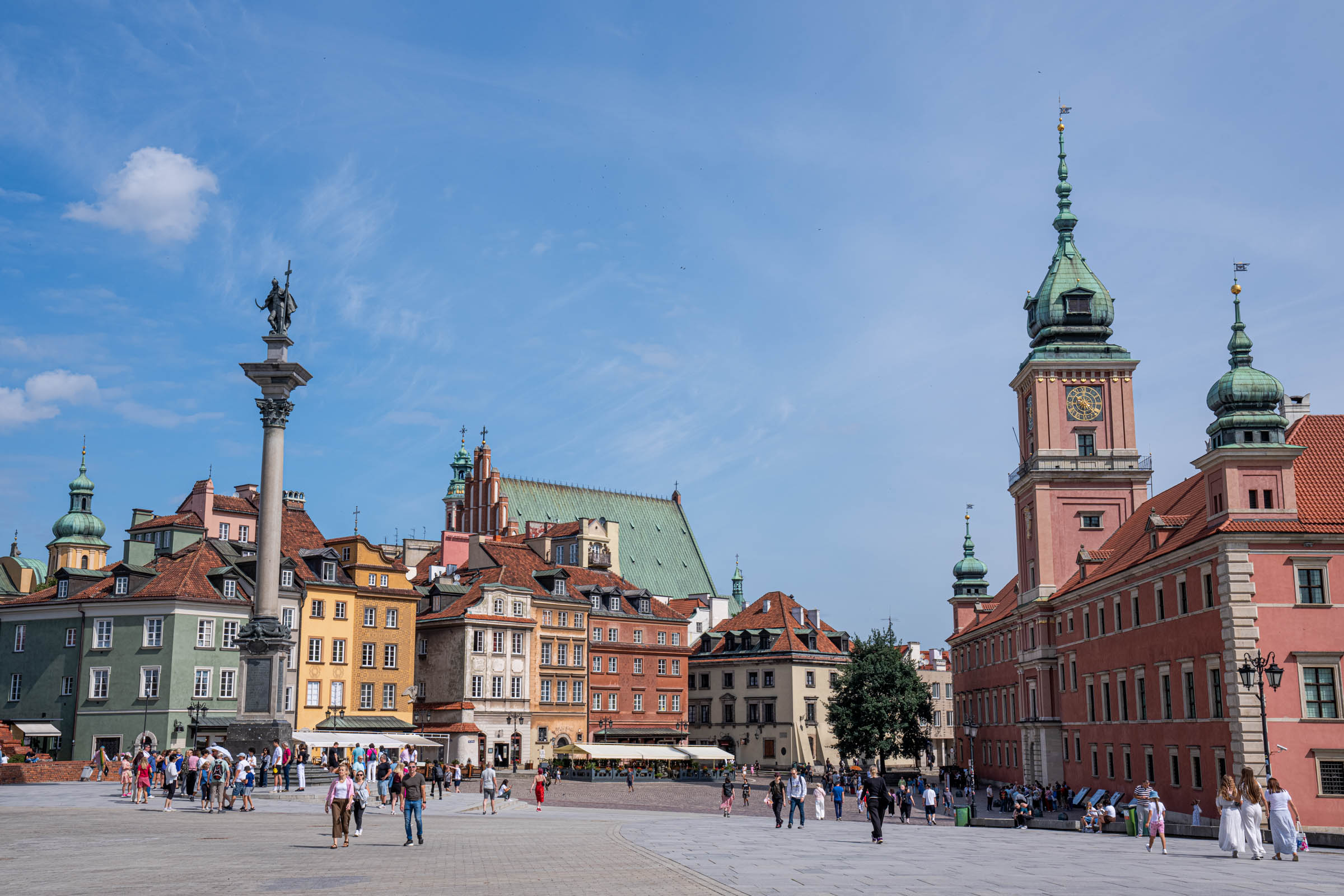
Castle Square is where Warsaw’s Old Town meets the Royal Route. In the middle stands a column with the figure of King Sigismund the Third Vasa, erected in 1644. The founder was his son, King Władysław IV.
It is interesting that it was the first monument of this kind in modern Europe dedicated to a secular figure. The authors of the conceptual solution were Augustyn Locci and Constantino Tencalla, and the model of the figure was made by Clemente Molli. After the war, the pillar was erected again in 1949.
On the eastern side of the square rises the Royal Castle with its distinctive tower and clock. The building was destroyed during the war, and its reconstruction was delayed for decades for political reasons. The castle was rebuilt in the seventies and eighties, and was partially opened to visitors in 1981.
I visited the square twice, during the day and in the evening. It is more beautiful in the evening, because the lighting brings out the colors from the facades. During the summer evenings, large light installations with the name of the city are installed here, around which families gather.

WARSAW BARBICAN: WALKING ALONG THE CITY’S MEDIEVAL WALLS
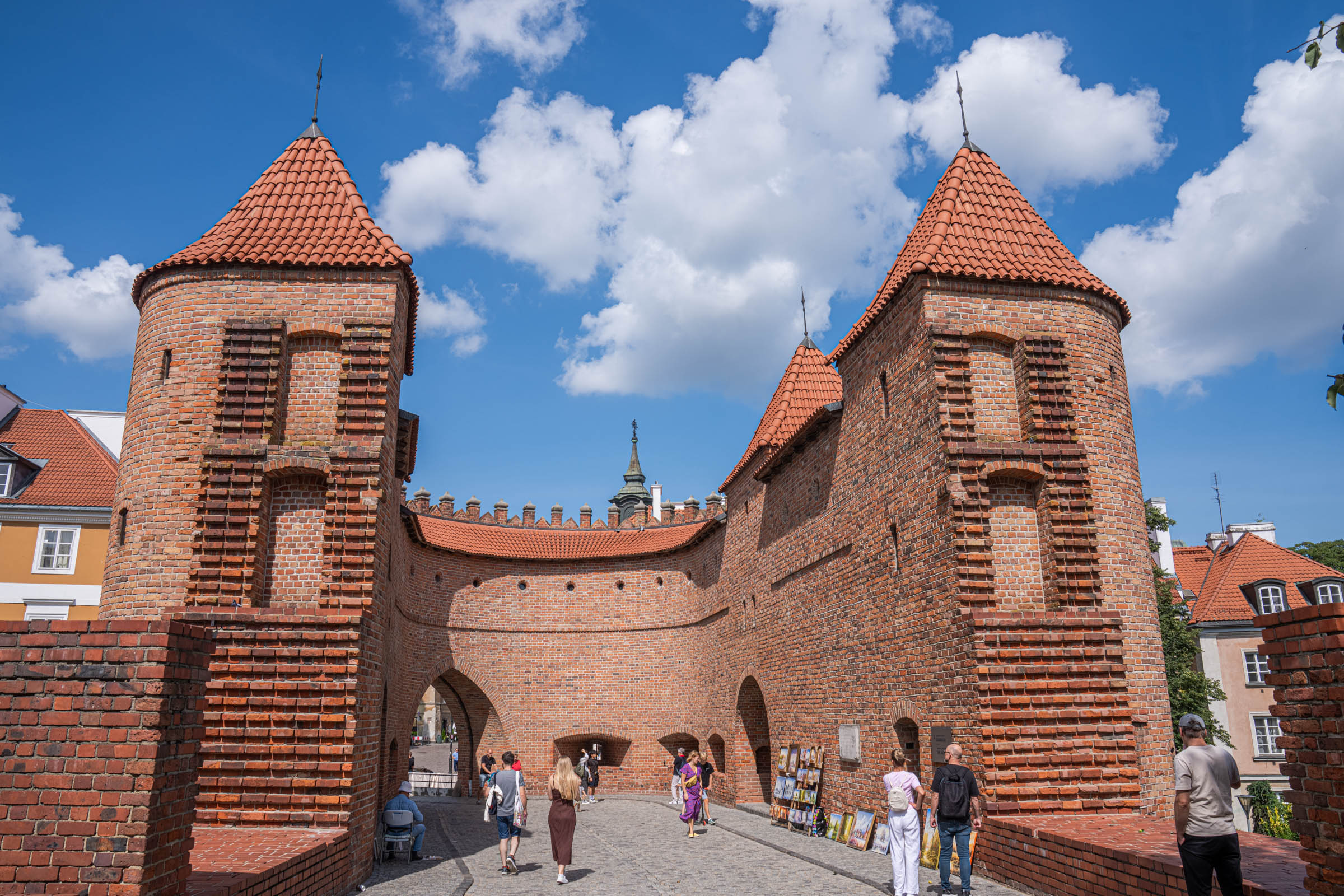
A few minutes north of the Old Town Market Square stands the Barbican, a brick fortification with round towers. It was built in 1548, according to the project of Giovanni Battista of Venice. It was supposed to defend the northern entrance to the city.
The irony is that it almost never served a purpose. It was used more seriously only twice, in 1656 and 1704. Meanwhile, artillery developed faster than walls.
The Barbican was also rebuilt after the war, between 1952 and 1954. The builders relied on graphics from the seventeenth century. The walls still contain original bricks from the sixteenth century.
Take a walk along the path along the walls, along the bottom of the former moat. From below you can see how high the fortification really is. On the way to Podwale, painters exhibit their works, so this is a pleasant place to rest.
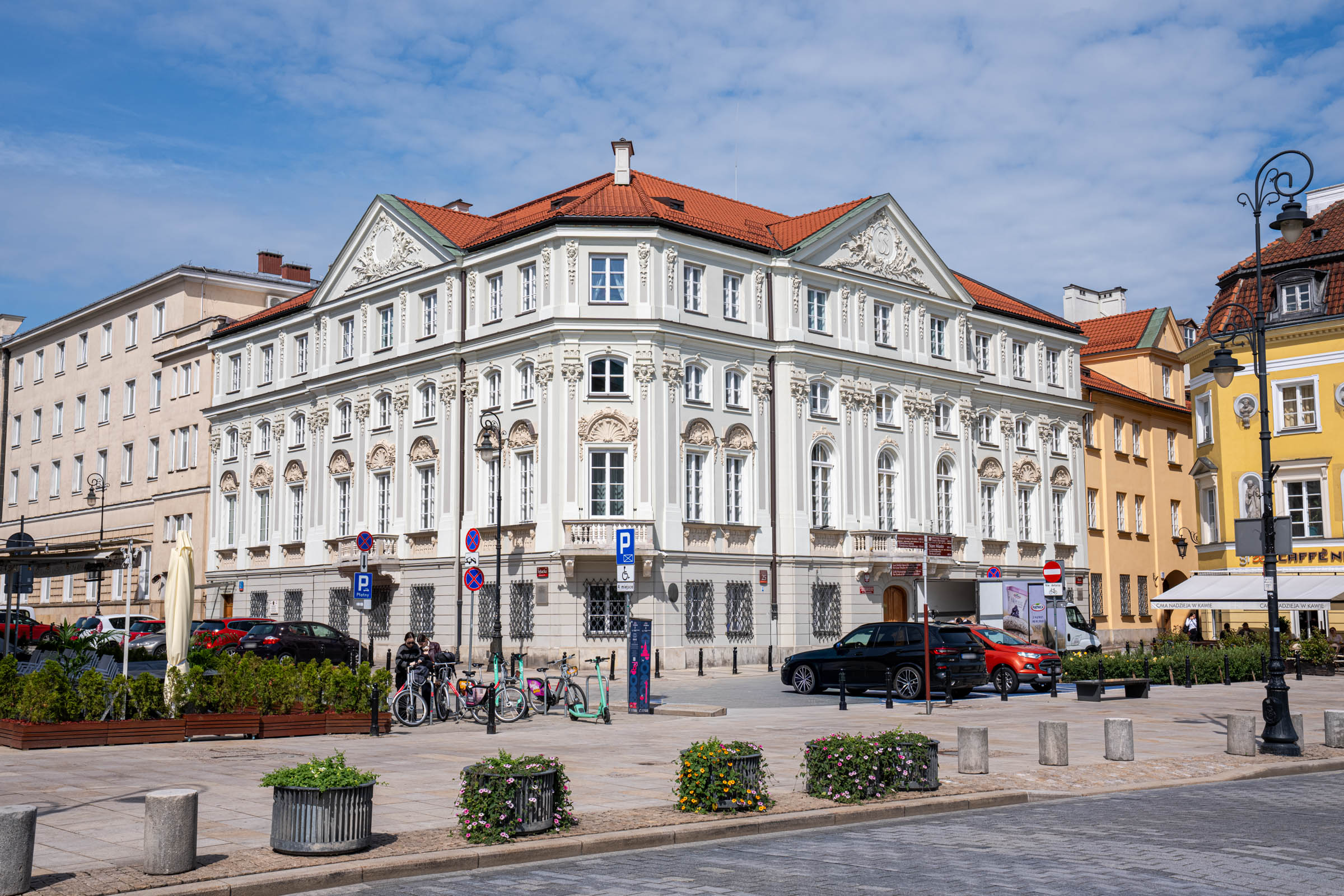

WARSAW’S ROYAL ROUTE: THE MOST BEAUTIFUL WALK IN THE CITY
The royal route is a tract that connects Castle Square with the south of the city. It runs along Krakowskie Przedmieście and Nowy Świat, and continues towards Łazienki and Wilanów. This is a walk I would recommend to anyone.
I left in the morning, coffee in hand. The street is wide, with low buildings and many trees. Every hundred meters you come across a palace, church or monument.
In the evening, Nowy Świat changes completely. The gardens are filling up, the lamps are lit, and people are walking leisurely in the middle of the sidewalk. From one end of the street you can see the tower of the basilica, and from the other the outline of the Castle Square.


CHOPIN’S HEART IN WARSAW: THE STORY BEHIND THE HOLY CROSS CHURCH
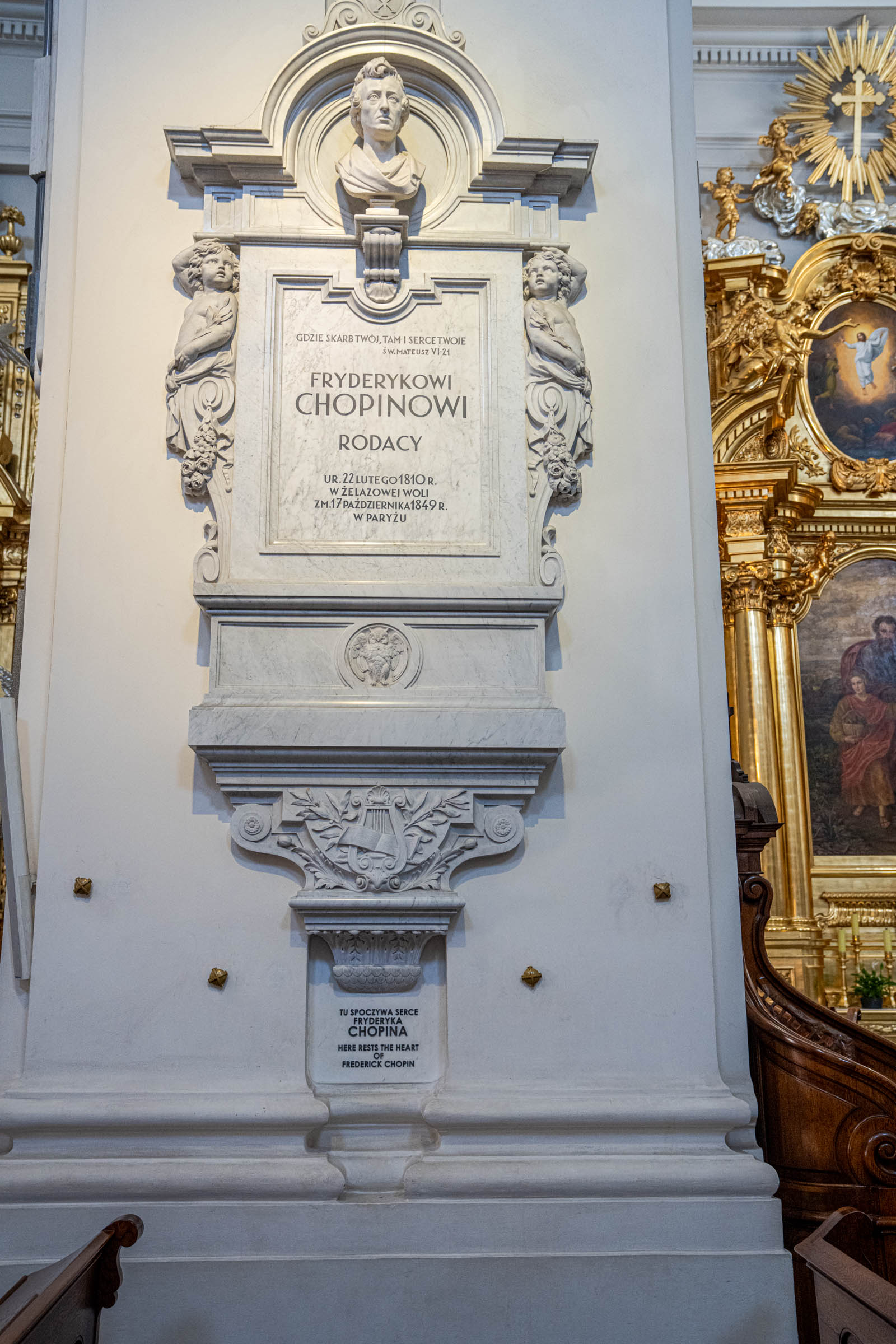
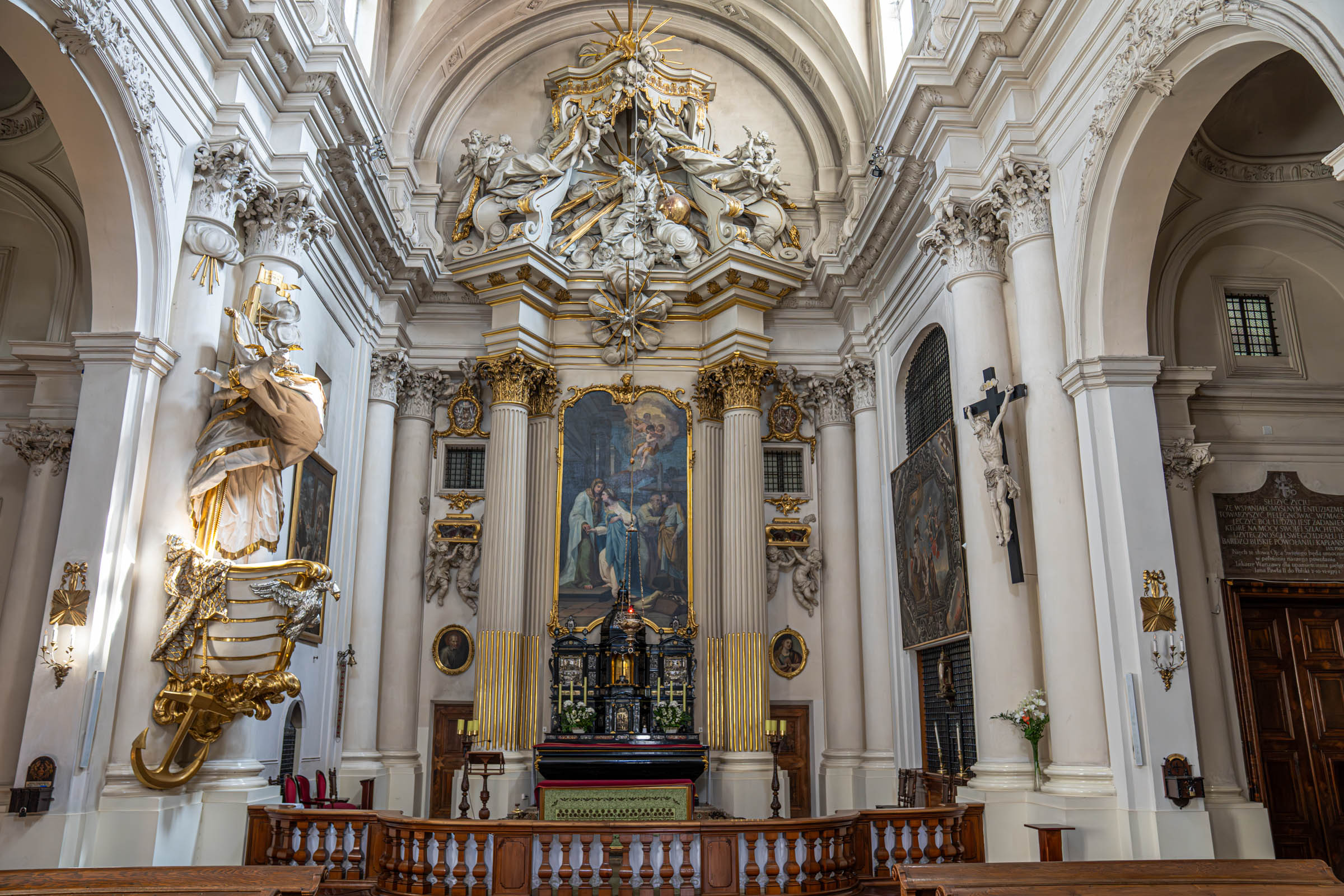
The Holy Cross Basilica on Krakowskie Przedmieście is one of the most important places in Warsaw. An urn with Frederic Chopin’s heart was built into one of the pillars of the main nave. The composer died in Paris, and his last wish was fulfilled by his sister Ludwika.
The white marble epitaph was made by Leonard Marconi, and was unveiled on March 5, 1880. In the same church rests the heart of the writer Władysław Reymont, since 1929. The interior is solemn, with gilded altars and cut glass chandeliers.
In front of the entrance stands a dark figure of Christ carrying a cross, with the inscription SVRSVM CORDA. The scene is powerful and without any knowledge of history. Enter in silence, because this is an active parish church.



WARSAW: COPERNICUS, CHOPIN AND THE UNIVERSITY AT THE HEART OF THE CITY
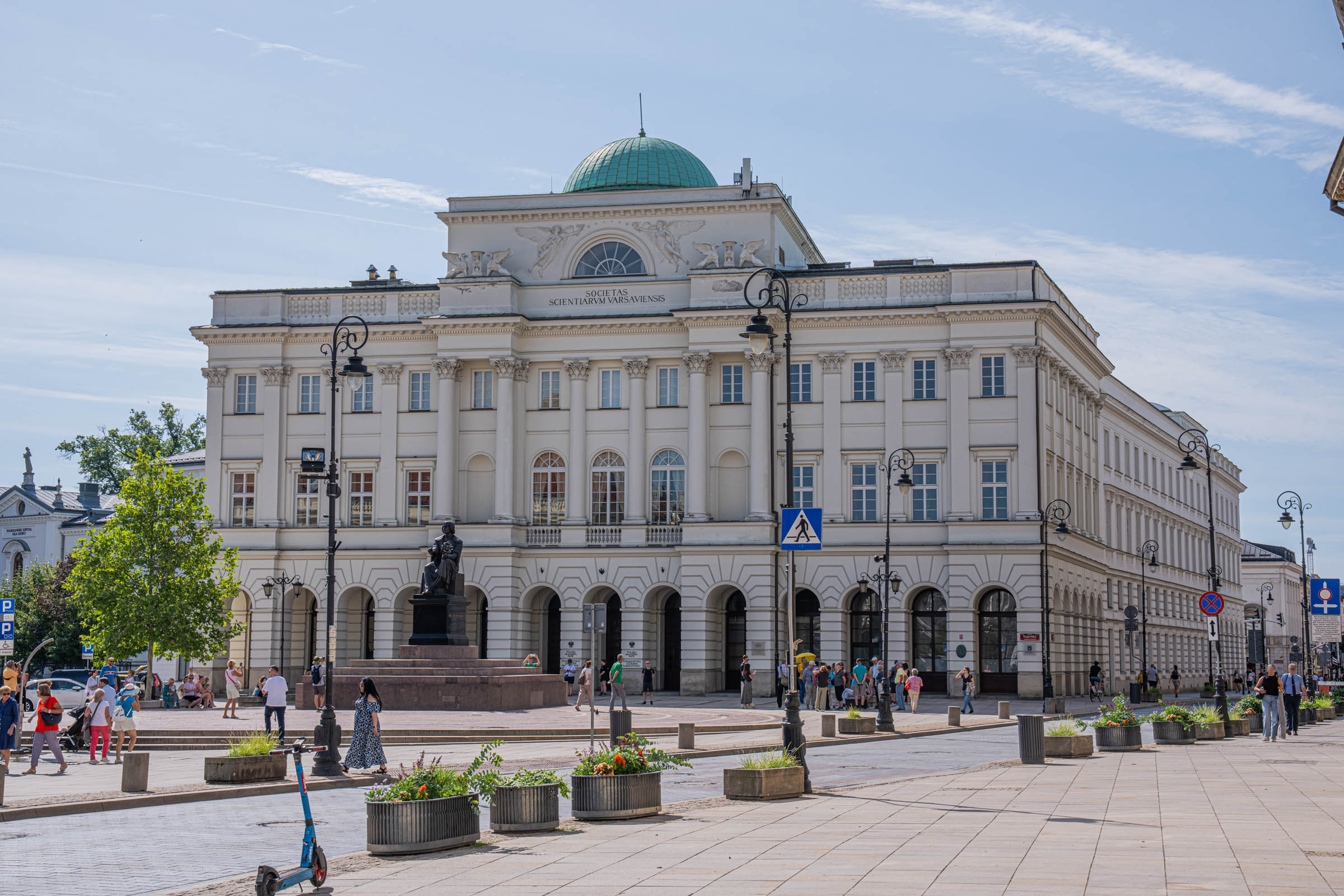
Right next to the basilica is the Staszic Palace with a green dome. In front of it sits a bronze Nicolaus Copernicus with an armillary sphere in his hands. The monument is the work of the Danish sculptor Bertel Thorvaldsen and was unveiled in 1830.
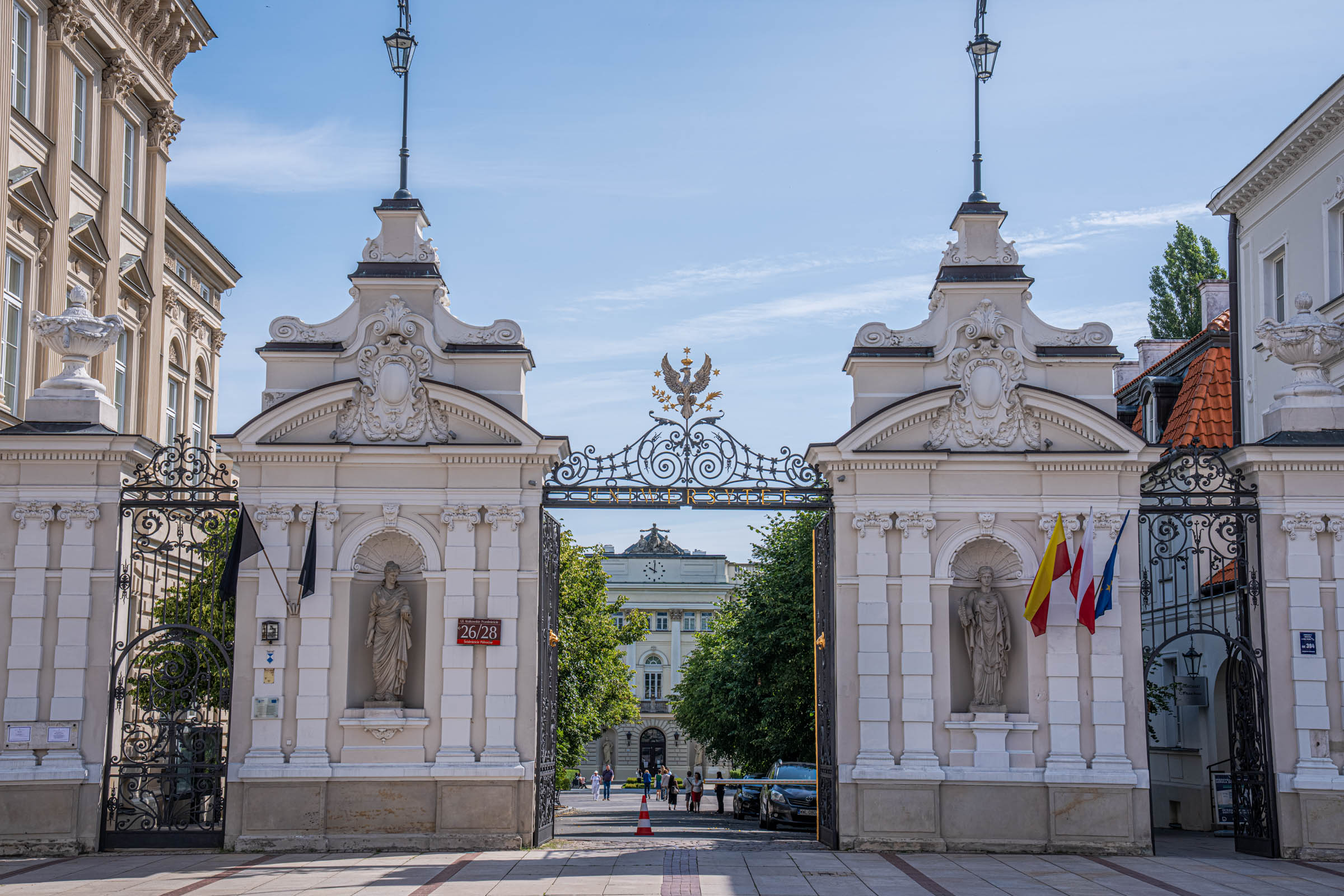
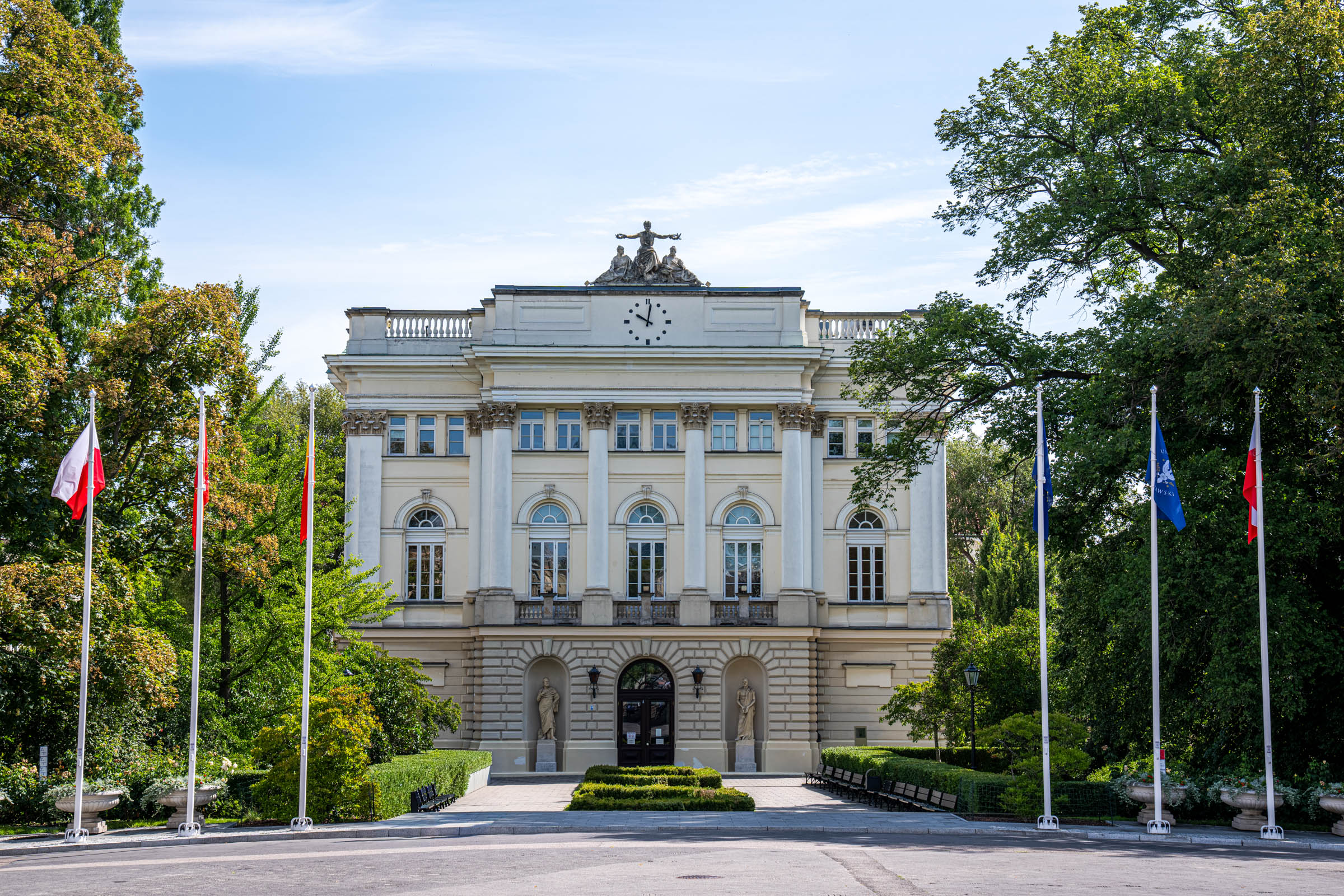
Across the street is the main gate of the University of Warsaw, with a gilded eagle on a forged arch. Behind the gate opens a quiet courtyard with the Casimir Palace, where the university was located in 1817. The Warsaw Lyceum used to be here.
A few steps away is the Church of the Visitation. The young Chopin played on its organ in 1825 and 1826, as a lyceum organist. This church is one of the few in Warsaw that survived the war unscathed.
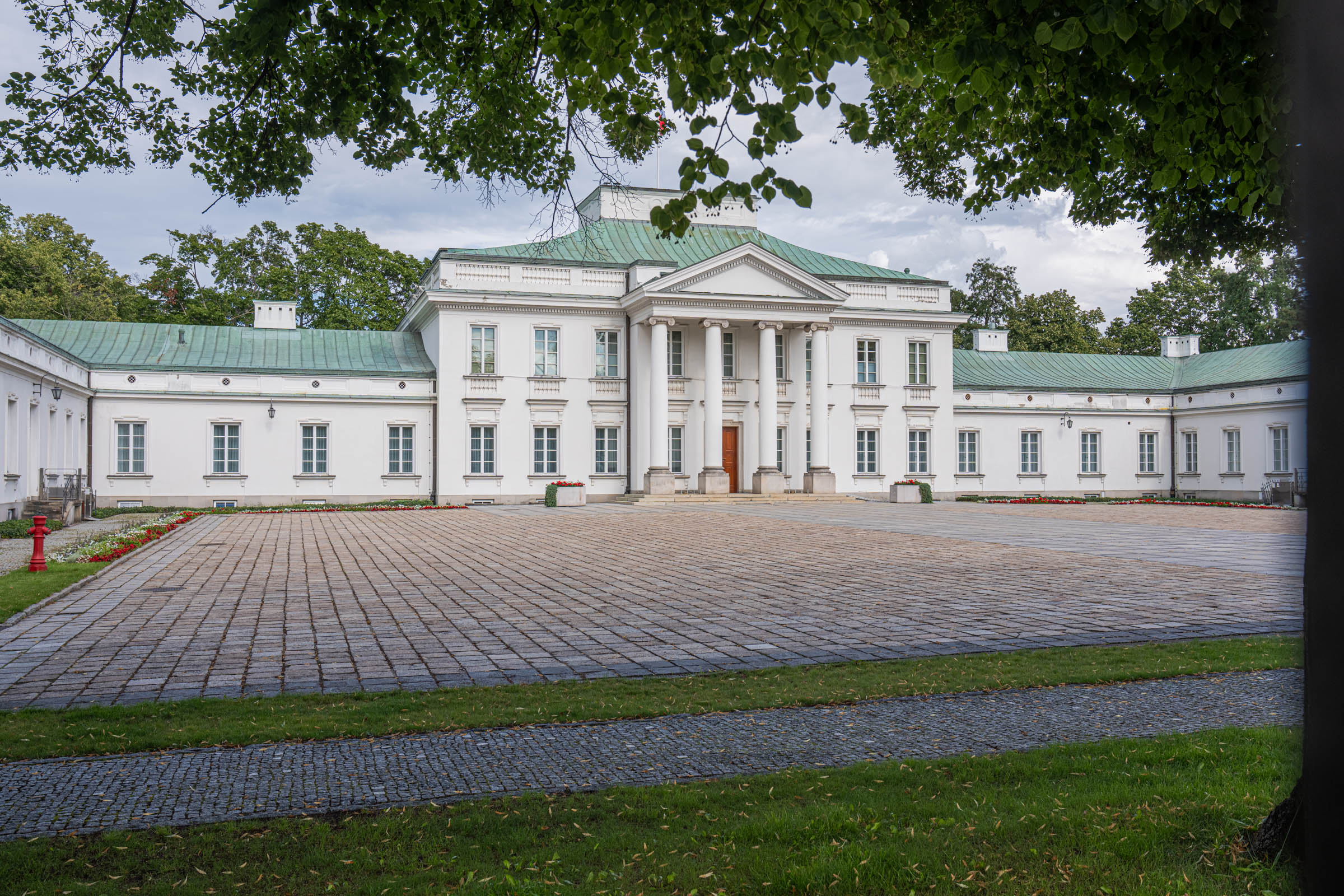
On the same stretch, you will also see the Presidential Palace, in front of which Prince Józef Poniatowski is riding. There is also a monument to Adam Mickiewicz, surrounded by a rose garden. A little further, on Małachowski Square, stands the evangelical church in the form of a rotunda, where the sixteen-year-old Chopin also performed.

WARSAW’S PALACE OF CULTURE AND SCIENCE: THE BUILDING THAT DIVIDES THE CITY
No building evokes as many different feelings as the Palace of Culture and Science. Construction began on May 1, 1952, and the building was handed over on July 21, 1955. It was a gift of the Soviet Union to the Polish people.
It was designed by the Soviet architect Lev Rudnev, based on the Moscow towers. With the antenna support, it is 237 meters high and has 42 floors. Inside there are more than three thousand rooms, theaters, museums, a cinema and a swimming pool.
The lookout point is on the thirtieth floor, at a height of 114 meters. From there you can see almost the whole city, including the new business towers. An old Warsaw joke says that it is the most beautiful view in the city, because it is the only place from which the palace itself cannot be seen.
For many Poles, this building remains a symbol of foreign rule. For others, it is simply part of the city’s identity, locals nicknamed it Pekin, the Polish word for Peking. In 2007, it was entered into the register of cultural monuments, which caused a new debate.
I photographed it from several sides, and the best angle is the one from the Parade Square (Plac Defilad) in the late afternoon. Then the light falls obliquely and highlights the stone details.


WARSAW’S NEW SKYLINE: GLASS, HEIGHT AND AMBITION
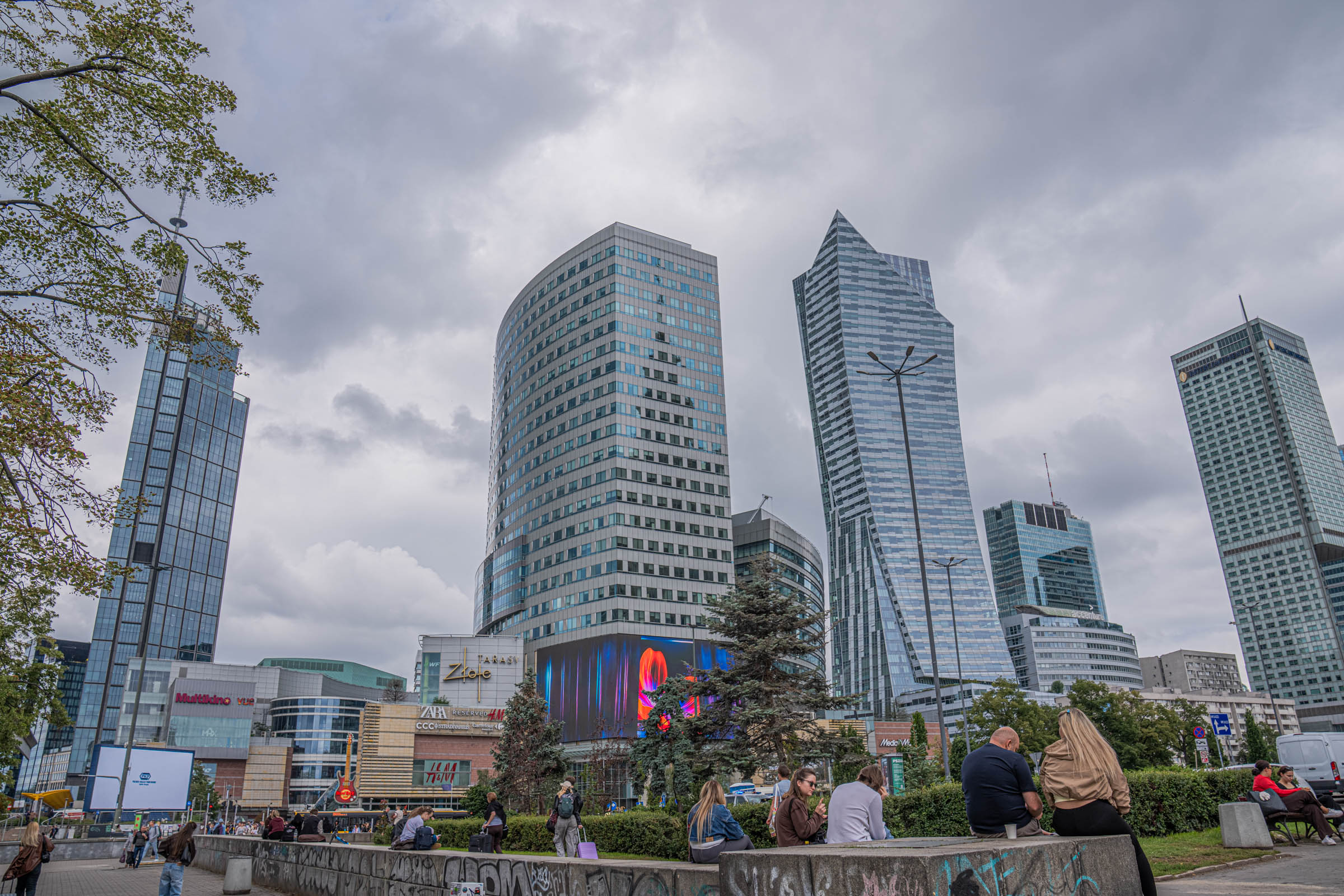
A veritable grove of skyscrapers has been built around the palace in recent years. The tallest is Varso Tower, at 310 metres including the spire. It is currently the tallest building in the European Union, and it was designed by Foster and Partners.
Not far from there stands Złota 44, a residential tower with an unusual shape. Its author is Daniel Libeskind, and the building is 192 meters high. Many people see a sail in its outline, so they call it that.
Around the Rondo ONZ and the Złote Tarasy shopping center, everything is modern and busy. Here you will see another Warsaw, the business one. For me, this contrast was one of the most interesting parts of the trip.
A few steps away, near the Three Crosses Square, there are also shops of large fashion houses. The neighborhood around Mokotowska Street is full of independent boutiques and cafes. If you love fashion, stay here for at least half a day.
ŁAZIENKI PARK, WARSAW: A ROYAL OASIS IN THE HEART OF THE CITY
Łazienki is my favorite place in Warsaw. This park occupies about 76 hectares and is the former summer estate of King Stanisław August Poniatowski. Today it is an open-air museum complex.
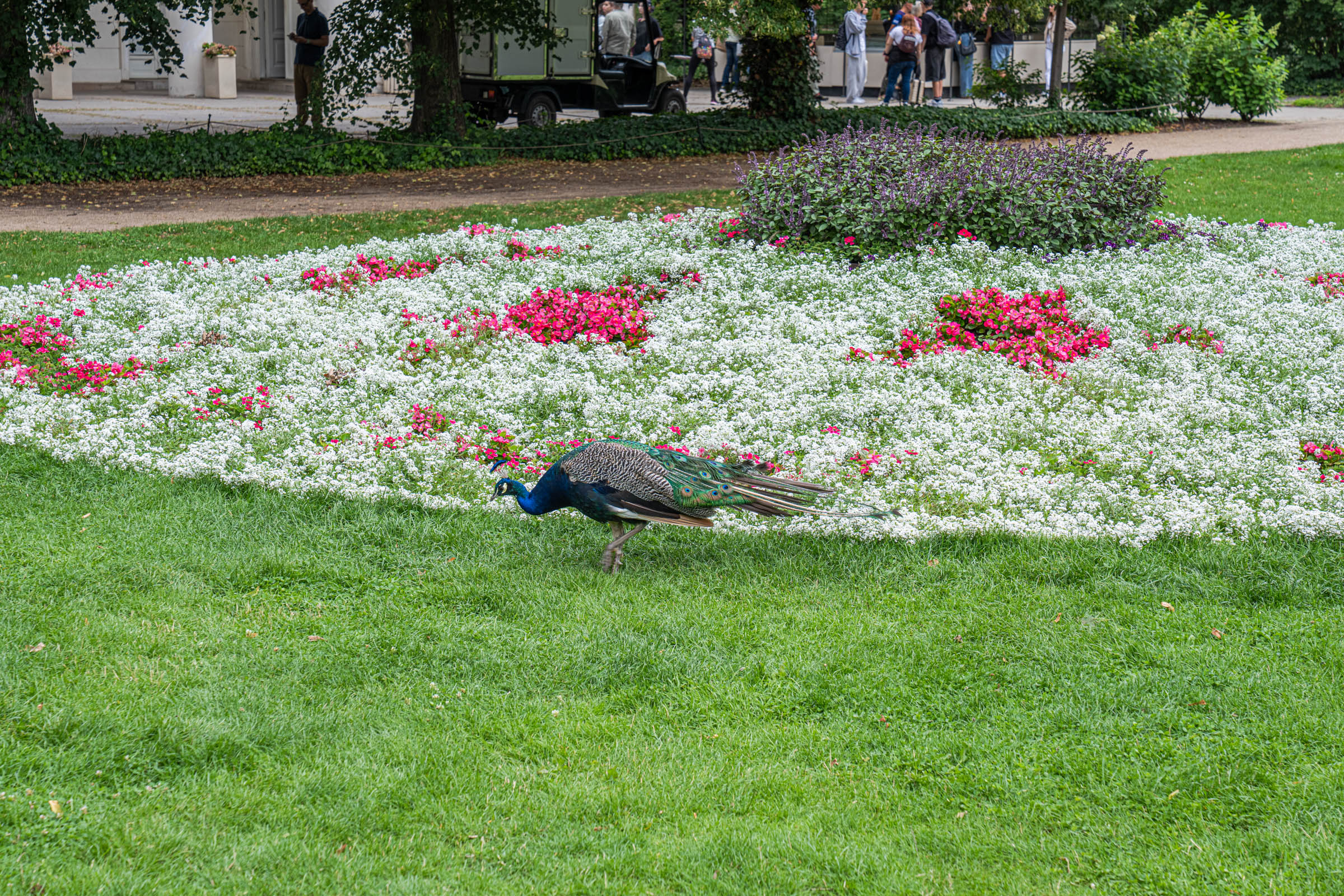
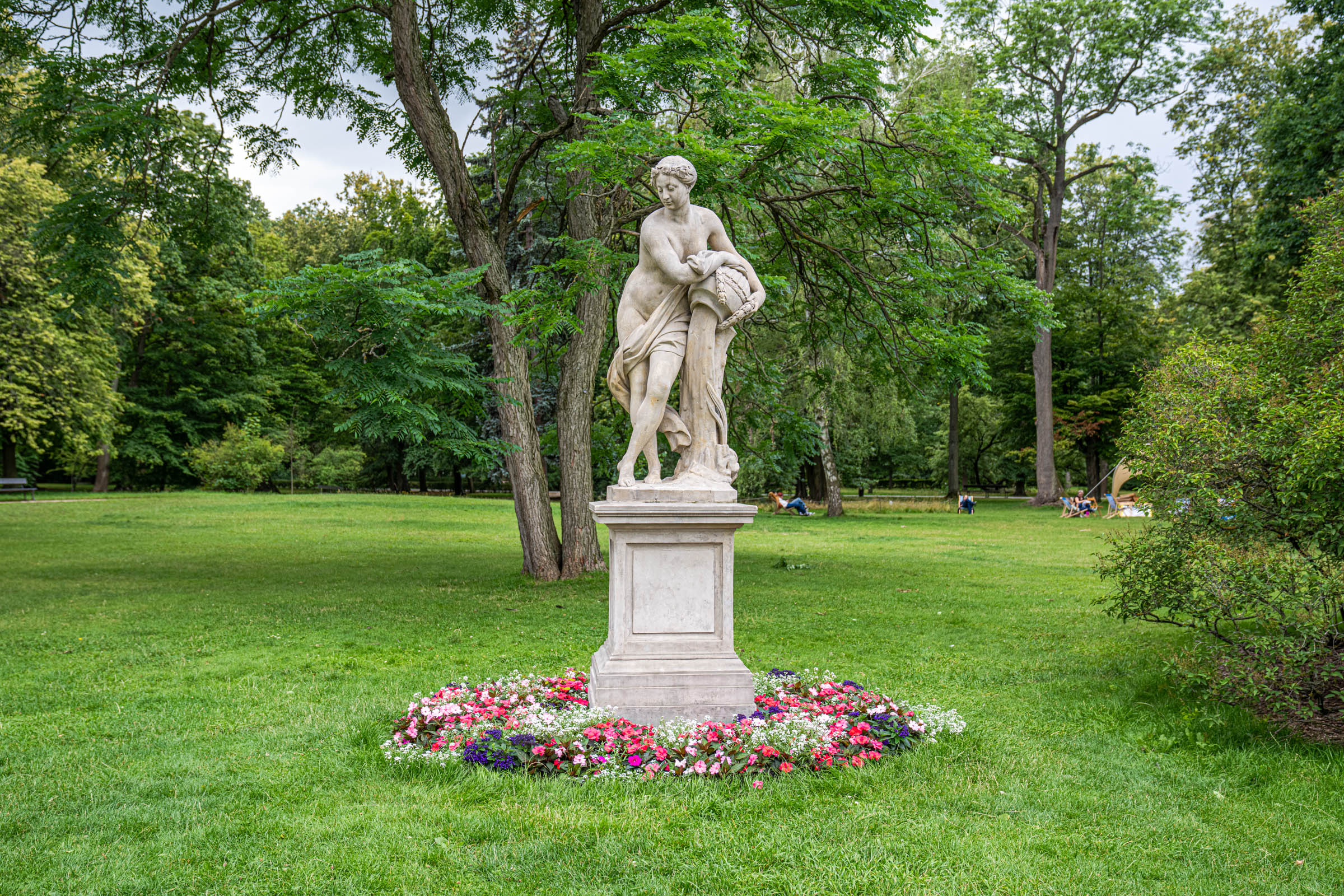
I entered through the gate from Aleje Ujazdowskie and immediately slowed down. Paths lead past lakes, bridges and sculptures. Peacocks walk the lawns as if they have been hired.
The park is so big that it’s easy to get lost, and in the most beautiful way. Allow half a day for a leisurely tour. Bring water and comfortable shoes.


CHOPIN CONCERTS IN WARSAW: MUSIC UNDER THE OPEN SKY OF ŁAZIENKI PARK
The most famous monument in the park is dedicated to Frederic Chopin. The composer sits under a stylized willow whose branches resemble a pianist’s hand. It is the work of sculptor Wacław Szymanowski and was unveiled in 1926.
The Germans destroyed the monument already in 1940, as one of the first in the city. A faithful reconstruction was placed in the same place in 1958. Since then, free weekly concerts have been held under it, from May to the end of September.
If you are traveling in the summer, coordinate your arrival with a Sunday. People sit on benches and blankets around the pond. The atmosphere is relaxed and the music is excellent.

WARSAW’S ŁAZIENKI PARK: PALACES, ORANGERIES AND PEACOCKS
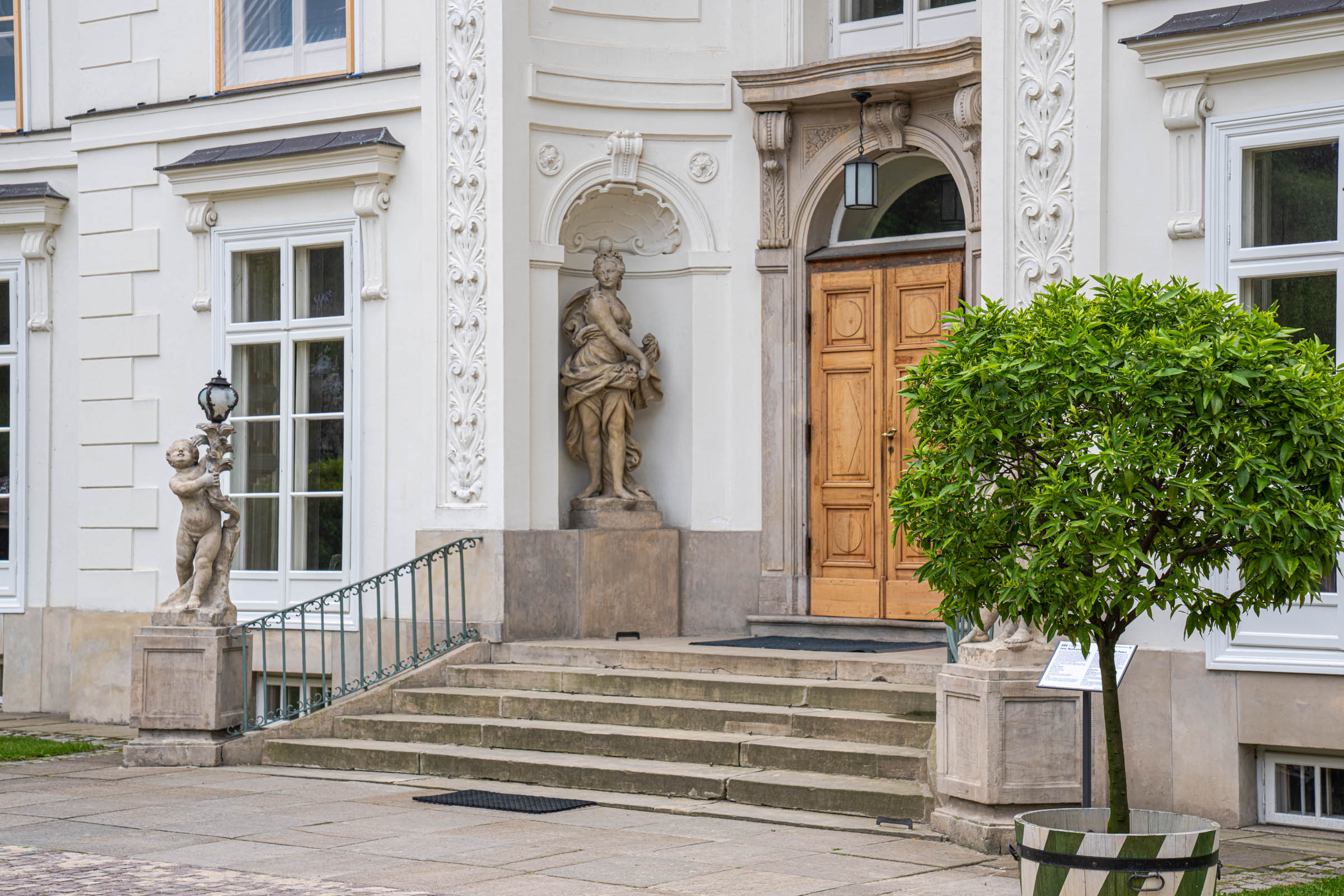
There are close to forty buildings in the park, ten of which have great historical value. The old orangery with a series of arched windows houses a collection of sculptures and a historic court theater. In front of it are statues on high pedestals.
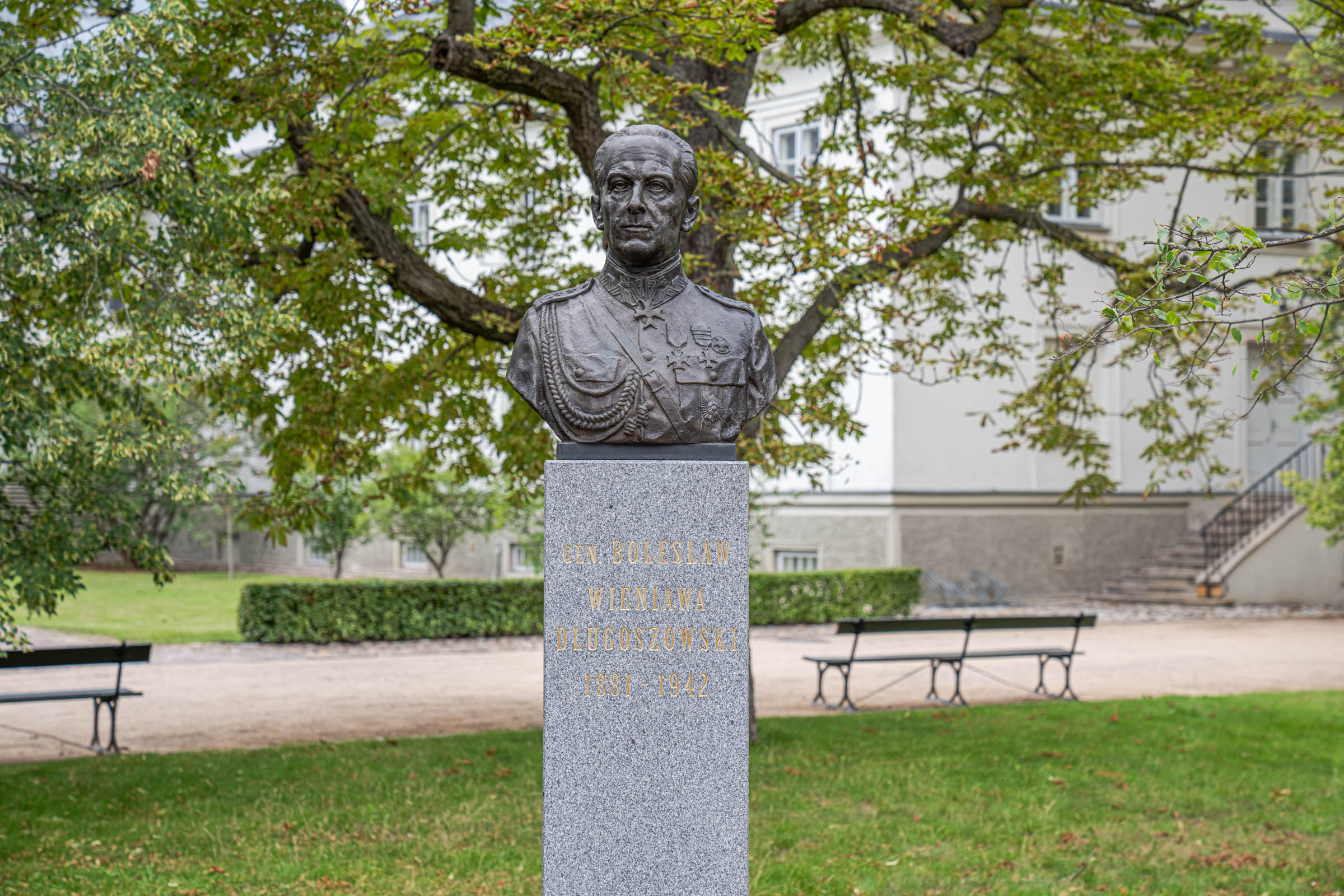
The Myślewicki Palace with rounded wings seems intimate and warm. Not far from there is the White House, and through the green you can see the Belweder with the Polish flag on the roof. In the park you will also find a bust of General Bolesław Wieniawa-Długoszowski.
The most beautiful scene for me was the one from the pond towards the Belweder. The meadow climbs up the slope, and the white facade peeks out between the treetops. I spent twenty minutes there without a single photo.


WILANÓW PALACE: THE POLISH VERSAILLES IN WARSAW
The Wilanów Palace is about ten kilometers from the center. It was built between 1677 and 1696 for King Jan III Sobieski and his wife Maria Casimir. The project was led by Augustyn Locci, and the side wings were added between 1723 and 1729.
The palace survived the wars in better condition than most Warsaw buildings. Today, it houses the Museum of the Palace of King Jan III. In 1994, the entire complex was declared a historical monument.


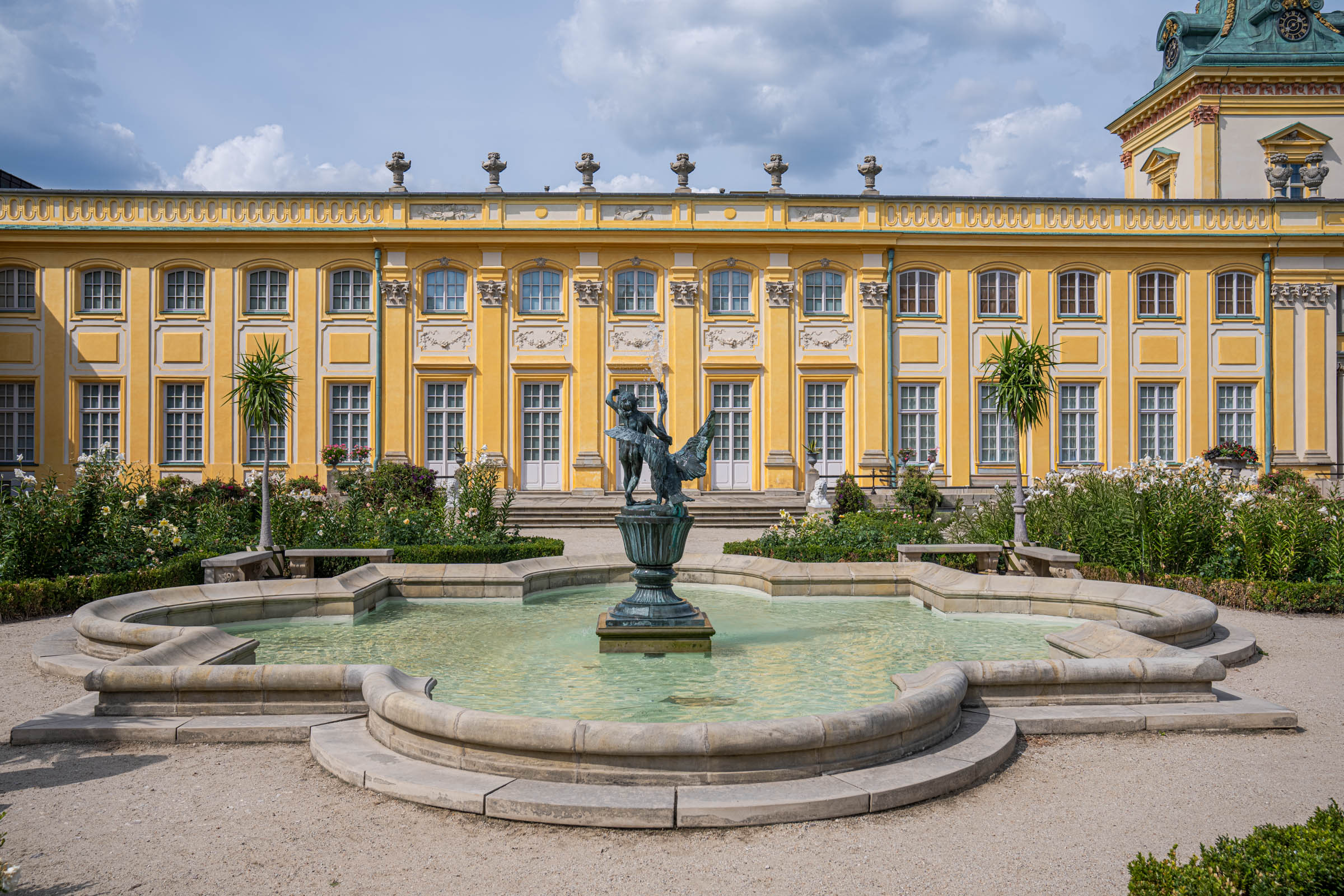
The facade is yellow, with white reliefs, golden details and clocks on the towers. Behind the palace are baroque gardens with fountains, a rose garden and strictly trimmed hedges. Modern sculptures are placed between the green walls, which works unexpectedly well.
For me, Wilanów was the most beautiful afternoon of the trip. The crowd is less than in the center, and the space is huge. Allow three to four hours for a tour of the palace and gardens, including travel.
The easiest way to reach Wilanów is by city bus from the Royal Route. The drive takes about half an hour, depending on traffic. Tickets for the gardens and the interior are purchased separately, so check opening times before you go.


THREE CROSSES SQUARE: A GLIMPSE INTO MY WARSAW NEIGHBORHOOD
I stayed at Three Crosses Square, and it turned out to be a great decision. The square is one of the most prestigious places in the city, at the very beginning of Nowy Świat street. Almost everywhere can be reached on foot from here.
In the middle of the square stands the church of St. Alexander, built between 1818 and 1825. It was designed by Chrystian Piotr Aigner, based on the Roman Pantheon. After war destruction, it was rebuilt between 1949 and 1952, in its original classicist form.
Around the square are ministries, embassies and boutiques of world fashion houses. There are cafes on the corners that smell of fresh pastries in the morning. I walked about thirty minutes to the Old Town, and fifteen to Łazienki Park, or the Royal Baths Park.


SHERATON GRAND WARSAW: MY BASE FOR EXPLORING THE CITY
I stayed at the Sheraton Grand Warsaw Hotel, on Bolesława Prusa Street number two. The building was designed between 1994 and 1996 by Tadeusz Spychała and Piotr Szaroszyk. The hotel was officially opened on September 22, 1996, and it welcomed its first guests already in May of that year.
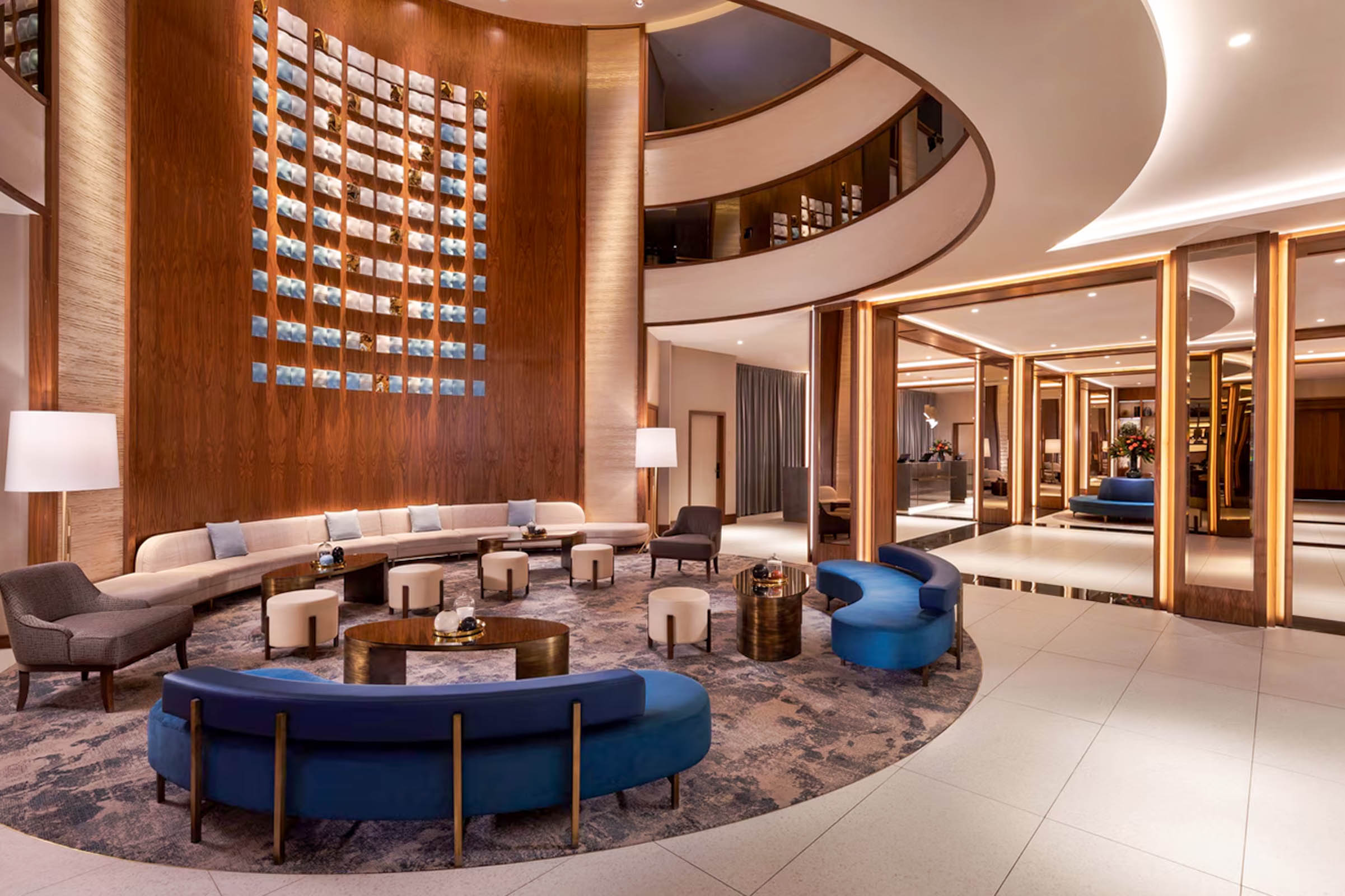
Today, this five-star hotel has 350 rooms and suites. The interiors were designed by London-based architect Alex Kravetz, and it is immediately noticeable. The hall is spacious, with wooden panelling, rounded sofas and soft lighting.
SHERATON GRAND WARSAW: INSIDE MY EXECUTIVE SUITE
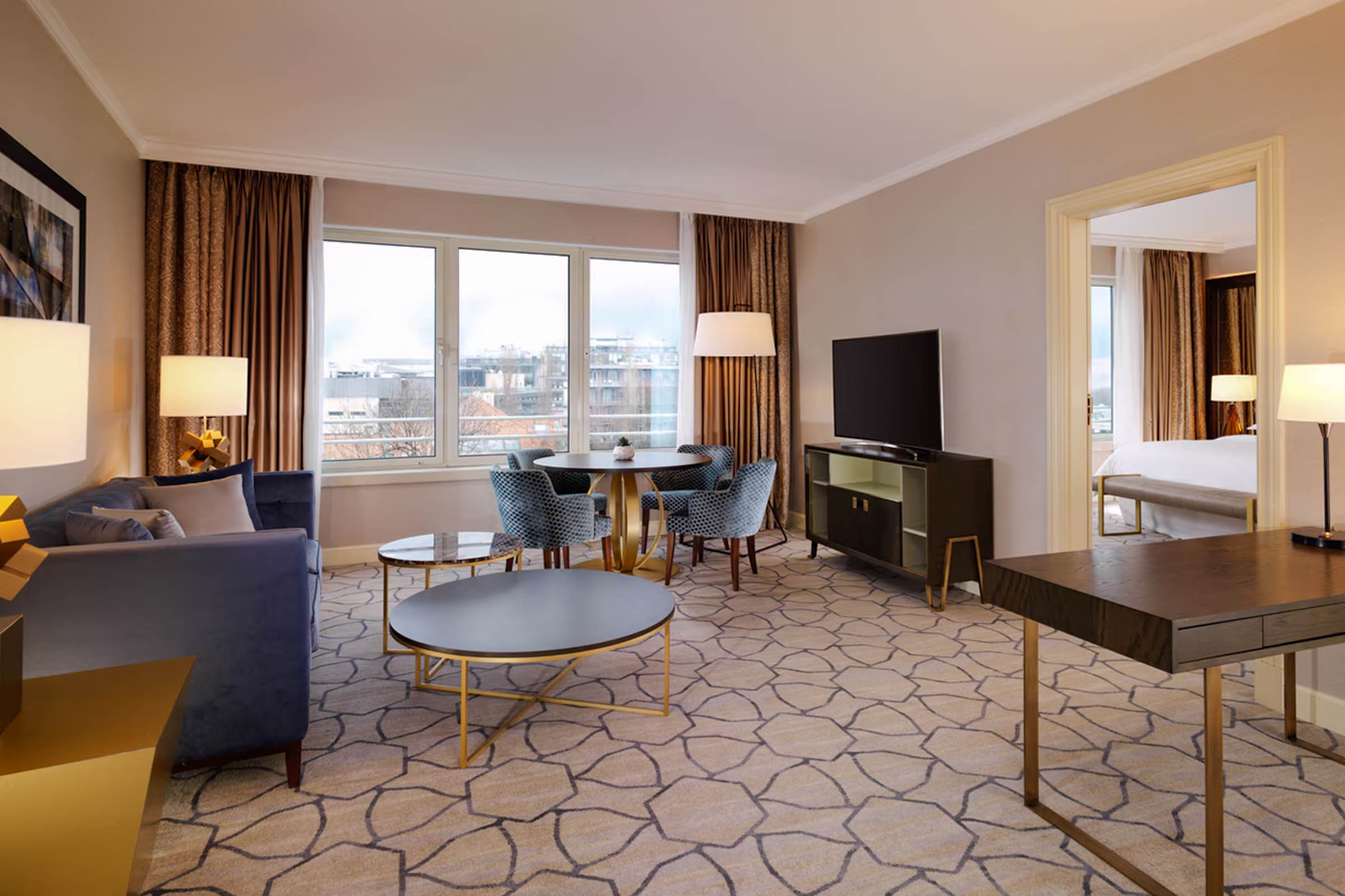
I stayed in the Executive Suite and I can say that the space is its biggest advantage. The apartment is divided into a living room and a bedroom, with a door between them. In the living area there is a sofa, a dining table for four people and a real desk.
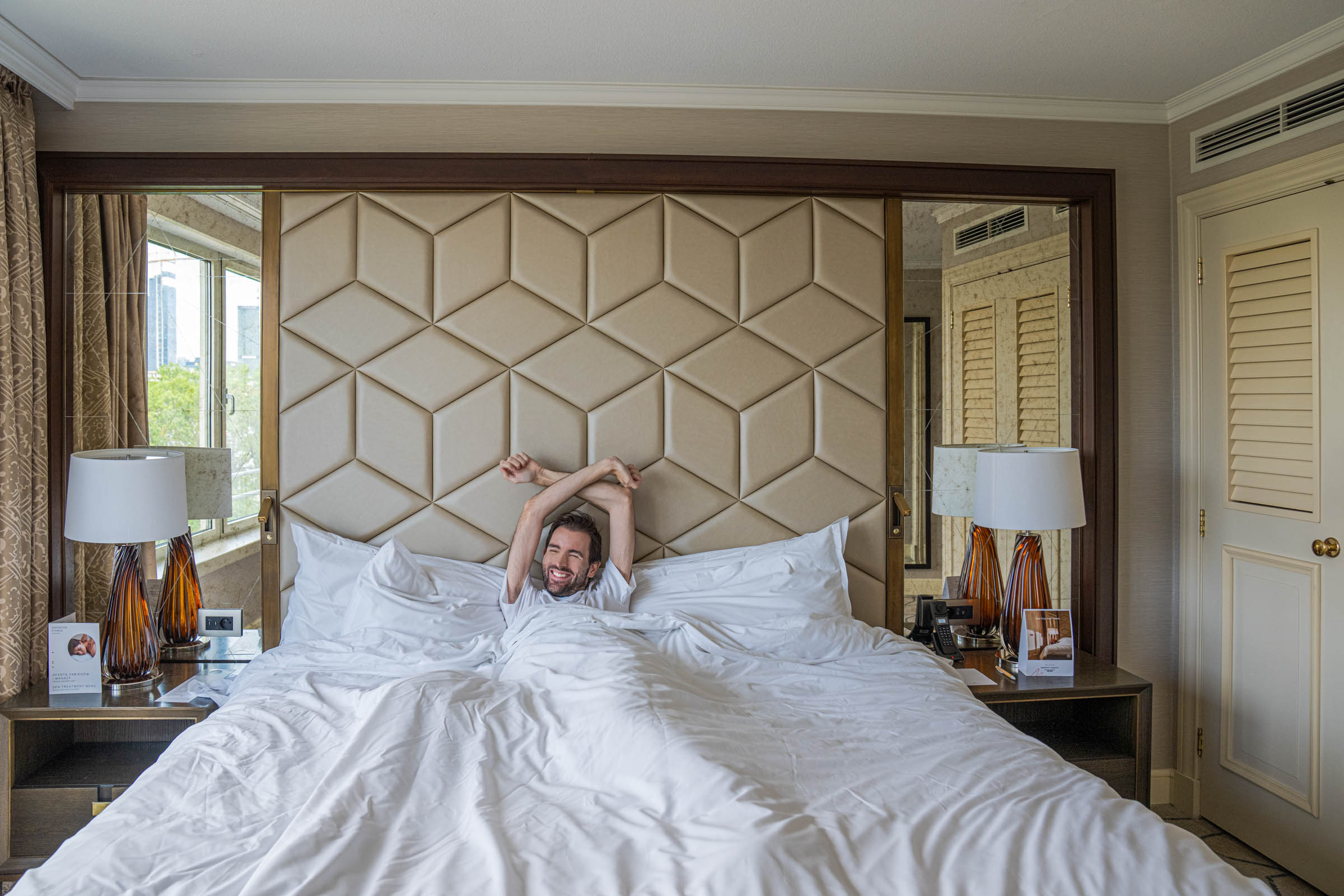
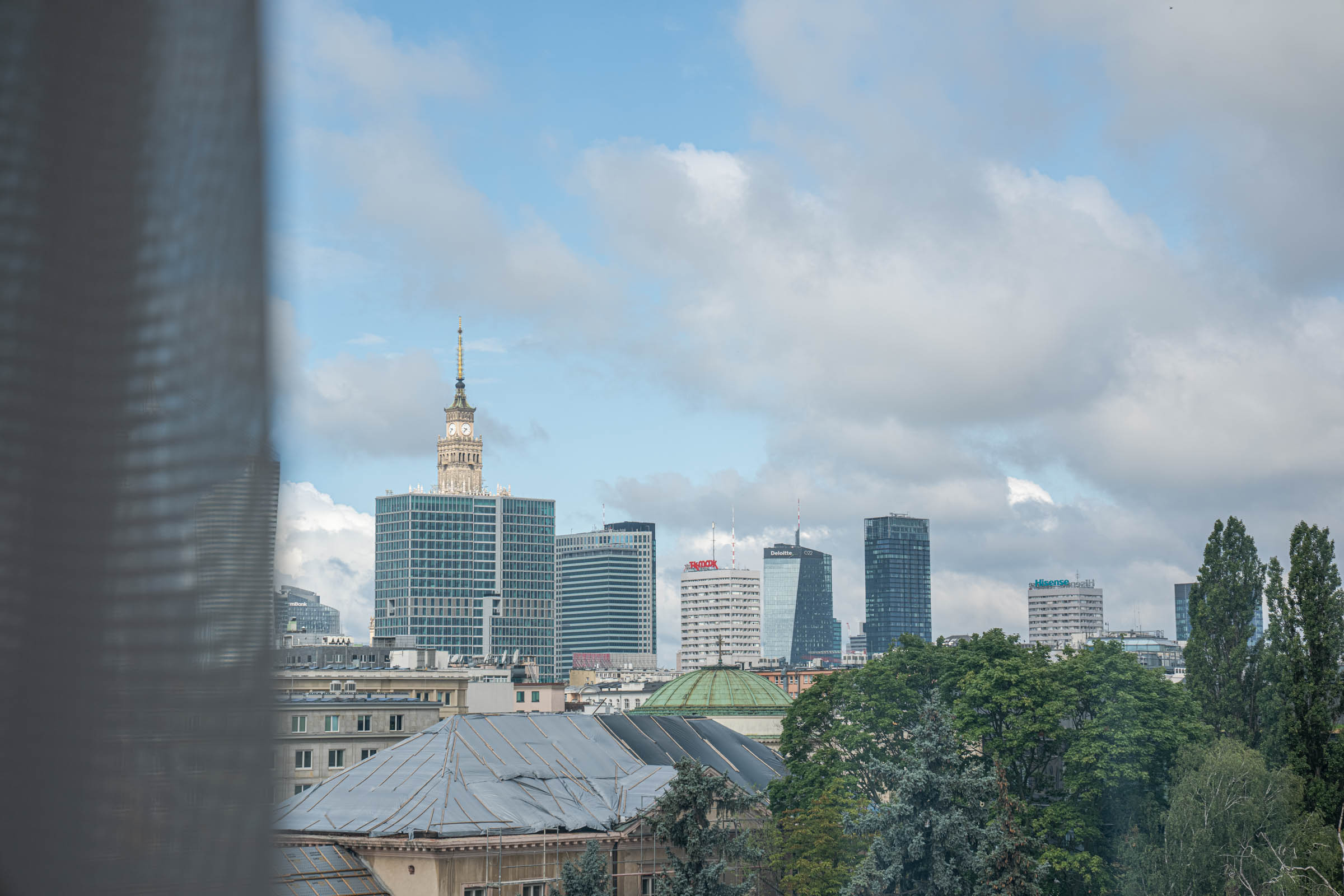
The bedroom has a king-size bed, an upholstered wall covering behind the headboard and a mirror to the side. The windows go almost to the floor, so you have a lot of light in the morning. From my side I could see the roofs and the tower of the Palace of Culture and Science.
The bathroom is classic, with a bathtub and a separate shower. It’s not the most modern I’ve seen, but it’s impeccably maintained. The bedding and mattress deserve a special mention, as I slept great all four nights.


SHERATON GRAND WARSAW: BEAUTY OF THE CLUB LOUNGE ON THE SIXTH FLOOR
The club lounge is located on the sixth floor and is the real reason to take this room category. Throughout the day there are hot and cold drinks, fruit and small snacks. In the early evening, a cold dinner is served with several hot side dishes.
The space is quiet, with comfortable armchairs and a view of the city. The staff remembers the guests on the second day. For me, it was the perfect spot for a morning coffee before heading out.
SHERATON GRAND WARSAW: DINING AT INAZIA AND CUCINA MIA
The hotel has two restaurants and I had the opportunity to enjoy both. Cucina Mia is open all day and offers Italian cuisine, from made-to-order breakfast to dinner. The atmosphere is relaxed, suitable for a business lunch.
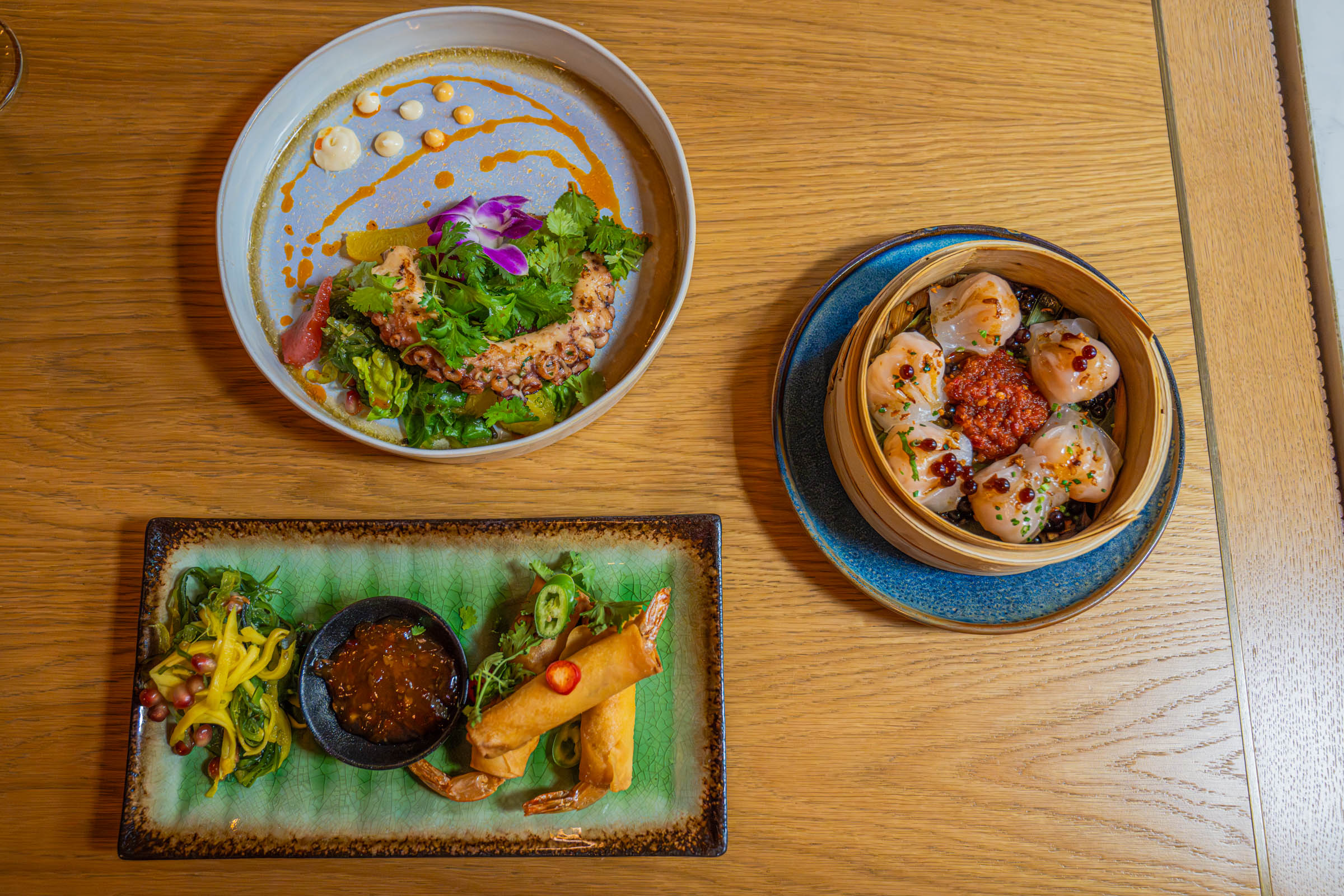
inAzia is an evening restaurant of Asian cuisine and its trump card is the cuisine of chef Marcin Sasin. The emphasis is on seafood and meat from the robata grill. I had octopus salad, dim sum steamed in a bamboo basket, and prawn spring rolls.
All three items were perfectly seasoned and beautifully served. The prices are at the level of a five-star hotel, but the quality-price ratio is fair. Reserve a table in advance, as the restaurant is also used by guests outside the hotel.
WHAT TO EAT IN WARSAW: THE POLISH DISHES YOU NEED TO TRY
Polish cuisine is generous and affordable. Pierogi are a must, whether filled with potato and cheese or with meat. You will find them in restaurants on the Old Town Market Square and in small bars outside the center.
Also try żurek, a sour soup that is sometimes served with bread. Bigos, a cabbage and meat stew, is perfect for colder days. Meat lovers will order kotlet schabowy, breaded and thinly battered.
For dessert, there is a pączki, a donut filled with rose jam. Coffee is a serious topic in Warsaw, and the offer of special cafeterias is surprisingly good. You will find the best addresses on Krakowskie Przedmieście and in the Powiśle district.
In the evening, it is worth crossing the Vistula and seeing Praga. That part of the city was not destroyed in the war, so it has a different character. There are also many young restaurants and bars.


WARSAW TRAVEL TIPS: EVERYTHING YOU NEED TO KNOW BEFORE YOU GO
BEST TIME TO VISIT WARSAW: WHEN SHOULD YOU GO?
I was at the end of summer and the weather was changeable. There were both sun and clouds, sometimes in the same hour. That’s why I recommend a light jacket even in August.
May, June and September are the best months in my opinion. The parks are in full bloom then, and the crowds are tolerable. Winter can be harsh, but December brings beautiful holiday markets.


HOW MANY DAYS DO YOU NEED IN WARSAW?
Three days are enough for a basic tour. For a calm rhythm, as I had, count four to five days. A trip to Wilanów and half a day in Łazienki allows for that much time.
If you only have a weekend, choose the Old Town, the Royal Route and the observation deck at the Palace of Culture. Leave the rest for next time. You can’t get around the city in one sitting anyway.
HOW TO GET AROUND WARSAW: THE BEST WAYS TO EXPLORE THE CITY
Warsaw has a metro, trams and buses, and they all work reliably. Tickets are valid for all means of transport, and timed tickets are the most cost-effective. Route planner apps work great in English too.
The center of Warsaw is still the best for walking. It took me about half an hour’s easy walk from the Three Crosses Square to the Old Town. Frédéric Chopin Airport is connected to the center by train and bus, and the journey takes a short time.
A few more little things that help. Card payment is accepted almost everywhere, so cash is not necessary. Museums have days with free entry, but check the dates on the website before arriving.

WHY WARSAW IS WORTH VISITING: THE CITY THAT DESERVES YOUR ATTENTION
Warsaw surprised me in a way that I rarely experience. I expected a gray, business town without a soul. I got a capital that has both history and energy, and doesn’t pretend to be important.
What remains the longest is not any single building. The feeling remains that this city refused to disappear. People raised it from the ruins because they could not imagine life without it.
That’s why every renovated facade here means more than it seems. It is not just a copy of the old one. It is proof that a city can be more stubborn than war.

The Sheraton Grand Warsaw proved to be the perfect starting point for such a trip. A hotel that offers the comfort of urban life located in the heart of the city on a square that itself is witness to a renewal. If you are planning a trip to Warsaw, feel free to put this address at the Three Crosses Square at the top of your list.
This was another letter from Poland. The next one is coming soon, and until then follow me on Instagram for more scenes from the capital that built itself. I will definitely come back again, because this city quietly but surely finds its way to your heart!
With Love from Warsaw,
Mr.M


This post is sponsored by the United Nations World Tourism Organization (UN Tourism) and the Sheraton Grand Warsaw hotel, as well as other local partners who selflessly supported this project. This post is my personal and honest review of the destination experience.
Hello Marko, I have been following your travel writing for quite some time, and this may be one of your most convincing destination pieces yet. I visited Warsaw briefly in 2019 and remember leaving with the impression that I had not given the city enough time. Your explanation of how the reconstruction changes one’s perception of the Old Town brought that feeling back immediately. I particularly appreciated that you did not present Warsaw as another postcard-perfect European capital, but as a city whose character needs to be understood gradually. The contrast between the historical streets and the modern skyline is… Read more »
Hallo Marko, ein wirklich außergewöhnlich ausführlicher Reisebericht, der mir Lust gemacht hat, Warschau noch einmal zu besuchen. Ich war vor etwa drei Jahren dort und habe damals im InterContinental Warszawa übernachtet, vor allem wegen des beeindruckenden Blicks über die moderne Skyline. Dein Aufenthalt im Sheraton Grand Warsaw zeigt jedoch eine ganz andere Seite der Stadt, besonders durch die Lage am Plac Trzech Krzyży. Diese Gegend hatte ich damals leider viel zu wenig erkundet. Besonders interessant fand ich deine Beobachtung, dass Warschau seine Schönheit nicht auf den ersten Blick preisgibt. Genau so habe ich die Stadt ebenfalls empfunden. Würdest du beim… Read more »
Bonjour Marko, j’ai lu votre récit avec beaucoup d’intérêt car Varsovie est une ville que j’ai découverte il y a plusieurs années et qui m’avait profondément surpris. Beaucoup de voyageurs occidentaux arrivent avec une image assez froide de la capitale polonaise, alors que son histoire lui donne une profondeur particulière. Votre passage sur la reconstruction de la vieille ville après la guerre est probablement la partie qui m’a le plus marqué. Lors de mon séjour, j’avais choisi le Sofitel Warsaw Victoria, près du jardin Saski, et j’en garde un excellent souvenir. En lisant votre article, je réalise cependant que le… Read more »
Ciao Marko, questo è il genere di reportage che mi piace leggere prima di scegliere una destinazione. Sono stato a Varsavia nel 2018 e ricordo perfettamente la sensazione di passare in pochi minuti dalle strade storiche ai grandi edifici contemporanei. All’epoca soggiornavo all’Hotel Bristol, vicino al percorso reale, quindi conoscevo bene quella parte della città. La tua esperienza allo Sheraton Grand Warsaw mi ha fatto però scoprire un quartiere che non avevo considerato abbastanza. Mi è piaciuto soprattutto il modo in cui hai raccontato la città senza cercare di renderla artificialmente romantica. Varsavia ha una bellezza più complessa e forse… Read more »
Fantastic post, Marko. I visited Warsaw for business about six years ago and made the classic mistake of assuming that I had “seen” the city simply because I had walked around the Old Town one evening. Your article makes a strong argument for slowing down and understanding the layers behind what one sees. I had no idea, at the time, how much the reconstruction itself is part of Warsaw’s identity rather than simply a historical footnote. The section about Wilanów was especially useful because I never ventured that far from the centre. I am now considering returning in September, when… Read more »
Hola Marko, llevaba tiempo sin leer un reportaje de viajes tan completo sobre una capital europea que normalmente recibe menos atención que otras. Visité Varsovia antes de la pandemia y, sinceramente, no esperaba encontrar una ciudad tan dinámica. Me alojé entonces en el Raffles Europejski Warsaw, principalmente por su ubicación en la Ruta Real, y fue una experiencia magnífica desde el punto de vista histórico. Sin embargo, después de leer tu reseña del Sheraton Grand Warsaw, entiendo perfectamente el atractivo de alojarse cerca de Three Crosses Square. Esa zona parece ofrecer un equilibrio muy cómodo entre elegancia, vida urbana y… Read more »
Beste Marko, wat een aangenaam en zorgvuldig geschreven verslag. Ik was ongeveer vier jaar geleden in Warschau en herinner me vooral hoe gemakkelijk de stad te voet te verkennen was, ondanks haar omvang. Jouw route langs de Royal Route bracht veel herinneringen terug aan mijn wandeling van Krakowskie Przedmieście naar Nowy Świat. Destijds verbleef ik in Hotel Verte, dicht bij de Oude Stad, wat prachtig was maar een heel andere ervaring bood dan jouw verblijf bij Three Crosses Square. Juist daarom vind ik hotelvergelijkingen in reisverhalen zo waardevol: de buurt bepaalt vaak meer dan reizigers vooraf denken. Łazienki Park heb… Read more »
Olá, Marko! Gostei muito da forma como descreveste Varsóvia como uma cidade que não tenta conquistar o visitante imediatamente. Estive lá em 2022 e tive exatamente essa sensação: no primeiro dia achei a cidade interessante, mas foi apenas no terceiro que comecei realmente a compreender o seu ritmo. Fiquei hospedado no InterContinental Warszawa e as vistas sobre a cidade moderna eram impressionantes, mas praticamente vivi numa bolha entre o centro financeiro e o hotel. O teu relato mostra como uma localização mais próxima da Three Crosses Square permite descobrir uma Varsóvia diferente. Também achei muito útil a tua recomendação de… Read more »
Marko, przeczytałem ten tekst z dużą przyjemnością, choć jako Polak znam Warszawę przede wszystkim z zupełnie innej perspektywy. Podoba mi się, że nie próbowałeś przedstawiać miasta jako „drugiego Paryża” czy „ukrytej Pragi”, bo Warszawa nie potrzebuje takich porównań. Najciekawsza w niej jest właśnie mieszanka historii, powojennej odbudowy i współczesnej ambicji. Bardzo trafnie opisałeś również kontrast między Starym Miastem a dzielnicą wieżowców. Wielu zagranicznych turystów zatrzymuje się tylko na Rynku, a potem mówi, że widziało Warszawę. Twój tekst pokazuje, że aby naprawdę zrozumieć to miasto, trzeba wyjść poza najbardziej oczywiste miejsca. Mam nadzieję, że kolejny list z Polski będzie równie osobisty.
Dear Marko, this was a refreshing read because you allowed the city to retain its contradictions. Too many travel articles try to sell a destination with superlatives, whereas your account explains why Warsaw becomes interesting once its history and geography begin to make sense together. I stayed at the Mamaison Hotel Le Regina several years ago, which was wonderfully atmospheric and very close to the Old Town. For that particular trip, it suited me perfectly, but I can now see why you preferred the more central position of the Sheraton Grand Warsaw. Your comments about the Executive Suite were also… Read more »
Lieber Marko, ich lese deine Reiseberichte schon länger und schätze besonders, dass du Städte nicht nur anhand von Sehenswürdigkeiten beschreibst. Warschau war für mich bisher immer eine Stadt, die ich auf einer Reise nach Krakau „irgendwann noch“ besuchen wollte. Nach diesem Bericht habe ich meine Prioritäten ehrlich gesagt geändert. Die Geschichte der zerstörten und anschließend rekonstruierten Altstadt verleiht jedem Spaziergang eine ganz andere Bedeutung. Ich war zuletzt im vergangenen Herbst in Polen, allerdings nur in Danzig und Breslau. Dein Hinweis, den Altstadtmarkt früh morgens oder am Abend zu besuchen, ist genau die Art praktischer Empfehlung, die ich mir in Reiseberichten… Read more »
Cher Marko, votre article m’a donné envie de revoir Varsovie avec davantage de patience. J’y ai passé seulement deux nuits il y a quelques années et je crois maintenant avoir commis une erreur en voulant tout concentrer dans un programme trop chargé. Nous avions séjourné au Raffles Europejski Warsaw, dont j’avais beaucoup aimé le dialogue entre patrimoine, art contemporain et emplacement sur la Route Royale. Pourtant, je comprends votre choix du Sheraton Grand Warsaw, surtout pour la proximité avec Łazienki et le quartier plus résidentiel autour de Three Crosses Square. Votre texte sur le Palais de la Culture et de… Read more »
Hello Marko, excellent work on this one. My wife and I visited Warsaw in 2017, and we still talk about how unexpectedly green the city felt compared with our expectations beforehand. We spent a pleasant afternoon around Łazienki, although we clearly did not allow enough time to see the wider park properly. Your advice to reserve half a day seems absolutely right. We stayed at the Sofitel Warsaw Victoria, which was convenient for the Saxon Garden and the historic centre, but your location at Three Crosses Square sounds better suited to a longer stay. I also enjoyed the food section… Read more »
Caro Marko, complimenti per questo viaggio raccontato con grande equilibrio. Sono stato a Varsavia nel 2021 e una delle cose che mi colpì maggiormente fu proprio il rapporto tra memoria e modernità. Non credo di aver mai visitato un’altra capitale europea dove la ricostruzione sia così presente, anche quando non la si nota immediatamente. Io soggiornai al Nobu Hotel Warsaw, un’esperienza molto diversa per atmosfera e stile rispetto al tuo Sheraton. Il Nobu era perfetto per chi cerca design contemporaneo, mentre dalla tua descrizione lo Sheraton sembra offrire un comfort più classico e una posizione molto pratica per esplorare la… Read more »
Marko, I think you have captured something many first-time visitors miss about Warsaw: it is not a city designed to impress you in the first five minutes. I spent four days there in 2023 and only really began to appreciate it after abandoning my itinerary one afternoon and simply walking along Nowy Świat. Your description of that transition from daytime to evening felt very familiar. I stayed at Hotel Bristol, a Luxury Collection Hotel, Warsaw, and loved being so close to the Royal Route, but the atmosphere around Three Crosses Square sounds considerably less tourist-oriented. The Palace of Culture also… Read more »
Olá Marko, este artigo fez-me recordar a minha viagem a Varsóvia há cerca de cinco anos. Na altura fiquei apenas três dias e hoje percebo que tentei visitar demasiadas coisas demasiado depressa. O teu ritmo de quatro ou cinco dias parece muito mais sensato, especialmente quando se inclui Wilanów e Łazienki. Fiquei hospedado no Hotel Bristol e adorei a proximidade da Royal Route, mas não conheci praticamente nada da zona de Three Crosses Square. Gostei muito da tua descrição honesta do quarto no Sheraton, sem aquela tendência comum de apresentar tudo como perfeito. Para mim, a informação sobre conforto da… Read more »
Hallo Marko, dein Bericht hat mich besonders wegen des historischen Teils beeindruckt. Ich wusste zwar, dass Warschau im Zweiten Weltkrieg schwer zerstört wurde, aber die Dimension der anschließenden Rekonstruktion hatte ich nie wirklich verstanden. Dadurch bekommt die Altstadt natürlich eine ganz andere Bedeutung als viele andere historische Zentren Europas. Ich habe Warschau vor Corona besucht und damals im Hotel Rialto übernachtet, das eine völlig andere, eher intime Atmosphäre hatte. Trotzdem finde ich deine Wahl des Sheraton Grand nachvollziehbar, weil man bei einer längeren Städtereise vor allem eine gute Ausgangslage braucht. Besonders hilfreich waren deine Entfernungsangaben zu Fuß zwischen dem Hotel,… Read more »
Bonjour Marko, quel plaisir de retrouver un véritable récit de voyage plutôt qu’une simple succession d’adresses. Je suis allée à Varsovie en 2019 et je me souviens encore de mon étonnement devant la reconstruction de la vieille ville. Au départ, je regardais les façades comme de simples bâtiments anciens, sans réaliser immédiatement que leur histoire était bien plus récente et complexe. Votre article donne justement ce contexte qui transforme une promenade en expérience culturelle. J’avais séjourné au Mamaison Hotel Le Regina, dans un cadre très calme près de la vieille ville, mais votre quartier semble plus vivant pour quelqu’un qui… Read more »
Hi Marko, I have read several of your previous travel pieces, and I particularly enjoy the way you combine personal impressions with practical details. This Warsaw story has the feeling of a diary without becoming self-indulgent, which is harder to achieve than it looks. I visited the city on a short business trip and stayed at the InterContinental Warszawa, so my strongest memories are of glass towers, the railway station and the Palace of Culture. Your article reminded me that I experienced only one version of Warsaw. The sections on Wilanów and the Vistula-side districts have given me several reasons… Read more »
Hola Marko, me ha gustado especialmente que hayas dedicado tanto espacio a explicar la historia antes de hablar de los lugares más fotogénicos. Creo que sin conocer la destrucción de la ciudad y su posterior reconstrucción es imposible interpretar correctamente el casco histórico. Yo estuve en Varsovia hace dos años y me alojé en el Sofitel Warsaw Victoria, una opción excelente para moverme por el centro y visitar los jardines cercanos. Sin embargo, después de leer tu experiencia, elegiría una zona diferente si regresara para una estancia más larga. Three Crosses Square parece una base muy interesante para combinar turismo,… Read more »
Dear Marko, this article arrived at exactly the right moment because my partner and I are considering Warsaw for our autumn city break. We had originally planned only three nights, but your itinerary has made me reconsider. I would hate to skip Wilanów simply because we tried to compress everything into a weekend. We usually prefer historic hotels, and Raffles Europejski Warsaw was initially at the top of our list because of its position on the Royal Route. Your review of the Sheraton Grand Warsaw, however, makes a convincing case for choosing practicality and neighbourhood atmosphere over pure historical romance.… Read more »
Hallo Marko, ik vond vooral je praktische benadering erg prettig. Veel reisblogs vertellen je dat een stad “magisch” is, maar vergeten vervolgens uit te leggen hoeveel tijd je werkelijk nodig hebt om haar te zien. Jouw advies om vier tot vijf dagen te nemen klinkt voor mij veel realistischer. Ik verbleef ooit in het Sofitel Warsaw Victoria en had daardoor een uitstekende uitvalsbasis voor het centrum, maar ik miste het gevoel van een echte buurt. Three Crosses Square lijkt mij daarvoor aantrekkelijker, vooral omdat je zowel richting het oude centrum als richting Łazienki kunt lopen. De beschrijving van Wilanów heeft… Read more »
Bonsoir Marko, je viens de terminer votre article et je dois dire que votre conclusion résume très bien ce que je ressens également pour Varsovie. Ce n’est pas forcément une ville qui cherche à séduire immédiatement, mais elle finit par rester longtemps dans la mémoire. Je l’ai visitée en 2016 et j’avais choisi le Bristol pour son caractère historique et son emplacement exceptionnel. Votre séjour au Sheraton Grand montre néanmoins qu’un hôtel plus contemporain peut offrir une expérience tout aussi intéressante lorsqu’il est intégré à un quartier vivant. J’ai beaucoup aimé votre passage sur les détails du parc Łazienki, notamment… Read more »
Marko, what struck me most was your description of Warsaw as a city that slowly draws you in. That was precisely my experience when I visited in 2018. I arrived expecting a rather austere capital and left wondering why I had postponed the trip for so long. I stayed at the Mamaison Hotel Le Regina, which was charming and wonderfully quiet, especially after evenings in the busier Old Town. Your account makes me think that the city deserves two different hotel experiences: one close to the historic core and another in the more contemporary centre. The section about the Palace… Read more »
Excelente artículo, Marko. Hace tiempo que sigo tus publicaciones de viajes y creo que esta tiene un tono especialmente personal. Estuve en Varsovia en 2020, justo antes de que el mundo cambiara por completo, y recuerdo que Łazienki Park fue uno de los lugares que más me sorprendieron. En mi caso me alojé en el InterContinental Warszawa, donde disfruté mucho de las vistas, aunque la experiencia era claramente más urbana y vertical. Tu descripción del Sheraton Grand Warsaw transmite una sensación diferente, más relacionada con utilizar el hotel como una auténtica base para descubrir la ciudad a pie. También me… Read more »
Ciao Marko, ho apprezzato moltissimo il capitolo dedicato a Wilanów. Durante il mio primo viaggio a Varsavia non ci sono andato perché pensavo fosse troppo lontano e oggi mi rendo conto che probabilmente ho seguito un’informazione sbagliata o semplicemente un itinerario troppo superficiale. La possibilità di raggiungerlo facilmente con l’autobus cambia completamente la pianificazione della giornata. Io soggiornai al Raffles Europejski, un hotel splendido per chi ama l’arte e gli edifici storici, ma trascorsi quasi tutto il tempo nel centro monumentale. Il tuo articolo mi ha mostrato una Varsavia più ampia, con parchi, quartieri e prospettive differenti. Mi piace anche… Read more »
Hello Marko, Warsaw has been sitting on my list for years, and this article has finally moved it much closer to the top. I have often heard people describe it as efficient, modern and historically important, but those words never quite explained what the experience of being there might feel like. Your account did. I was particularly interested in the Three Crosses Square area because I usually prefer staying somewhere that feels local while remaining walkable to the main sights. I have previously stayed at the Nobu Hotel Warsaw during a different trip to Poland’s capital, and while the design… Read more »
Hallo Marko, ich muss zugeben, dass ich Warschau bisher unterschätzt habe. Nach deinem Bericht verstehe ich besser, warum viele Besucher erst beim zweiten Blick anfangen, die Stadt wirklich zu mögen. Besonders spannend finde ich den Gedanken, dass die Rekonstruktion nicht als bloße Kopie der Vergangenheit verstanden werden sollte, sondern als Teil der Identität Warschaus. Ich war vor zwei Jahren im Hotel Verte und habe die Lage nahe der Altstadt sehr genossen. Für einen ersten Besuch war das ideal, aber dein Bericht über den Plac Trzech Krzyży macht mich neugierig auf eine andere Gegend. Dort scheint man stärker am täglichen Leben… Read more »
Bonjour Marko, votre récit m’a rappelé mon premier séjour à Varsovie il y a presque dix ans. À cette époque, je n’avais lu que quelques guides très classiques et je suis arrivé avec une vision assez limitée de la ville. Ce sont finalement les longues promenades qui m’ont permis de comprendre son caractère. J’avais choisi le Sofitel Warsaw Victoria, très confortable et parfaitement situé, mais je regrette de ne pas avoir consacré davantage de temps à Łazienki et à Wilanów. Votre article donne justement envie de voyager moins vite. J’ai également apprécié votre honnêteté concernant les prix du restaurant inAzia:… Read more »
Marko, I thoroughly enjoyed this piece and have already sent it to a friend who is planning a trip to Poland. I visited Warsaw in 2024 and was surprised by how straightforward the public transport system was, especially compared with the complicated arrangements I had expected in a large capital. Still, I agree with your impression that walking is often the best way to experience the centre. I stayed at Hotel Verte, and the proximity to the Old Town was excellent, although I found myself taking taxis more often than I would have liked when heading south. Your location at… Read more »
Querido Marko, me ha encantado leer una descripción de Varsovia escrita sin clichés. La ciudad tiene una historia demasiado intensa como para reducirla a una lista de “lugares imprescindibles”. Cuando estuve allí en 2017 me alojé en el Hotel Bristol y pasaba cada mañana por la zona de Krakowskie Przedmieście, pero entonces no comprendía del todo la importancia histórica de muchos edificios. Después de leer tu explicación, creo que disfrutaría mucho más de ese mismo recorrido hoy. También me parece muy acertado dedicar atención a la arquitectura contemporánea y no concentrarse únicamente en el pasado. El contraste con Varso y… Read more »
Beste Marko, dit verslag voelde voor mij als een goede combinatie van persoonlijke ervaring en een praktische reisgids. Ik bezocht Warschau in 2021 en verbleef toen in het InterContinental, vooral omdat ik nieuwsgierig was naar de beroemde skyline van de stad. Dat hotel bood spectaculaire uitzichten, maar ik merk nu dat mijn herinneringen aan Warschau daardoor misschien te veel rond het moderne centrum draaien. Jouw wandeling langs de Royal Route en je tijd in Łazienki geven een veel completer beeld. Vooral de tip om de Oude Stad vroeg in de ochtend of later op de avond te bezoeken vind ik… Read more »
Marko, parabéns por mais uma excelente crónica de viagem. Já tinha lido os teus textos sobre outras cidades europeias e gosto particularmente da forma como manténs uma voz pessoal sem transformar a viagem numa autobiografia. Em Varsóvia fiquei hospedado no Mamaison Hotel Le Regina, numa zona muito tranquila e próxima da Cidade Velha. Foi uma escolha romântica, mas para uma estadia mais longa talvez preferisse agora a localização do Sheraton Grand Warsaw. A possibilidade de caminhar até Łazienki e também chegar ao centro histórico parece muito conveniente. Gostei ainda da tua reflexão sobre o Palácio da Cultura e da Ciência,… Read more »
Hi Marko, I think your timing recommendations are among the strongest parts of the article. Travel writers often mention a destination but rarely explain how long one should realistically stay there. I have made the mistake of giving Warsaw only two nights, and your suggested four-to-five-day rhythm feels much closer to what the city deserves. During my stay I was at the Raffles Europejski Warsaw, which was exceptional and perfectly placed for exploring the Royal Route. However, I spent so much time around the hotel and Old Town that I barely reached the southern districts. Your experience demonstrates how hotel… Read more »
Ciao Marko, il tuo articolo mi ha colpito soprattutto per il ritmo. Non sembra scritto da qualcuno che ha voluto semplicemente “spuntare” tutte le attrazioni principali, ma da una persona che ha realmente trascorso del tempo nella città. Sono stato a Varsavia nel 2019 e ho soggiornato al Sofitel Warsaw Victoria, che ricordo come molto elegante e comodo per il centro. Tuttavia, non sono mai arrivato a Wilanów e dopo aver letto la tua descrizione mi sembra una delle omissioni più evidenti del mio viaggio. Mi piace l’idea di dedicare un pomeriggio intero al palazzo e ai giardini invece di… Read more »
Hello Marko, I have always thought Warsaw was a city best understood through contrast, and your article reinforces that impression beautifully. The rebuilt Old Town, the Soviet-era Palace of Culture and the new skyscrapers could easily feel disconnected, yet somehow they create a coherent portrait of the city. I visited in 2015 and stayed at the Hotel Bristol, which gave me a very traditional experience of Warsaw. Your Sheraton review interested me because it focuses less on spectacle and more on the practical pleasures that matter during a longer stay: a comfortable bed, enough space to work, a quiet lounge… Read more »
Hola Marko, creo que has conseguido transmitir algo muy difícil: la sensación de descubrir una ciudad sin intentar convertirla en algo que no es. Varsovia no necesita competir con París, Viena o Praga para resultar interesante. Su historia y su reconstrucción le dan una personalidad completamente propia. Estuve allí hace unos años y me alojé en el Nobu Hotel Warsaw, una experiencia muy centrada en el diseño y en la parte más contemporánea de la ciudad. Por eso me resulta interesante comparar aquella estancia con la tuya en el Sheraton, que parece más equilibrada para alguien que quiere recorrer la… Read more »
Marko, bravo pour ce très beau travail. J’ai particulièrement apprécié la place que vous accordez à l’histoire de Varsovie avant de parler de confort hôtelier ou de bonnes adresses. C’est exactement ce qui distingue un récit de voyage d’une simple brochure touristique. Lors de mon séjour, j’avais choisi le Raffles Europejski Warsaw et j’avais été séduit par son rapport avec l’histoire artistique de la ville. Pourtant, votre choix du Sheraton Grand me paraît très pertinent pour un voyage plus long, notamment grâce à la proximité avec le parc Łazienki. Votre description du salon exécutif m’a également intéressé, car je voyage… Read more »
Hallo Marko, ich habe deinen Bericht heute Morgen mit einem Kaffee gelesen und plötzlich hatte ich große Lust, wieder nach Polen zu reisen. Besonders deine Beschreibung des Łazienki-Parks hat bei mir etwas ausgelöst. Ich war vor vielen Jahren einmal dort, allerdings nur kurz und ohne wirklich zu verstehen, wie groß die Anlage ist. Damals wohnte ich im Sofitel Warsaw Victoria, was für das Zentrum sehr praktisch war. Dein Hotelstandort wirkt jedoch für einen längeren Aufenthalt deutlich ausgewogener. Interessant finde ich auch, dass du nicht behauptest, Warschau sei „schöner“ als andere Hauptstädte, sondern erklärst, warum die Stadt auf ihre eigene Art… Read more »
Hi Marko, one question came to mind while reading your article: if you had to choose only one experience outside the immediate city centre for a first-time visitor, would you choose Łazienki Park or Wilanów Palace? I can see the appeal of both, but they seem to offer very different perspectives on Warsaw. I visited the city briefly in 2022 and stayed at the InterContinental Warszawa, so I experienced the modern centre more thoroughly than the royal side of the city. Your article has made me realise how unbalanced my itinerary was. The fact that Warsaw can move from reconstructed… Read more »
Caro Marko, seguo il tuo blog da tempo e questa volta mi hai davvero sorpreso con la scelta della destinazione. Varsavia è una città che molti viaggiatori italiani considerano ancora una meta secondaria, probabilmente perché Cracovia ha una fama molto più immediata. Il tuo racconto dimostra però che la capitale offre un’esperienza completamente diversa e forse più complessa. Io soggiornai al Hotel Verte durante una breve visita e apprezzai moltissimo la vicinanza al centro storico. La prossima volta sceglierei però un quartiere come Three Crosses Square per vivere una Varsavia meno turistica. Mi incuriosisce molto anche inAzia: dopo diversi giorni… Read more »
Dear Marko, I found your comments about Warsaw’s rebuilt identity particularly moving. There is something extraordinary about walking through a place knowing that much of what appears ancient was reconstructed through an act of collective determination. I visited Warsaw in 2016 but did not have that context at the time, and I suspect I would see the same streets very differently today. We stayed at the Mamaison Hotel Le Regina, which was intimate and peaceful, but your review of the Sheraton Grand makes me appreciate the advantages of being closer to the centre of everyday city life. I also liked… Read more »
Hola Marko, este es uno de esos artículos que se leen con calma y no simplemente buscando información práctica. Me gustó especialmente la parte dedicada al recorrido entre Castle Square y Nowy Świat porque permite imaginar la ciudad como una experiencia continua y no como puntos aislados en un mapa. Cuando estuve en Varsovia me alojé en el Hotel Bristol y hacía ese paseo con frecuencia, aunque seguramente sin prestar atención a muchos de los detalles que mencionas. Tu explicación sobre la iglesia donde se conserva el corazón de Chopin también añade una dimensión cultural muy interesante al itinerario. Creo… Read more »
Hoi Marko, ik ben normaal gesproken niet iemand die een reisblog van begin tot eind leest, maar dit artikel hield mijn aandacht verrassend goed vast. Misschien komt dat doordat je niet alleen vertelt wat je hebt gezien, maar ook waarom bepaalde plekken betekenis krijgen zodra je hun geschiedenis kent. Ik bezocht Warschau in 2019 en verbleef toen bij Raffles Europejski, een prachtige keuze voor wie van historische gebouwen houdt. Toch had ik toen nauwelijks tijd voor Łazienki en helemaal geen tijd voor Wilanów. Jouw verslag laat zien dat je met drie dagen vooral de basis ziet en pas daarna echt… Read more »
Bonjour Marko, j’ai beaucoup aimé votre manière de parler du Sheraton Grand Warsaw sans tomber dans le langage habituel des critiques hôtelières. Vous mentionnez clairement les qualités de la suite, mais vous notez aussi que la salle de bains n’est pas la plus contemporaine que vous ayez vue. Cette nuance inspire davantage confiance qu’une liste interminable de compliments. Lors de mon dernier séjour à Varsovie, j’avais choisi l’InterContinental Warszawa pour ses vues et son architecture spectaculaire. C’était une expérience très agréable, mais je reconnais que l’hôtel orientait presque tout mon séjour vers le quartier moderne. Votre emplacement permet apparemment de… Read more »
Marko, thank you for such a substantial guide. I had previously considered Warsaw a destination for a long weekend, but I now understand why that approach might be unfair to the city. I am particularly interested in architecture, and the sequence you describe from the reconstructed Old Town to the Palace of Culture and then the contemporary towers sounds like an excellent way to understand Warsaw’s twentieth and twenty-first centuries. I stayed at the Sofitel Warsaw Victoria several years ago and enjoyed its central position, especially for walking towards the Old Town. Still, I never reached Wilanów, which seems to… Read more »
Marko, vielen Dank für diesen ausführlichen Einblick in Warschau. Ich war 2023 dort und habe im Raffles Europejski übernachtet, weil ich mich für historische Hotels interessiere. Die Lage an der Royal Route war natürlich hervorragend, und das Gebäude selbst hat eine ganz besondere Atmosphäre. Trotzdem musste ich beim Lesen deiner Hotelbeschreibung feststellen, dass ich den Süden des Zentrums kaum kennengelernt habe. Der Bereich rund um den Plac Trzech Krzyży scheint mir für einen längeren Aufenthalt fast praktischer. Besonders gut fand ich deine Hinweise zum Wetter im Spätsommer. Viele Reisende unterschätzen, wie schnell sich das Wetter in Mitteleuropa ändern kann. Ich… Read more »
Olá Marko, gostei especialmente da tua secção sobre gastronomia porque não tentaste transformar Varsóvia numa cidade exclusivamente gourmet. A cozinha tradicional parece fazer parte natural da experiência, e pratos como żurek ou pierogi dizem provavelmente mais sobre o país do que muitos restaurantes modernos. Quando estive em Varsóvia, fiquei no Hotel Bristol e lembro-me de ter caminhado bastante pela zona histórica. No entanto, não atravessei o rio para conhecer Praga, algo que agora considero um erro. A ideia de encontrar uma zona que preservou uma atmosfera diferente por não ter sofrido a mesma destruição durante a guerra é muito interessante.… Read more »
Hello Marko, I think this may be one of the most useful city guides I have read recently because it never feels like a checklist. You give Warsaw enough historical context to make the sightseeing meaningful, but you also remember the ordinary questions travellers actually have. How many days are needed, where should one stay, when should one visit the Old Town, and how easily can one move around? Those are the details that determine whether a trip feels enjoyable or exhausting. I stayed at Hotel Verte on my last visit and loved the building, but I agree that being… Read more »
Hola Marko, después de leer tu artículo entiendo perfectamente el título. Varsovia es probablemente una de esas capitales que muchos viajeros subestiman porque no ofrece una imagen única y reconocible en una fotografía. Sin embargo, precisamente esa diversidad parece ser su mayor atractivo. Estuve allí hace cuatro años y me alojé en el Mamaison Hotel Le Regina, cerca del casco antiguo, en una zona muy tranquila. Me encantó el hotel, pero ahora elegiría quizá una ubicación más cercana a Three Crosses Square para tener acceso más equilibrado a toda la ciudad. También me ha gustado mucho tu reflexión final sobre… Read more »