
My dear fashionistas, welcome to another fashion adventure on the Mr.M blog! Some world metropolises simply radiate a special energy. Paris has its timeless elegance, Milan that unbridled passion for timeless Italian aesthetics, and London classic English restraint and sophistication. However, hardly any city manages to combine tradition and the future with such refined harmony as Tokyo. It is in this fascinating megalopolis, where skyscrapers rise above ancient temples and neon lights illuminate tranquil Zen gardens, that I found the perfect backdrop for one of my favorite outfits on this journey through Asia, one that celebrates the mastery of Yuhaku craftsmanship from four continents.
When talking about true luxury, it’s never just a matter of price. The real luxury lies in the stories that the objects carry with them, in the hands of the masters who created them, in the hours of dedication and decades of perfecting the skills. Each piece of clothing and accessory that I chose for this Tokyo adventure carries just such a story, deeply rooted in tradition, but alive and relevant for the modern man.


YUHAKU: WHEN SKIN BECOME CANVAS
If there is one brand that deserves a special place in this story, it is definitely Yuhaku. Founded in 2009 in Yokohama by Tomohiro Nakagaki, this Japanese leather goods manufacturer is a perfect example of what the Japanese call monozukuri, the art of making things with soul.
Nakagaki studied architecture before turning to leatherwork, which explains the precise lines and elegant structure of his creations. However, the real turning point in his career came when he met an Italian master bag maker. That encounter awakened in him a passion for leather as a material, but also a desire to create something completely new and different.


What makes Yuhaku truly unique is the revolutionary leather dyeing technique that does not exist anywhere else in the world. Inspired by painting techniques, Nakagaki developed a process of manually applying colors in layers of four to as many as eight different shades of color are applied directly to the leather, creating a depth and transparency never before seen in leather products. Each piece goes through fifteen to twenty processing steps, resulting in leather that looks almost like it’s glowing from within.
It is this philosophy of portable art, as Nakagaki himself calls it, that attracted me to this brand. Interestingly, the brand name Yuhaku actually comes from the Japanese reading of Nakagaki’s stage name, another detail that shows how personally involved he is in each creation.


Yuhaku opened his first boutique gallery in Tokyo’s Ginza district in 2020, at Ginza 3-chome. This space is not just a shop, it is a gallery in the truest sense of the word, where the artworks of Nakagaki himself are exhibited and occasionally they organize exhibitions in collaboration with other artists. One of the most impressive was the collaboration with the calligrapher Koki Sugita, whose brushstrokes harmonize perfectly with the organic lines of the hand-dyed leather.
The dyeing process that Yuhaku uses requires extreme skill and patience. Each color must be applied at a precise moment, when the previous one is not yet completely dry, but not too wet either. This delicate balance allows the colors to blend into each other, creating those unique gradients that have become the brand’s trademark. Masters in the workshop go through years of training before they are allowed to work independently on the final products.
For the Tokyo walk, I chose three pieces from the Cobweb series: a crocodile bag, a wallet and a business card case.

Yuhaku crocodile bag from the special series Cobweb
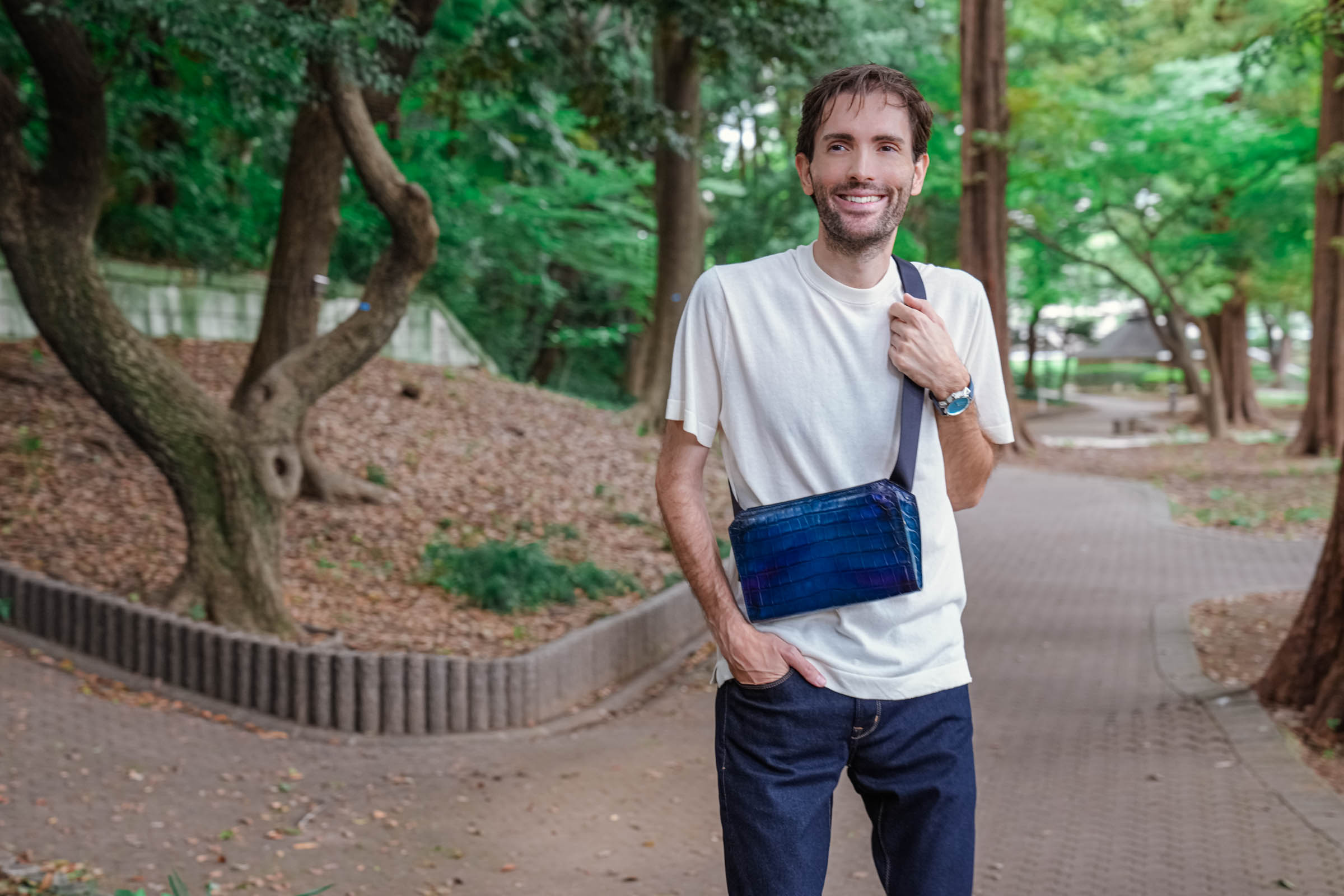
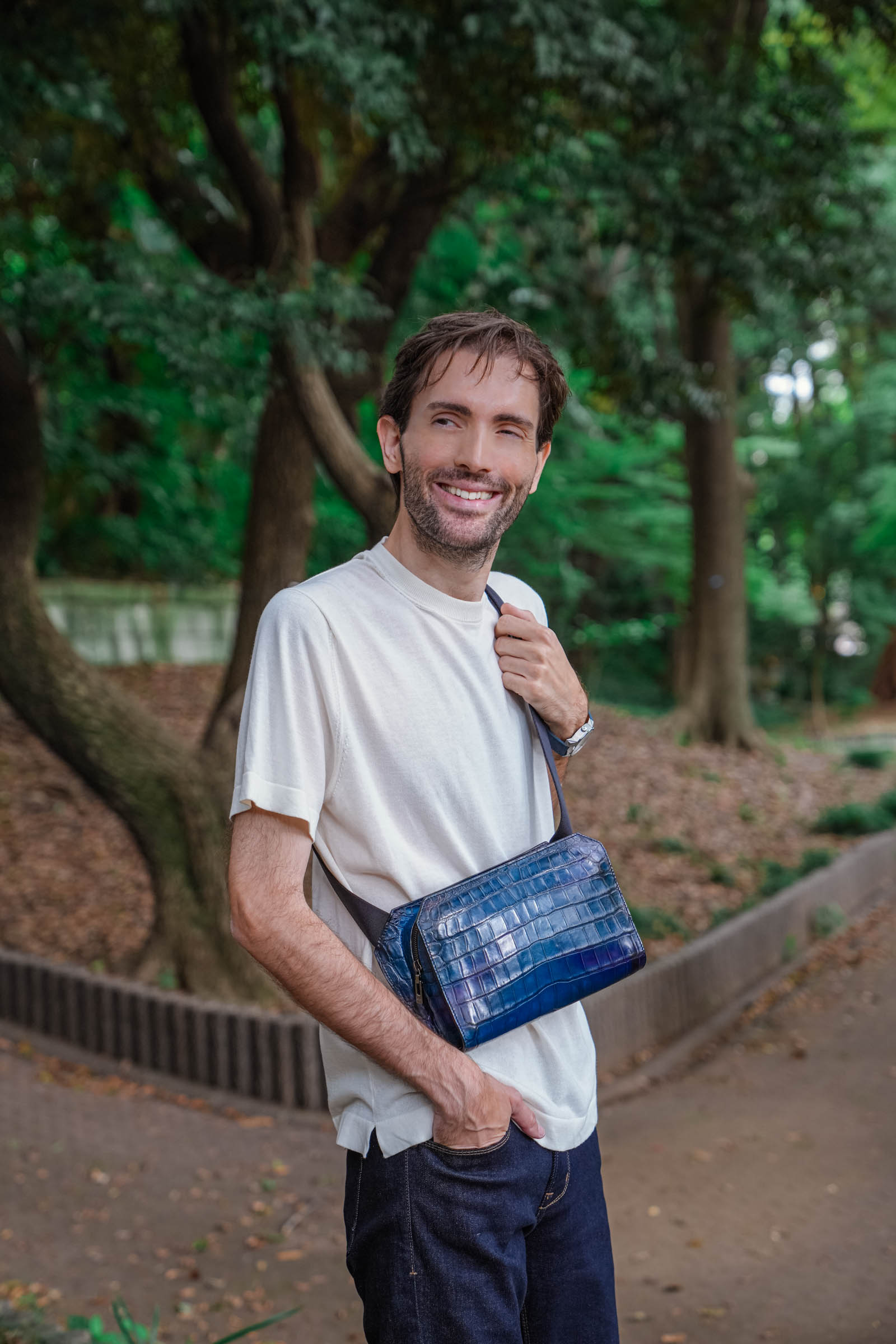
The Yuhaku Crocodile Body Bag I’m carrying in these photos is the pinnacle of what Yuhaku has to offer. Made from real crocodile leather processed by the H.C.P. factory, owned by Hermès, the same factory that supplies one of the most prestigious fashion brands in the world, this bag is proof that Japanese craftsmen work with the best materials the industry knows.
The name of the Cobweb series, which means cobweb, comes from the specific way in which the crocodile’s scales are arranged, spreading like rays from the center, reminiscent of the structure of a spider web. That natural geometry, combined with Yuhaku’s unique coloring technique, creates a visual effect that is both dramatic and refined.

The bag’s dimensions of 28 centimeters in width, 17 centimeters in height and 7 centimeters in depth make it ideal for everyday use, spacious enough to hold everything you need for a walk around town, yet compact enough not to hinder your movement. The adjustable strap allows it to be worn over the shoulder or diagonally across the body, which is especially practical in the crowded Tokyo subway.
What particularly fascinates me about crocodile leather is its durability. Despite its delicate appearance, this leather is actually tougher than cowhide and with proper maintenance can last for generations. It’s not a one-season purchase, it’s an investment in a piece you’ll pass down to posterity.


The Japanese tradition of leatherwork has a long and rich history, although often neglected in favor of more well-known crafts such as ceramics or blacksmithing. During the Edo period, master tanners created items for samurai from sword scabbards to armor, developing processing techniques that have been passed down to this day. Yuhaku draws on this heritage, combining it with a contemporary design sensibility and of course that revolutionary dyeing technique.
The value of such pieces is also reflected in the fact that Yuhaku offers a complete maintenance and restoration service. If after years of use your bag or wallet needs a refresh, the craftsmen in the workshop can polish it, re-dye it and restore it to its original shine. It’s an approach that was once standard in the luxury industry, but has unfortunately become increasingly rare in the era of disposable consumption.
Yuhaku: Wallet with Patent Clasp
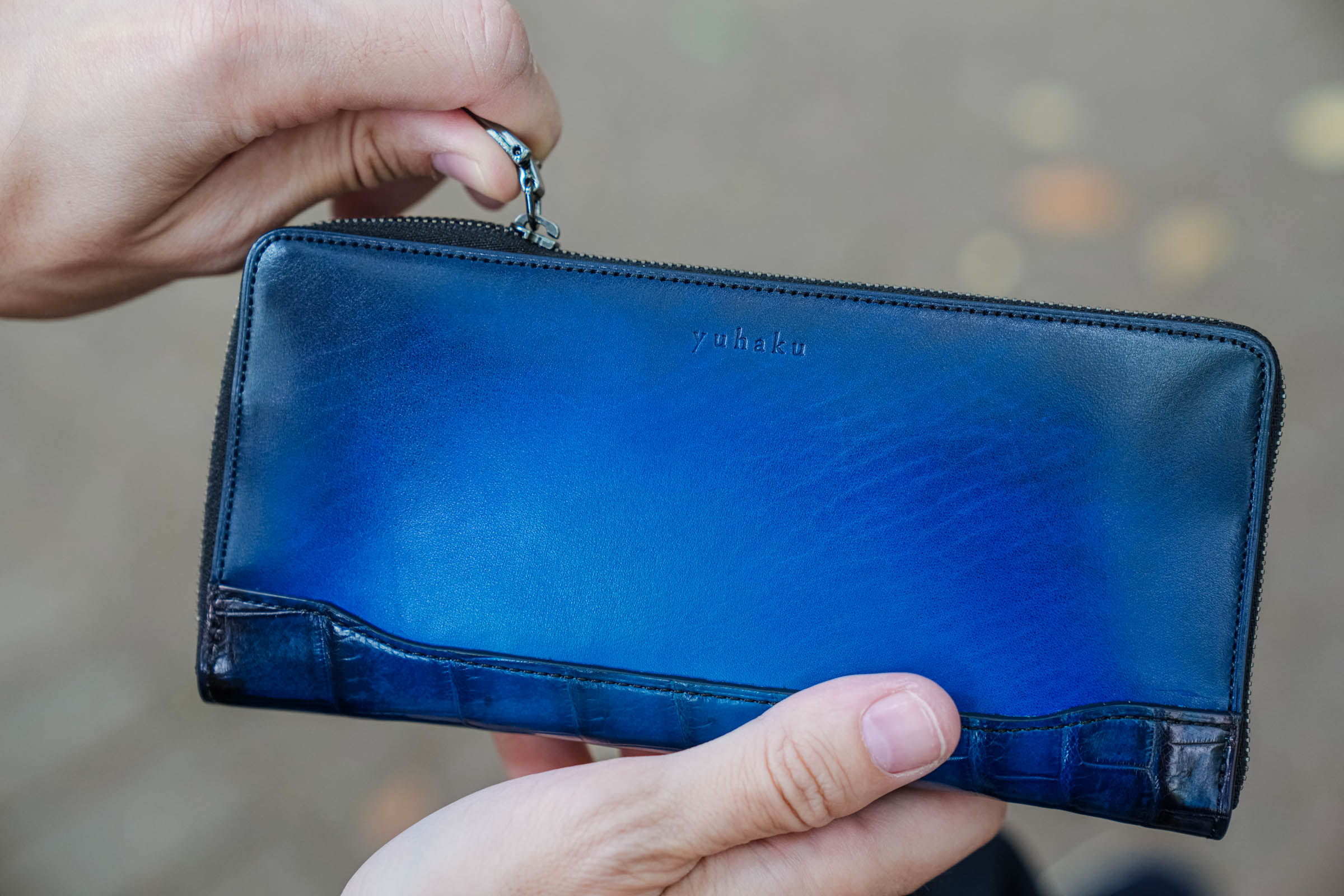
The wallet from the same Cobweb series combines crocodile skin on the outside with soft calfskin on the inside. The dimensions of 198 by 95 millimeters and the thickness of 22 millimeters make it very practical: two sections for bills, twelve pockets for cards, a special pocket for small change and two additional pockets for everything else.

But numbers cannot describe the feeling you get when you hold this wallet in your hands. Coloring in blue tones, characteristic of the Cobweb series, creates an illusion of depth that seems to draw you into your skin. Every time I open it, I marvel anew at the craftsmanship required to achieve such an effect.
Yuhaku: Business card case
In Japanese business culture, exchanging business cards is a real ritual. Meishi kokan, as the custom is called, requires that the card be received and handed over with both hands, with a slight bow, and that it is never placed in the back pocket of the pants, as this would be considered extremely rude. Therefore, a quality card case is more than a practical accessory, it is an expression of respect for business partners.
Yuhaku’s Cobweb series business card case perfectly meets this exacting standard. The combination of crocodile skin and calf leather, carefully made in Japan, speaks of seriousness and commitment to quality, values that are highly valued by Japanese business partners.


CIFONELLI: FOUR GENERATIONS OF PARISIAN TAILORING
When talking about high fashion, it’s impossible to bypass Paris. And when we talk about Parisian tailoring, it is impossible not to mention the house of Cifonelli. The beige knit short sleeve shirt I chose for this outfit may look simple, but behind it is a story that is over a hundred and forty years old.
House Cifonelli was founded in 1880 in Rome by Giuseppe Cifonelli. He was a man obsessed with detail, a craftsman who believed that a suit is not just a piece of clothing, but an extension of the wearer’s personality. His son Arturo, sent to London to learn the trade at a prestigious tailoring academy, brought with him British precision which he combined with an Italian sense of line and French charm when he opened a shop in Paris in 1926.

OUTFIT
T-Shirt: Cifonelli
Body Bag: Yuhaku
Wallet: Yuhaku
Case for Business Cards: Yuhaku
Watch: Schaefer & Companions
Jeans: Façonnable
Sneakers: Carlos Santos

Since then, at 31 Rue Marbeuf, in the very heart of Paris’ golden triangle, successive generations of tailors have dressed some of the world’s most elegant men. François Mitterrand, the long-time president of France, was a loyal customer. Marcello Mastroianni, Lino Ventura, Cary Grant, the list of famous names dressed by Cifonelli reads like an encyclopedia of twentieth-century masculine elegance.
Today, the fourth generation, brothers from uncles Lorenzo and Massimo Cifonelli run a workshop with over forty craftsmen who work on a single suit for more than eighty hours. Every stitch is handmade, every suit is unique. Their trademark is a specific shoulder cut with a slight arc that seems to float above the body, allowing full freedom of movement while creating a breathtaking silhouette. The legendary Karl Lagerfeld once said that he could recognise a Cifonelli shoulder from a hundred meters away.

The shirt I’m wearing, made from 100% cotton in Italy, may not require eighty hours of work, but it carries the same DNA of perfection. The soft, knit structure provides a comfort that mass-produced pieces simply can’t achieve, while the tailoring ensures that even the simplest piece looks thoughtful and elegant.
Between 1992 and 2007, Cifonelli was the exclusive producer of all bespoke suits for the fashion house Hermès, perhaps the highest possible compliment a tailor can receive. That collaboration further cemented Cifonelli’s reputation as a top manufacturer in the world of high fashion.
What I especially appreciate about this brand is their dedication to preserving the craft. At a time when many traditional tailoring salons are closing their doors because the younger generations do not want to learn a trade that requires years of study before the first serious seam can even be sewn, Cifonelli is actively training new masters. All of the workshop’s employees are full-time, unusual in an industry where most tailors work on a piece-by-piece basis as freelancers. This approach makes it possible to create a cohesive team that shares the same vision and the same standards.
FAÇONNABLE: THE SPIRIT OF THE COTE AZURINE
Jeans have always been a symbol of the American spirit, practical, durable, democratic. But when they’re redefined by French designers from the Cote d’Azur, you get something else entirely, a piece that combines that relaxed practicality with Mediterranean sophistication.
The House of Façonnable was founded in 1950 in Nice by master tailor Jean Goldberg. His small shop on Raj Street, right in the heart of this glamorous resort, quickly became a favorite destination for film stars visiting the Cannes Festival. Tony Curtis and Cary Grant came to pick up their tuxedos and evening suits, delighted by Goldberg’s unique take on classic tailoring with a modern twist.


When Jean retired in 1961, his son Albert took over the business and transformed it. After visiting the famous Brooks Brothers in New York, Albert realized that the future lay in high-quality ready-to-wear. He renamed the company Façonnable, a word that means to shape or give form in French, and created a collection that would define the term sporty chic a decade before Ralph Lauren or Calvin Klein even thought about the concept.
In the 1970s, Goldberg began collaborations with prestigious companies such as Sebago, Olden and Loro Piana. With the latter, he created Façorain, an invisible membrane that allows cashmere and wools to be wind and water resistant while retaining their texture and breathability. It was a revolution that showed that Façonnable is not just a follower of trends, but their creator.
The jeans I’m wearing in this combination are a classic straight fit, made from a cotton, polyester and elastane blend that provides comfort and flexibility without sacrificing shape. Washed indigo denim has that perfect patina that speaks of quality without being pretentious, an ideal choice for the more relaxed side of Tokyo life.


SCHAEFER & COMPANIONS: WHERE ART AND TIME MEET
On my wrist this time I carried something really special, the Solune Grand Art watch from the Antarctic series with an enamel dial. This timepiece represents something new and exciting on the Swiss watchmaking scene, and behind it stands a story of dedication to an artistic craft that is rarely seen in the modern world.
Schaefer & Companions is a Swiss watch brand founded in 2024 in Le Locle by Christoph Schaefer. Le Locle, together with neighboring La Chaux-de-Fonds, has been on the UNESCO World Heritage List since 2009 precisely because of its outstanding contribution to watchmaking. In this small town in the Jura mountains, where the winters are long and cold, generations of farmers have sat in their workshops during the months when farming was not possible and created some of the finest mechanisms that mankind has ever produced.


What makes Schaefer & Companions special is their commitment to the so-called métiers d’art artistic crafts that include enameling, engraving, marquetry and miniature painting. Each of their dials is the work of a craftsman, not a machine, and that’s where the real value lies.
The Antarctic series, to which my watch belongs, is inspired by the icy expanses of the most distant continent. Fabienne Remone, an enamel master with thirty years of experience at the prestigious Donzé Cadrans workshop, creates each dial using a technique known as grand feu enamel. This ancient technique requires multiple firings at temperatures in excess of eight hundred degrees Celsius, with each layer of paint having to be perfectly applied before the next firing. A single moment of inattention can destroy hours of work.
What makes Remone’s work truly unique is her use of crinkled silver foil under the enamel. Each fold, each texture, creates a unique visual effect reminiscent of the frozen waves and motionless landscapes of Antarctica. No two dials are identical, each one is unique, forever frozen in time.
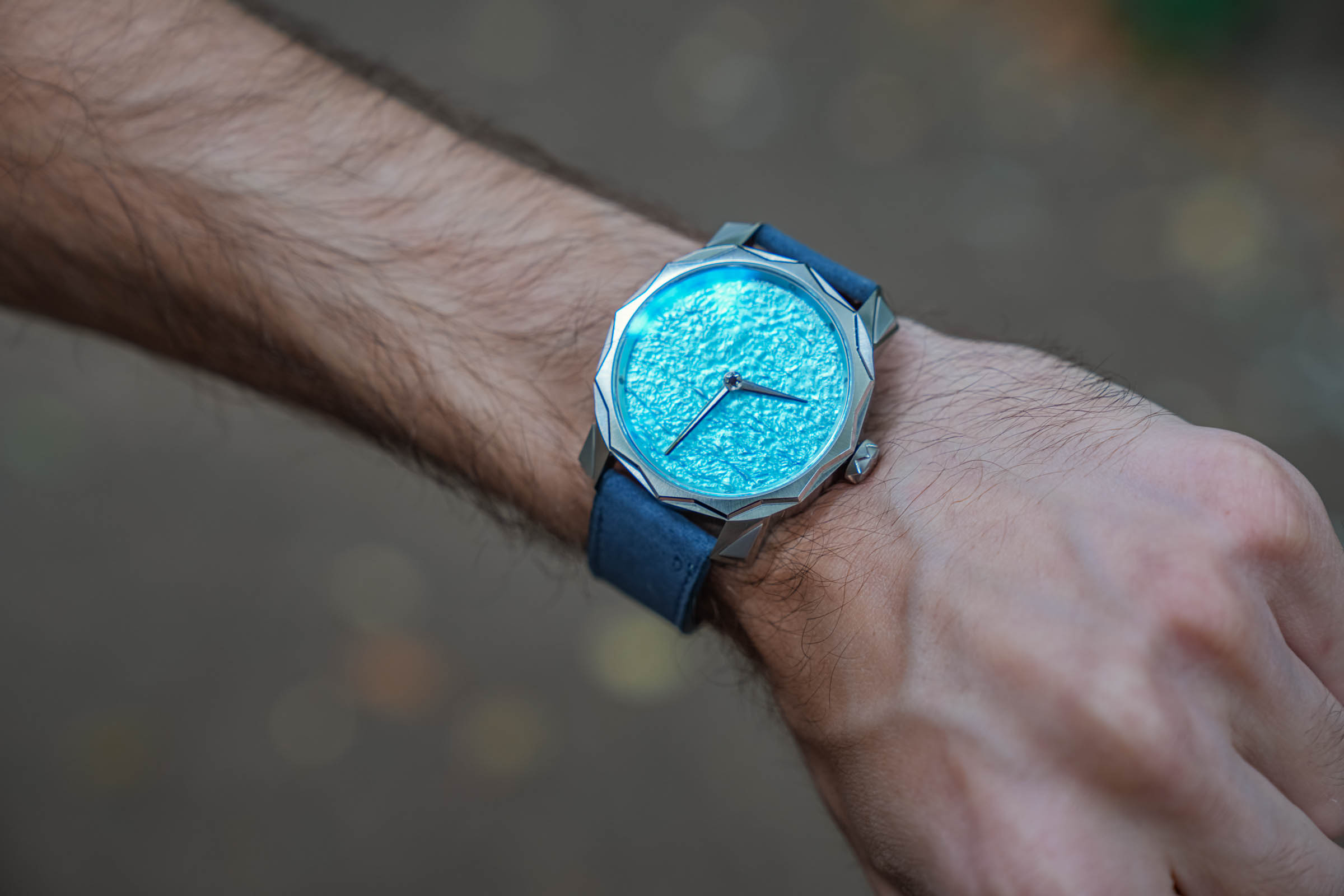
The case of the Solune Grand Art is made of 904L steel, the same alloy that Rolex uses for its sports models, known for its exceptional strength and resistance to corrosion. Angular lines and polished edges catch the light in a dramatic way, while the double-curved sapphire crystal protects the artwork below. At the heart of the watch beats the Swiss movement ETA 2892-A2, one of the most reliable automatic calibers ever produced.
The Swiss watchmaking industry has a history of more than four centuries. It all started when the Protestant reformer Jean Calvin banned the wearing of jewelry in Geneva in the mid-sixteenth century, goldsmiths faced with ruin had no choice but to turn their skills to making watches, the only jewelry that remained permitted. Thus, from a religious prohibition, an industry was born that would conquer the world.

Le Locle and La Chaux-de-Fonds, the towns where Schaefer & Companions was founded, represent the heart of this tradition. During the long winters, when field work was not possible, farmers set up their workbenches and created precise mechanisms in the upper floors of their houses, where the lighting was best. This combination of rural life and high technology created a unique culture where watchmaking became a family tradition passed down from generation to generation.
In 2020, UNESCO declared the craft of mechanical watchmaking part of the Intangible Cultural Heritage of Humanity, a recognition that reflects the exceptional value of these skills in an increasingly digitized world. Schaefer & Companions represents a new generation of producers who continue this tradition, bringing freshness and artistic vision while respecting the old methods.
CARLOS SANTOS: THE PORTUGUESE SHOE-MAKING HERITAGE
No outfit is complete without the right shoes, and for this occasion I chose leather Brody sneakers from the Carlos Santos brand. If you’re unfamiliar with the name, it’s time to correct that, as this Portuguese manufacturer represents one of the best-kept secrets in the world of luxury footwear.
The story begins in 1942 in São João da Madeira, a small town in northern Portugal nicknamed the shoe capital. The Zarco family workshop was involved in the production of shoes for the local market, until a young man named Carlos Santos started working there at the age of fourteen.
Santos was obsessed with shoes in a way that bordered on the manic. While others worked in offices or in sales, he escaped to the factory to watch the craftsmen at work. In the 1970s and 1980s, he traveled the world, visited fashion shows and bought shoes, not to wear them, but to take them apart and understand how they were made. He believed that Portuguese craftsmen could make shoes as good as the best Italian and British manufacturers. They just needed someone to teach them how.


Gradually, Santos bought shares in Zarco until he became the sole owner. Then in 2010 he launched his eponymous brand and proved himself right, today his shoes are sold in Germany, France, Holland, Japan, Belgium, Switzerland, Spain and the United States. About ninety-nine percent of the production is exported, and every day the factory turns out about four hundred and fifty pairs of top quality shoes.
Carlos Santos is one of the few Portuguese manufacturers that uses the Goodyear Welt system, a traditional method of shoe construction where the sole is sewn to the upper using a special welt belt. This technique, invented back in the nineteenth century, allows the sole to be replaced when worn, meaning that well-maintained shoes can last for decades.

Today, Portugal is the second largest exporter of shoes in Europe, just behind Italy, and its reputation for quality is constantly growing. São João da Madeira, the city where the Santos factory is located, is also known for its hat industry FEPSA, a local company, produces felt used by prestigious fashion houses such as Hermès, Giorgio Armani and Chanel. Even movie stars like Harrison Ford as Indiana Jones wore hats made from felt from this small Portuguese town.
That tradition of artisanal excellence permeates the entire region and explains why Santos can achieve such quality at prices that are significantly more affordable than its Italian and British competitors. The factory uses French and Italian calf leather for the uppers, and they are especially proud of their patination service, an artistic coloring of the leather that gives each pair of shoes a unique character.
The Brody sneakers I’m wearing in these photos combine suede and smooth leather in ink and cosmos tones. It’s a shoe that blurs the line between formal and informal, ideal for the man who wants elegance without stiffness. The soft leather interior and carefully sculpted sole provide the comfort needed for long walks on the streets of Tokyo, while the visual complexity of the material ensures that you turn heads wherever you go.
TOKYO: A FASHION SCENE THAT INSPIRES
The images for this fashion story were created in Tokyo, a city that uniquely illustrates everything I’ve written about. This is a place where past and future coexist in harmonious tension, where respect for tradition never clashes with the desire for innovation.
Japanese fashion culture has one characteristic that makes it unique in the world, an extraordinary attention to detail. Here, people don’t wear clothes just to be dressed. Every piece, every detail, has its own meaning and purpose. A concept the Japanese call kodawari, the obsessive commitment to perfection in every aspect is visible in the way the locals dress, but also in the way local brands like Yuhaku approach their craft.

It is interesting to note how Tokyo manages to maintain a balance between global fashion trends and authentic Japanese aesthetics. While you can find stores of all the big European and American brands, there is also a strong scene of local designers and producers offering something completely different. That coexistence creates an atmosphere of creativity and possibility that you rarely find anywhere else.
Ginza, the famous district where I spent some time, is a perfect example of this phenomenon. The name comes from a silver mint that existed there as early as the Edo period, from the seventeenth to the nineteenth century. Today, it is the most exclusive shopping destination in all of Asia, where department stores that are more than a century old and avant-garde shops such as Dover Street Market can be found under the same sky. Every weekend, the main street of Chuo-dori is closed to traffic and transformed into a pedestrian zone that the Japanese call walking tengoku, a pedestrian’s paradise.
What makes Tokyo particularly inspiring for fashion lovers is the fact that people here really think about what they wear. You won’t see people in tracksuits and slippers shopping in luxury boutiques. Instead, you’ll see carefully crafted combinations that reflect personality, culture and respect for craftsmanship. It’s a city where Yuhaku’s philosophy of wearable art fits perfectly, where your accessories are expected to say something about you.

In addition to Ginza, Tokyo offers other fascinating fashion districts. Omotesando, sometimes called Tokyo’s Champs-Élysées, is home to avant-garde boutiques and exquisite modern architecture. Shibuya attracts a younger crowd with its energetic street fashion and an iconic intersection that has become a symbol of the city. Harajuku has been a center of alternative fashion and creative expression for decades. Each of these neighborhoods has its own character, but they all share the same core value, respect for aesthetics and individual expression.
Visiting Tokyo always reminds me how much fashion is a cultural phenomenon, not just an industry. In this city, clothes and accessories are not only functional items, they are a means of communication, an expression of identity, a bridge between tradition and modernity. And it is this philosophy, so deeply rooted in Japanese culture, that makes my Yuhaku pieces even more meaningful. They are not just bags, wallets and card cases, they are ambassadors of a culture that believes that everyday objects deserve to be art.
WHAT REALLY MAKES REAL LUXURY?
Let’s go back to the beginning and the question of what actually constitutes real luxury. Each piece in this combination could be replaced with a cheaper alternative that would look visually similar. But that alternative would not carry the stories I told you. It would not have a hundred and forty years of tradition, nor a unique dyeing technique, nor the hours of work of an enamel master, nor the Portuguese dedication to excellence.
We live in a time when everything is available instantly, when we can order clothes from the other side of the world and receive them in a few days, when algorithms suggest what to buy based on our previous choices. In such an environment, the conscious decision to support artisan work, to invest in quality instead of quantity, becomes almost an act of resistance.
The Japanese have another concept that perfectly describes this approach: mottainai. The word expresses a feeling of regret for waste, but also a deep respect for things and the work that went into their creation. When you buy a Yuhaku wallet or Carlos Santos shoes, you’re not just buying a functional item, you’re buying hours of someone’s life, years of learning, generations of passed down knowledge. Throwing away such an item, or replacing it as soon as a new model appears, would be considered mottainai, an inappropriate relationship to effort and resources.

It may be an outdated way of thinking in the eyes of some. But I believe that this kind of thinking is what makes us better people aware, thoughtful, respectful of other people’s work and the resources of the planet. Quality clothes and accessories are not the privilege of the rich, they are a choice we can all make, maybe less often, but more thoughtfully.
When choosing what to wear, I don’t just choose texture and color. I choose the story I want to tell the world about myself. I choose to support craftsmen who dedicate their lives to perfecting their craft. I choose quality that will last, instead of fashion that will pass.
Tokyo taught me that true style is never overdone. He is confident, grounded in knowledge and respect. The Japanese have an expression for it “shibui”, which describes beauty in simplicity, elegance in restraint. I believe that the combination that I have presented to you perfectly reflects that spirit.
I hope today’s fashion story has inspired you to think not only about what you wear, but also why you wear it. Because in the end, we don’t just dress our bodies, we dress stories. And it’s those stories that make the difference between a wardrobe that passes and a style that stays.
Until the next fashion story, stay stylish not only on the outside, but also on the inside. Because true style starts with who we are, not what we wear.
How did you like my outfit today? I really tried to prepare this post with lots of love and I hope you like it! If you have any questions, comments, suggestions or messages for me, you can write me below in the comments. Of course, as always, you can contact me via e-mail or social networks, which you can find on the CONTACT page. See you soon in new fashion adventures on the Mr.M blog!
With Love from Tokyo,
Mr.M

This post is sponsored by Cifonelli, Yuhaku, Façonnable, Schaefer & Companions, Carlos Santos brands. This post represents my personal and honest review of the destination, services and products provided.
Hello Marko, this is one of the most comprehensive fashion articles I have read in a long time. I must admit I had never heard of Yuhaku before, but the concept of hand-dyeing leather with four to eight layers of color to create that depth and transparency is absolutely fascinating. The fact that founder Tomohiro Nakagaki studied architecture before turning to leatherwork explains the precise lines visible in the crocodile bag you featured. I have been collecting quality leather goods for years and this Japanese brand has now moved to the top of my wish list. The Tokyo backdrop for… Read more »
Guten Tag Marko, vielen Dank für diese faszinierende Einführung in die Welt von Yuhaku. Als langjähriger Sammler von hochwertigen Lederwaren bin ich beeindruckt von der Tatsache, dass das verwendete Krokodilleder von der H.C.P. Fabrik stammt, die zu Hermès gehört. Diese Verbindung zu einem der prestigeträchtigsten Modehäuser der Welt spricht für die außergewöhnliche Qualität. Die Cobweb-Serie mit ihrer spinnenwebartigen Anordnung der Krokodilschuppen ist visuell atemberaubend. Ich werde definitiv die Yuhaku-Boutique in Ginza besuchen, wenn ich das nächste Mal nach Tokyo reise. Deine Fotografien in den Straßen von Tokyo vermitteln perfekt die Atmosphäre dieser einzigartigen Stadt.
Marko, your article has introduced me to a brand I never knew existed, and I am genuinely grateful for that. The philosophy of monozukuri, the art of making things with soul, resonates deeply with how I approach my own wardrobe choices. I currently own several pieces from Italian leather houses like Bottega Veneta and Berluti, but Yuhaku’s unique dyeing technique that creates leather appearing to glow from within sounds like something entirely different. The information that each piece goes through fifteen to twenty processing steps demonstrates the level of dedication involved. Could you tell me if Yuhaku ships internationally, or… Read more »
Cher Marko, quel article magnifique sur Yuhaku et ton ensemble complet. Je possède plusieurs pièces de Cifonelli, donc je connais bien la qualité de cette maison parisienne fondée en 1880 à Rome par Giuseppe Cifonelli. Le fait que les frères Lorenzo et Massimo représentent la quatrième génération et emploient plus de quarante artisans qui travaillent plus de quatre-vingts heures sur un seul costume témoigne de leur engagement envers l’excellence. Ta chemise en maille de coton semble parfaite pour le climat de Tokyo. La combinaison des accessoires Yuhaku avec le savoir-faire français crée un équilibre visuel remarquable entre l’Orient et l’Occident.
Hello Marko, I have been following your blog for some time and this Yuhaku feature is exceptional. As someone who appreciates fine craftsmanship, the story of Tomohiro Nakagaki meeting an Italian master bag maker and developing his revolutionary dyeing technique inspired by painting is truly compelling. I own a crocodile wallet from a well-known French maison, but the Cobweb series with its unique coloring that creates an illusion of depth sounds like a different level of artistry altogether. The Japanese concept of kodawari, the obsessive commitment to perfection, is clearly visible in these pieces. Your photos shot against Tokyo’s urban… Read more »
Caro Marko, grazie per avermi fatto conoscere Yuhaku. Come appassionato di pelletteria di lusso, sono rimasto affascinato dalla tecnica di tintura unica che crea quella profondità mai vista prima nei prodotti in pelle. Il fatto che il nome del marchio derivi dalla lettura giapponese del nome d’arte di Nakagaki aggiunge un tocco personale molto significativo. Possiedo diverse borse di Bottega Veneta e Valextra, ma Yuhaku sembra offrire qualcosa di completamente diverso nel panorama della pelletteria mondiale. La borsa in coccodrillo della serie Cobweb con le sue dimensioni di 28 centimetri di larghezza, 17 di altezza e 7 di profondità sembra… Read more »
Marko, thank you for this wonderfully detailed article. I purchased my first Yuhaku wallet three years ago after discovering the brand during a business trip to Tokyo, and I can confirm that the quality is extraordinary. The way the colors seem to have depth and transparency, as if the leather is glowing from within, is exactly as you describe. What impressed me most was that after two years of daily use, the patina has only improved, giving it an even richer character. Your mention of Yuhaku’s restoration service is important information for potential buyers, knowing that the craftsmen can polish,… Read more »
Hallo Marko, dieser Artikel hat mein Interesse an Yuhaku geweckt. Die Information, dass die Färbemeister im Atelier jahrelange Ausbildung durchlaufen, bevor sie selbstständig an den Endprodukten arbeiten dürfen, zeigt den Ernst, mit dem diese Marke die Qualitätskontrolle angeht. Ich besitze bereits Lederwaren von deutschen Herstellern wie Goldpfeil und einige italienische Stücke, aber die japanische Herangehensweise an die Lederverarbeitung scheint einzigartig zu sein. Besonders interessant finde ich, dass Yuhaku 2020 seine erste Boutique-Galerie in Ginza eröffnet hat, wo auch Ausstellungen in Zusammenarbeit mit anderen Künstlern wie dem Kalligrafen Koki Sugita organisiert werden. Das verbindet Mode mit Kunst auf eine sehr elegante… Read more »
Hola Marko, tu artículo sobre Yuhaku es absolutamente fascinante. Nunca había escuchado hablar de esta marca japonesa, pero la filosofía de arte portátil que describes me ha cautivado por completo. El hecho de que cada color deba aplicarse en un momento preciso, cuando el anterior no está completamente seco pero tampoco demasiado húmedo, demuestra el nivel de habilidad requerido. Actualmente poseo piezas de Loewe y Moynat, pero Yuhaku parece ofrecer algo completamente diferente en términos de técnica artística. Las fotos que tomaste en Tokyo capturan perfectamente la dualidad entre tradición y modernidad que defines en tu texto. Definitivamente investigaré más… Read more »
Hello Marko, I must commend you on this exceptional fashion article. The information about Carlos Santos shoes was particularly enlightening for me. I had no idea that this Portuguese manufacturer uses the Goodyear Welt system, the same traditional construction method that allows soles to be replaced, meaning well-maintained shoes can last for decades. The story of Carlos Santos buying shoes not to wear them but to take them apart and understand how they were made shows true dedication to the craft. Your Brody sneakers in ink and cosmos tones look perfect paired with the Façonnable jeans. The fact that São… Read more »
Bonjour Marko, merci pour cet article remarquable. En tant qu’amateur de maroquinerie fine, je suis particulièrement intéressé par la technique révolutionnaire de teinture de Yuhaku où quatre à huit nuances de couleur différentes sont appliquées directement sur le cuir. Le résultat que tu décris, un cuir qui semble briller de l’intérieur, est exactement le genre d’artisanat que je recherche. Je connais bien Cifonelli car j’ai commandé plusieurs costumes sur mesure chez eux au fil des années, et leur travail est impeccable. La combinaison de ces pièces japonaises et françaises dans ton outfit crée une harmonie visuelle impressionnante. Tokyo semble être… Read more »
Marko, your article on Yuhaku has opened my eyes to a world of leather craftsmanship I was unaware of. The detail about the Cobweb series name coming from the way crocodile scales spread like rays from the center, reminiscent of a spider web structure, is fascinating. I have collected exotic leather goods from various European houses for over two decades, but this Japanese approach to treating leather as a canvas for painting is revolutionary. The mention that crocodile leather is actually tougher than cowhide and can last for generations with proper maintenance reinforces the investment value. I will definitely be… Read more »
Caro Marko, che articolo straordinario su Yuhaku e il tuo outfit completo. Come collezionista di orologi, sono rimasto particolarmente colpito dalla sezione su Schaefer & Companions. Il fatto che questa marca svizzera sia stata fondata nel 2024 a Le Locle, una città inserita nella lista del Patrimonio UNESCO per il suo contributo all’orologeria, aggiunge credibilità immediata. La tecnica grand feu enamel utilizzata da Fabienne Remone, con le sue multiple cotture a temperature superiori a ottocento gradi Celsius, è una forma d’arte che pochi maestri padroneggiano oggi. Anche le tue scelte di accessori Yuhaku dimostrano un occhio raffinato per l’artigianato di… Read more »
Hello Marko, this is precisely the kind of in-depth fashion content I appreciate. I was familiar with Cifonelli from their legendary reputation, but learning that they were the exclusive producer of all bespoke suits for Hermès between 1992 and 2007 adds another layer to my understanding of their prestige. The Karl Lagerfeld quote about recognizing a Cifonelli shoulder from a hundred meters away perfectly captures what makes their tailoring distinctive. Your choice to pair this French excellence with Japanese Yuhaku accessories demonstrates a sophisticated understanding of how different craft traditions can complement each other. The Tokyo setting provides the ideal… Read more »
Lieber Marko, herzlichen Dank für diesen aufschlussreichen Artikel. Die Geschichte von Façonnable hat mich besonders interessiert. Ich wusste nicht, dass die Marke 1950 in Nizza von Jean Goldberg gegründet wurde und dass Filmstars wie Tony Curtis und Cary Grant zum Cannes Festival kamen, um ihre Smokings abzuholen. Die Entwicklung von Façorain, der unsichtbaren Membran in Zusammenarbeit mit Loro Piana, die Kaschmir und Wolle wind- und wasserabweisend macht, zeigt echte Innovation. Deine Jeans in gewaschenem Indigo-Denim passen perfekt zu den Yuhaku-Accessoires. Die Kombination verschiedener europäischer und japanischer Handwerkstraditionen in diesem Outfit ist wirklich beeindruckend.
Marko, thank you for introducing me to Yuhaku. As someone who has invested in leather goods from Hermès and Dunhill over the years, I am always searching for brands that offer something truly unique. The concept of wearable art, as Nakagaki calls it, perfectly describes what I look for in luxury accessories. The information that Yuhaku opened their first boutique gallery in Ginza in 2020 and occasionally organizes exhibitions with other artists like calligrapher Koki Sugita elevates this beyond a mere fashion brand into the realm of cultural institution. Your photographs beautifully capture the interplay between the sophisticated accessories and… Read more »
Querido Marko, este artículo es una obra maestra del periodismo de moda. La información sobre Carlos Santos y cómo la fábrica produce aproximadamente cuatrocientos cincuenta pares de zapatos de alta calidad cada día, exportando el noventa y nueve por ciento, demuestra el reconocimiento internacional de la calidad portuguesa. No sabía que São João da Madeira también es conocida por su industria de sombreros, donde FEPSA produce fieltro utilizado por casas de moda prestigiosas como Hermès, Giorgio Armani y Chanel. El hecho de que incluso Harrison Ford como Indiana Jones usara sombreros hechos con fieltro de esta pequeña ciudad portuguesa es… Read more »
Hello Marko, your article has convinced me to explore Yuhaku for my next leather purchase. I currently own a crocodile card holder from a well-known Italian brand, but your description of the Cobweb series business card case with its combination of crocodile and calf leather sounds superior. The cultural context you provide about meishi kokan, the Japanese business card exchange ritual requiring cards to be received and handed over with both hands and a slight bow, explains why a quality card case is so important in Japanese business culture. This kind of cultural insight elevates your fashion writing beyond simple… Read more »
Cher Marko, ton article sur Yuhaku m’a vraiment impressionné. La philosophie japonaise de mottainai que tu mentionnes, ce sentiment de regret pour le gaspillage et de profond respect pour les objets et le travail qui a contribué à leur création, résonne profondément avec ma propre approche de la mode. Je possède plusieurs montres de marques suisses établies, mais la description de Schaefer & Companions avec ses cadrans en émail grand feu créés par Fabienne Remone est fascinante. Le fait que chaque cadran utilise une feuille d’argent froissée sous l’émail pour créer des effets visuels uniques rappelant les paysages gelés de… Read more »
Marko, this is exactly the type of detailed fashion content that sets your blog apart. The historical background on Swiss watchmaking, from Jean Calvin banning jewelry in Geneva in the mid-sixteenth century forcing goldsmiths to turn to watchmaking, to UNESCO declaring mechanical watchmaking part of the Intangible Cultural Heritage of Humanity in 2020, provides wonderful context for understanding Schaefer & Companions. I have been collecting watches for decades and the Antarctic series with its enamel dials by master craftsman Fabienne Remone sounds like something truly special. Your pairing of this Swiss timepiece with Japanese Yuhaku leather goods creates a narrative… Read more »
Ciao Marko, grazie per questo articolo così dettagliato e informativo. La storia di Cifonelli mi ha particolarmente colpito, specialmente il fatto che Giuseppe Cifonelli fondò la casa nel 1880 a Roma con l’ossessione che un abito non sia solo un capo di abbigliamento ma un’estensione della personalità di chi lo indossa. Il dettaglio che suo figlio Arturo fu mandato a Londra per imparare il mestiere e poi combinò la precisione britannica con il senso italiano della linea e il fascino francese quando aprì il negozio a Parigi nel 1926 è affascinante. La tua maglietta in maglia sembra semplice ma elegante,… Read more »
Hello Marko, I must thank you for this exceptional introduction to Yuhaku. The detail about each color needing to be applied at a precise moment when the previous one is not yet completely dry but not too wet either, allowing colors to blend into each other to create those unique gradients, demonstrates the extraordinary skill required. I have a passion for exotic leathers and own pieces from Asprey and Smythson, but Yuhaku’s approach sounds revolutionary. The mention that masters in the workshop go through years of training before being allowed to work independently on final products shows the seriousness with… Read more »
Hallo Marko, dein Artikel über Yuhaku ist äußerst aufschlussreich. Die Tatsache, dass die Marke 2009 in Yokohama von Tomohiro Nakagaki gegründet wurde, der zuvor Architektur studierte, erklärt die präzisen Linien und die elegante Struktur seiner Kreationen. Ich sammle seit Jahren hochwertige Lederaccessoires von europäischen Herstellern, aber die japanische Philosophie des monozukuri, die Kunst, Dinge mit Seele zu machen, bietet eine völlig neue Perspektive. Die Kombination von Yuhaku mit Carlos Santos Schuhen aus Portugal zeigt, wie verschiedene Handwerkstraditionen aus verschiedenen Teilen der Welt harmonisch zusammenwirken können. Deine Fotografien aus Tokyo vermitteln die einzigartige Energie dieser Stadt perfekt.
Marko, your fashion article on Yuhaku is remarkable in its depth and detail. As a collector of fine leather goods, I was particularly intrigued by the information that Yuhaku offers a complete maintenance and restoration service, where craftsmen can polish, re-dye and restore items to their original shine. This approach was once standard in the luxury industry but has become increasingly rare in our era of disposable consumption. The Japanese concept of shibui that you mention, describing beauty in simplicity and elegance in restraint, perfectly captures what I seek in my own wardrobe choices. Your outfit photographed against the Tokyo… Read more »
Hola Marko, gracias por este artículo tan completo sobre Yuhaku y tu outfit. La información sobre el reloj Schaefer & Companions me ha fascinado especialmente. El hecho de que la marca fue fundada en 2024 en Le Locle, una ciudad que junto con La Chaux-de-Fonds está en la lista del Patrimonio Mundial de la UNESCO desde 2009 por su contribución a la relojería, demuestra un compromiso serio con la tradición relojera suiza. La técnica de esmalte grand feu que requiere múltiples cocciones a más de ochocientos grados Celsius es verdaderamente artesanal. La combinación de este reloj suizo con los accesorios… Read more »
Hello Marko, thank you for this beautifully crafted article. I purchased my first pair of Carlos Santos shoes two years ago on the recommendation of a friend in the footwear industry, and I can confirm the exceptional quality. The Goodyear Welt construction you mention has already proven its worth as I recently had the soles replaced, giving the shoes a new lease of life while the uppers have developed a beautiful patina. Your Brody sneakers in suede and smooth leather combination look perfect for navigating Tokyo’s streets. The context about Portugal being the second largest exporter of shoes in Europe,… Read more »
Lieber Marko, dieser Artikel hat mein Verständnis von japanischer Lederwaren-Handwerkskunst völlig verändert. Die historische Verbindung, die du zwischen der Tradition der Lederverarbeitung während der Edo-Periode, als Meistergerber Gegenstände für Samurai von Schwertscheiden bis zu Rüstungen herstellten, und dem modernen Yuhaku herstellst, ist faszinierend. Die Erwähnung, dass Krokodilleder trotz seines zarten Aussehens tatsächlich widerstandsfähiger als Rindsleder ist und bei richtiger Pflege über Generationen halten kann, macht diese Stücke zu echten Erbstücken. Ich werde mich definitiv über Yuhaku informieren und einen Besuch ihrer Ginza-Boutique bei meiner nächsten Tokyo-Reise einplanen.
Marko, your article has been an absolute pleasure to read. The section on Façonnable’s history was particularly enlightening. I had no idea that Albert Goldberg visited Brooks Brothers in New York and realized the future lay in high-quality ready-to-wear, or that he coined the term sporty chic a decade before Ralph Lauren or Calvin Klein even thought about the concept. The collaboration with Loro Piana to create Façorain, the invisible membrane making cashmere and wool wind and water resistant while retaining texture and breathability, shows genuine innovation. Your jeans look excellent paired with the Yuhaku crocodile bag. The Tokyo photographs… Read more »
Bonjour Marko, merci pour cet article exceptionnel sur Yuhaku et ton ensemble complet. La section sur l’histoire de la relojerie suisse, depuis l’interdiction des bijoux par Jean Calvin à Genève au milieu du seizième siècle jusqu’à la reconnaissance de l’UNESCO en 2020, fournit un contexte historique précieux. Je collectionne les montres depuis des décennies et la série Antarctic de Schaefer & Companions avec ses cadrans en émail créés par Fabienne Remone, une maître émailleur avec trente ans d’expérience chez Donzé Cadrans, semble véritablement unique. La combinaison de cette montre suisse avec les accessoires Yuhaku japonais et les vêtements français crée… Read more »
Hello Marko, this is precisely the quality of fashion journalism I seek out. Your explanation of the Japanese term kodawari, the obsessive commitment to perfection in every aspect, perfectly describes what I observe in Yuhaku’s approach to leather craftsmanship. I have spent years building a collection of quality accessories and the information that the crocodile leather used by Yuhaku is processed by H.C.P. factory owned by Hermès immediately speaks to the caliber of materials involved. The photographs you have taken in Tokyo, with its blend of ancient temples and futuristic skyscrapers, provide the ideal visual context for discussing a brand… Read more »
Marko, thank you for this magnificent article introducing Yuhaku to a wider audience. As someone who appreciates fine craftsmanship across all categories, I was fascinated by every brand you featured. The detail about Cifonelli training new masters and employing all workshop employees full-time, unusual in an industry where most tailors work as freelancers, shows their commitment to preserving traditional skills. The Japanese concept of mottainai, expressing regret for waste and deep respect for things and the work that went into their creation, should guide all our purchasing decisions. Your outfit photographed in Tokyo beautifully demonstrates how pieces from different cultural… Read more »