
My dear fashionistas, welcome to a new fashion story on the Mr.M blog. I believe that with all of us who love fashion, we simply have some pieces that we wear once and immediately know that they will stay with us for years. The Giannetto Portofino denim jacket is just such a piece. One July summer day, I decided to dress up and evoke the beauty of Italian elegance, even during hot summer days.
In today’s fashion adventure, I’m taking you through the story of a family workshop from the south of Italy, but also about the cloth that became a symbol of style from a worker’s uniform. Along the way, we’ll dwell on the details that separate a good piece from an exceptional one. I believe that after reading this text, you will no longer look at denim the same way.


DISCOVER THE STORY BEHIND GIANNETTO PORTOFINO
The story begins in 1979 in the south of Italy. Riccardo and Nunzia Sansonne then followed a dream: to make clothes of uncompromising quality, shaped by hand and guided by tradition. The world raced forward that year, and the two of them patiently sewed shirts. From small collaborations, they reached their own collections and laid the foundations of the family shirtmaking business.
The real turning point came in 2000. Then their children, Vincenzo and Stefania, join the business, and the family vision gets a new name – Giannetto Portofino. Today, the brand rests on the same values set by the parents: respect, authenticity and individuality. Each piece is created in Italy, through a ritual that they describe simply. Drawing, tailoring, sewing and ironing are not production steps for them, but the language they speak.
My favorite thing about this house is one sentence from their philosophy: true style is timeless. They don’t make clothes for one season, but for the man who is constantly on the move and looking for lightness without fuss. This is precisely why their pieces look familiar already the first time you put them on.
There is also one symbol that you will notice in several places. A small yellow sun appears as a pin on the lapel of the jacket, but also as an embroidery next to the buttons on the shirt. That cheerful signature of the Giannetto Portofino house perfectly describes the spirit of their collections. The sun of southern Italy is sewn, literally, into every piece.

WHAT MAKES GIANNETTO PORTOFINO DENIM SO SPECIAL?
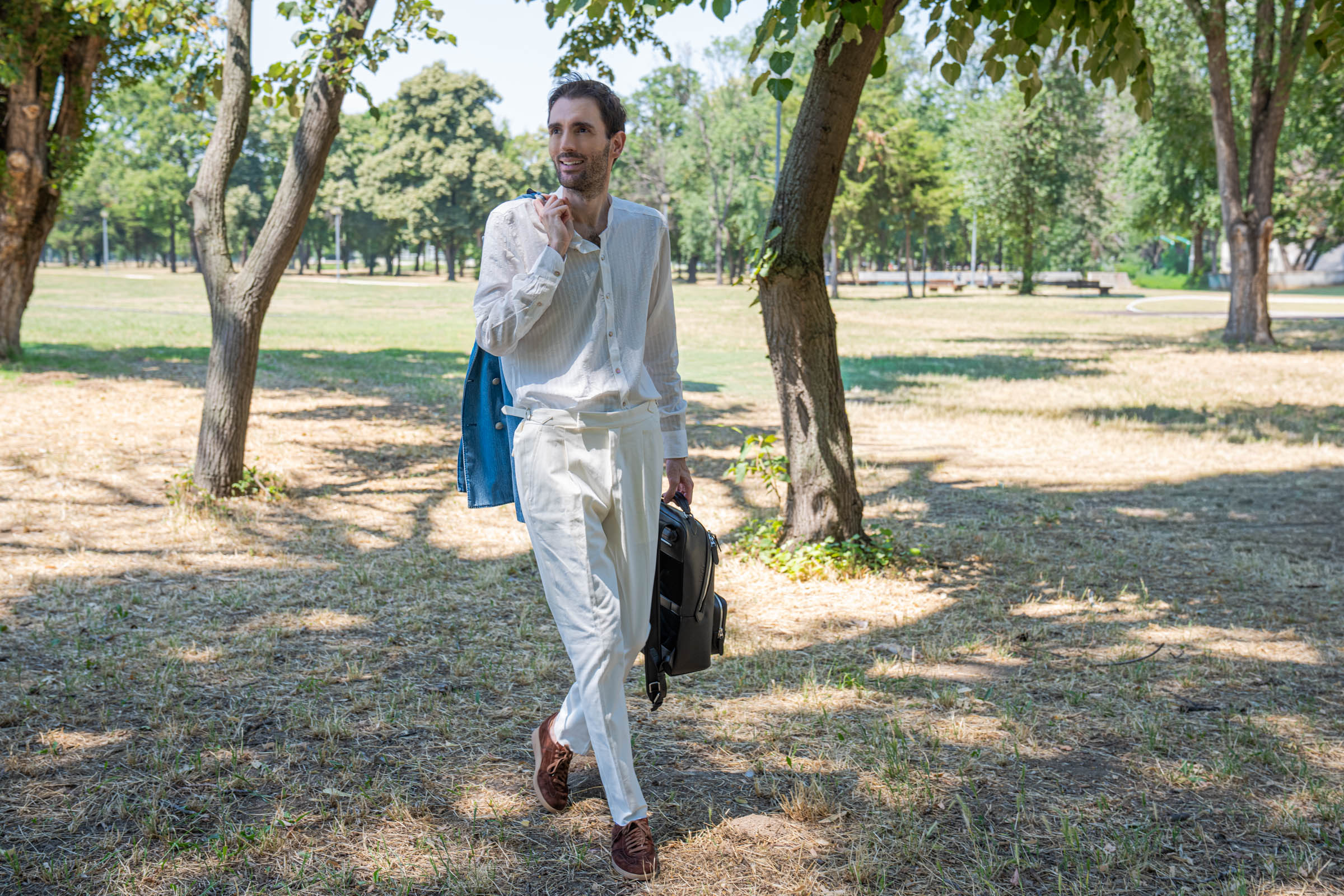
There are denim jackets everywhere, but you don’t come across one like this very often. The Giannetto Portofino denim jacket comes from a limited edition and is cut in Italy from 100% cotton. It shatters expectations at first glance. Instead of a classic workman’s jacket, you have a real jacket with two rows of buttons and pronounced pointed lapels. Such a silhouette carries the authority of tailoring tradition, while denim brings relaxation. That balance, in my opinion, is its greatest asset.
The detail that sets this Giannetto Portofino jacket apart is the metal buttons, sewn on by hand. Each button has an embossed motif and sits on the canvas like an old uniform button. It is precisely such moves that turn everyday material into a memorable piece. Add to that a small pin with a yellow sun on the lapel and you have a jacket with character, without a single visible logo.


When worn, the Giannetto Portofino jacket is light and naturally fits the body. It doesn’t have the stiffness we usually associate with waisted jackets, so it behaves like a shirt with support. I wore it slung over my shoulder while the sun burned, and later dressed in the shade of the tree line. It looked equally good in both variants, which for me is the test of any summer layer.
There is another reason why I consider it a smart investment. Light blue washed denim does not demand attention, but it is always noticed. It looks festive with white pants, completely casual with jeans. Few jackets cover so many occasions in one go.
HOW DID DENIM GO FROM WORKWEAR TO THE ICONIC DENIM JACKET?
To understand this Giannetto Portofino jacket, it is worth going back two centuries. The word denim itself comes from the French term serge de Nîmes, after the city of Nîmes where the strong twill cloth was woven. The English shortened the name over time, so the fabric from Nimes became denim. In our country, the term texas has become popular, after the American state, which we associate with cowboys and hard work.
The key date of the whole story is May 20, 1873. On that day, Levi Strauss and tailor Jacob Davis received a patent for workers’ trousers reinforced with copper rivets. That paper is considered the birth certificate of jeans. Canvas clothed miners, railroad workers and farmers for decades because it could withstand what other materials could not.
In the middle of the last century, the picture changed. The film rebels of the fifties turned denim into a sign of youth and resistance, so school administrations in America even banned it for a while. What was forbidden became irresistible. Since then, denim has been slowly conquering the catwalks.
Today, we’ve reached the point where Italian houses are making point collar jackets from that same fabric. I find that arc of history fascinating. Wear miner’s cloth, tailored with the techniques of top shirtmakers. Few materials carry so much story in their weave, and Giannetto Portofino tells that story without words.

GIANNETTO PORTOFINO: THREE RULES FOR WEARING A DENIM JACKET
Readers often ask me how to fit a denim jacket, so here are three rules that have never failed me. Nothing complicated, but the difference in the mirror is huge.
First rule: separate the shades. Denim on denim can work, but only if the tones are distinctly different. A light jacket calls for dark jeans, and vice versa. The same shade from head to toe feels like a uniform, not a decision. The safest terrain, however, remains bright pants like these, gray woolen or classic beige variants.
Second rule: keep the contrast of formality. This jacket looks best when you contrast it with something more structured than itself. A shirt with a clear line, trousers with a falta, well-groomed shoes. If you throw it over a faded T-shirt and ripped jeans, it loses all its tailoring charm. He likes company that lifts him up, and in turn brings the whole combination down to earth just as it needs to be.
Rule Three: Calm down the extras. Metal buttons are already an ornament, so reduce jewelry to a watch and, possibly, a discreet bracelet. For footwear, choose natural materials, i.e. leather, smooth leather or canvas. Sports shoes with thick plastic soles drag the whole look towards the gym, and we definitely don’t want that here.
For the brave, I also have a small accessory. Over a dark polo shirt, this jacket looks great in the evening, especially with white trousers. Try it once and let me know your impressions.


GIANNETTO PORTOFINO: WHY LYOCELL IS THE PERFECT CHOICE FOR A SUMMER SHIRT
The Giannetto Portofino shirt I chose with the jacket seems simple, but its material deserves a separate chapter. Lyocell is a fiber obtained from wood pulp, most often from fast-growing trees. It is produced in a so-called closed cycle, where the solvent is reused, so it is considered one of the more responsible choices in the modern textile industry. Nature also gave him a practical side. The fiber absorbs moisture very well, breathes and leaves the skin feeling cool to the touch.
For summer days, that means one thing: a shirt that doesn’t stick and doesn’t suffocate. Giannetto Portofino made a slim fit shirt in a natural white shade from 100% lyocell. The fabric has a fine striped structure, so the surface catches the light and gives a quiet glow. The material falls fluidly, almost like silk, but is much easier to maintain. It is machine washable on a cold cycle, without bleach, and it’s all science.


Mother-of-pearl buttons complete the look. They are warm on the eye and go well with the cream tone of the canvas. In the strong sun, the shirt remained comfortable even after an hour of walking, which is the most important rating for me. Elegance that is not felt on the skin is not real elegance.
To be honest, I have been looking for a white summer shirt that is not linen for a long time. I like linen, but it creases quickly and demands attention during the day. Lyocell gave me similar ease with a much quieter surface. For travel and long days in the city, this is a complete hit.


GIANNETTO PORTOFINO: HOW A MANDARIN COLLAR CHANGES THE ENTIRE LOOK
There’s no classic collar on this Giannetto Portofino shirt, and that’s on purpose. The mandarin collar, also known in our country as an upright or clerical collar, fits the neck in a low band and has no falling points. It has its origins in the Asian clothing tradition, and entered European fashion in waves during the last century. Today, it is the sign of a man who wears elegance casually.
What does it practically change? First, it eliminates the question of a tie, because with a collar like this, a tie is not an option. Then, it visually lengthens the neck and clears the line around the face. Finally, it works perfectly with the two rows of buttons on the jacket. A classic collar would be pushed with wide lapels, while a mandarin stripe sits quietly beneath them.
There is also one hidden detail that bought me at first glance. Next to the second button, the house embroidered a tiny yellow sun, the same one from the pin on the lapel. It can only be seen from close up, as a small wink to those who know how to look. Such quiet joys distinguish family workshops from large plants. Someone decided to please you with a detail that most people will never notice, and that’s why it’s worth it.


OUTFIT
Denim Jacket: Giannetto Portofino
Shirt: Giannetto Portofino
Watch: Biatec
Backpack: 1900
Trousers: Cifonelli
Sneakers: Santoni


CIFONELLI TROUSERS: 150 YEARS OF TAILORING HERITAGE
Let’s move on to the lower part of the combination, because it carries the oldest story of this text. The Cifonelli house was founded by Giuseppe Cifonelli back in 1880 in Rome. His son Arturo then went to London to study cutting with the masters there, so the family reached Paris in 1926. The atelier in Rue Marbeuf is still the mecca of world tailoring today.
The style of the house is often described as a fusion of three schools. The Italian softness gives the line, the English construction gives the hold and the French finish gives the perfection of detail. At the helm today are cousins Lorenzo and Massimo Cifonelli, the fourth generation of the family, who took over the helm in the nineties. For one tailor-made suit, their masters spent over eighty hours of manual work.
The house’s reputation is best spoken by its clients. In the past, Cifonelli dressed Josephine Baker, and later Karl Lagerfeld. It was Lagerfeld who uttered the sentence that is quoted to this day: he said that Cifonelli’s shoulder could be recognized from a hundred meters away. When you receive such a compliment from a man who has seen all the fashion in the world, it is worth more than any advertisement.
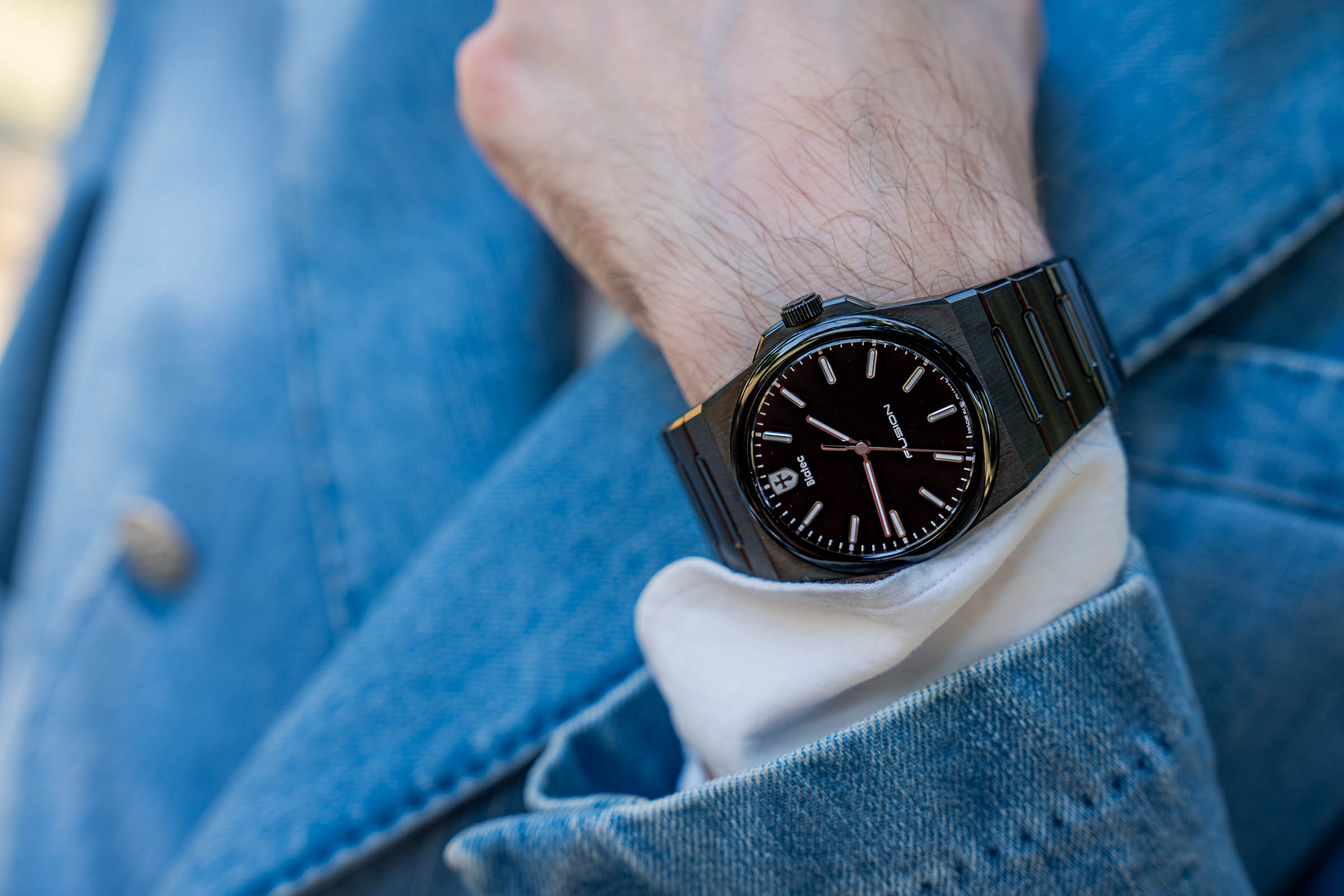
My pants carry that pedigree in a discreet way. Cream tone, high waist, double fall and extended waistband with side adjusters instead of a belt. The leg tapers slightly towards the bottom and ends right at the heel. Nothing sticks out, nothing catches the eye, and everything fits as it should.

HOW HIGH-WAISTED TROUSERS TRANSFORM THE MALE SILHOUETTE
The high waist is not a fad, but a return to the proportions that men have worn for decades. When the belt sits on the natural waist, the legs visually gain in length, and the torso is shortened to a perfect ratio. The whole stance becomes more upright, almost cinematic. The low waist, which reigned for a long time, disturbed that balance.
The double fault has its own task. It gives space to the thigh when walking and sitting, so the pants follow the body instead of being tight. Towards the bottom, the line calms down and narrows, which keeps the silhouette clean. Side adjusters solve the belt issue once and for all. Without a metal buckle in the middle, the transition between shirt and pants remains uninterrupted.
With a mandarin collar and a tucked-in shirt, this cut looks harmonious even without a jacket. This is crucial for summer, because the jacket often ends up over the shoulder or on the back of the chair. A good combination must also work when you take off the top layer. With these pants, it works.
BIATEC FUSION 03: THE CELTIC COIN THAT INSPIRED A WATCH
On my hand this time is an old acquaintance from the blog, the Slovakian Biatec Fusion 03. The story of this brand proves that top watches are not only made in Switzerland. Founder Peter Kožár has been a lover of mechanics since childhood, and he is supported by designer and co-founder Miloš Jakubec and chief watchmaker Vladimír Wágner. Their workshop in the heart of Slovakia combines Swiss mechanisms with domestic design and assembly.
The name itself hides a nice history lesson. Biatec is the name of a Celtic coin minted in the area of today’s Bratislava as early as the first century BC. Most likely, the name of the ruler was written on those coins, so the brand literally forged its name in the history of its own country. The logo of the house combines the Slovakian double cross and elements of the Celtic cross, as a seal on each dial.
Their motto is: in search of perfection. Behind those words is a concrete guarantee of five years for each watch, which is rarely found in this class. They mostly sell directly, without expensive ambassadors, so the price remains fair to the customer. Such an approach is close to me, because the money goes into the watch, not into marketing.

INTEGRATED-BRACELET WATCHES: HOW THEY BEGAN AND WHY THEY ARE POPULAR AGAIN
To understand the Fusion collection, it’s worth knowing where this whole genre comes from. In the 1970s, the Swiss industry was looking for an answer to cheap quartz watches from Japan. The answer came from the pen of legendary designer Gérald Genta. In 1972, he designed the Royal Oak for Audemars Piguet, a steel sports watch with an octagonal bezel and a bracelet that springs straight from the case. It was priced higher than many gold watches of the era, which sounded crazy at the time.
History decided otherwise. The Royal Oak became an icon, and in 1976, Genta designed the Nautilus, another pillar of the same genre, for Patek Philippe. Since then, watches with an integrated bracelet have stood for sporty elegance in its purest form. They are resistant enough for the sea and thin enough for a shirt cuff.
Biatec pays homage to this heritage openly and honestly. Fusion does not copy any specific model, but combines the spirit of the entire era into its own, recognizable form. I especially like that the Slovaks have stepped into the genre held by the biggest names in watchmaking, with a watch that costs a fraction of their price. Such courage is rarely seen, and this summer I wear it on my arm.

BIATEC: WHAT LIES BENEATH THE BLACK DLC COATING OF THIS WATCH?
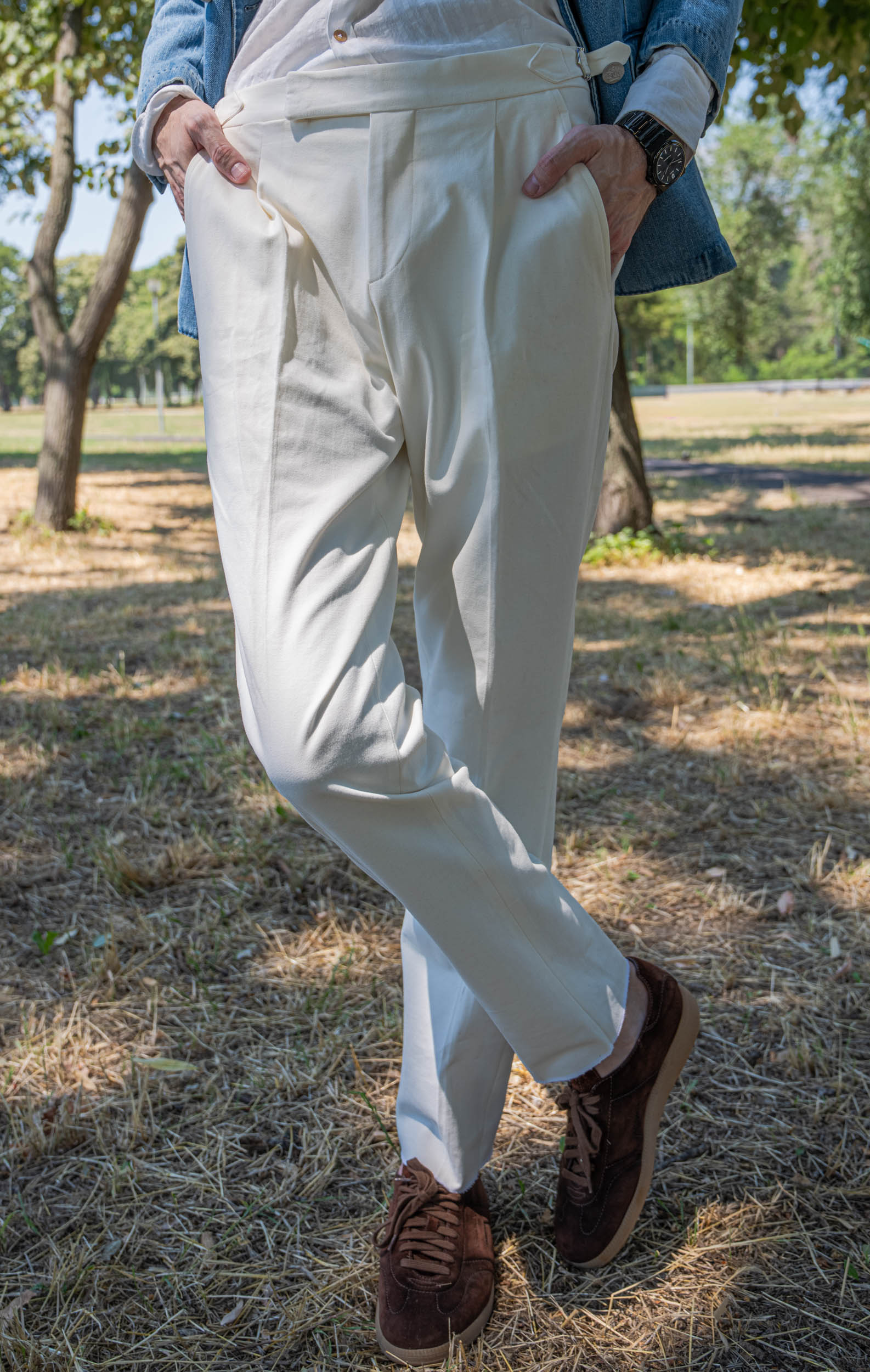
The Fusion collection was created as a fusion of case and bracelet into one whole, but also as a tribute to the most famous watches with an integrated bracelet in the history of watchmaking. Fusion 03 is the darkest in the family. The 316L steel case is covered with a black DLC coating, with alternating brushed and polished surfaces that live a life of their own in the sun.
The numbers speak in favor of carrying capacity. The width is 39 millimeters, and the thickness is only 9, so the watch slides under the shirt cuff without getting stuck. It sits like saliva on my wrist. Sapphire glass protects the dial, while the transparent sapphire back reveals the Swiss automatic Sellita SW300 TOP movement. It beats at 28,800 semi-oscillations per hour and maintains a power reserve of approximately 56 hours.
The black lacquered dial bears applied indices covered with black gold, with a Super-LumiNova mass that glows blue at night. Water resistance of 100 meters covers both the beach and the splash. I am most pleased with the butterfly clasp with a total of 4.4 millimeters of micro-adjustment. In summer, when the wrist swells from the heat, expand the bracelet in seconds, without tools. A small detail, a huge difference in everyday life.

1900 TEMPO GRANDE BACKPACK: WHERE LEATHER MEETS EVERYDAY ELEGANCE
For everything a day in the city requires, there is the Tempo Grande backpack from the 1900 brand. Behind this name stands Manifattura Ceraolo Moroni, a house with more than forty years of experience in the world of luxury products. Their formula is interesting: design originates in Italy, and engineering in Switzerland. After the shoulder bag from the same collection, which I have already presented to you, it was the turn of the large backpack.
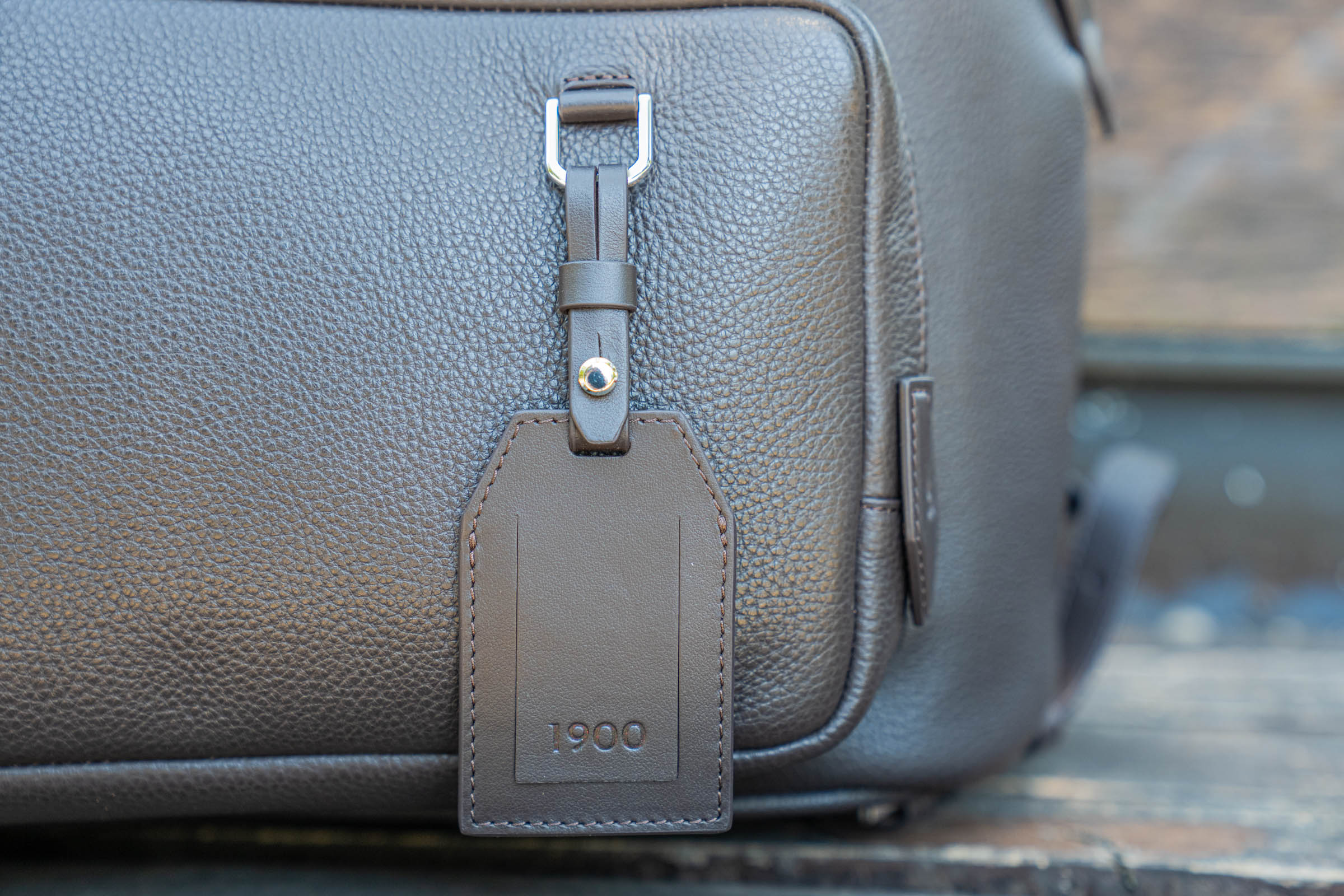
The dark brown grained leather looks sumptuous, and the smooth leather strips frame the form and give it architectural order. The trademark of the model is the zipper placed at an angle, which cuts the front like a diagonal in the drawing. The move is more than just a decoration, as it opens the main compartment in a wide sweep and makes things easier to access.
The interior is organized down to the last pocket. The placed partition keeps the laptop safe, the phone has its place, the cards have their slots, and the keys have their hook. There are also holders for two pens, an internal zipped pocket and two external pockets for small items. Travelers will appreciate the strap for hanging on the suitcase handle and the leather tag that can be personalized. The dimensions of 34 by 20 by 42 centimeters swallow the entire working day, and the adjustable leather straps distribute the weight evenly. Elegance that really does the job.


SANTONI OLY SNEAKERS: 50 YEARS OF ITALIAN CRAFTSMANSHIP IN EVERY STEP
For the end of the combination, I left Santoni shoes with the most beautiful family story. In 1975, Andrea Santoni, together with his wife Rosa, opened a workshop in Corridonia, in the Italian region of Marche, famous for its shoemaking trade. Before that, he went all the way from a leather cutter, to a seamstress, to a production manager. When he finally went after his name, he knew every inch of the business.
His philosophy was simple: everything under one roof, to keep quality under control. Son Giuseppe took the brand to the world in the early nineties and today runs the company, but the shoes are still made by hand in Corridonia. There, older craftsmen pass on their knowledge to younger ones, so that the craft does not die out. Such an attitude towards heritage is rare and therefore worth supporting with your wallet.
The Oly model is a modern tribute to tennis shoes from the seventies. The rolled leather is hand-toned, so the color goes from lighter to darker shades and gives that famous Santoni patina effect. The side panel with a zigzag edge is inspired by the double buckle, a trademark of their classic shoes. A thermoformed forefoot further accentuates the stitching, and a honey-colored natural rubber sole rounds out the vintage charm. On the foot, they are light, soft and immediately stepped on. Retro soul, modern body.

THE COLOR FORMULA BEHIND THIS OUTFIT
The whole combination rests on three tones and one rule. Indigo blue above, ivory below, dark brown on feet and back. The rule is: two-thirds light, one-third dark. Light tones carry summer lightness, while brown accents give center of gravity and seriousness. A black clock is a period at the end of a sentence.
When the palette is this calm, the textures have to do the talking. That’s why I crashed them on purpose. The washed denim is dry and firm, the lyocell flows down the body, the tumbled leather is velvety, and the grain leather of the backpack is rough under the fingers. The eye does not see the colorfulness, but there is always something to discover. This is the essence of the quiet elegance I often write about.
There is also a practical reason for this arrangement. Light pants and a white shirt reflect the sun, so it’s easier to breathe in them. The dark details endure the dust of the park and the back of the bench without consequences. Beautiful and smart do not have to be mutually exclusive, on the contrary.



WHEN TO WEAR THIS OUTFIT
The shortest answer would be: for almost everything between the beach and the reception. Dressed like this, I sit down to my morning coffee, conduct a business meeting without a tie and walk around the city until late afternoon. The backpack accommodates a laptop, so the combination covers a working day and a plane trip without any changes. The strap on the back slides over the suitcase handle, which is worth its weight in gold at the airport.
A small change is enough for dinner. Replace the sneakers with brown moccasins or nubuck shoes and the level is immediately raised. On the other hand, when the heat wins, the jacket goes over the shoulders and the mandarin collar shirt and high waist carry the whole look alone. That is the power of a well-thought-out combination. It does not depend on one piece, but each layer stands on its own legs.
I would only spare her strict protocol occasions. Where a dark suit is required, denim remains at home, no matter how noble it is tailored.


DENIM, SUEDE AND GRAINED LEATHER: HOW TO CARE FOR YOUR FAVORITE PIECES
Good things last as long as we take care of them, so let me share my routine. I wash the denim jacket as rarely as possible, and between washes I air it out on a wide towel. When washing the sea, etiquette is the law: cold water, no bleach, air dry and away from radiators. That’s how the paint ages beautifully, through wearing, not through the machine.
Overturned skin requires a brush and discipline. After wearing, I brush the suede in one direction to straighten the hairs. Twice a year, sneakers get a protective spray, and when rain is announced, they stay in the closet. If they do get caught in a downpour, I let them dry naturally before brushing.
The grain leather of the backpack is more grateful. A soft dry cloth after a hard day and a skin cream once a season keep it looking young. When the backpack is at rest, I stuff it with paper to keep it in shape and keep it out of direct sunlight. The watch is the lightest of all. The automatic movement is happiest when worn, and the DLC coating and sapphire crystal stand up to day-to-day life better than I do. Five minutes of attention a week, and this whole team will serve you for years.


WHY I BELIEVE IN INVESTING IN A QUALITY WARDROBE THAT LASTS FOR YEARS
If you’ve been following the blog for any length of time, you know that I advocate a simple calculation: fewer pieces, better pieces. A seriously priced jacket sounds like an expense, until you divide the price by the number of wears. A piece you wear for ten years, a hundred times a year, ends up costing less than one cup of coffee per wear. A cheap jacket that falls apart after two seasons turns out to be more expensive, and without a single moment of real satisfaction.
There is a deeper reason than mathematics. When you buy from single-family homes, you’re paying for hours of human labor, not rental billboards. Hand-stitched buttons, toned tumbled leather, and a mechanism that has been ticking for decades bear inside one’s knowledge and pride. Such things are not thrown away. They are stored, repaired and one day passed on.
That’s why I ask myself three questions before every purchase. Will I still be wearing this in five years? Does it fit with what’s already hanging in the closet? Do I know who made the piece and how? When all three answers are yes, the wallet is opened with a clear conscience. This summer combination passed the test without a second thought.

GIANNETTO PORTOFINO: HOW ITALIAN CRAFTSMANSHIP ELEVATES YOUR WARDROBE
When I draw the line, this combination is actually a story about families. The Sansonne family has been sewing since 1979, Cifonelli has been tailoring since 1880, while Santoni has been shoeing the world since 1975, while in Slovakia Kožár and his team are forging their name into steel. They all speak through seam, edge and tone, a language understood by anyone who has once worn a well-made piece.
The Giannetto Portofino denim jacket for me is the best proof of that philosophy. He took the world’s most recognizable material and tailored it with the respect usually reserved for wool and cashmere. Along with the lyocell shirt with the sun by the button, I’ve got a summer duo that I’ll wear until it falls apart, which I suspect will be a while.
If you choose only one piece from this text, make it the jacket. He is a bridge between two worlds, work and formal, and precisely such bridges carry the wardrobe of a mature man. Everything else is built up over time, piece by piece, without haste. Trends will come and go, while good denim will calmly see them all off.
How did you like my outfit today? I really tried to prepare this post with lots of love and I hope you like it! If you have any questions, comments, suggestions or messages for me, you can write me below in the comments. Of course, as always, you can contact me via e-mail or social networks, which you can find on the CONTACT page. See you soon in new fashion adventures on the Mr.M blog!
Finally, a question for you. Do you see a denim jacket as a serious part of a man’s wardrobe, or do you still keep it in your drawer for the weekend? Write to me in the comments, I look forward to your impressions. Until next text, wear what lasts.
With Love,
Mr.M


This post is sponsored by Cifonelli, Biatec, 1900 (Manifattura Ceraolo Moroni), Giannetto Portofino and Santoni brands. This post is my personal and honest product review.
Hello Marko, this is the first denim jacket I’ve seen in years that actually justifies the word jacket rather than blouson. The double row of buttons with those pointed lapels is a genuinely bold decision, because most brands would have played safe with the four-pocket workwear template. What convinced me completely is the absence of any visible logo the hand-sewn embossed buttons and that small yellow sun on the lapel do all the talking. I’ve owned washed denim outerwear before and the usual problem is stiffness across the shoulders, so your note that it behaves like a shirt with support… Read more »
Quello che rende questo articolo diverso dai soliti pezzi promozionali è che parti dal 1979, non dal capo. Riccardo e Nunzia Sansonne che cucivano camicie nel sud d’Italia mentre il mondo correva altrove è esattamente il tipo di storia che sta scomparendo dal nostro settore. E il fatto che nel 2000 siano entrati Vincenzo e Stefania mi dice che la trasmissione del mestiere è avvenuta prima che il marchio diventasse un’operazione di marketing. Il sole giallo cucito accanto ai bottoni è un gesto che riconosco: nelle sartorie familiari c’è sempre un segno che non serve a vendere, serve a firmare.… Read more »
Guten Tag Marko, ich lese Ihren Blog vor allem wegen der Uhrenteile, und dieser Beitrag hat mich sofort überzeugt. 39 Millimeter Durchmesser bei nur 9 Millimetern Höhe ist genau das Verhältnis, das unter einer Hemdmanschette funktioniert, ohne dass man ständig den Ärmel zurechtziehen muss. Dass Biatec das Sellita SW300 TOP verbaut und dazu fünf Jahre Garantie gibt, halte ich in dieser Preisklasse für außergewöhnlich, denn üblicherweise bekommt man zwei. Die 56 Stunden Gangreserve reichen bequem über ein Wochenende, wenn man die Uhr am Freitagabend ablegt. Meine Frage betrifft die schwarze DLC-Beschichtung: wie verhält sie sich an den Kanten des integrierten… Read more »
Le passage sur Cifonelli valait à lui seul la lecture. Rappeler que Giuseppe a ouvert à Rome en 1880, que son fils Arturo est allé apprendre la coupe à Londres, et que la maison s’est installée à Paris en 1926, c’est restituer une trajectoire que beaucoup résument bêtement en « tailleur parisien ». La rue Marbeuf reste effectivement une adresse à part, et la formule des trois écoles la souplesse italienne, la construction anglaise, la finition française décrit mieux leur style que n’importe quel adjectif. Le mot de Lagerfeld sur l’épaule reconnaissable à cent mètres est cité partout, mais dans… Read more »
Hej Marko, jag har letat efter en vit sommarskjorta som inte är av linne i flera år, precis av samma skäl som du nämner. Linne är vackert i en timme och därefter kräver det ständig uppmärksamhet, särskilt om dagen innehåller möten. Att lyocellen kommer från trämassa och tillverkas i ett slutet kretslopp där lösningsmedlet återanvänds är ett argument jag kan ta med mig, men det som avgör för mig är hur tyget beter sig i värmen. Din beskrivning av att materialet faller nästan som silke men går att maskintvätta kallt låter nästan för bra. Min fråga är rent praktisk: behöver… Read more »
The historical section is where this post separates itself from the usual outfit rundown. Tracing the word back to serge de Nîmes and the twill woven in that city is correct, and it’s a detail most writers get wrong or skip entirely. The date you cite matters too the twentieth of May 1873, when Levi Strauss and the tailor Jacob Davis were granted the patent for riveted work trousers. Calling that document the birth certificate of jeans is fair, because everything after it is variation. What I find genuinely funny is that American schools banned the fabric in the fifties,… Read more »
Goedemiddag Marko, de 1900 Tempo Grande is voor mij het interessantste stuk van deze combinatie. Dat het ontwerp in Italië ontstaat en de engineering in Zwitserland gebeurt is een ongebruikelijke formule, en Manifattura Ceraolo Moroni met veertig jaar ervaring erachter geeft dat wel gewicht. De diagonaal geplaatste rits is duidelijk meer dan decoratie, want een schuine opening geeft je werkelijk breder toegang tot het hoofdvak dan een rechte bovenrits. Ook de indeling klinkt doordacht: een geplaatst tussenschot voor de laptop, kaartsleuven, een sleutelhaak en twee pennenhouders. Mijn vraag gaat over de maat van 34 bij 20 bij 42 centimeter past… Read more »
Hola Marko, agradezco que hayas dedicado un apartado entero a Santoni y no lo hayas dejado como una nota al pie. Que Andrea Santoni abriera el taller en Corridonia en 1975 junto a su esposa Rosa, después de haber pasado por el corte, la costura y la dirección de producción, explica esa obsesión por tenerlo todo bajo el mismo techo. El modelo Oly me interesa especialmente porque el guiño a las zapatillas de tenis de los setenta suele hacerse mal, con suelas exageradas y proporciones deformes. Aquí, en cambio, el panel lateral con el borde en zigzag remite a la… Read more »
Trzy zasady noszenia kurtki jeansowej to najbardziej użyteczny fragment całego tekstu. Zasada rozdzielania odcieni jest oczywista dopiero wtedy, gdy ktoś ją napisze wprost jasna kurtka wymaga ciemnych spodni, w przeciwnym razie całość zamienia się w mundur. Druga zasada, o kontraście formalności, jest tą, którą większość mężczyzn łamie: wrzucają taką kurtkę na sprany T-shirt i dziwią się, że krój przestał działać. Twoje sformułowanie, że ta kurtka lubi towarzystwo, które ją podnosi, zapamiętam na dłużej. Trzecia zasada wydaje mi się najtrudniejsza, bo rezygnacja z dodatków wymaga pewności siebie, a nie wiedzy. Ręcznie przyszywane guziki z wytłoczonym motywem to już wystarczająca ozdoba, więc… Read more »
The section on the colour formula is the part I’ll return to. Two thirds light, one third dark, with indigo above, ivory below and dark brown at the feet and on the back written out like that it sounds almost mathematical, and yet the photographs prove it works. What makes it more than a rule is your point about texture doing the talking once the palette goes quiet: dry firm denim against fluid lyocell, velvety tumbled suede against rough grained leather. That is the difference between a restrained outfit and a dull one, and very few people writing about quiet… Read more »
O capítulo sobre os relógios de bracelete integrada está historicamente correcto, o que já é raro. A crise do quartzo japonês nos anos setenta obrigou a indústria suíça a inventar uma categoria inteira, e foi Gérald Genta que a desenhou. O Royal Oak de 1972 para a Audemars Piguet, com o bisel octogonal e a bracelete que nasce da caixa, custava mais do que muitos relógios de ouro da época, e hoje esse detalhe parece apenas uma anedota. Quatro anos depois veio o Nautilus para a Patek Philippe e o género ficou definido para sempre. O que me interessa é… Read more »
Hei Marko, avsnittet om vedlikehold er grunnen til at jeg leser denne bloggen fremfor de fleste andre. Rådet om å vaske denimjakken så sjelden som mulig og lufte den på et bredt håndkle mellom vaskene er nøyaktig slik jeg selv har behandlet mine i mange år. Kaldt vann, ingen blekemiddel, lufttørking og bort fra radiatoren det står på etiketten, men nesten ingen leser den. Poenget ditt om at fargen skal eldes gjennom bruk og ikke gjennom maskinen oppsummerer hele saken. At du pusser semskede sko i én retning etter bruk og bare bruker beskyttelsesspray to ganger i året virker fornuftig,… Read more »
Der Abschnitt über die hohe Bundhöhe spricht mir aus der Seele. Was heute als Modeerscheinung verkauft wird, war jahrzehntelang einfach die richtige Proportion, und wer alte Aufnahmen aus den vierziger oder fünfziger Jahren betrachtet, sieht das sofort. Sitzt der Bund auf der natürlichen Taille, gewinnt das Bein optisch an Länge und der Oberkörper verkürzt sich auf ein stimmiges Verhältnis. Die tiefe Bundhöhe, die so lange herrschte, hat genau dieses Gleichgewicht zerstört und ganze Generationen kürzer wirken lassen. Die doppelte Bundfalte erfüllt dabei eine Funktion und ist kein Zierrat: sie gibt dem Oberschenkel Raum beim Gehen und Sitzen, während sich die… Read more »
Hei Marko, mandariinikaulus on minulle vielä uusi asia, ja kirjoituksesi selvitti sen paremmin kuin mikään aiemmin lukemani. Se että kaulus istuu matalana nauhana kaulan ympärillä eikä siinä ole lainkaan kärkiä poistaa koko solmiokysymyksen kerralla, mikä kesällä on pelkkä helpotus. Huomiosi siitä, että se pidentää kaulaa optisesti ja rauhoittaa kasvojen ympäryksen, vastaa omaa kokemustani väljemmistä kauluksista. Ymmärrän myös miksi se toimii juuri tämän takin kanssa, sillä leveiden terävien käänteiden alla tavallinen kaulus jäisi puskemaan. Kysyisin kuitenkin yhtä asiaa: toimiiko tämä kaulusmalli myös ilman takkia liikeneuvottelussa, vai jääkö vaikutelma silloin liian vapaaksi? Ja pysyykö nauha ryhdissään päivän aikana ilman tukikangasta, vai alkaako… Read more »
Your closing argument about investing in a wardrobe that lasts is the most sensible version of that case I have read this year. Dividing the price by the number of wears is a calculation almost nobody performs, and the moment you do, the cheap jacket that collapses after two seasons turns out to be the expensive one. What raises the argument above arithmetic is your second point, that buying from a family workshop means paying for hours of human labour rather than rented billboards. Hand-stitched buttons, hand-toned tumbled leather and a movement that has been ticking for decades carry someone’s… Read more »
Buongiorno Marko, ho guardato le fotografie prima di leggere il testo, come faccio sempre, e la giacca funziona esattamente quanto scrivi in due situazioni opposte. Appoggiata sulla spalla sotto il sole non perde forma, e chiusa all’ombra del filare di alberi diventa quasi un abito. Quel vecchio albero accanto al quale sei in posa fa un lavoro che nessun fondale di studio potrebbe fare, perché la corteccia grigia e la luce filtrata rendono visibile la trama del denim lavato. La stessa cosa vale per la panca di legno consumata su cui hai poggiato lo zaino: il pellame martellato accanto al… Read more »
Le choix du lyocell mérite qu’on s’y arrête, et vous l’avez fait sans tomber dans le discours écologique de façade. Une fibre issue de pulpe de bois, produite en circuit fermé où le solvant est réutilisé, reste l’une des options les plus défendables du textile contemporain, et c’est un fait vérifiable plutôt qu’un slogan. Ce qui m’intéresse davantage, c’est que ses qualités techniques et son confort vont dans le même sens: la fibre absorbe très bien l’humidité, respire, et laisse une sensation fraîche sur la peau. En été, cela signifie simplement une chemise qui ne colle pas, ce qui est… Read more »
What strikes me about the Biatec section is how much of the brand’s logic is spelled out openly. A workshop in the heart of Slovakia, Swiss movements combined with domestic design and assembly, founded by Peter Kožár with Miloš Jakubec on design and Vladimír Wágner as head watchmaker those are actual named people rather than a marketing entity. Selling directly and skipping expensive ambassadors is the only honest way a small house can keep the price fair, and the five-year guarantee tells you where the money went. I’ve watched the microbrand field for a decade and the ones that survive… Read more »
Ochenta horas de trabajo manual para un solo traje a medida es una cifra que conviene repetir cada vez que alguien se queja del precio de la sastrería. En Cifonelli esas horas se reparten entre tres tradiciones distintas, y ahí está la clave de la casa: la suavidad italiana da la línea, la construcción inglesa da el aplomo y el acabado francés da la perfección del detalle. Que Lorenzo y Massimo, primos y cuarta generación, tomaran el mando en los años noventa y hayan mantenido ese equilibrio dice mucho de una familia que lleva desde 1880 en el oficio. El… Read more »
Marko, de Santoni Oly is het stuk waar ik het langst naar heb gekeken. Dat het getrommelde leer met de hand wordt getint, waardoor de kleur van lichter naar donkerder verloopt, is precies wat die schoenen dat levendige oppervlak geeft dat je bij industriële afwerking nooit ziet. Het feit dat de schoenen nog steeds in Corridonia met de hand worden gemaakt en dat oudere vaklieden hun kennis daar aan jongere doorgeven is de reden dat dit soort patina nog bestaat. Ook het thermogevormde voorblad vind ik slim, omdat het de stiksels laat uitkomen zonder een extra naad toe te voegen.… Read more »
Hello Marko, the relationship between the mandarin collar and the double-breasted front is the cleverest part of this outfit and I don’t think you gave yourself enough credit for it. A pointed collar would fight those wide peak lapels for the same visual space, whereas a low band simply sits beneath them and disappears. The result is that the eye reads one clean vertical line from chin to waist rather than a collision of angles. It also settles the tie question permanently, which in July is a mercy. My question concerns the version without the jacket, since you mention the… Read more »
Die Formel hinter der Marke 1900 finde ich ungewöhnlich und überzeugend zugleich: Entwurf in Italien, Konstruktion in der Schweiz. Dass dahinter die Manifattura Ceraolo Moroni mit über vierzig Jahren Erfahrung im Luxussegment steht, erklärt, warum der Rucksack technisch so durchdacht wirkt und trotzdem italienisch aussieht. Das dunkelbraune genarbte Leder trägt die Form, und die glatten Lederstreifen fassen sie ein und geben ihr eine fast architektonische Ordnung. Der schräg gesetzte Reißverschluss ist der eigentliche Entwurfsgedanke, denn eine diagonale Öffnung erschließt das Hauptfach in einem weiten Bogen statt in einer geraden Linie. Nach der Umhängetasche derselben Kollektion, die Sie hier bereits vorgestellt… Read more »
God kväll Marko, fjärilslåset med totalt 4,4 millimeter mikrojustering är detaljen jag fastnade för i hela texten. Att kunna vidga bandet på några sekunder utan verktyg när handleden sväller i värmen är precis den funktion som saknas på de flesta klockor med integrerat armband. Just den kategorin brukar vara som gjord för att sitta illa i juli, eftersom armbandet är en del av boettens design och därför sällan kan justeras finkornigt. Att kombinera det med 39 millimeter i diameter och 9 millimeters höjd gör klockan användbar under en skjortmanschett hela dagen. Min fråga är hur mycket motstånd mikrojusteringen har kan… Read more »
Fragment o drodze denimu od odzieży roboczej do wybiegu jest najlepiej udokumentowaną częścią tego wpisu. Fakt, że nazwa pochodzi od serge de Nîmes, czyli od tkaniny z francuskiego Nîmes, a Anglicy skrócili ją z czasem do denim, wiele tłumaczy w historii tego materiału. Patent Levi Straussa i krawca Jacoba Davisa na spodnie robocze wzmocnione miedzianymi nitami z maja 1873 roku rzeczywiście można nazwać aktem urodzenia dżinsów. Przez dziesięciolecia ta tkanina ubierała górników, kolejarzy i farmerów po prostu dlatego, że wytrzymywała to, czego inne materiały nie wytrzymywały. Dopiero kino lat pięćdziesiątych zamieniło ją w symbol młodości i buntu, a szkolne zakazy… Read more »
La storia di Santoni è raccontata come si racconta una famiglia, e questo cambia tutto. Andrea Santoni che apre nel 1975 a Corridonia insieme alla moglie Rosa, dopo essere passato dal taglio del pellame alla cucitura e infine alla direzione di produzione, non è un imprenditore che entra in un settore: è un artigiano che conosceva ogni centimetro del mestiere prima di metterci il proprio nome. La sua idea di tenere tutto sotto un unico tetto per controllare la qualità sembra ovvia oggi, ma negli anni settanta significava rinunciare a scorciatoie molto convenienti. Il figlio Giuseppe ha portato il marchio… Read more »
The section on when to wear this combination answered the question I actually had. Morning coffee, a business meeting without a tie, a long walk through the city and a flight, all without changing anything, is a genuinely high bar for one outfit to clear. The detail about the backpack strap sliding over the suitcase handle is the sort of thing you only value once you’ve stood at a gate holding everything in your hands. Swapping the sneakers for brown moccasins or nubuck shoes as a single-move upgrade for dinner is smart, because it changes the register without changing the… Read more »
Ce sont les pantalons qui font tenir l’ensemble, et c’est rarement ce que l’on remarque en premier. Un ton crème, une taille haute, une double pince et une ceinture prolongée avec des pattes de serrage latérales : quatre décisions, aucune superflue. L’absence de boucle métallique au centre est le point décisif, car elle laisse la ligne entre la chemise et le pantalon absolument ininterrompue. Avec un col mao et une chemise rentrée, cette continuité verticale devient l’axe du regard, et le résultat se voit immédiatement sur vos photographies. La jambe qui s’affine légèrement et s’arrête juste au talon évite le… Read more »
O pormenor que me ficou na memória é o sol amarelo, e sobretudo o facto de aparecer duas vezes de maneiras diferentes. Como alfinete na lapela do casaco é um gesto visível, uma assinatura discreta num casaco que não tem qualquer logótipo aparente. Bordado ao lado do segundo botão da camisa, torna-se algo completamente diferente: só se vê de perto e só é notado por quem sabe olhar. Escreveste que é uma piscadela para quem repara, e essa é a definição exacta do que distingue um laboratório familiar de uma grande fábrica. Alguém decidiu agradar ao cliente com um detalhe… Read more »
Hei Marko, jeg vil gjerne kommentere selve fotograferingen, for lyset i denne serien gjør mye av arbeidet. Skyggen fra trerekken bryter sollyset i flekker, og det er nettopp der man ser strukturen i den vaskede denimen og de fine stripene i lyocellskjorten. Bildene i full sol viser en helt annen jakke, nesten flatere og lysere, og sammen forteller de to seriene mer enn et studiobilde ville gjort. Den forvitrede trebenken med ryggsekken på er kanskje det beste bildet i hele innlegget, fordi grovt gammelt tre og narvet skinn hører sammen på en måte man ikke kan planlegge. Den tørre sommergresset… Read more »
Fifty years after the Royal Oak, the integrated bracelet has become the most crowded category in watchmaking, and most entrants simply trace the outline. What makes the Biatec approach defensible is exactly what you identified: it takes the spirit of the era rather than the shape of one particular reference. Genta’s achievement in 1972 was never really the octagonal bezel, it was the idea that a bracelet could grow out of the case as a single object, and the Nautilus in 1976 confirmed the principle. Any brand working in this genre today is either honouring that idea or borrowing a… Read more »
Sehr geehrter Marko, Ihre Pflegeroutine für Veloursleder deckt sich mit meiner, mit einer Ausnahme, und deshalb frage ich nach. Nach dem Tragen in eine Richtung zu bürsten, damit sich der Flor wieder aufstellt, ist der wichtigste und am häufigsten übersprungene Schritt. Zweimal jährlich einen Schutzspray und bei angekündigtem Regen im Schrank bleiben das ist Disziplin, aber es funktioniert. Meine Frage betrifft den Fall, dass die Schuhe doch in einen Platzregen geraten: Sie schreiben, dass Sie sie natürlich trocknen lassen, bevor Sie bürsten, aber verwenden Sie dabei einen Schuhspanner aus Zedernholz? Bei handgetöntem Veloursleder habe ich die Sorge, dass ein feuchter… Read more »
Buenas tardes Marko, la segunda de tus tres reglas es la que más me hace pensar. Contrastar la formalidad, es decir, acompañar esta chaqueta con algo más estructurado que ella misma, va justo en contra del instinto de la mayoría. Casi todo el mundo asume que una prenda de denim pide compañía informal, cuando en realidad pierde todo su encanto sartorial encima de una camiseta desgastada y unos vaqueros rotos. Tu formulación de que le gusta la compañía que la eleva, y que a cambio baja el conjunto entero a tierra, resume el mecanismo perfectamente. Mi pregunta es hasta dónde… Read more »
There is not a single visible logo in this entire outfit and that is the loudest statement in the post. A jacket that identifies itself only through hand-sewn embossed buttons and a small enamel sun on the lapel is asking to be judged on construction, which is a risk most brands no longer take. The same applies to the shirt, where the house hid its signature as an embroidered sun beside the second button, invisible from more than a metre away. I have spent years explaining to people that restraint is not the same as blandness, and this post makes… Read more »
Kello on tämän kokonaisuuden hiljaisin osa ja samalla kiinnostavin. Biatecin nimi tulee kelttiläisestä kolikosta, joka lyötiin nykyisen Bratislavan alueella ensimmäisellä vuosisadalla ennen ajanlaskun alkua, ja tuohon rahaan oli mitä todennäköisimmin kirjoitettu hallitsijan nimi. Se on huomattavasti parempi lähtökohta kuin keksitty sveitsiläinen sukunimi, jota tässä hintaluokassa näkee jatkuvasti. Logossa yhdistyvät Slovakian kaksoisristi ja kelttiläisen ristin elementit, joten koko kansallinen historia on kaiverrettu kellotauluun ilman yhtään turhaa sanaa. Se että perustaja Peter Kožár on ollut mekaniikan ystävä lapsuudesta asti ja työskentelee suunnittelija Miloš Jakubecin ja kelloseppä Vladimír Wágnerin kanssa tekee tästä oikeasti pienen verstaan eikä brändiä. Viiden vuoden takuu ja suoramyynti ilman… Read more »
Goedendag Marko, ik reis wekelijks en daarom las ik het stuk over de Tempo Grande met bijzondere aandacht. De band waarmee de rugzak over de handgreep van een koffer schuift is voor mij geen extraatje maar een voorwaarde, en het verbaast me hoe vaak dure leren rugzakken die weglaten. Ook de indeling met een geplaatst tussenschot voor de laptop, kaartsleuven, een sleutelhaak, twee pennenhouders en twee externe vakjes voor kleine dingen klinkt als iets dat door iemand is ontworpen die zelf reist. Wat mij betreft is de schuine rits daarbij het slimste onderdeel, omdat je bij de securitycontrole in één… Read more »
Il lyocell è la vera sorpresa di questo articolo, almeno per me. Sapevo che si ottiene dalla polpa di legno e che il processo a ciclo chiuso recupera il solvente, ma non avevo considerato quanto conti la caduta del tessuto. La tua descrizione, un materiale che scende fluido quasi come la seta ma molto più facile da mantenere, coincide con quello che cercavo senza saperlo nominare. Anche il fatto che la fibra assorba bene l’umidità e lasci la pelle fresca al tatto spiega perché la camicia resti comoda dopo un’ora di cammino al sole. La struttura a righe finissime che… Read more »
The Cifonelli passage deserves a longer discussion than a comment allows, but the three-school description is the part worth defending. Italian softness for the line, English construction for the hold, French finish for the perfection of detail that formula is repeated often, yet it is genuinely what distinguishes the house from Neapolitan and Savile Row work alike. Arturo going to London to learn cutting before the family settled in Paris in 1926 is precisely how that hybrid came about, and it explains why Cifonelli sits in neither camp. My question concerns the ready-made side of the business: your trousers are… Read more »
Zegarek jest tutaj traktowany poważnie i to doceniam, bo w tekstach o modzie zwykle zostaje wspomniany jednym zdaniem. Wodoszczelność stu metrów przy grubości dziewięciu milimetrów to zestawienie, którego wiele tak zwanych zegarków sportowych nie osiąga, mimo znacznie większej koperty. Aplikowane indeksy pokryte czarnym złotem na czarnej lakierowanej tarczy brzmią jak przepis na nieczytelność, ale masa Super-LumiNova świecąca na niebiesko rozwiązuje ten problem po zmroku. Szkło szafirowe z przodu i przezroczysty dekiel z tyłu, przez który widać szwajcarski automat Sellita SW300 TOP, są dokładnie tym, czego oczekuję w tej klasie. Częstotliwość dwudziestu ośmiu tysięcy ośmiuset półwahnięć na godzinę i około pięćdziesięciu… Read more »
Am Ende Ihres Textes steht der Satz, dass diese Zusammenstellung eigentlich eine Geschichte über Familien ist, und genau das bleibt hängen. Die Familie Sansonne näht seit 1979, Cifonelli schneidert seit 1880, Santoni beschuht die Welt seit 1975, und in der Slowakei schmieden Kožár und sein Team gerade erst ihren Namen in Stahl. Vier Betriebe, vier Länder, und alle sprechen über Naht, Kante und Ton, wie Sie es formulieren. Dass Sie diese Verbindung erst am Schluss ziehen und nicht als Aufhänger verwenden, macht sie glaubwürdiger. Für mich ist das auch der eigentliche Grund, bei solchen Häusern zu kaufen: man bezahlt Arbeitsstunden… Read more »
Vous demandez si la veste en denim peut être une pièce sérieuse du vestiaire masculin, et je répondrai simplement que la question ne porte pas sur la matière mais sur la coupe. Une veste croisée à revers pointus, taillée en Italie dans un coton cent pour cent, avec des boutons métalliques cousus à la main, appartient au vocabulaire du tailleur, quel que soit le tissu. C’est précisément ce renversement que vous décrivez lorsque vous écrivez qu’elle porte l’autorité de la tradition tandis que le denim apporte la détente. L’équilibre entre ces deux forces est ce qui rend la pièce utilisable… Read more »